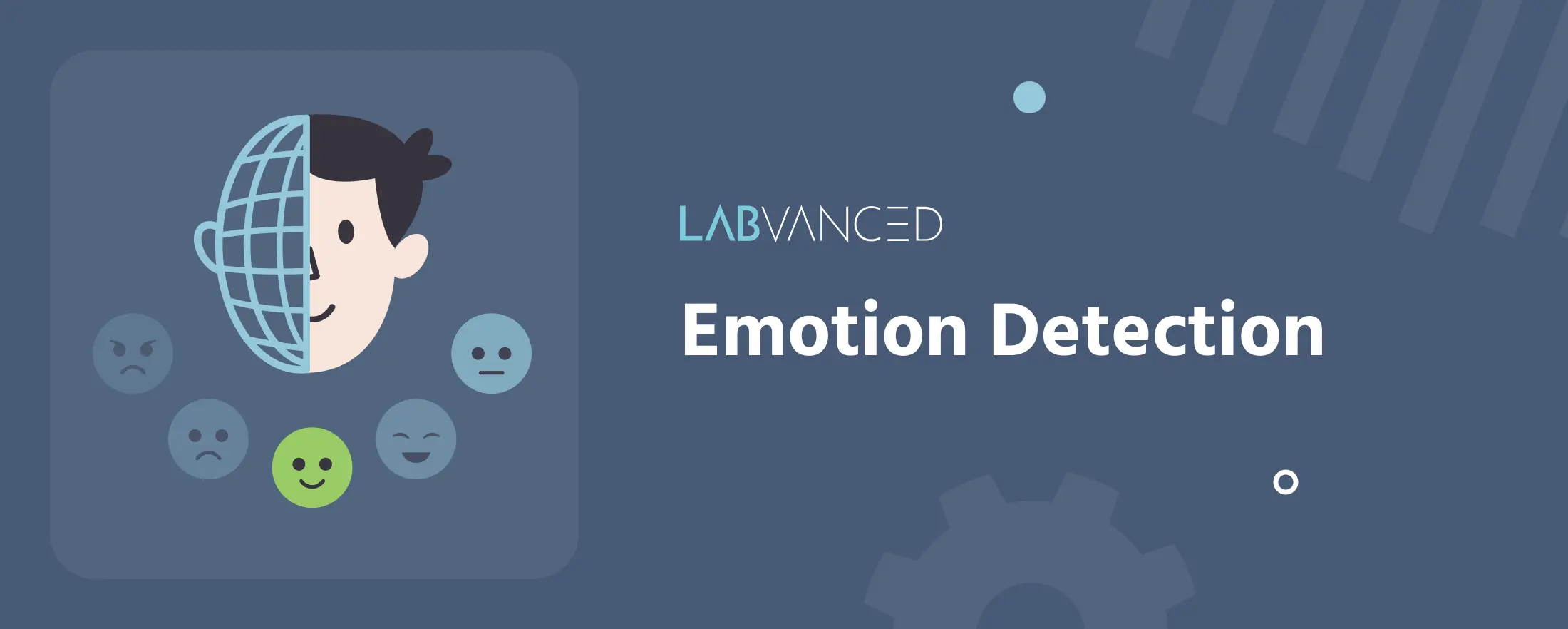
Emotion Detection | Facial Expression Analysis
Labvanced supports automated emotion detection using participants’ webcams, enabling researchers to capture facial expressions and infer emotional states in real time. This allows affective data to be collected alongside behavioral, cognitive, and self-report measures—without requiring specialized hardware or in-lab setups.
Emotion detection can be integrated seamlessly into online experiments, making it possible to study affective processes remotely and at scale.
Table of Contents
Overview | What is Emotion Detection?
Emotion detection refers to the use of computer vision and machine learning techniques to identify human emotional expressions from facial images or video streams. By analyzing features such as eye movement, mouth shape, and facial muscle activation, algorithms can classify expressions into categories such as happiness, sadness, anger, surprise, fear, and neutrality.
Unlike traditional approaches that rely on self-report or manual coding (e.g., FACS-based annotation), automated emotion detection provides continuous, objective, and scalable measurement of affective responses.
This makes it particularly valuable for studying spontaneous emotional reactions during tasks, stimuli presentation, or naturalistic interactions.
Emotion Detection in Labvanced: How it works
Labvanced integrates facial emotion detection directly into the experimental workflow. Using participants’ webcams, the system captures images at regular intervals and processes them to estimate emotional expressions.
Emotion Detection in Labvanced
- Activated easily as part of a study configuration
- Runs during tasks, stimuli presentation, or defined time windows
- Operates at a default sampling rate of 2 Hz (two detections per second) with Physiology Toolbox Version 2.0, up from 1 Hz in the first generation
- Can be combined with surveys, reaction time tasks, and experimental manipulations
Participant Experience
- No wearables or sensors required
- Uses the participant’s webcam
- Client-side processing, ie. GDPR-compliant
- Suitable for remote participation on personal devices
A series of images are presented, the participant is asked to mimic the expression. The highest emotion detected of the participant's expression is reported, along with valence and arousal values.
Data Collected with Emotion Detection in Labvanced
A few key metrics collected with emotion detection in Labvanced:
- Categorical emotion classification: 8 in total (angry, contempt, disgust, fear, happy, neutral, sad, surprise)
- Continuous emotion classification: valence and arousal scores
- Time-stamped measurements aligned with experimental events
- Exportable together with other study data for analysis

Methodological Foundation
Labvanced’s emotion detection builds on recent advances in facial expression recognition, drawing on modern deep learning methods developed in the research community. These approaches use neural networks trained on large and diverse image datasets to learn patterns in how facial expressions relate to emotional states.
In particular, the implementation is informed by contemporary research that emphasizes robust feature extraction and classification techniques, enabling reliable interpretation of facial expressions across a range of real-world conditions. Such methods are designed to handle variability in lighting, pose, and individual differences while maintaining strong performance.
This research-driven foundation allows Labvanced to reflect current progress in computer vision, while remaining lightweight and efficient enough for real-time use directly in the browser.
Methodological Advantages | Emotion Detection in Behavioral and Cognitive Research
Emotion detection enables the continuous measurement of affective expressions during experimental tasks, providing signals that are not always accessible through self-report or behavior alone.
Key methodological advantages:
Multimodal integration: Combines facial expression data with behavioral, cognitive, and self-report measures
Non-intrusive measurements: No physical sensors required, minimizing interference with task performance and participant experience
Remote data collection: Enables affective research outside the laboratory using standard webcams
Scalable study designs: Supports large and diverse participant samples in online experimental settings
Time-resolved affective measurement: Provides timestamped emotion labels and confidence scores aligned with experimental events
Research Applications | Emotion Detection in Behavioral and Cognitive Research
Emotion detection enables the investigation of affective and cognitive processes across a wide range of experimental paradigms, particularly in settings where continuous behavioral coding or in-person observation is not feasible.
Key applications include:
Emotional and affective processing: Assessing facial expression responses to emotional stimuli, task feedback, or arousing content
Cognitive-affective interaction: Investigating how emotional expressions relate to attention, memory, and decision-making processes
Social interaction research: Analyzing facial expressions during interactive tasks, virtual communication, or observational paradigms
UX and human-computer interaction: Evaluating emotional responses to interfaces, system feedback, or user experience manipulations
Remote and large-scale studies: Capturing affective responses across distributed participant samples using standard webcams
Multimodal experimental designs: Integrating facial expression data with behavioral, cognitive, and self-report measures
Further Reading
Webcam Eye Tracking
Capture gaze patterns and visual attention with built-in, code-free and peer-reviewed webcam eye tracking.
Heart Rate Detection (rPPG)
Estimate beats per minute from the participant's webcam feed using remote photoplethysmography.
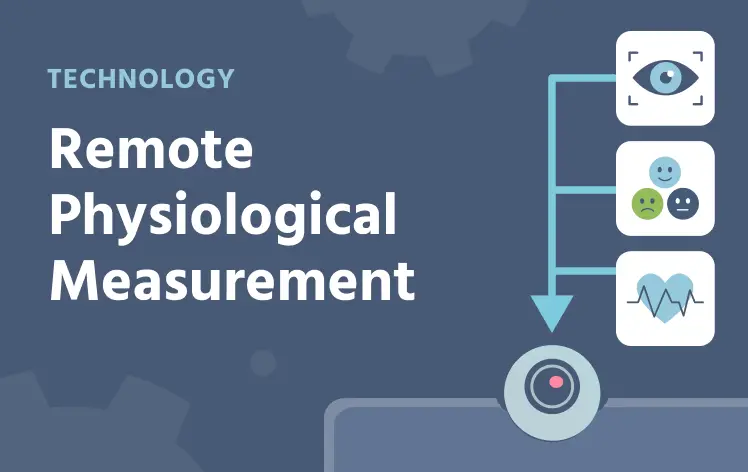
Remote Physiological Measurement
Run eye tracking, emotion detection, and heart rate detection together from a single webcam feed.
Use Emotion Detection in your next study
Emotion detection extends Labvanced’s capabilities into affective computing, allowing researchers to measure emotional responses continuously and remotely.
- Combine emotion data with cognitive tasks and surveys
- Run studies remotely at scale
- Capture spontaneous emotional reactions to stimuli
Explore emotion detection in Labvanced or contact us to discuss affective measurement options for your research.