labvanced logoLabVanced
Contact
    • Remote Physiological Measurements
    • Eye Tracking
    • Head & Face-Tracking
    • Emotion Detection
    • Heart Rate Detection (rPPG)
    • Generative AI
    • Audio Transcription
    • EEG & Hardware Integrations
    • Decision Making
    • Reaction Times
    • Keyboard Inputs
    • Mouse Tracking
    • Mobile / Touch
    • Questionnaires
    • Gamepad / Joystick Integration
    • Audio Recordings
    • Audio Transcription
    • Video Recordings
    • Screen Recordings
    • Photos / Snapshots
    • Video Conferencing
    • Canvas Drawings
    • Build with AI
    • Build with Spreadsheets
    • Using the Experiment Editor
    • Coding
    • Creating Questionnaires
    • Balancing & Randomization
    • UX & Website Testing
    • Single Session Studies
    • Factorial Designs
    • Longitudinal & Multi-session Studies
    • Individual & Case Studies
    • Real-time Multi-user Studies
    • Interviews & Video Calls
    • Surveys & Questionnaires
    • Experience Sampling & Diaries
    • Classroom & Group Testing
    • Interventions & Clinical Trials
    • In the Browser
    • Mobile App
    • Desktop App
    • WebBridge Chrome Extension
    • Stroop Test
    • Flanker Task
    • N-back Task
    • Implicit Association Test
    • Trail Making Test
    • Digit Span
    • Corsi Block Tapping
    • Tower of London
    • Balloon Analog Risk Task
    • Preferential Looking
    • Browse more →
    • DASS-21
    • GAD-7
    • Rosenberg Self-Esteem Scale
    • PHQ-9
    • Ten-Item Personality Inventory
    • Big Five Personality Test
    • Adult ADHD Self-Report Scale
    • Browse more →
    • Building a Multi-user Study
    • Webcam Eye Tracking with AOIs
    • Website Frame Eye Tracking
    • Conditional Eye Tracking Opt-in
    • ChatGPT Study
    • Desktop App Study with EEG
    • Between-subjects Group Balancing
    • Building a Reading Study
    • Stroop Task
    • Lexical Decision Task
    • Browse more →
    Public Experiment Library
    • Arts Research
    • Clinical Psychology & Neuropsychology Medicine
    • Cognitive Psychology
    • Developmental Psychology
    • Behavioral Economics & Decision Science
    • Educational Research & Psychology
    • HCI & Human Factors
    • Linguistics & Language Sciences
    • Consumer & Marketing Research
    • Social & Personality Psychology
    • Sport & Movement Science
    • UX & Website Testing
    • Executive Functions
    • Language & Reading
    • Decision-Making & Reasoning
    • Attention
    • Overview
    • HCI & Human Factors
    • UX & Website Testing
    • Consumer & Marketing Research
    • White-Label App
    • PageGazer
    • Webcam vs. Lab Eye Tracking in InfantsAnna Banki & Gabriela Markova
    • Eye Tracking for Influencer MarketingDr. Alexander Edeling
    • Eye Tracking Infant Word ComprehensionDr. Giulia Calignano
    • Sentence Reading and Grammar JudgmentsDr. Jonathan Mirault
    • Regulating Emotions with MusicDr. Katrin Starcke
    • Game-Based Grammar Learning in ChildrenDr. Mireia Marimon
    • Gaze Cueing and AutismMax Soares Miehstein
    • Personality and Hearing in NoiseDr. Malte Wöstmann
    • All interviews →
    • Lab Notes
    • How to Cite Labvanced
    • Labvanced Platform Paper (2017)
    • Webcam Eye Tracking Validation (2024)
    • Webcam Eye Tracking Studies
    • Cognitive Psychology Studies
    • Developmental Psychology Studies
    • Linguistics Studies
    • See all publications →
    • Getting Started
    • Guide
    • Video Tutorials
    • Walkthroughs
    • Live Chat
    • Webinars & Onboarding Calls
    • AI Assistant
    • FAQ
    • Importing Templates Guide
    • Test Templates
    • Live Eye Tracking Metrics
    • Mouse Tracking Demo
    • ChatGPT Demo
    • Audio Recording Object Demo
    • Adding Image Stimuli Demo
    • Score & Feedback Demo
    • Browse all technical demos →
    • Timing Precision
    • Stimuli Presentation
    • Headphone Checks
    • Bot Checks
    • Participant Management
    • Comparisons
    • Research Blog
    • Prolific Integration
    • CloudResearch Integration
    • Sona Systems Integration
    • BeSample Integration
    • Panelabs Integration
    • Clickworker Integration
    • Labvanced Webhook API
    • Labvanced REST API
    • About Us
    • Newsletter Archive
    • Terms & Conditions
    • Data Security & Data Privacy
    • Technical & Organisational Measures
    • Accessibility
    • W-8BEN-E Form
    • Data Processing Agreement Template
    LinkedInYouTubeDiscord
    • Individual
    • Lab
    • Department / Consortium
    • Teaching
    • Campus
    • Commercial
    • Browse recording top-ups →
    • Browse AI token top-ups →
    • Overview
    • Study Building
    • Subject Recruitment
    • Dedicated Support
    Checkout
  • Contact
    • EN
      • 中國人
      • Deutsch
      • Français
      • Español
      • English
      • 日本語
    • Logout
    • Loginlogin icon
    Platform
    Labvanced makes it easy to implement the most advanced study design and reliably collect your data.
    Biosignals & AI
    Remote Physiological MeasurementsEye TrackingHead & Face-TrackingEmotion DetectionHeart Rate Detection (rPPG)Generative AIAudio TranscriptionEEG & Hardware Integrations
    Behavioral Recordings
    Decision MakingReaction TimesKeyboard InputsMouse TrackingMobile / TouchQuestionnairesGamepad / Joystick Integration
    Media Recordings
    Audio RecordingsAudio TranscriptionVideo RecordingsScreen RecordingsPhotos / SnapshotsVideo ConferencingCanvas Drawings
    Implementation Techniques
    Build with AIBuild with SpreadsheetsUsing the Experiment EditorCodingCreating QuestionnairesBalancing & RandomizationUX & Website Testing
    Study Formats

    Your study can take whatever format your research needs. Here are a few popular examples.

    Single Session StudiesFactorial DesignsLongitudinal & Multi-session StudiesIndividual & Case StudiesReal-time Multi-user StudiesInterviews & Video CallsSurveys & QuestionnairesExperience Sampling & DiariesClassroom & Group TestingInterventions & Clinical Trials
    Where Studies Run

    Run your study online in the browser, on mobile or tablet with the mobile app, or in-lab with the desktop app.

    In the BrowserMobile AppDesktop AppWebBridge Chrome Extension
    Tests
    Explore cognitive tests, questionnaires, walkthroughs, and our public experiment library: a starting point for your next study.
    Popular Cognitive Tests
    Stroop TestFlanker TaskN-back TaskImplicit Association TestTrail Making TestDigit SpanCorsi Block TappingTower of LondonBalloon Analog Risk TaskPreferential Looking
    Browse more →
    Questionnaires & Scales
    DASS-21GAD-7Rosenberg Self-Esteem ScalePHQ-9Ten-Item Personality InventoryBig Five Personality TestAdult ADHD Self-Report Scale
    Browse more →
    Public Experiment Library

    Take a look at what other researchers in the community are doing through our extensive, open catalog of shared studies.

    Open the public library →
    Walkthroughs

    Step-by-step builds of complete studies, from a blank project to a running experiment, that you can follow along or adapt.

    Building a Multi-user StudyWebcam Eye Tracking with AOIsWebsite Frame Eye TrackingConditional Eye Tracking Opt-inChatGPT StudyDesktop App Study with EEGBetween-subjects Group BalancingBuilding a Reading StudyStroop TaskLexical Decision Task
    Browse more →
    Research
    One platform for students, academics, and industry researchers studying human behavior.
    Harvard UniversityStanford UniversityCambridge UniversityUCLNYUMax Planck InstituteUCLATU Munich

    Trusted by researchers at 1,500+ universities worldwide

    Academic Research
    Arts ResearchClinical Psychology & Neuropsychology MedicineCognitive PsychologyDevelopmental PsychologyBehavioral Economics & Decision ScienceEducational Research & PsychologyHCI & Human FactorsLinguistics & Language SciencesConsumer & Marketing ResearchSocial & Personality PsychologySport & Movement ScienceUX & Website Testing
    Research Areas
    Executive FunctionsLanguage & ReadingDecision-Making & ReasoningAttention
    Industry / Commercial
    OverviewHCI & Human FactorsUX & Website TestingConsumer & Marketing ResearchWhite-Label AppPageGazer
    Researcher Interviews

    Conversations with researchers about the studies they ran with Labvanced, what worked, and what they learned.

    Webcam vs. Lab Eye Tracking in InfantsAnna Banki & Gabriela MarkovaEye Tracking for Influencer MarketingDr. Alexander EdelingEye Tracking Infant Word ComprehensionDr. Giulia CalignanoSentence Reading and Grammar JudgmentsDr. Jonathan MiraultRegulating Emotions with MusicDr. Katrin StarckeGame-Based Grammar Learning in ChildrenDr. Mireia MarimonGaze Cueing and AutismMax Soares MiehsteinPersonality and Hearing in NoiseDr. Malte Wöstmann
    All interviews →
    Our Research
    Lab NotesHow to Cite Labvanced
    Peer Reviewed Studies

    A selection of peer-reviewed work built on Labvanced: our own platform and validation papers, and studies by the research community grouped by area. Hundreds more are listed on the full publications page.

    Labvanced Platform Paper (2017)Webcam Eye Tracking Validation (2024)Webcam Eye Tracking StudiesCognitive Psychology StudiesDevelopmental Psychology StudiesLinguistics Studies
    See all publications →
    Resources
    Valuable resources to help you learn the platform, stay updated, and more.
    Documentation
    Getting StartedGuideVideo TutorialsWalkthroughs
    Support
    Live ChatWebinars & Onboarding CallsAI AssistantFAQ
    Templates & Demos

    These are a few popular examples. Browse our guide and a selection of technical demos to get started with implementation.

    Importing Templates GuideTest TemplatesLive Eye Tracking MetricsMouse Tracking DemoChatGPT DemoAudio Recording Object DemoAdding Image Stimuli DemoScore & Feedback Demo
    Browse all technical demos →
    Methodology
    Timing PrecisionStimuli PresentationHeadphone ChecksBot ChecksParticipant ManagementComparisonsResearch Blog
    Integrations & APIs
    Prolific IntegrationCloudResearch IntegrationSona Systems IntegrationBeSample IntegrationPanelabs IntegrationClickworker IntegrationLabvanced Webhook APILabvanced REST API
    Company & Legal
    About UsNewsletter ArchiveTerms & ConditionsData Security & Data PrivacyTechnical & Organisational MeasuresAccessibilityW-8BEN-E FormData Processing Agreement Template
    LinkedInYouTubeDiscord
    Pricing
    Our licenses and additional services at a glance.
    Licenses
    IndividualLabDepartment / ConsortiumTeachingCampusCommercial
    Top-Ups

    Need more recordings for your lab or your own research? Simply use one of these recording top-up packages.

    Browse recording top-ups →

    Need more AI tokens for the AI assistant and study translations? Simply use one of these AI token top-up packages.

    Browse AI token top-ups →
    Additional Services

    Hire Labvanced’s expert team to quickly bring your project to the level of rigor it needs.

    OverviewStudy BuildingSubject RecruitmentDedicated Support
    Checkout

    Ready to purchase a license or top-up? Head straight to checkout.

    Go to checkout →
    • 中國人
    • Deutsch
    • Français
    • Español
    • English
    • 日本語
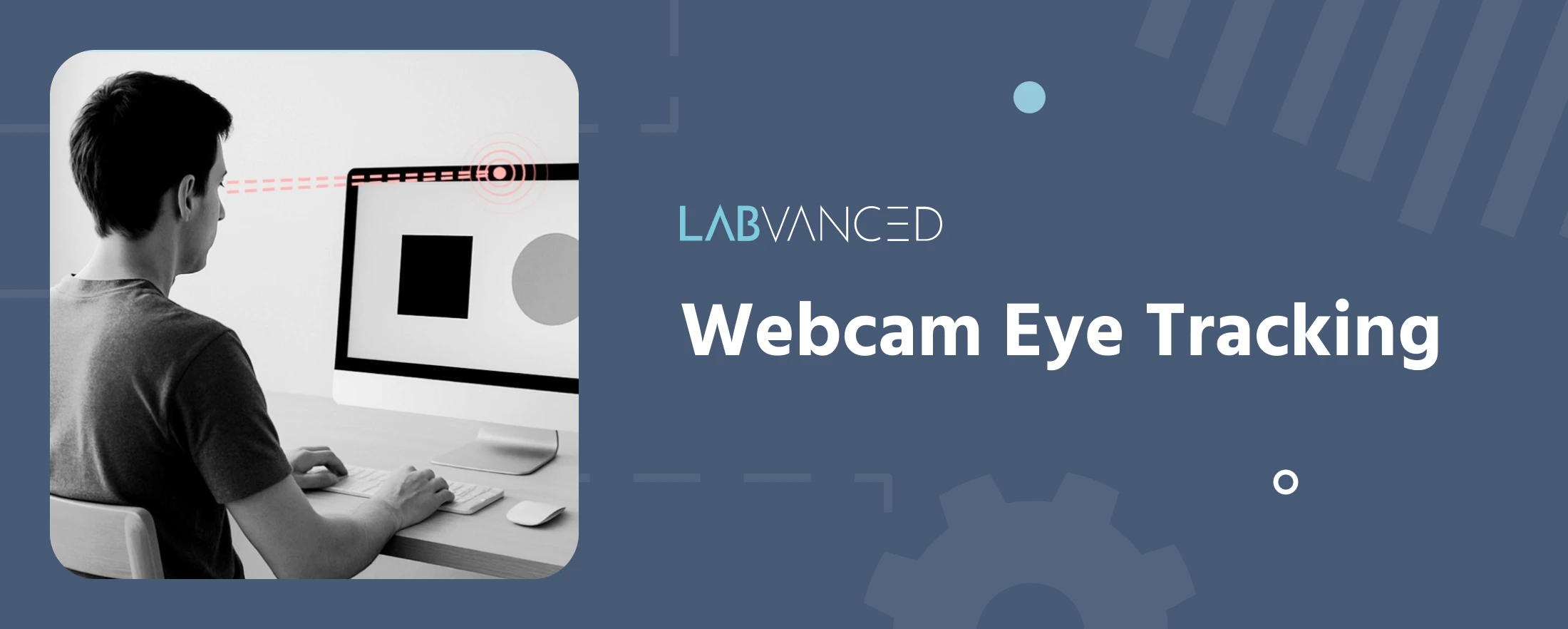
    A participant sitting in front of a computer looking at two shapes as a part of the psychology experiment where webcam eye tracking is activated to measure gaze data.

    Webcam Eye Tracking by Labvanced

    Labvanced’s webcam eye-tracking technology reaches a median accuracy ranging from 1.8 degrees of visual angle (a 2-minute calibration with balanced screening) to 1.4 degrees (a 5-minute calibration with strict participant screening) for real online participants with Eye Tracking 2.0, building on a laboratory validation against hardware-based eye trackers that measured 1.3 degrees in a peer-reviewed study (Kaduk et al., 2024). It runs on any standard webcam with no dedicated hardware required, and works for both in-lab and remote studies, enabling researchers to collect consistent, high-quality gaze measurements across diverse participant populations.


    Table of Contents

    • Key Functionalities
    • Data Collected
    • Calibration Control
    • Benchmarking / Validation
    • Publications
    • Interactive Demos

    Labvanced Webcam Eye Tracking: The New Gold Standard for Remote Eye Tracking

    Labvanced delivers research-grade eye tracking available to anyone with a standard webcam. With increased accessibility and full integration into the experimental workflow, researchers conducting in-lab and remote studies can easily utilize highly accurate, peer-reviewed webcam eye tracking.


    PropertySpecifications
    ArchitecturePre-trained CNN for gaze estimation
    Accuracy1.8 visual degrees with online participants (Eye Tracking 2.0); 1.3 visual degrees (1.4 cm) at the center of the screen in the laboratory (first generation)
    Precision0.75 visual degrees with online participants (Eye Tracking 2.0); 1.1 visual degrees (1.2 cm) in the laboratory (first generation)
    Sampling Rate30 Hz to 60 Hz (depending on webcam's frame rate)
    FixationsBuilt-in fixation detection algorithm
    CalibrationAdjustable length (30 sec. - 5 min.+) and properties (infant-friendly, virtual chinerest constrains, etc.)
    Minimum Resolution1280x720px (HD-ready webcam)
    Device RequirementsDevice agnostic: Works on desktops, tablets, and phones; no further specific requirements
    Data OutputGaze, Fixations, Dwell Time, Time to First Fixation, Fixation Duration, Number Fixations, Custom Metrics
    PrivacyClient-side processing (directly on the participant’s device), meaning no facial data is ever transmitted

    Sign Up

    4 Key Functionalities for Successful Webcam Eye Tracking

    To run successful webcam eye tracking studies, four principles are crucial: Accuracy ensures reliable data despite hardware variability; Adaptability and Control allow researchers to tailor protocols and performance thresholds to the specific compliance levels of diverse participants; and uncompromising Privacy is non-negotiable for ethical remote data capture and participant trust.
    Icon of a target symbolizing accuracy for webcam eye tracking.

    Accuracy

    Utilizing proprietary, deeply trained neural networks, Labvanced achieves robust gaze estimation reliability, demonstrating a median accuracy ranging from 1.8 degrees of visual angle (a 2-minute calibration with balanced screening) to 1.4 degrees (a 5-minute calibration with strict participant screening), based on research with real online participants using Eye Tracking 2.0.

    A lock icon representing safety and security during webcam eye tracking studies

    Privacy

    Through automatic client-side processing, all sensitive visual data is calculated locally, guaranteeing that no sensitive participant information leaves their device.

    Small icons of people demonstrating various populations for which Labvanced's webcam eye tracking can be applied to.

    Adaptability

    The system features adjustable settings and flexible configurations specifically designed to accommodate the unique needs and compliance challenges of populations ranging from infants to older adults.

    Icon of gear and a control panel, symbolizing flexible settings for Labvanced's webcam eye tracking technology.

    Control

    Gain full authority over the experimental process, like defining minimum gaze performance requirements, specifying calibration processes, and setting precise administrative rules across every task and trial.


    Data Collected

    Labvanced offers a wide range of webcam-based eye-tracking outputs, making it easy to capture exactly the level of detail a study requires. From precise gaze coordinates to rich fixation metrics and trial-level diagnostics, the platform provides comprehensive data for understanding how participants engage with visual stimuli.

    Gaze Position

    Gaze position coordinates (X and Y) can be captured throughout the task and can further be tailored such that data only records specifically for AOIs or regions of interest. This is then paired with additional data points like the time stamp (T) and the confidence interval (C) which is a measure of how open the eye was during the measurement.

    This also extends to elements on a live, external website embedded in your study. See Labvanced Web Bridge for how website eye tracking works.
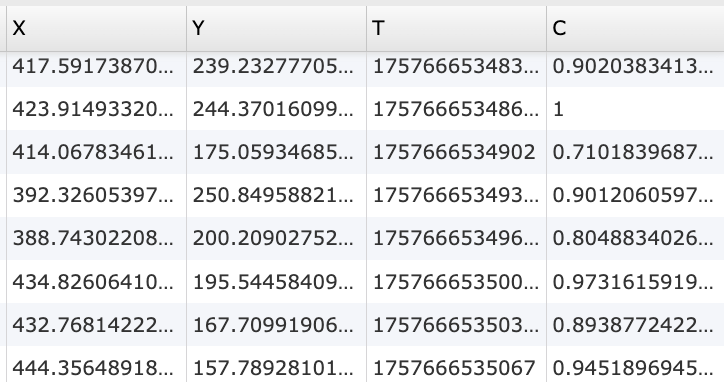

    Preview of data collected using Labvanced's webcam eye tracking.

    Preview of data collected using Labvanced's webcam eye tracking
    X: X-coordinate of gaze; Y: Y-coordinate of gaze; T: Timestamp; C: Confidence Interval

    Fixations

    For studies that want to collect data beyond gaze coordinates, fixation-based data collection is also an option where key metrics include:

    • Number of fixations
    • Time to first fixation
    • Fixation duration
    Example of fixation metrics for image-specific regions of interest. The red circle takes on the X- and Y- coordinates of gaze in real-time.

    More Trial-Specific Gaze Data

    Labvanced’s webcam-based eye tracking provides rich, trial-specific data that goes far beyond gaze coordinates. For each trial, researchers can access data like the last cached gaze position or last cached fixation, as well diagnostic metrics such as calibration errors. This added layer of granularity makes it easier to evaluate data quality and interpret participants’ viewing behavior with greater confidence, as well as use this information to further control the behavior of the experiment.

    The data collected can then be exported in a ready-to-analyze format according to your specifications, including CSV, XLSX, TSV.


    Fine-Grained Calibration Options

    The calibration procedure is closely intertwined with data quality and output. Labvanced gives you the options to specify exactly when and how calibration should run.
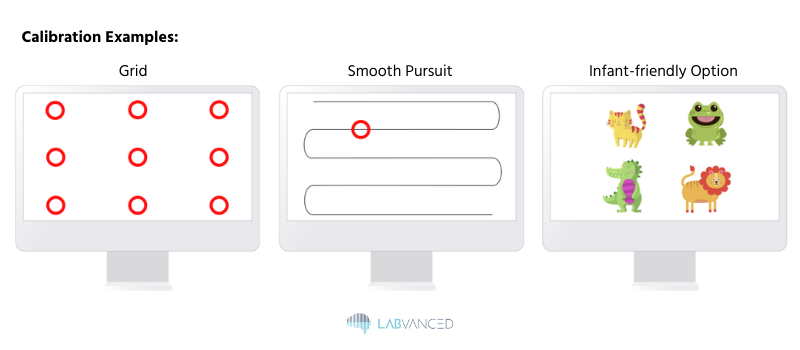
    Examples of calibration scenarios when using Labvanced's webcam eye tracking.

    • Eye Tracking Calibration is the only part where researchers are required to actively engage with the eye tracking system.
    • As requirements differ for each study, a lot of settings are adjustable for the calibration procedure.
    • There is a main tradeoff between length of calibration and accuracy, where longer calibration procedures will lead to more accurate data outputs.
    • Other adjustments such as the strength of the Virtual Chinrest or Re-calibration settings are also useful to consider.

    Sign Up

    Benchmarking Accuracy

    Labvanced’s webcam eye tracking is 2-3 times as accurate as its next best competitor and over 80% of all eye tracking research will be possible with our system. Labvanced offers the only webcam eye tracking solution with a research grade (peer-reviewed) scientific publication.

    Validation with Online Participants (Eye Tracking 2.0)

    • With Eye Tracking 2.0, the median online participant reaches an accuracy of 1.8 visual degrees after a two-minute calibration, on their own computer and in their own room.
    • With the long calibration and very strict screening, the median accuracy reaches about 1.4 visual degrees.
    • The validation is based on about 500 Prolific participants, and the anonymized data is published.
    • Read the full report in our Lab Note: Labvanced Eye Tracking 2.0: accurate webcam eye tracking for all online research.

    Validation via Comparison to Hardware-based Eye Tracking

    • In the laboratory, the first generation of our webcam-based eye-tracking system reached an accuracy of about 1.2 to 1.4 visual degrees.
    • Our comparison study with an EyeLink 1000 hardware eye tracking system shows a Pearson correlation of larger 0.9.
    • Visual analysis of natural scenes visually confirms how close Labvanced’s prediction is to the ground truth as compared to EyeLink.
    • Labvanced’s webcam-based eye tracking accuracy was only about 0.5° lower than the EyeLink 1000 system.
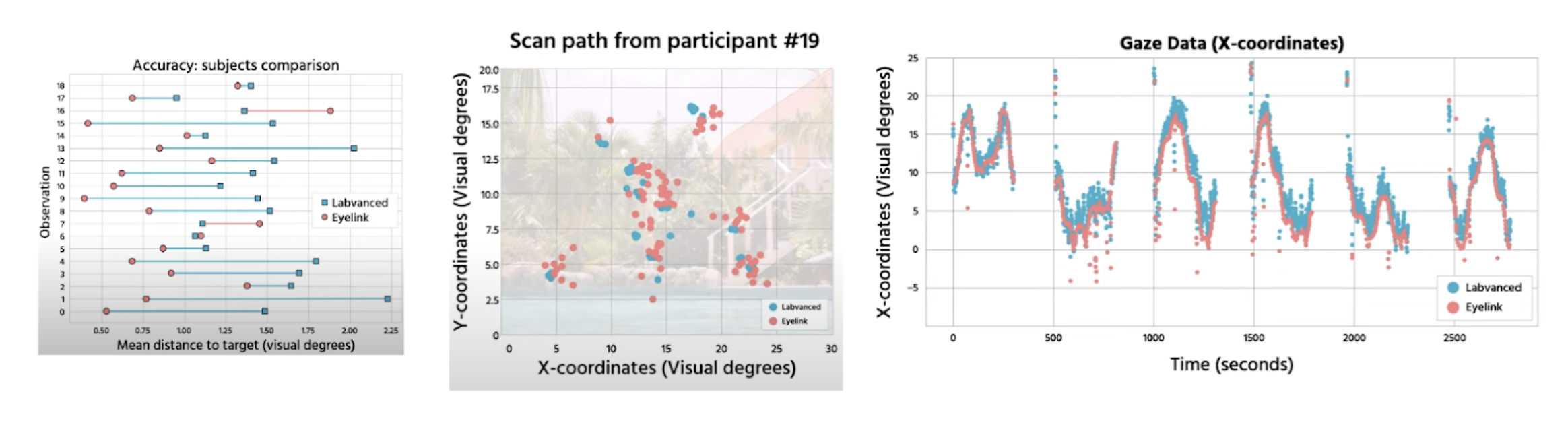
    Preview of key findings and graphs of Labvanced's peer-reviewed paper on its webcam eye tracking accuracy.
    • Accuracy increased even further for stimuli presented in the center of the screen.
    • The accuracy was consistent across time and did not drop off over time.
    • The only other popular webcam-based system (WebGazer - Papoutsaki, 2015) has a reported accuracy of about 4 visual degrees, illustrating that our system is about 3 times more accurate than anything else.

    Peer-reviewed paper about Labvanced's webcam eye tracking technology

    Comparison between Labvanced Webcam Eye Tracking and WebGazer

    Typically, webcam eye tracking has become synonymous with WebGazer. Labvanced’s eye tracking belongs to its own category by using custom neural networks in order to estimate gaze coordings. A quick look at the table below demonstrates just how differently these two eye-tracking tools perform:


    MetricWebGazerLabvanced
    Accuracy4.17 visual degrees1.3 visual degrees
    Main TechnologyRidge RegressionPre-Trained CNN
    Release Year20162022
    PublicationIJCAI (Conference paper)BRM (Journal paper)
    Fixation DetectorNo / too noisyYes, it’s built-in

    For the full side-by-side, including fixation detection, calibration, cost, and WebGazer's maintenance status, see the Labvanced vs WebGazer comparison.

    Gorilla, a no-code experiment platform, also uses WebGazer for its webcam eye tracking. See the full Labvanced vs Gorilla comparison for how the two platforms differ beyond eye tracking.


    Scientific Impact: Labvanced in Peer-reviewed Literature

    How are others using Labvanced’s webcam eye tracking in their research? Here are a few examples:

    JMIR Publication logo featuring Labvanced's webcam eye tracking
    Effect of artificial intelligence helpfulness and uncertainty on cognitive interactions with pharmacists: Randomized controlled trial

    In this randomized controlled trial study, the researchers leveraged Labvanced’s webcam-based eye tracking to determine how pharmacists’ visual attention shifts when interacting with AI decision support. By remotely capturing gaze during a medication verification task, the researchers revealed how AI advice, even when uncertain, reshapes cognitive processing.

    Tsai, C. C., et al. (2025). Effect of artificial intelligence helpfulness and uncertainty on cognitive interactions with pharmacists: Randomized controlled trial. Journal of Medical Internet Research, 27, e59946.

    Environmental Psychology journal Publication logo featuring Labvanced's webcam eye tracking
    Beyond built density: From coarse to fine-grained analyses of emotional experiences in urban environments

    In this study, the authors used Labvanced’s webcam‑based eye‑tracking technology to collect gaze data as participants viewed images of urban environments. By tracking participants’ looking behaviors at different urban scene features, the researchers could relate visual attention to emotional appraisal of built versus natural elements. The use of Labvanced allowed this to be done online and at scale, capturing fine-grained eye movement metrics without requiring specialized in‑lab hardware.

    Sander, I., et al. (2024). Beyond built density: From coarse to fine-grained analyses of emotional experiences in urban environments. Journal of Environmental Psychology, 96, 102337.
    Journal of Marketing Publication logo featuring Labvanced's webcam eye tracking
    Finding goldilocks influencers: How follower count drives social media engagement

    In this multimethod study, the authors used Labvanced’s webcam-based eye‑tracking to measure how participants visually engage with influencer content. By tracking gaze behavior while participants viewed Instagram profiles with different influencer follower counts (as the region of interest), they were able to assess how attention patterns relate to perceived connection and engagement.

    Wies, S., Bleier, A., & Edeling, A. (2023). Finding goldilocks influencers: How follower count drives social media engagement. Journal of Marketing, 87(3), 383-405.

    Browse More Webcam Eye Tracking Publications

    Interactive Demos

    Preview of a study displaying real-time metrics of webcam eye tracking

    Live Metrics

    In this demo of a simple looking task, several eyentracking functions are shown for two pictures serving as areas of interest (AoIs): dwell time, time to first fixation, number of fixations, and average fixation duration. Note: the study begins with a 5 minute calibration (medium-loose chinrest constraint) which you can further edit upon importing.

    Preview of the preferential looking paradigm task in Labvanced

    Preferential Looking Paradigm

    This study investigates visual attention in infants using a preferential looking paradigm and can be further used as a template for such research. Participants view either images or videos side-by-side, while gaze patterns, fixation durations and head orientation are recorded, as well as a video recording of the participant. Note: uses infant-friendly calibration.
    Face perception demo showing live dwell time and fixation metrics for the eyes and mouth AOIs while a gaze marker moves across a face

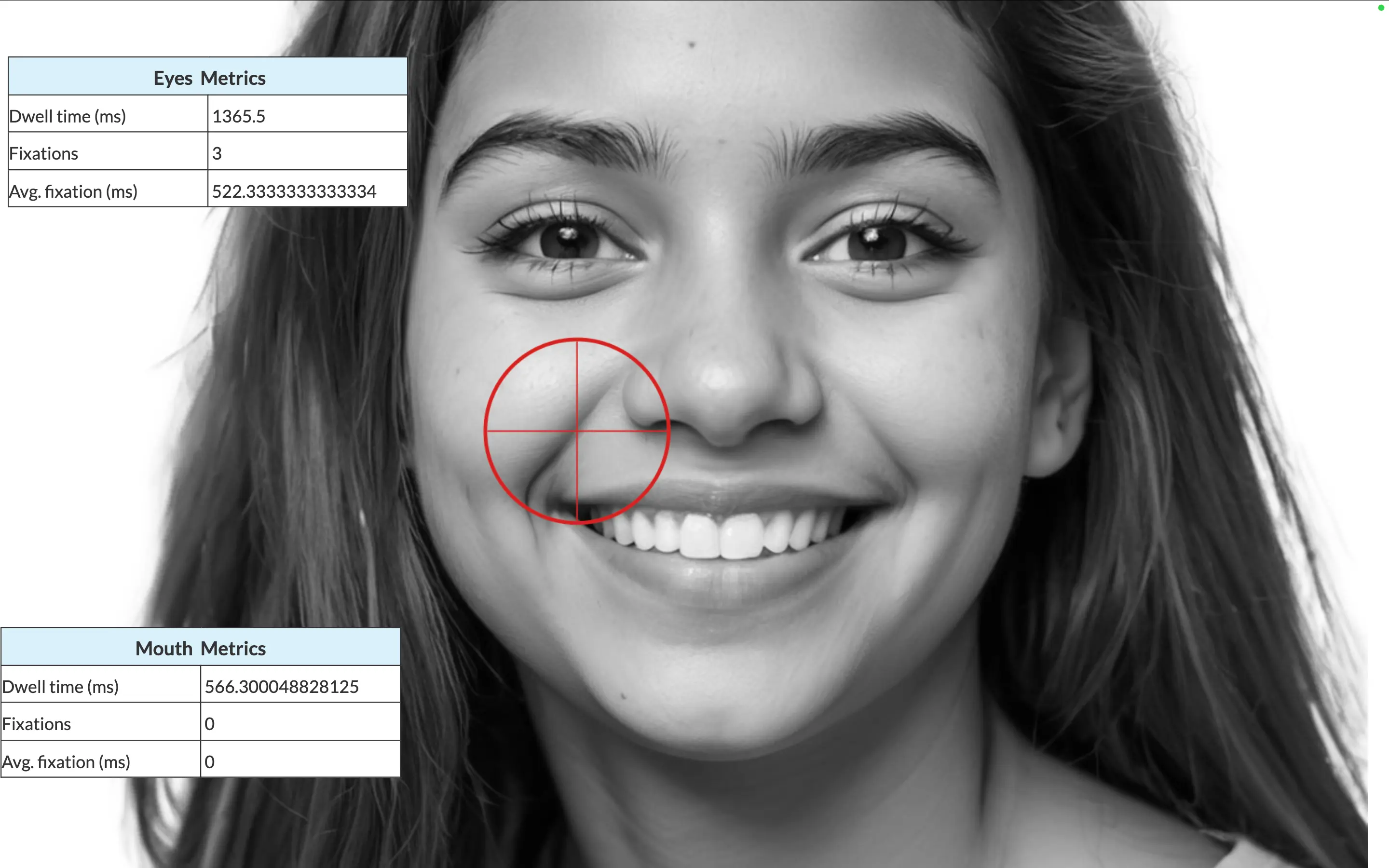
    Face Perception with Polygon AOIs

    Polygon shapes mark the eyes and mouth as AOIs, and dwell time, fixation count, and average fixation duration update live for each region. See how events record eye tracking data and how objects define unique AOIs.
    Results screen from the Banner Blindness study showing attention to images, text, and promotions relative to their share of the page

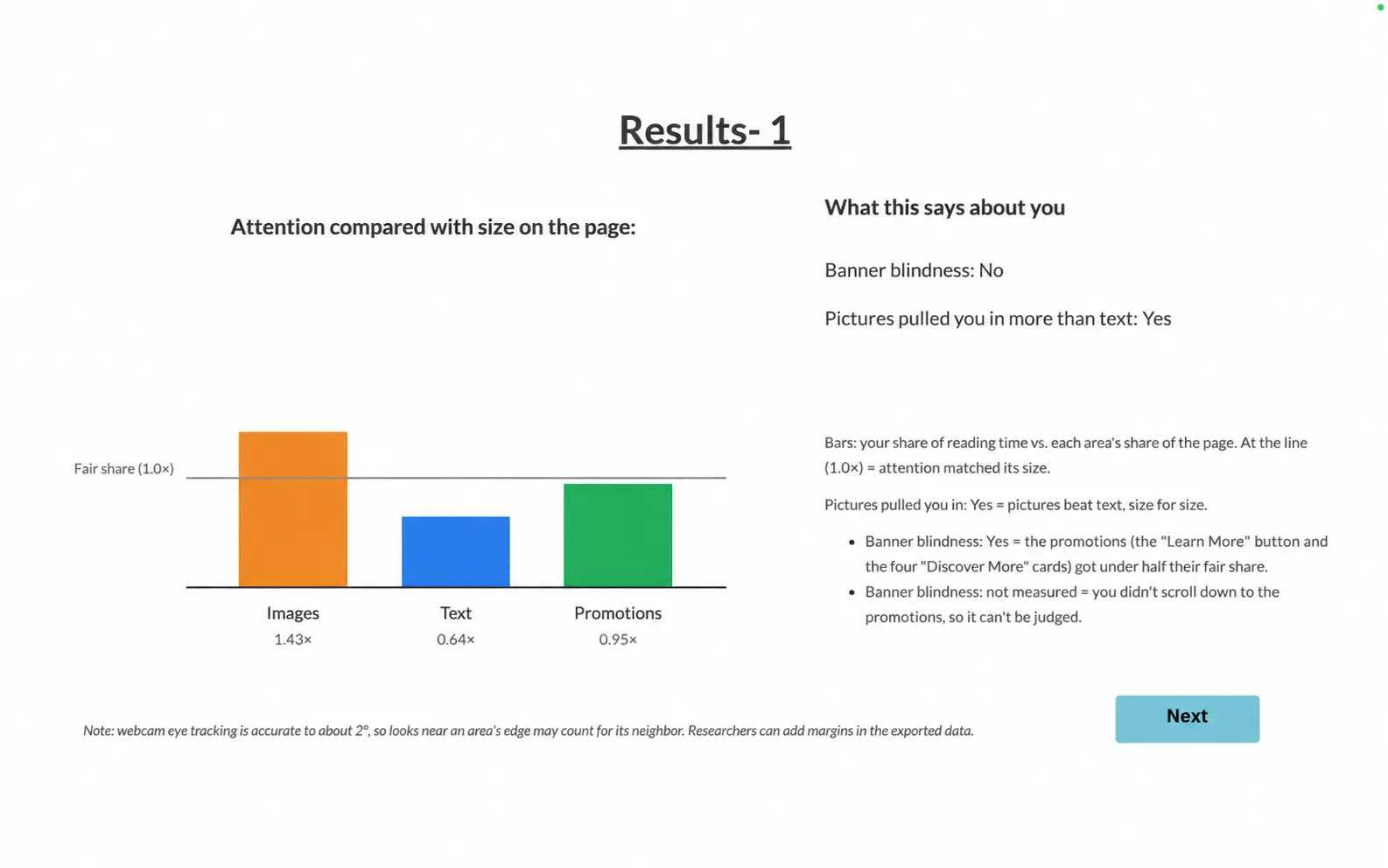
    Banner Blindness on a Real Website

    Participants read a live NASA science page embedded with Web Bridge while webcam eye tracking records attention to the page title, images, text, and promotions. At the end, a results screen compares each area's share of attention with its share of the page.

    Head tracking demo utilizing webcam eye tracking technology

    Head Tracking

    In this demo, you can try different head positions to move the sliders on the screen which serve as visualizations of numeric values. Head tracking is typically used as either a compliment or alternative to eyetracking.


    Data Privacy and Webcam Eye Tracking 🔐

    At Labvanced, we take data privacy and security extremely seriously. This can best be shown by the following points:

    • All processing of face and eye data happens on the user’s device, ensuring true privacy by design for eye data.
    • Only gaze position, and fixation durations (numeric data which is completely anonymous) will be saved to our server.
    • An external security audit (VAPT) has been conducted and passed successfully. Documents can be provided on request.
    • Our servers belong to us and are solely located within the European Union / under European jurisdiction.
    • We provide you with our Technical and Organizational Measures (ToM), and data processing agreements (DPAs) on request.
    • All data can be end-to-end encrypted (PGP), such that the data will only be stored in an encrypted format on our server.

    Documentation
    Guide hub for setting up and running webcam eye tracking studies in Labvanced

    Webcam Eye Tracking Guide

    The full documentation hub for setting up, calibrating, and running webcam eye tracking studies in Labvanced.
    Overview of calibration settings for webcam eye tracking studies in Labvanced

    Choosing Calibration Settings

    How to choose calibration length, type, and constraints to balance data quality against participant compliance.
    Image of building blocks symbolizing how to integrate webcam eye tracking into a task in Labvanced

    Setting Up Eye Tracking in a Task

    A step-by-step overview of enabling eye tracking and designing tasks that reliably capture gaze data in Labvanced.

    Further Reading
    A person's face with facial expression analysis overlay used for webcam emotion detection in Labvanced

    Emotion Detection

    Classify facial expressions into categorical emotions with continuous valence and arousal scores.
    A heart rate waveform representing remote rPPG heart rate detection in Labvanced

    Heart Rate Detection (rPPG)

    Estimate beats per minute from the participant's webcam feed using remote photoplethysmography.
    Collection of icons illustrating the different platform features of Labvanced

    Feature Overview

    See the full range of Labvanced's platform features, from experiment building to data export, in one place.
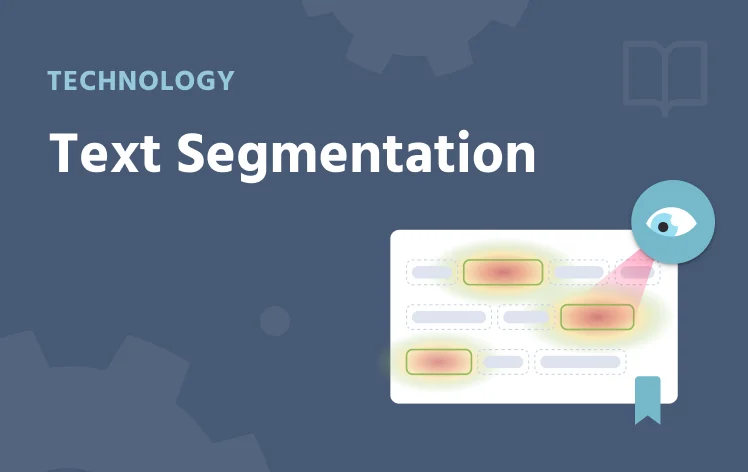
    Per-word area of interest boxes on a sentence, built automatically by Labvanced's Text Segmentation Object

    Text Segmentation

    Automatic per-word AOIs for reading research, built on this same gaze engine.

    Common Questions about Labvanced's Webcam Eye Tracking


    Is Labvanced webcam eye tracking the same as WebGazer?
    No. This is a common misconception, likely because WebGazer is the best-known open-source webcam eye tracking library and gets bundled into other platforms (including Gorilla). Labvanced does not use WebGazer. It runs on its own proprietary, pre-trained neural network built and trained in-house, a completely different technology from WebGazer's ridge regression approach. The accuracy difference reflects that: Labvanced measures 1.3 visual degrees of accuracy versus WebGazer's 4.17, making Labvanced roughly 3 times more accurate. Labvanced's system is also the only webcam eye tracking solution validated in a peer-reviewed journal publication (Kaduk et al., 2024, Behavior Research Methods), rather than a conference paper. See the full comparison table for the complete breakdown.

    Is my webcam video recorded or sent anywhere during eye tracking?
    No. All processing of face and eye data happens on the user's device. Only gaze position and fixation durations, numeric and anonymous, are saved to Labvanced's servers.

    Is there other physiological data that can be recorded with a webcam, alongside eye tracking?
    Yes. Labvanced also enables researchers to combine eye tracking with rPPG (remote heart rate detection) and emotion detection, all from the same webcam feed on the same shared, time-aligned data grid. See Three Signals, One Webcam for how the combination works.

    Feasibility Check

    If you need more support or are curious about a particular webcam eye tracking feature, please reach out to us via chat or email. We are more than happy to hear about your research and walk you through any questions about the platform and discuss project feasibility.


    Sign up today and enable webcam-based eye tracking for your online psychology experiment.