labvanced logoLabVanced
Contact
    • Remote Physiological Measurements
    • Eye Tracking
    • Head & Face-Tracking
    • Emotion Detection
    • Heart Rate Detection (rPPG)
    • Generative AI
    • Audio Transcription
    • EEG & Hardware Integrations
    • Decision Making
    • Reaction Times
    • Keyboard Inputs
    • Mouse Tracking
    • Mobile / Touch
    • Questionnaires
    • Gamepad / Joystick Integration
    • Audio Recordings
    • Audio Transcription
    • Video Recordings
    • Screen Recordings
    • Photos / Snapshots
    • Video Conferencing
    • Canvas Drawings
    • Build with AI
    • Build with Spreadsheets
    • Using the Experiment Editor
    • Coding
    • Creating Questionnaires
    • Balancing & Randomization
    • UX & Website Testing
    • Single Session Studies
    • Factorial Designs
    • Longitudinal & Multi-session Studies
    • Individual & Case Studies
    • Real-time Multi-user Studies
    • Interviews & Video Calls
    • Surveys & Questionnaires
    • Experience Sampling & Diaries
    • Classroom & Group Testing
    • Interventions & Clinical Trials
    • In the Browser
    • Mobile App
    • Desktop App
    • WebBridge Chrome Extension
    • Stroop Test
    • Flanker Task
    • N-back Task
    • Implicit Association Test
    • Trail Making Test
    • Digit Span
    • Corsi Block Tapping
    • Tower of London
    • Balloon Analog Risk Task
    • Preferential Looking
    • Browse more →
    • DASS-21
    • GAD-7
    • Rosenberg Self-Esteem Scale
    • PHQ-9
    • Ten-Item Personality Inventory
    • Big Five Personality Test
    • Adult ADHD Self-Report Scale
    • Browse more →
    • Building a Multi-user Study
    • Webcam Eye Tracking with AOIs
    • Website Frame Eye Tracking
    • Conditional Eye Tracking Opt-in
    • ChatGPT Study
    • Desktop App Study with EEG
    • Between-subjects Group Balancing
    • Building a Reading Study
    • Stroop Task
    • Lexical Decision Task
    • Browse more →
    Public Experiment Library
    • Arts Research
    • Clinical Psychology & Neuropsychology Medicine
    • Cognitive Psychology
    • Developmental Psychology
    • Behavioral Economics & Decision Science
    • Educational Research & Psychology
    • HCI & Human Factors
    • Linguistics & Language Sciences
    • Consumer & Marketing Research
    • Social & Personality Psychology
    • Sport & Movement Science
    • UX & Website Testing
    • Executive Functions
    • Language & Reading
    • Decision-Making & Reasoning
    • Attention
    • Overview
    • HCI & Human Factors
    • UX & Website Testing
    • Consumer & Marketing Research
    • White-Label App
    • PageGazer
    • Webcam vs. Lab Eye Tracking in InfantsAnna Banki & Gabriela Markova
    • Eye Tracking for Influencer MarketingDr. Alexander Edeling
    • Eye Tracking Infant Word ComprehensionDr. Giulia Calignano
    • Sentence Reading and Grammar JudgmentsDr. Jonathan Mirault
    • Regulating Emotions with MusicDr. Katrin Starcke
    • Game-Based Grammar Learning in ChildrenDr. Mireia Marimon
    • Gaze Cueing and AutismMax Soares Miehstein
    • Personality and Hearing in NoiseDr. Malte Wöstmann
    • All interviews →
    • Lab Notes
    • How to Cite Labvanced
    • Labvanced Platform Paper (2017)
    • Webcam Eye Tracking Validation (2024)
    • Webcam Eye Tracking Studies
    • Cognitive Psychology Studies
    • Developmental Psychology Studies
    • Linguistics Studies
    • See all publications →
    • Getting Started
    • Guide
    • Video Tutorials
    • Walkthroughs
    • Live Chat
    • Webinars & Onboarding Calls
    • AI Assistant
    • FAQ
    • Importing Templates Guide
    • Test Templates
    • Live Eye Tracking Metrics
    • Mouse Tracking Demo
    • ChatGPT Demo
    • Audio Recording Object Demo
    • Adding Image Stimuli Demo
    • Score & Feedback Demo
    • Browse all technical demos →
    • Timing Precision
    • Stimuli Presentation
    • Headphone Checks
    • Bot Checks
    • Participant Management
    • Comparisons
    • Research Blog
    • Prolific Integration
    • CloudResearch Integration
    • Sona Systems Integration
    • BeSample Integration
    • Panelabs Integration
    • Clickworker Integration
    • Labvanced Webhook API
    • Labvanced REST API
    • About Us
    • Newsletter Archive
    • Terms & Conditions
    • Data Security & Data Privacy
    • Technical & Organisational Measures
    • Accessibility
    • W-8BEN-E Form
    • Data Processing Agreement Template
    LinkedInYouTubeDiscord
    • Individual
    • Lab
    • Department / Consortium
    • Teaching
    • Campus
    • Commercial
    • Browse recording top-ups →
    • Browse AI token top-ups →
    • Overview
    • Study Building
    • Subject Recruitment
    • Dedicated Support
    Checkout
  • Contact
    • EN
      • 中國人
      • Deutsch
      • Français
      • Español
      • English
      • 日本語
    • Logout
    • Loginlogin icon
    Platform
    Labvanced makes it easy to implement the most advanced study design and reliably collect your data.
    Biosignals & AI
    Remote Physiological MeasurementsEye TrackingHead & Face-TrackingEmotion DetectionHeart Rate Detection (rPPG)Generative AIAudio TranscriptionEEG & Hardware Integrations
    Behavioral Recordings
    Decision MakingReaction TimesKeyboard InputsMouse TrackingMobile / TouchQuestionnairesGamepad / Joystick Integration
    Media Recordings
    Audio RecordingsAudio TranscriptionVideo RecordingsScreen RecordingsPhotos / SnapshotsVideo ConferencingCanvas Drawings
    Implementation Techniques
    Build with AIBuild with SpreadsheetsUsing the Experiment EditorCodingCreating QuestionnairesBalancing & RandomizationUX & Website Testing
    Study Formats

    Your study can take whatever format your research needs. Here are a few popular examples.

    Single Session StudiesFactorial DesignsLongitudinal & Multi-session StudiesIndividual & Case StudiesReal-time Multi-user StudiesInterviews & Video CallsSurveys & QuestionnairesExperience Sampling & DiariesClassroom & Group TestingInterventions & Clinical Trials
    Where Studies Run

    Run your study online in the browser, on mobile or tablet with the mobile app, or in-lab with the desktop app.

    In the BrowserMobile AppDesktop AppWebBridge Chrome Extension
    Tests
    Explore cognitive tests, questionnaires, walkthroughs, and our public experiment library: a starting point for your next study.
    Popular Cognitive Tests
    Stroop TestFlanker TaskN-back TaskImplicit Association TestTrail Making TestDigit SpanCorsi Block TappingTower of LondonBalloon Analog Risk TaskPreferential Looking
    Browse more →
    Questionnaires & Scales
    DASS-21GAD-7Rosenberg Self-Esteem ScalePHQ-9Ten-Item Personality InventoryBig Five Personality TestAdult ADHD Self-Report Scale
    Browse more →
    Public Experiment Library

    Take a look at what other researchers in the community are doing through our extensive, open catalog of shared studies.

    Open the public library →
    Walkthroughs

    Step-by-step builds of complete studies, from a blank project to a running experiment, that you can follow along or adapt.

    Building a Multi-user StudyWebcam Eye Tracking with AOIsWebsite Frame Eye TrackingConditional Eye Tracking Opt-inChatGPT StudyDesktop App Study with EEGBetween-subjects Group BalancingBuilding a Reading StudyStroop TaskLexical Decision Task
    Browse more →
    Research
    One platform for students, academics, and industry researchers studying human behavior.
    Harvard UniversityStanford UniversityCambridge UniversityUCLNYUMax Planck InstituteUCLATU Munich

    Trusted by researchers at 1,500+ universities worldwide

    Academic Research
    Arts ResearchClinical Psychology & Neuropsychology MedicineCognitive PsychologyDevelopmental PsychologyBehavioral Economics & Decision ScienceEducational Research & PsychologyHCI & Human FactorsLinguistics & Language SciencesConsumer & Marketing ResearchSocial & Personality PsychologySport & Movement ScienceUX & Website Testing
    Research Areas
    Executive FunctionsLanguage & ReadingDecision-Making & ReasoningAttention
    Industry / Commercial
    OverviewHCI & Human FactorsUX & Website TestingConsumer & Marketing ResearchWhite-Label AppPageGazer
    Researcher Interviews

    Conversations with researchers about the studies they ran with Labvanced, what worked, and what they learned.

    Webcam vs. Lab Eye Tracking in InfantsAnna Banki & Gabriela MarkovaEye Tracking for Influencer MarketingDr. Alexander EdelingEye Tracking Infant Word ComprehensionDr. Giulia CalignanoSentence Reading and Grammar JudgmentsDr. Jonathan MiraultRegulating Emotions with MusicDr. Katrin StarckeGame-Based Grammar Learning in ChildrenDr. Mireia MarimonGaze Cueing and AutismMax Soares MiehsteinPersonality and Hearing in NoiseDr. Malte Wöstmann
    All interviews →
    Our Research
    Lab NotesHow to Cite Labvanced
    Peer Reviewed Studies

    A selection of peer-reviewed work built on Labvanced: our own platform and validation papers, and studies by the research community grouped by area. Hundreds more are listed on the full publications page.

    Labvanced Platform Paper (2017)Webcam Eye Tracking Validation (2024)Webcam Eye Tracking StudiesCognitive Psychology StudiesDevelopmental Psychology StudiesLinguistics Studies
    See all publications →
    Resources
    Valuable resources to help you learn the platform, stay updated, and more.
    Documentation
    Getting StartedGuideVideo TutorialsWalkthroughs
    Support
    Live ChatWebinars & Onboarding CallsAI AssistantFAQ
    Templates & Demos

    These are a few popular examples. Browse our guide and a selection of technical demos to get started with implementation.

    Importing Templates GuideTest TemplatesLive Eye Tracking MetricsMouse Tracking DemoChatGPT DemoAudio Recording Object DemoAdding Image Stimuli DemoScore & Feedback Demo
    Browse all technical demos →
    Methodology
    Timing PrecisionStimuli PresentationHeadphone ChecksBot ChecksParticipant ManagementComparisonsResearch Blog
    Integrations & APIs
    Prolific IntegrationCloudResearch IntegrationSona Systems IntegrationBeSample IntegrationPanelabs IntegrationClickworker IntegrationLabvanced Webhook APILabvanced REST API
    Company & Legal
    About UsNewsletter ArchiveTerms & ConditionsData Security & Data PrivacyTechnical & Organisational MeasuresAccessibilityW-8BEN-E FormData Processing Agreement Template
    LinkedInYouTubeDiscord
    Pricing
    Our licenses and additional services at a glance.
    Licenses
    IndividualLabDepartment / ConsortiumTeachingCampusCommercial
    Top-Ups

    Need more recordings for your lab or your own research? Simply use one of these recording top-up packages.

    Browse recording top-ups →

    Need more AI tokens for the AI assistant and study translations? Simply use one of these AI token top-up packages.

    Browse AI token top-ups →
    Additional Services

    Hire Labvanced’s expert team to quickly bring your project to the level of rigor it needs.

    OverviewStudy BuildingSubject RecruitmentDedicated Support
    Checkout

    Ready to purchase a license or top-up? Head straight to checkout.

    Go to checkout →
    • 中國人
    • Deutsch
    • Français
    • Español
    • English
    • 日本語
    • Getting Started
    • Guide
      • GETTING STARTED

        • Task Editor
        • Frames
          • Canvas Frame
          • Page Frame
          • Website Frame
          • Overlays & Dialogs | Labvanced
        • Trial Timeline
        • Stimulus Presentation
        • Correctness of Response
        • Objects
        • Events
        • Variables
        • Task Wizard
        • AI Assistant
        • Trial System
        • Experiment Design
          • Creating a Study
          • Importing Templates in Labvanced
          • Data Frame Patterns
          • Multi-user Experiment Design
          • Longitudinal Experiment Design
      • FEATURED TOPICS

        • Randomization & Balance
        • Eye Tracking
          • Presenting Stimuli in an Eye Tracking Task
          • How to Choose Eye Tracking Calibration Settings
          • Setting Up Eye Tracking in a Task
          • Recording and Exporting Gaze Data
          • Using Shapes as Areas of Interest (AOI) for Eye Tracking
          • The Participant Calibration Experience
        • Web Bridge
          • Selecting Website AOIs | Anchor, Adjust, and Verify AOI Tracking
          • Tracking Mouse Behavior on a Website AOI | Web Bridge Guide
        • Questionnaires
        • Desktop App
        • Sample Studies
        • Participant Recruitment
        • API Access
          • REST API
          • Webhook API
          • WebSocket API
        • Other Topics

          • Precise Stimulus Timings
          • Multi User Studies
          • Head Tracking in Labvanced | Guide
      • MAIN APP TABS

        • Overview: Main Tabs
        • Dashboard
        • My Studies
        • Shared Studies
        • My Files
        • Experiment Library
        • My Account
        • License & Services
      • STUDY TABS

        • Overview: Study-Specific Tabs
        • Study Design
          • Tasks
          • Blocks
          • Sessions
          • Groups
        • Task Editor
          • Task Controls
          • The Trial System
          • Frame Types
          • Objects
          • Object Property Tables
          • Variables
          • System Variables Table
          • The Event System
          • Text Editor Functions
          • Eye Tracking Options in the Task Editor
          • Head Tracking in a Task
          • Multi-User Studies
        • Settings
        • Variables
        • Media
        • Texts & Translate
        • Launch & Participate
        • Subject Management
        • Dataview and Export
    • Video Tutorials
      • Video Overview
      • Getting Started in Labvanced
      • Creating Tasks
      • Element Videos
      • Events & Variables
      • Advanced Topics
    • Walkthroughs
      • Introduction
      • Stroop Task
      • Lexical Decision Task
      • Posner Gaze Cueing Task
      • Change Blindness Flicker Paradigm
      • Eye-tracking Sample Study
      • Infant Eye-tracking Study
      • Attentional Capture Study with Mouse Tracking
      • Rapid Serial Visual Presentation
      • ChatGPT Study
      • Eye Tracking Demo: SVGs as AOIs
      • Multi-User Demo: Show Subjects' Cursors
      • Gamepad / Joystick Controller- Basic Set Up
      • Desktop App Study with EEG Integration
      • Between-subjects Group Balancing and Variable Setup
      • Building a Multi-user Study
      • Website Frame Eye Tracking Walkthrough
      • Conditional Webcam Eye Tracking
      • Text Segmentation Study Building
      • Building a Study with AI
    • FAQ
      • Features
      • Support Policy & Guidelines
      • Security & Data Privacy
      • Licensing
      • Precision of Labvanced
      • Programmatic Use & API
      • Using Labvanced Offline
      • Troubleshooting
      • Study Creation Questions

    Eye Tracking Demo: SVGs as AOIs

    Overview

    In this demo, our goal is to capture eye tracking gaze data. Specifically, we want to capture the gaze data associated with specific Areas of Interest (AOIs) which are included in the study as SVG shape objects.

    A preview of the demo in action is shown below with the red circle providing feedback by indicating the location of the gaze in real time:
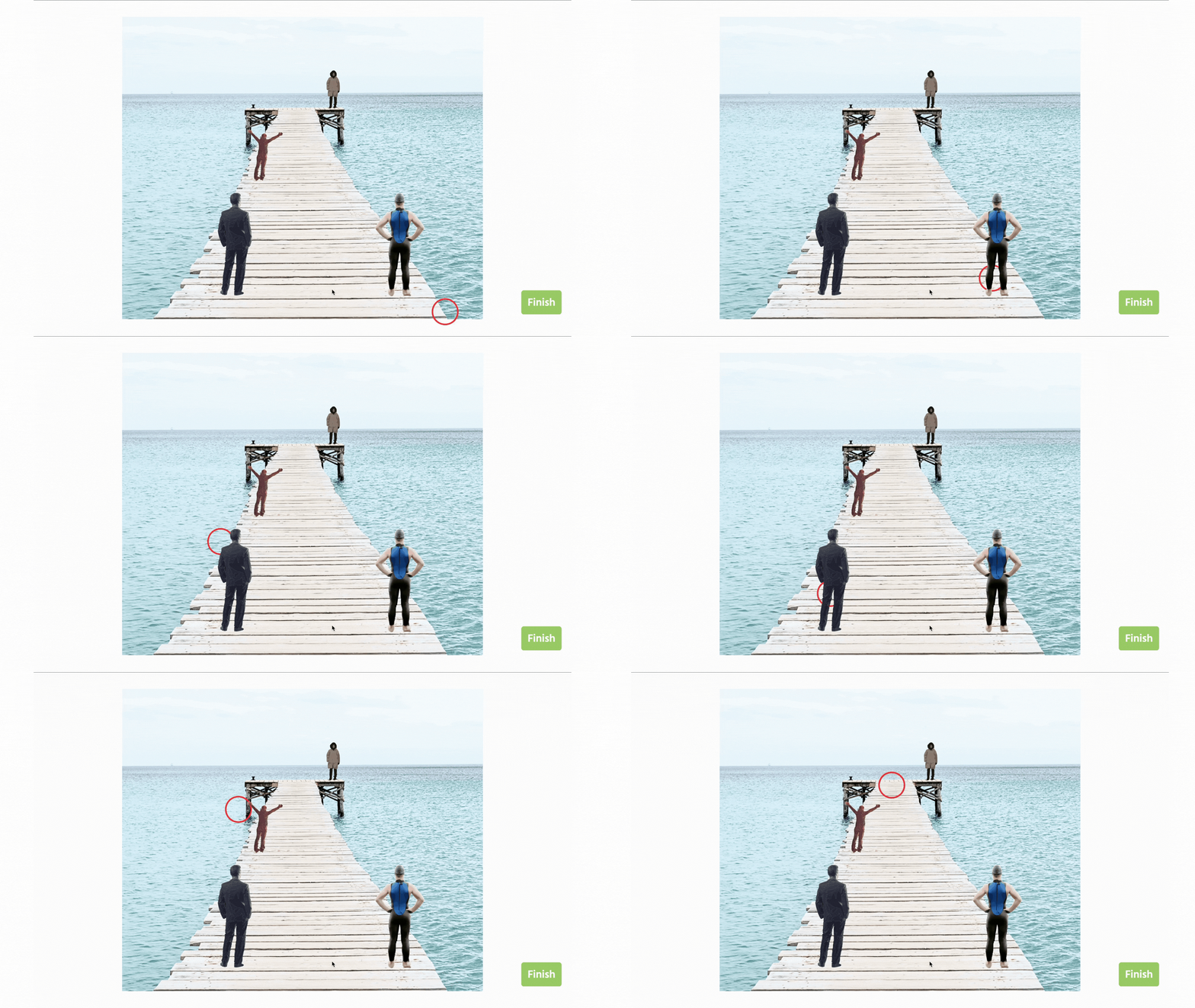
    Preview of the gaze location in a webcam-based eye tracking experiment.

    • NOTE: The demo recording was accomplished with a 5.5 minute calibration option; the red circle is an object that represents the participants gaze in real time and the overall set up is explained further below.

    Take a look at this quick video that shows the demo in action, as well as a preview of the data recorded at the end:

    Objects

    This demo includes a background image of a pier on which 4 SVG objects of people are placed upon. There is also a gaze feedback object (red circle). For the purposes of this demo, we wanted to represent gaze in real time and this red circle reflects that.
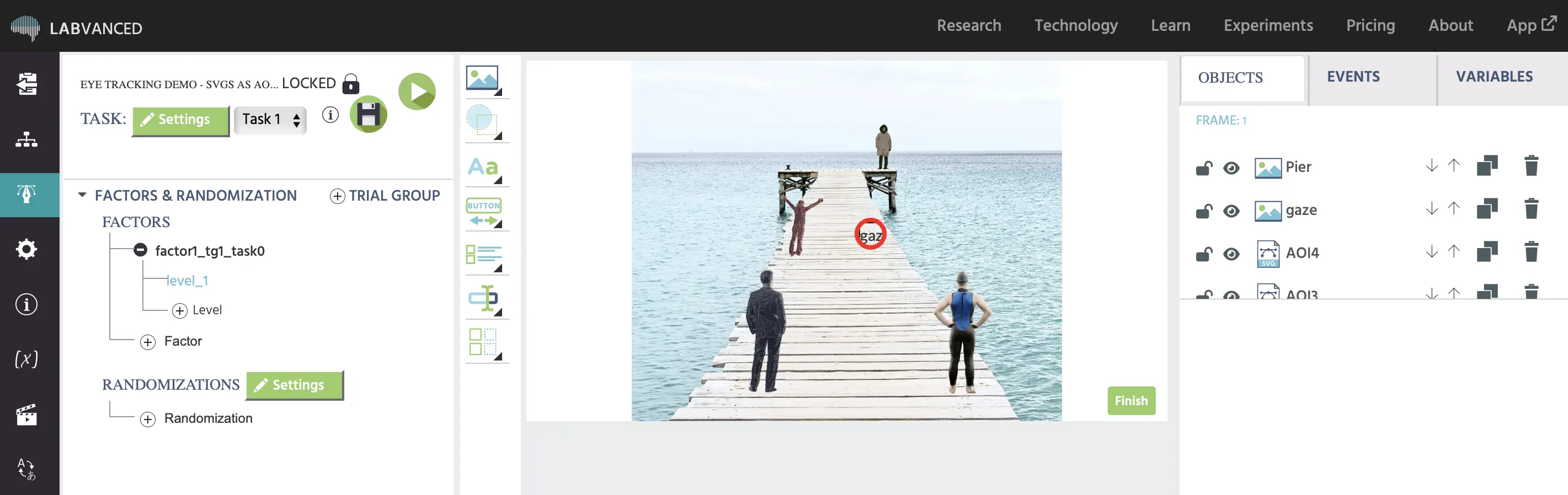
    The objects placed in the Labvanced editor

    Custom Variables Created

    In order to record data, variables are required. A list of all the custom variables that were created for this demo are shown below, accessible via the ‘Variables’ Tab. The image below shows the details and settings for the variables that this demo makes use of:
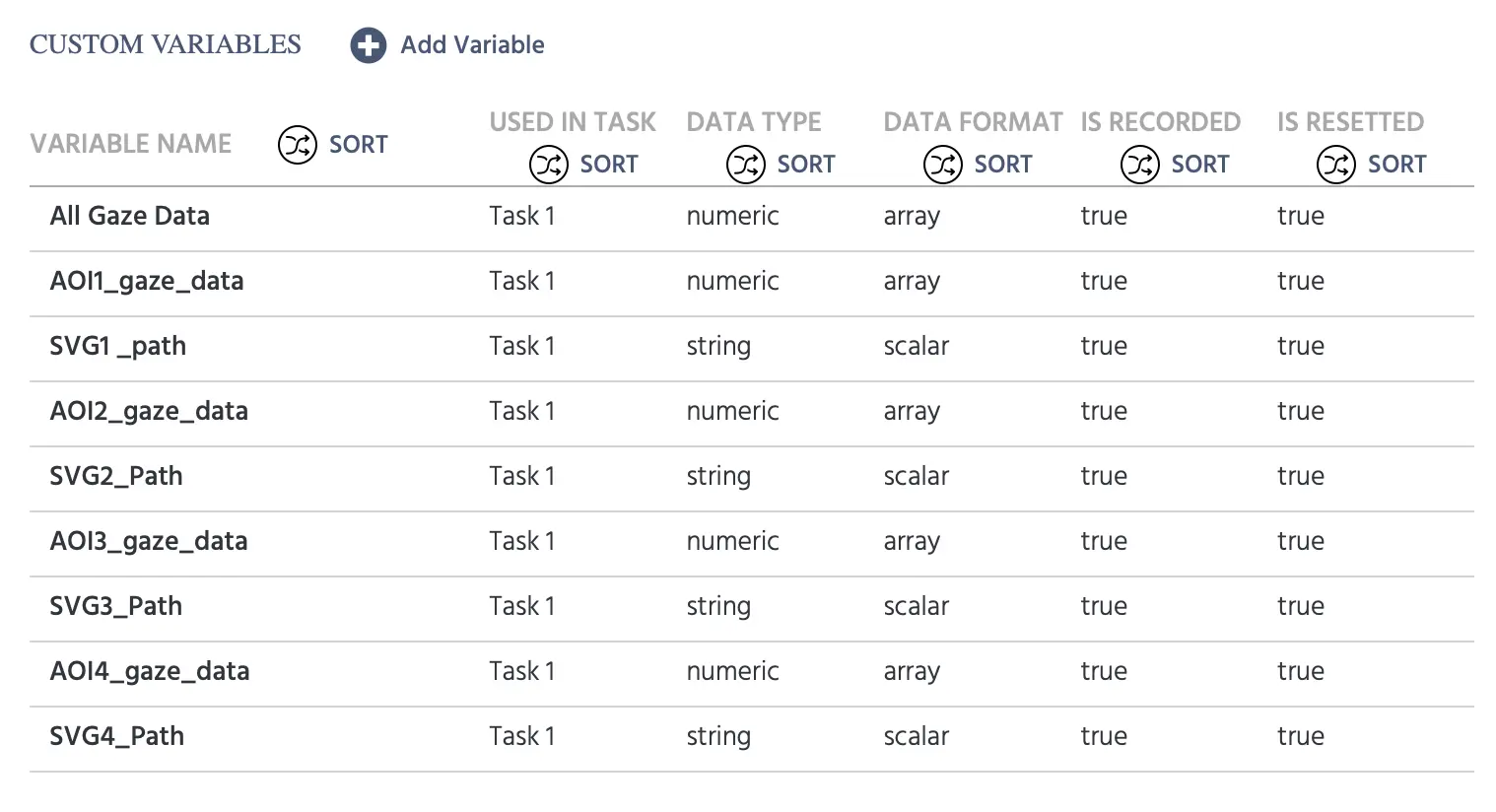
    Custom variables created for this webcam-based eye tracking study.

    Below is an explanation of the variables and their purpose:

    Variable NameDescriptionRecord Type
    All Gaze DataUsed to store the array of x/y coordinates [X,Y], as well as the Time Capture [T] and the confidence level [C] of the measurement.All changes / time series
    AOI1_gaze_dataUsed to store the array of [X,Y,T,C] when the participant looks at the SVG object named AOI1.All changes / time series
    SVG1_pathRecords the path of the SVG node that the gaze rested upon of AOI1 (explained further below).All changes / time series
    AOI2_gaze_dataUsed to store the array of [X,Y,T,C] when the participant looks at the SVG object named AOI2.All changes / time series
    SVG2_pathRecords the path of the SVG node that the gaze rested upon of AOI2.All changes / time series

    And so on….

    Events Set Up

    Since we are interested in capturing gaze data, the following events are used:

    1. All Gaze Data: This event initiates as soon as the task begins and records eye tracking gaze data continuously.
    2. AOI Gaze Data: This event initiates as soon as the participant looks at a specific AOI (ie. one of the four people) and records the gaze-related values.
    3. Finish Experiment: An event that accepts / ends the session and records the data upon the subject clicking the ‘Finish’ button.

    Event 1: All Gaze Data

    For the first event, we want to accomplish the following:

    • record all eye tracking data throughout the duration of the study
    • display the detected location of the gaze on the screen in real time (so you as the researcher can have a sense of the webcam tracking when trying out the demo)

    Trigger

    Thus, we use an eye tracking gaze trigger to initiate this event.
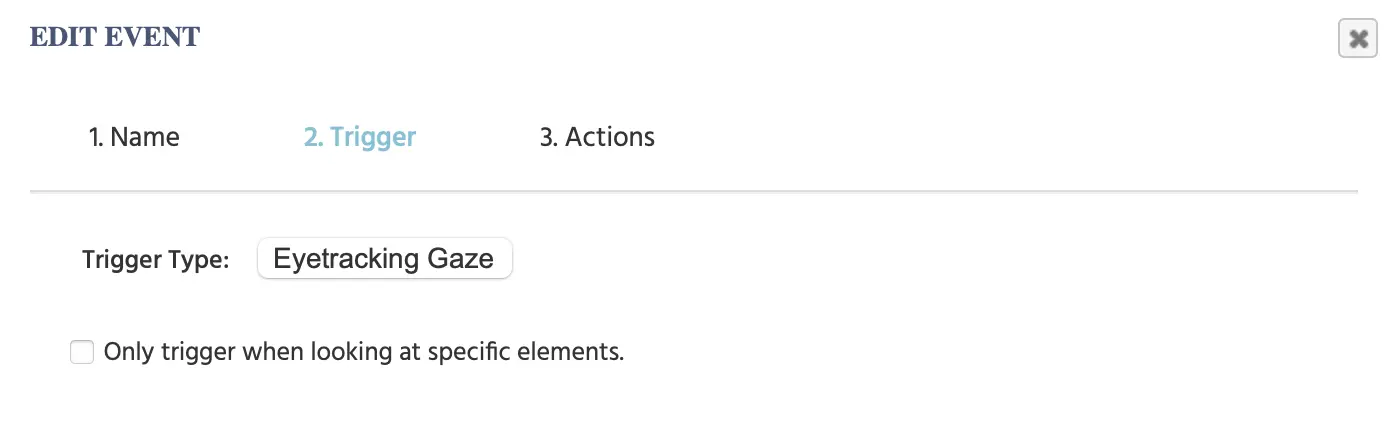
    selecting the Eyetracking gaze trigger option.

    Action

    Once gaze is detected, the following actions will occur: First, we call on the All Gaze Data variable that we created earlier in a Set / Record Variable action in order to record the data as [X,Y,T,C] array.
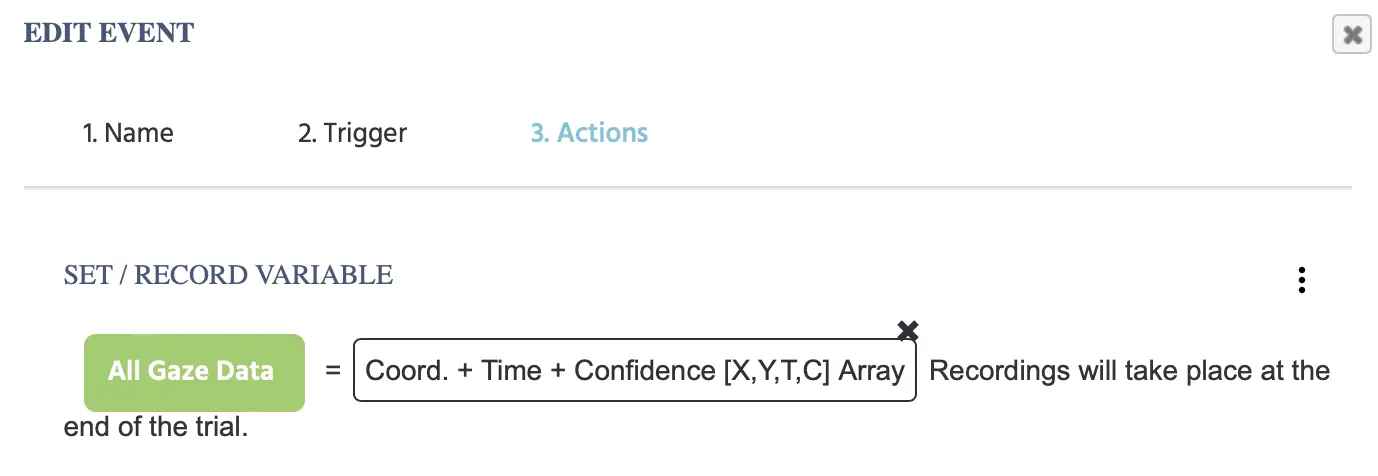
    Recording the data array and setting the eye tracking values

    The above is accomplished (as shown below) by clicking the green button, selecting the target variable, then clicking the pencil icon value-select menu and then choosing the [X,Y,T,C] array from the trigger-specific (Eyetracking Gaze) menu, as shown below:
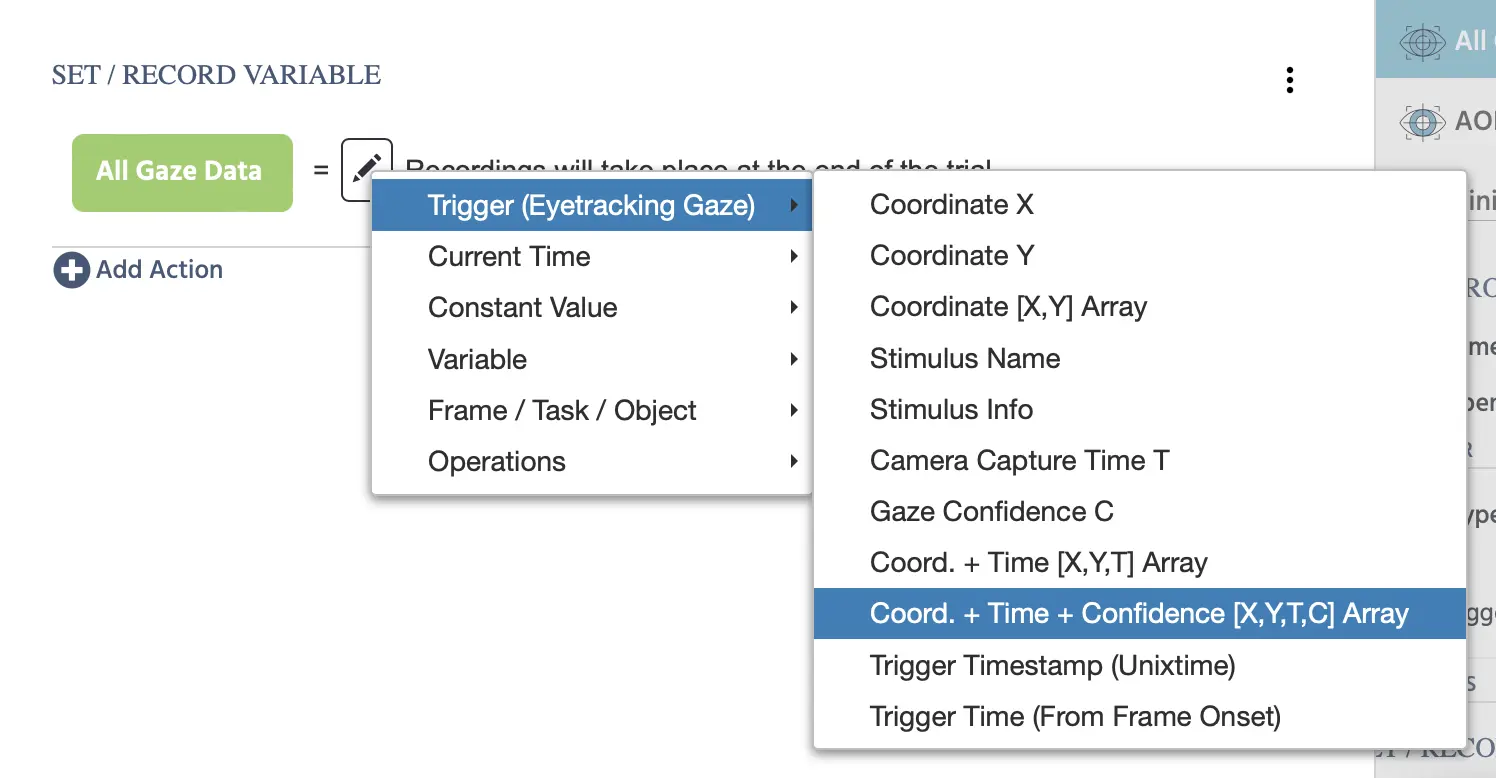
    Selecting which eye tracking data values should be recorded

    We also add the Set Object Property action in order to set the red circle object (called ‘gaze’) to set its X property equal to the and the Y property set to the coordinate X and the coordinate Y, respectively. In other words, we set the object’s x- and y-values to be equal to the x- and y-coordinates… ultimately, this is what makes the object move in real-time.
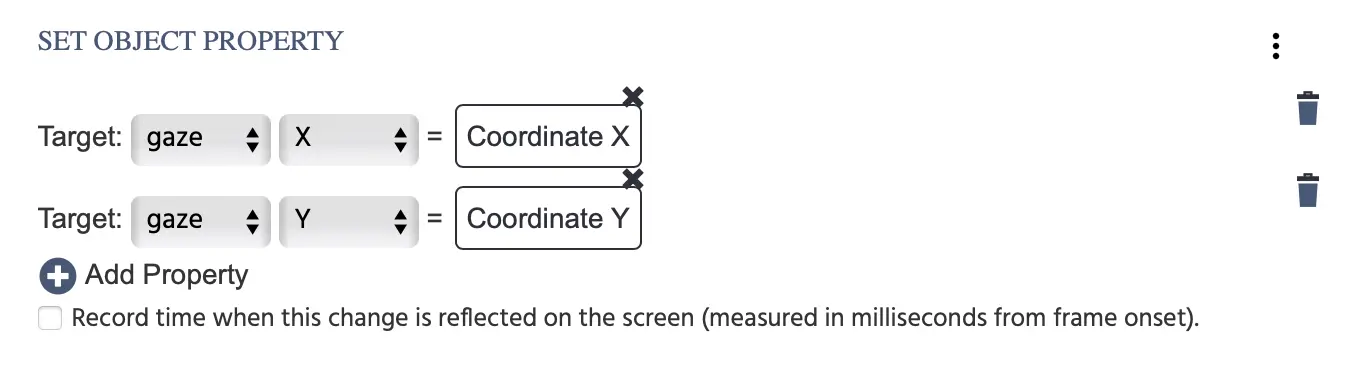
    Setting the object property to take on the gaze coordinates in order to provide visual feedback of where the gaze is in real-time.

    NOTE: the options for Coordinate X and Coordinate Y are selected from the trigger-specific (Eyetracking Gaze) menu.

    Event 2: AOI Gaze Data

    In this event, we want to set up the events such that:

    • gaze is also recorded when the gaze is specifically set on the target AOIs (ie. the SVG objects we have uploaded)
    • the specific SVG node data of the AOI is reported

    Trigger

    The Eyetracking Gaze trigger is also used as the trigger here. But in this context, we indicate that we are only interested in specific elements by clicking the respective option and then selecting the 4 SVG objects which are acting as Areas of Interest (AOIs).
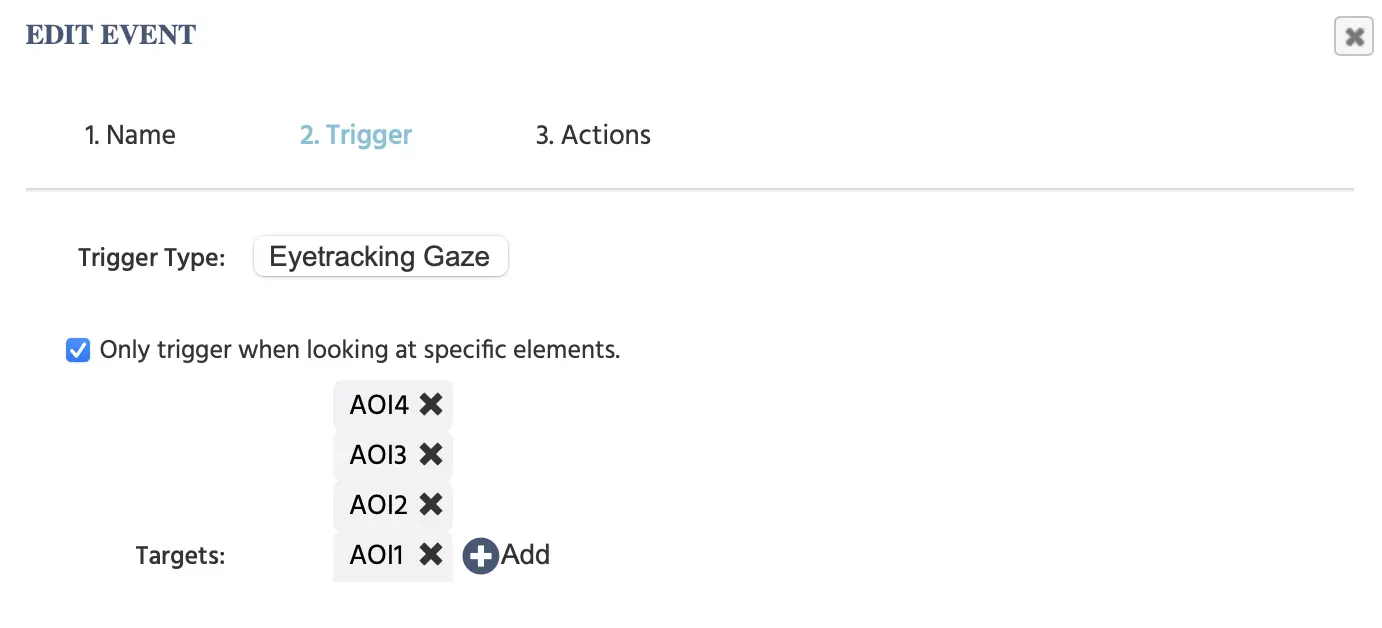
    Specifying the target Areas of Interest (AOIs) for the webcam-based eye tracking experiment.

    Action

    To set the call on each AOI, we need a Control Action → Requirement Action (If…Then). Essentially we want Labvanced to do the following…. “If the participant is gazing at AOI1, then we want to record the specific data for it in a specific variable, as well as the SVG path of that gaze”

    First we click on the + Requirement button and the two pen icon values will appear.

    • First pen icon: For the first field we select, from the trigger-specific (Eyetracking Gaze) menu, the Stimulus Name option which uses the object name of the stimulus that the trigger (in this case gaze) was on.
    • Second pen icon: Select Constant Value and then select the String option and type in the object name (ie. AOI1):
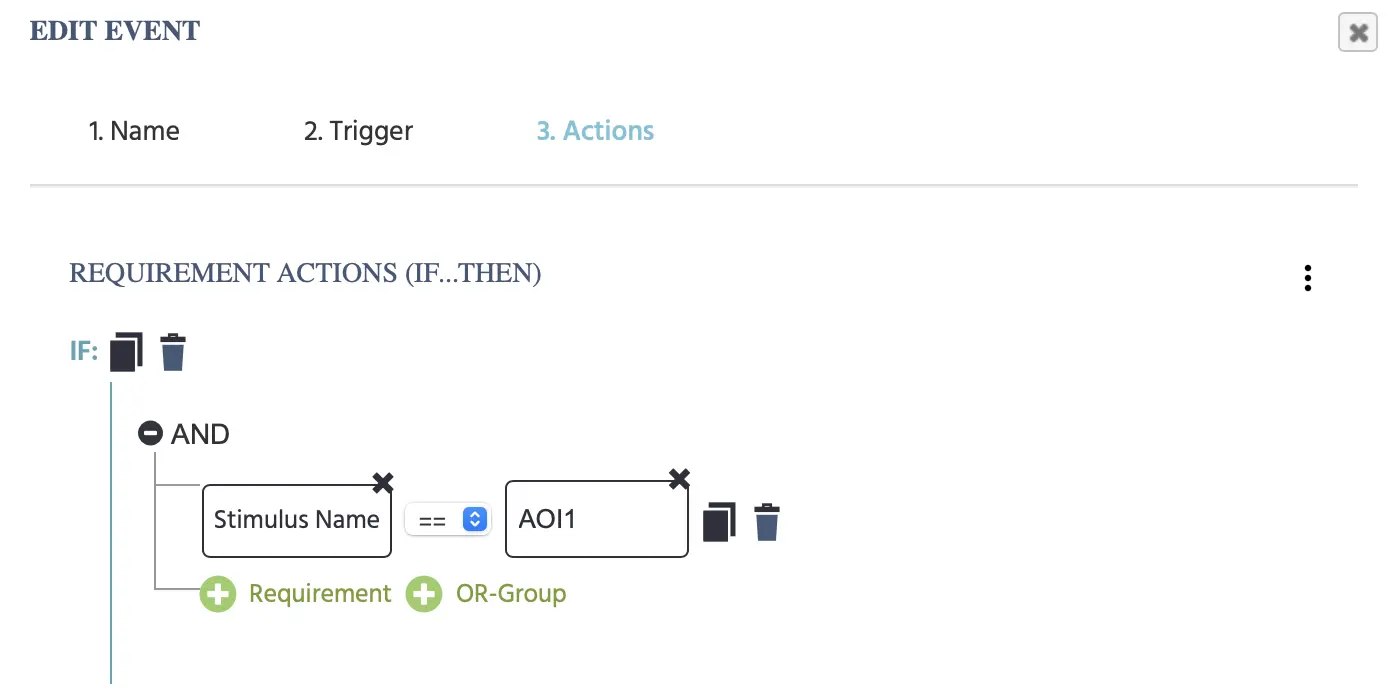
    Setting the stimulus in an if/then event to be AOI1

    So up to this point we have established that when the trigger (gaze) is on the stimulus named AOI1... then:
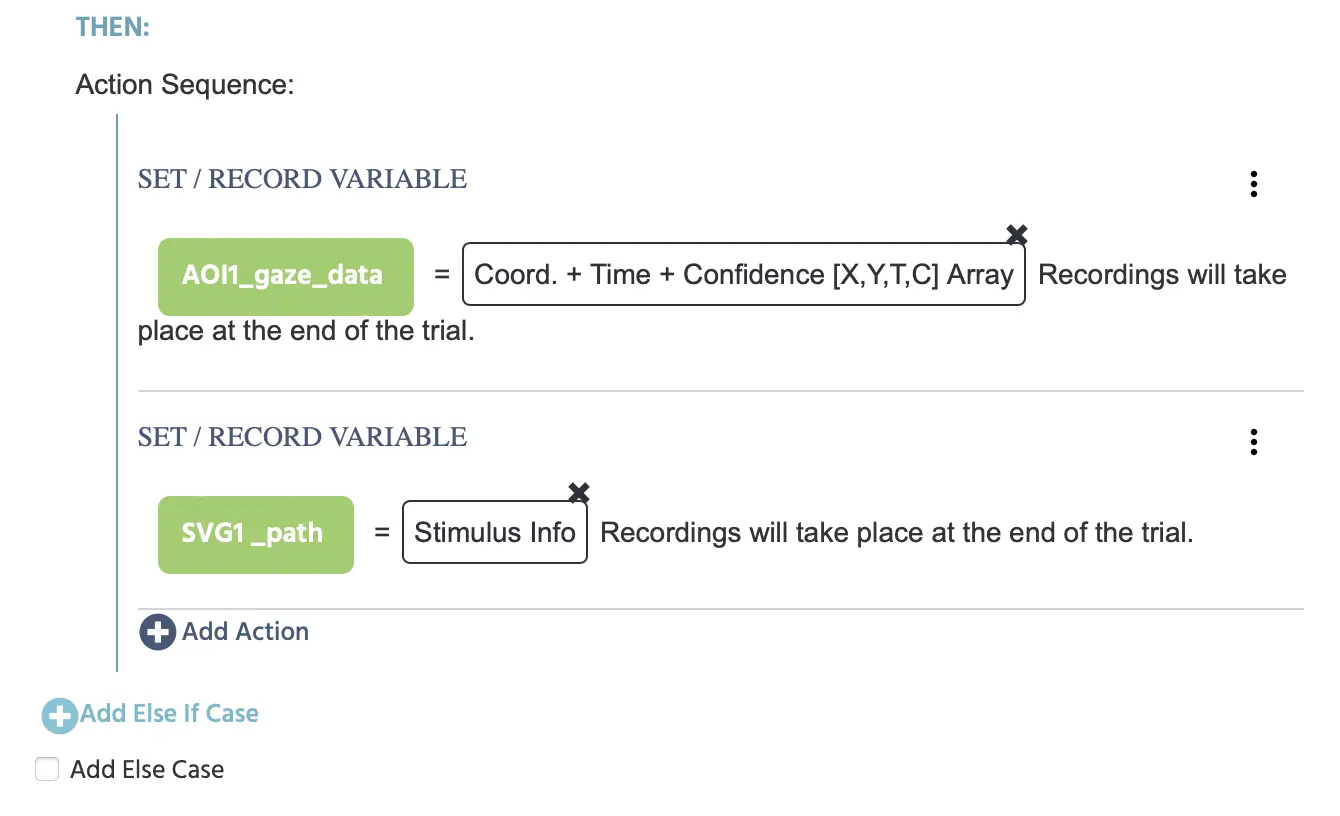
    Specifying what actions occur when the gaze is on AOI1.

    • The variable AOI_gaze_data that we created earlier will record the [X,Y,T,C] array.
    • Also the SVG1_path variable will be recorded to contain the Stimulus Info which, in this case, since target of interest (AOI1) is an SVG, the stimulus info will contain the nodes of the SVG.

    To specify the next AOI, the +Add Else If Case button in the dialog box and and then just repeat the structure / set up as it was shown above but with the main differences being setting the Stimulus Name as AOI2 and then also call the specific variables for storing the data, ie. AOI2_gaze_data and SVG2_Path as shown below:
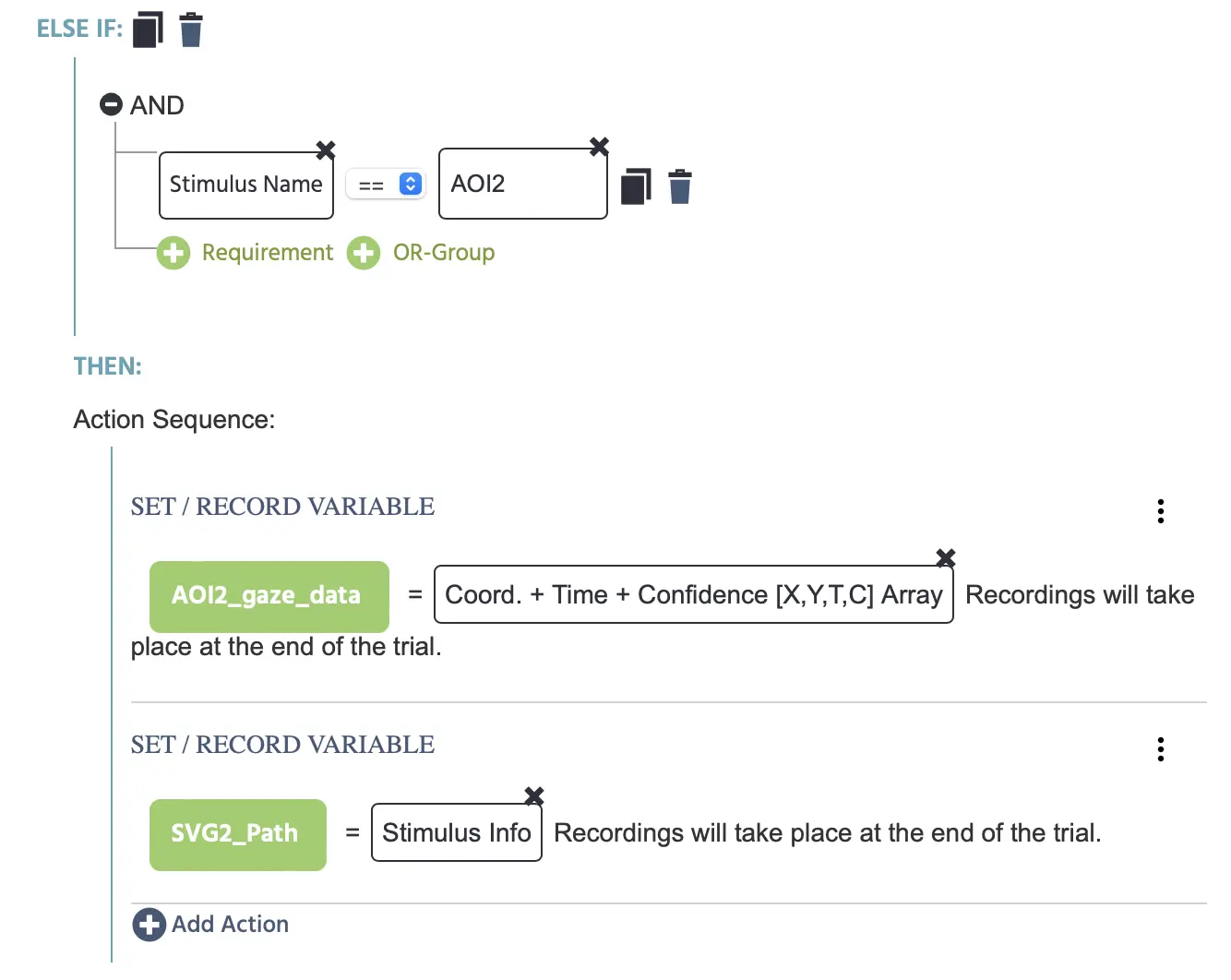
    Specifying that when the gaze is on AOI2 then the gaze array coordinates and the SVG path are recorded.

    Next, for AOI3, we choose to Add Else If Case again and follow the same structure but with the custom variables we have created to store the data for this specific AOI:
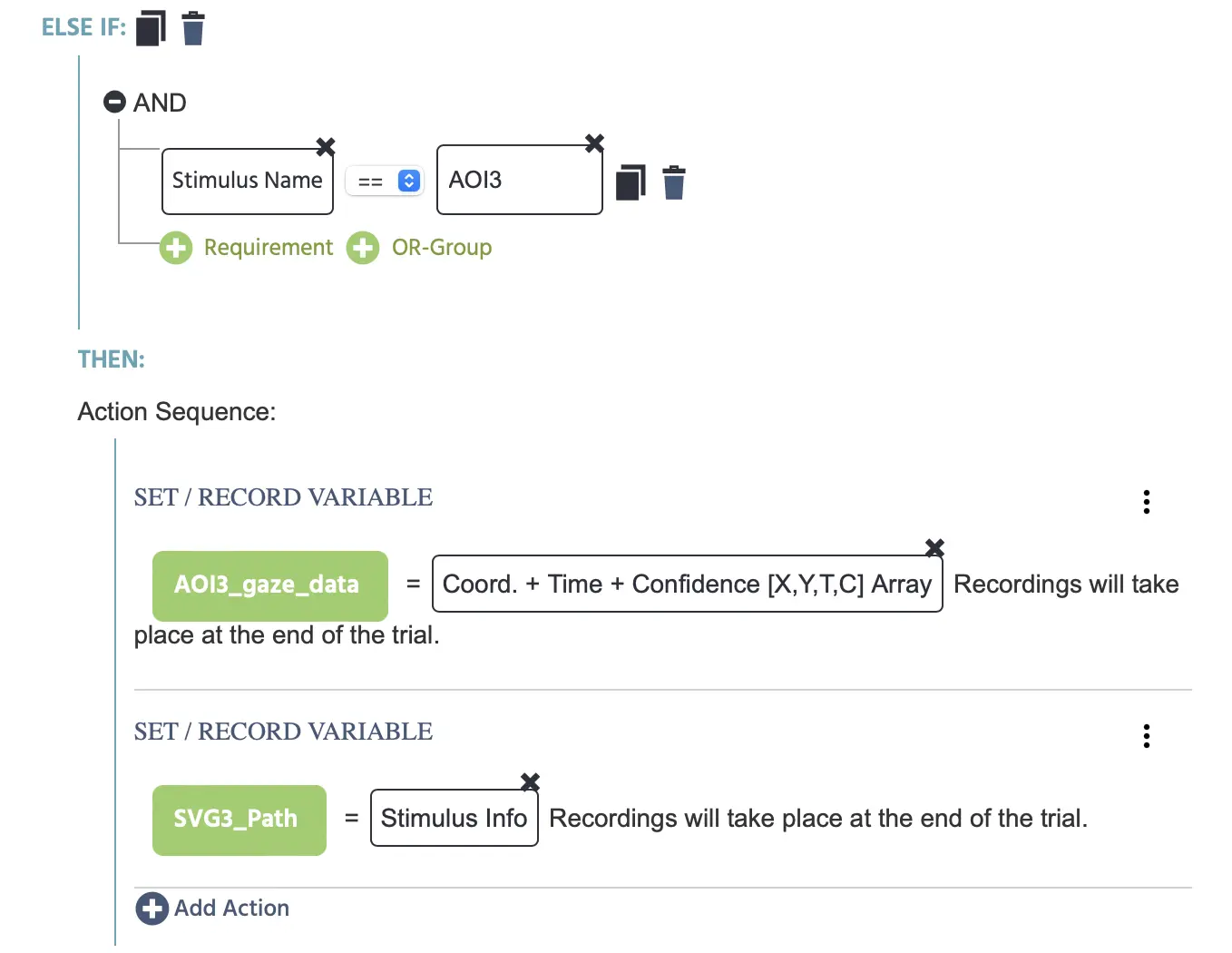
    Specifying that when the gaze is on AOI3 then the gaze array coordinates and the SVG path are recorded.

    Again, for AOI4, we choose to Add Else If Case again and follow the same structure but with the custom variables we have created to store the data for this specific AOI:
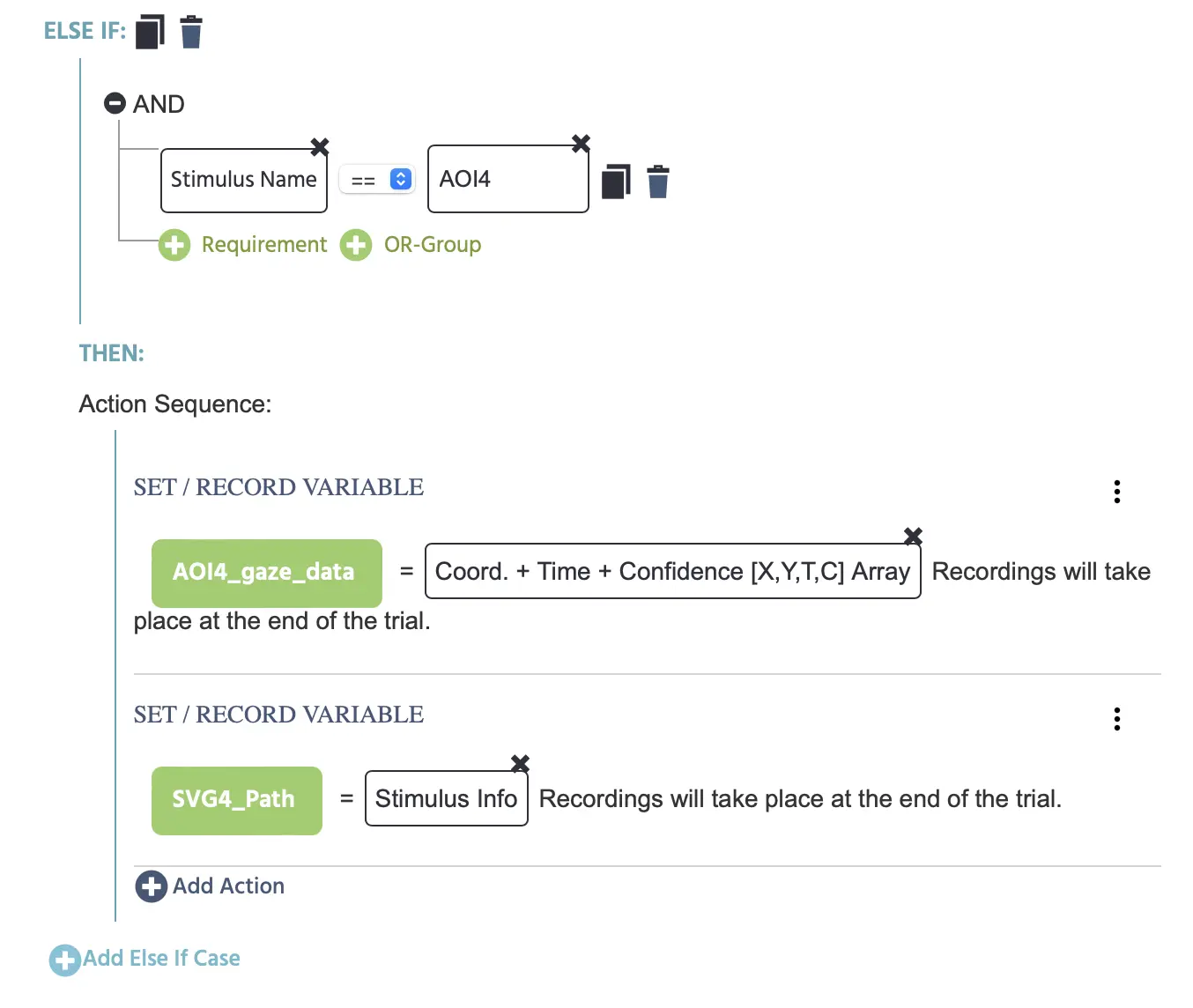
    Specifying that when the gaze is on AOI4 then the gaze array coordinates and the SVG path are recorded.

    Event 3: Finish Experiment / Save Data

    Lastly, for the data to be recorded and stored, we need to choose the Jump Action to Accept / End Session action once the Finish button is clicked on (which is the trigger), as shown below.

    Trigger

    The trigger is specified to occur when the ‘Finish Button’ is used:
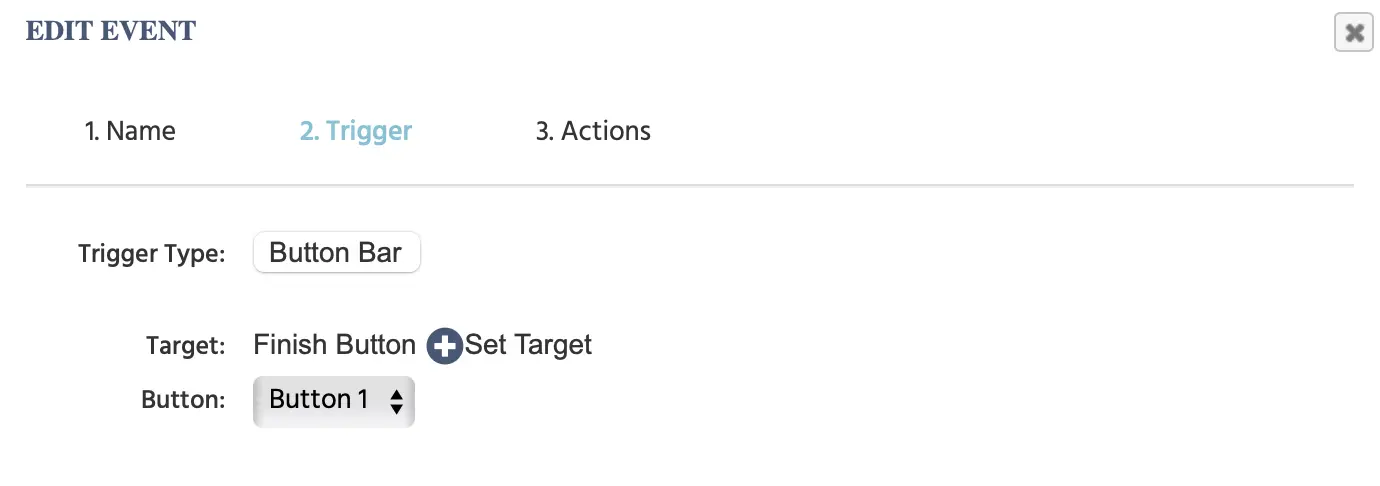
    Selecting a button click as the trigger.

    Action

    The action that will occur is that the session will be accepted which, as a result, means that the data will be recorded.
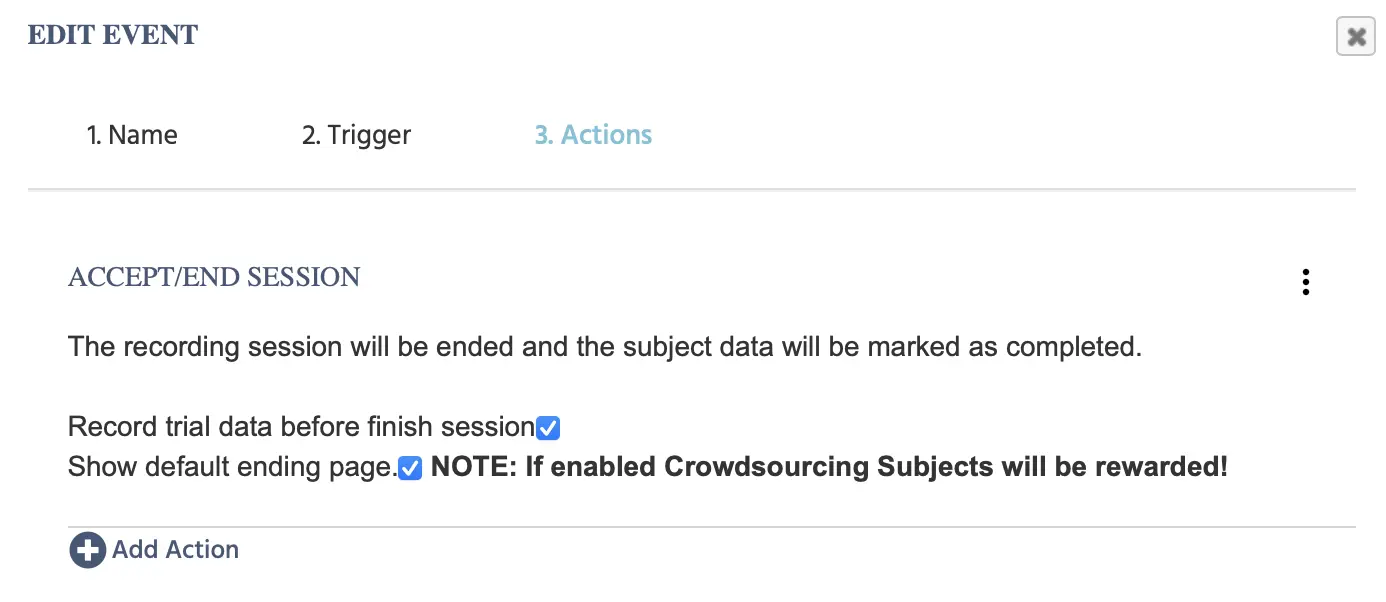
    Selecting the accept/end session as the action

    Let’s take a look at how the data recorded will look like in the next section.

    Data Recorded

    The data recorded includes all of the custom variables plus experiment-specific values like the task number, the session number, etc.

    In the example below, the Dataview & Export tab shows what the data looks like when it is separated by time series files. Each time series variable (ie. the variables that record all changes) is shown with its own CSV file on the left-panel below. This can be accomplished by specifying the relevant setting utilizing the Configure Export settings.

    When the All Gaze Data.csv is selected, numerous variables are recorded including those shown below. The ‘value’ column captures the [X,Y,T,C] array where the values are separated by commas:
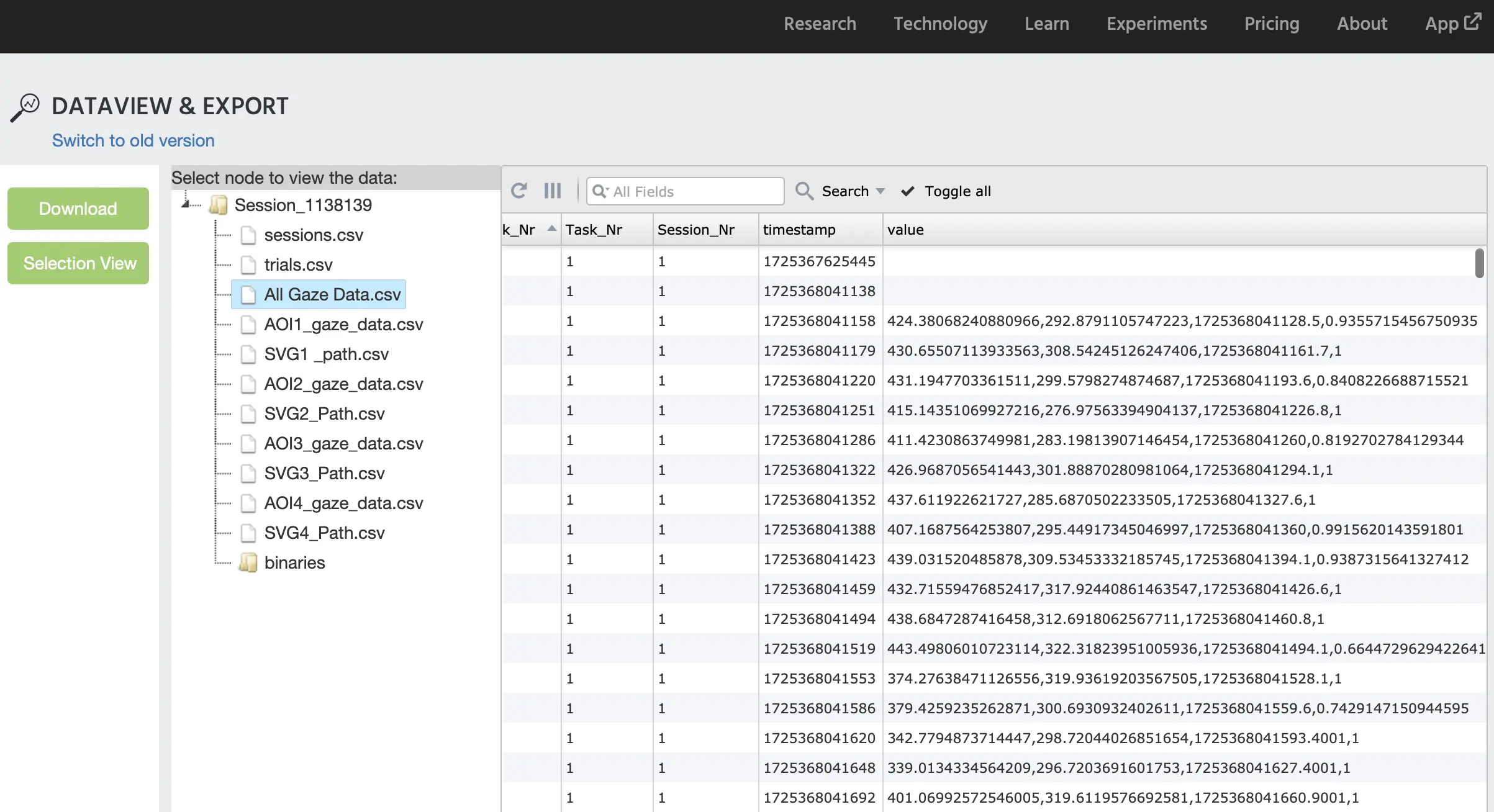
    Preview of all the gaze eye tracking data

    The image below shows a preview of the arrays that were recorded specifically when the gaze was on AOI1, as shown by the ‘value’ column:
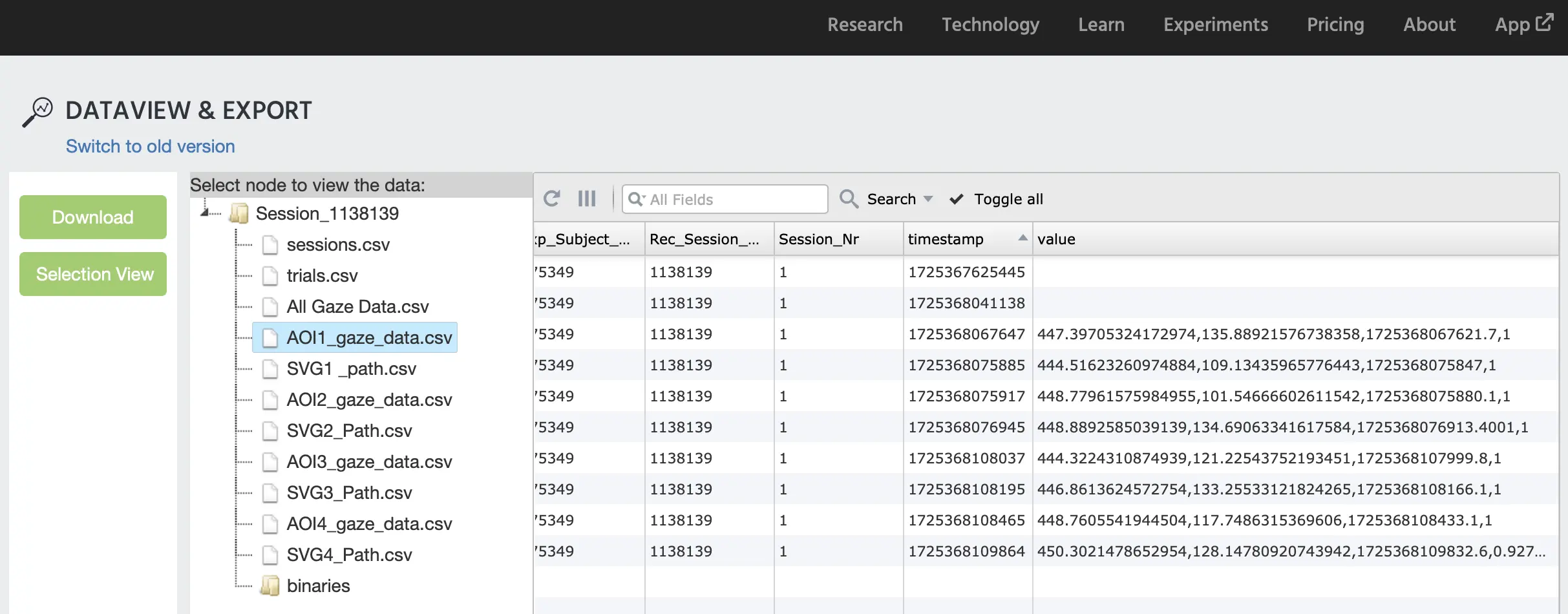
    Preview of the gaze eye tracking data that was recorded for AOI1

    The image below shows a preview of the SVG paths that were recorded specifically when the gaze was on AOI1, as shown by the ‘value’ column:
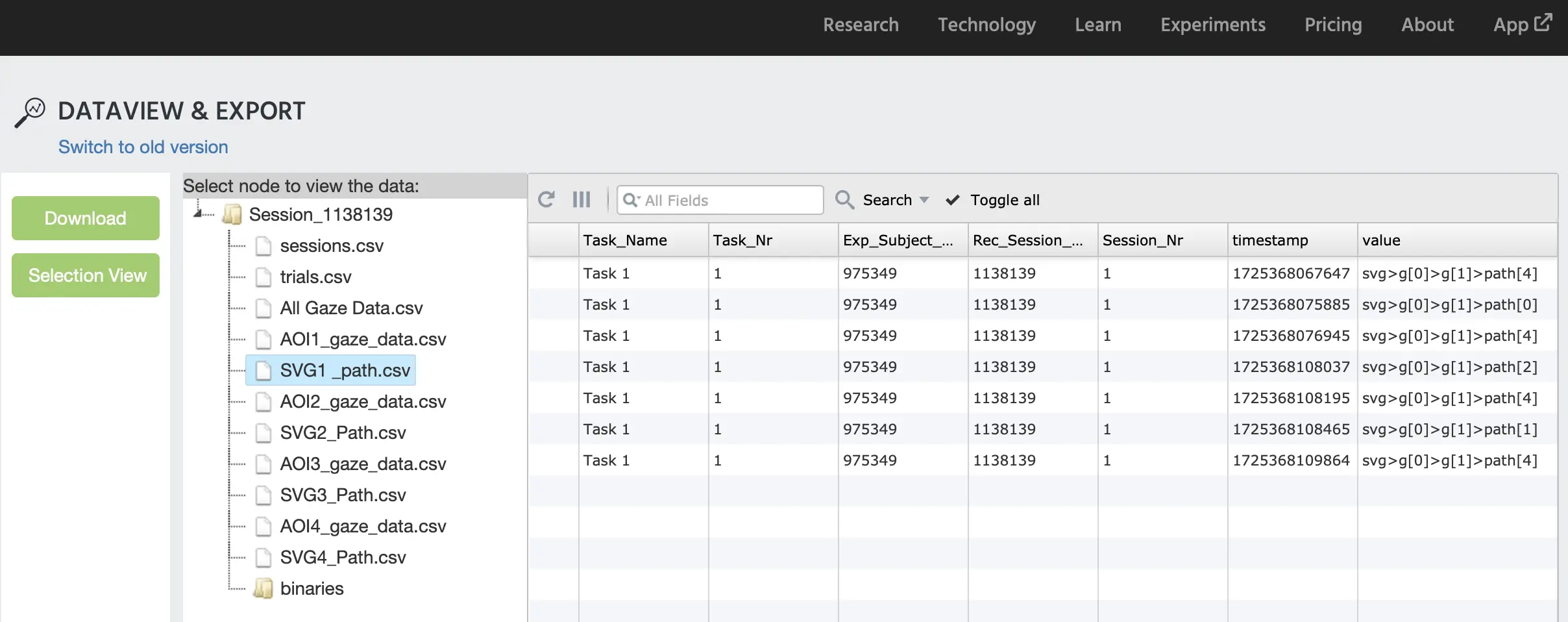
    Preview of the gaze eye tracking data that was recorded for the SVG path

    Conclusion

    This demo aims to show how to record gaze data and utilize SVG objects to record gaze specifically in the context of when gaze occurs on an Area of Interest (AOI).

    If you have any questions, please reach out to us and let us know about the details of your experiment, especially if you need to conduct a feasibility check!

    Prev
    ChatGPT Study
    Next
    Multi-User Demo: Show Subjects' Cursors