Text Segmentation
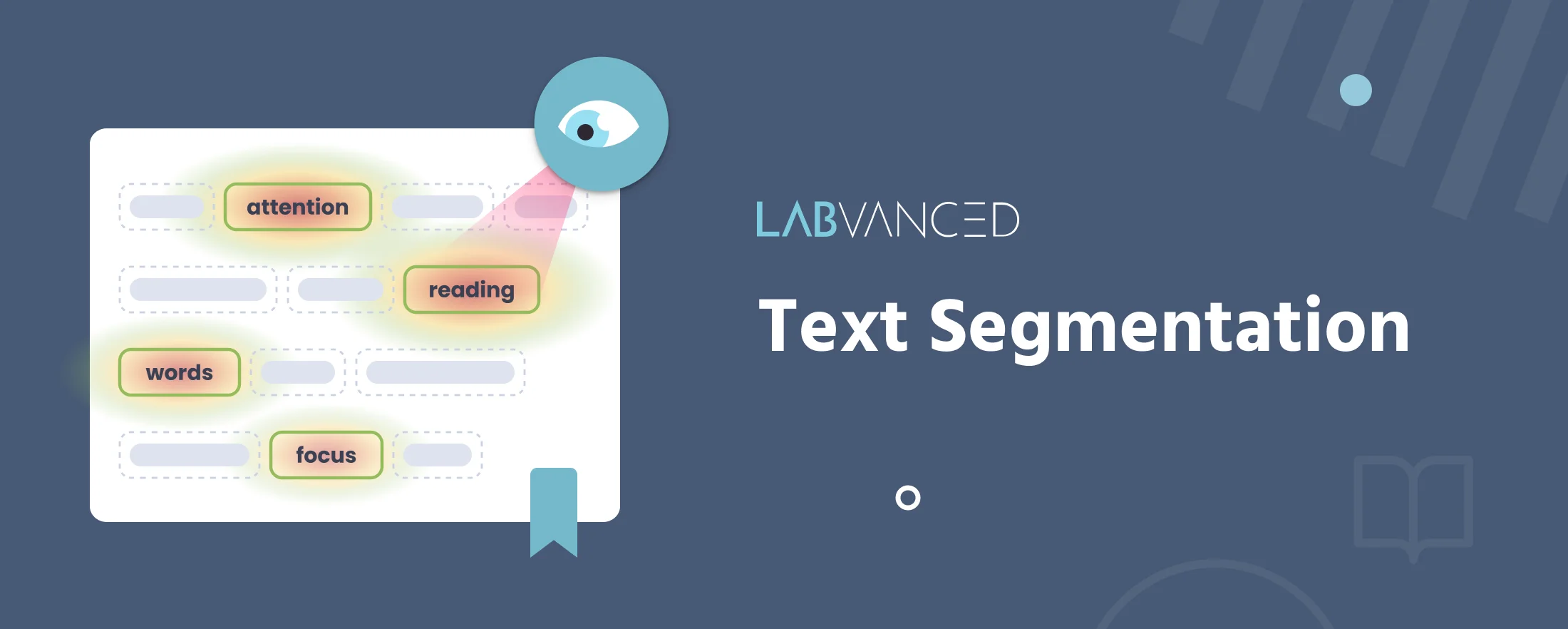
Text Segmentation in Labvanced allows researchers to build a word-level area of interest for every word in a sentence automatically in just a few minutes. There is no manual AOI placement: link a spreadsheet of stimuli and Labvanced measures every word's position, then, with webcam eye tracking enabled, records five gaze metrics per word, per trial.
Table of Contents
How Text Segmentation Works
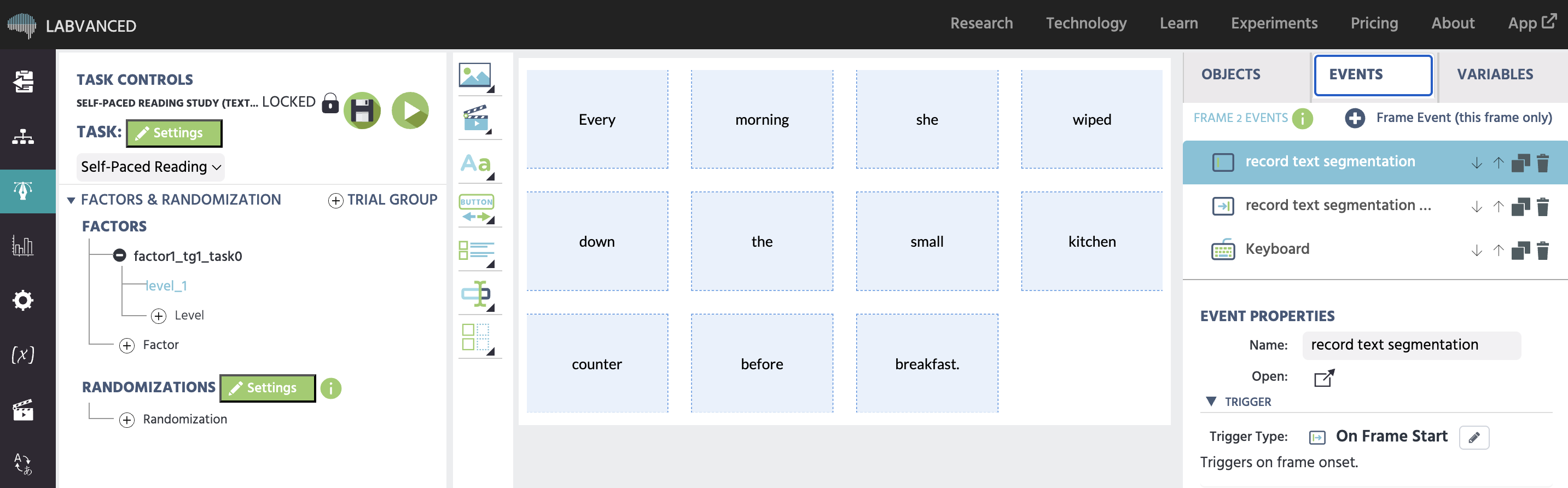
Reading research built around per-word or per-region gaze data has historically meant hand-placing an AOI for every word or phrase in every stimulus, a process that does not scale much past a handful of sentences. Text Segmentation in Labvanced removes that step: upload a spreadsheet of sentences, and every word in every row gets its own AOI without a researcher placing a single box.
| Property | Specification |
|---|---|
| Text Source | CSV upload, existing data frame, or array variable (one sentence per trial) |
| AOI Unit | One box per word, measured automatically in Labvanced frame units |
| Layout Modes | Flow (wraps at element width) or Grid (equal-width columns, gapless AOI coverage) |
| Recorded Tables | AOI geometry (word, position, size) and, with eye tracking on, per-word gaze metrics |
| Per-Word Gaze Metrics | Dwell time, total fixations, total fixation duration, time to first fixation, mean fixation duration |
| Compatible With | Longitudinal designs, mouse tracking and more |
Each word's AOI is measured directly from the rendered element, not estimated from font metrics, so the recorded geometry matches what was actually on screen when the trial displayed it. See the AOI geometry table below for what this looks like recorded.
The per-word gaze metrics run on Labvanced's peer-reviewed webcam eye tracking pipeline (1.3 visual degrees of accuracy, validated against an EyeLink 1000; Kaduk et al., 2024, Behavior Research Methods), the same gaze engine behind every other eye tracking capability on the platform. See the per-word metrics table below for what this looks like recorded.
Automatic AOIs Instead of Manual Placement
The spreadsheet format matches how stimuli are usually built for this kind of study already, one row per trial, one word per column, so an existing stimulus set can often be linked directly.

Within just a few minutes, you can go from a CSV to a fully functional prototype study in Labvanced, with AOIs mapped and webcam eye tracking enabled.
Data Collected and Preview
Two data frame tables are available per trial, row-aligned so the same word occupies the same row in both:
| AOI Geometry Table | Per-Word Metrics Table |
|---|---|
word_index, word, line_index, x, y, width, height | word_index, word, line_index, dwell_time, total_fixations, total_fixation_duration, time_to_first_fixation, mean_fixation_duration |
A word that was never looked at keeps its row with zeros across every metric column, rather than an empty cell, so no analysis script has to special-case missing data.
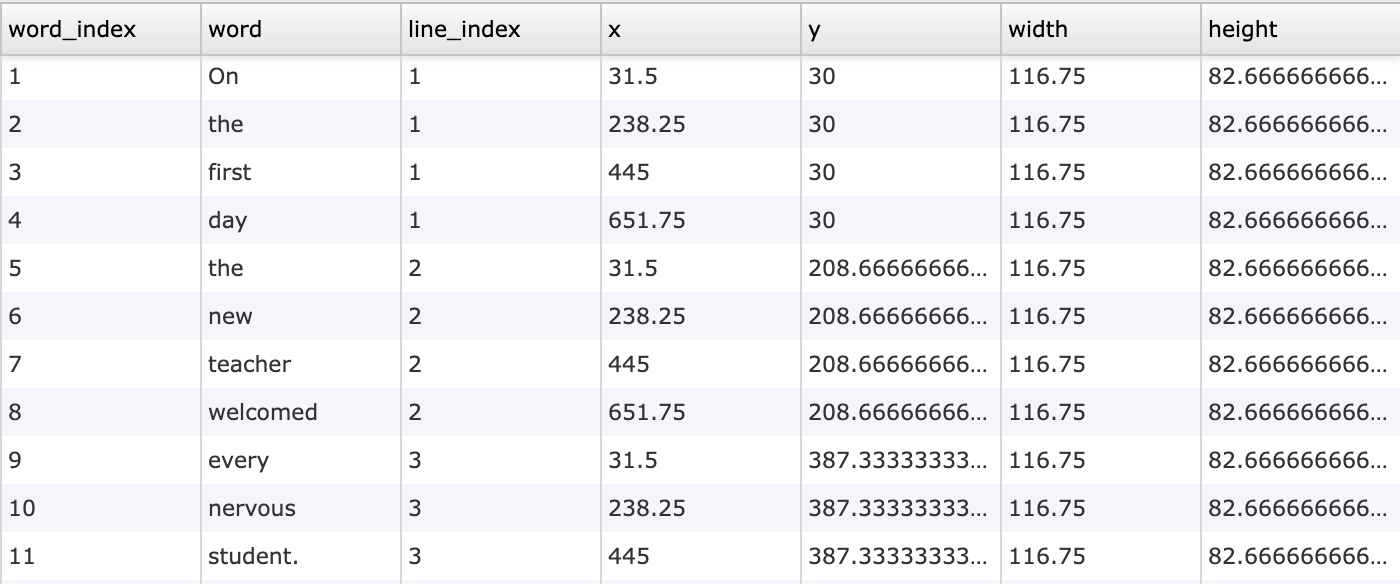
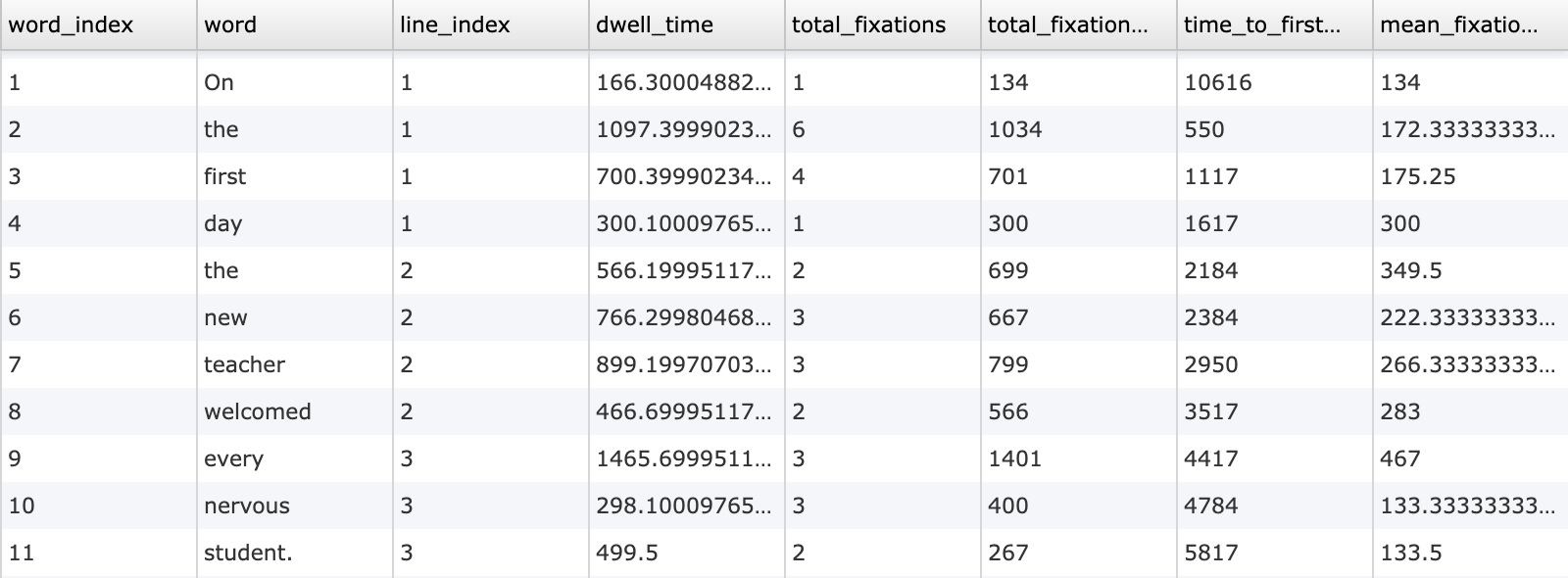
Both tables are written by dedicated event actions: Record Text Segment AOIs writes the geometry at the start of a frame and keeps it in step with what is rendered, and Record Text Segment Eyetracking Metrics writes the gaze metrics at frame end, once every word's fixation data for that trial is final.
Interactive Demos
The full task setup, recorded variables, and research applications of this study are described on the Self-Paced Reading Task page.
Documentation

Text Segmentation Object
Full object reference: properties, setup wizard, and the two recording actions.

Building a Reading Study
Step-by-step walkthrough of a real word-frequency reading study built with Text Segmentation.