
labvanced logoLabVanced
  • Research
    • Publications
    • Researcher Interviews
    • Use Cases
      • Developmental Psychology
      • Linguistics
      • Clinical & Digital Health
      • Educational Psychology
      • Cognitive & Neuro
      • Social & Personality
      • Arts Research
      • Sports & Movement
      • Marketing & Consumer Behavior
      • Economics
      • HCI / UX
      • Commercial / Industry Use
    • Labvanced Blog
  • Technology
    • Feature Overview
    • Desktop App
    • Phone App
    • Precise Timing
    • Experimental Control
    • Eye Tracking
    • Multi User Studies
    • More ...
      • Questionnaires
      • Artificial Intelligence (AI) Integration
      • Mouse Tracking
      • Data Privacy & Security
      • Text Transcription
  • Learn
    • Guide
    • Videos
    • Walkthroughs
    • FAQ
    • Release Notes
    • Documents
    • Classroom
  • Experiments
    • Cognitive Tests
    • Sample Studies
    • Public Experiment Library
  • Pricing
    • Pricing Overview
    • License Configurator
    • Single License
    • Research Group
    • Departments & Consortia
  • About
    • About Us
    • Contact
    • Downloads
    • Careers
    • Impressum
    • Disclaimer
    • Privacy & Security
    • Terms & Conditions
  • Appgo to app icon
  • Logingo to app icon
Research
Publications
Tasks
Researcher Interviews
Use Cases
Labvanced Blog
  • 中國人
  • Deutsch
  • Français
  • Español
  • English
  • 日本語
Publications
Tasks
Researcher Interviews
Use Cases
Labvanced Blog
  • 中國人
  • Deutsch
  • Français
  • Español
  • English
  • 日本語
  • Publications
  • Tasks
  • Researcher Interviews
    • Comparing Online Webcam- and Laboratory-Based Eye-Tracking for the Assessment of Infant Audio-Visual Synchrony Perception
    • Finding Goldilocks Influencers- How Follower Count Drives Social Media Engagement
    • The semantic interference in 9- to 36-month old infants: An at-home eye-tracking study on infants' lexical abilities
    • Song Is More Memorable Than Speech Prosody - Discrete Pitches Aid Auditory Working Memory
    • Orthographic Relatedness and Transposed-word Effects in the Grammatical Decision Task
    • Emotion Modulation through Music after Sadness Induction
    • Children Learning Non-Adjacent Dependencies
    • Personality Hear in Noise
    • Are All Eyes the Same?
    • Verbal Priming in Infants
  • Use Cases
    • Research Areas

      • Developmental Psychology
      • Linguistics
      • Clinical & Digital Health
      • Educational Psychology
      • Cognitive & Neuro
      • Social & Personality Psychology
      • Arts, Music & Digital Media
      • Sports & Movement Psychology
      • Marketing & Consumer Behavior
      • Economics
      • HCI / UX
      • Commercial / Industry Use
    • Researchers

      • Students
      • Researchers
      • Groups
  • Blog
    • Generative AI in Educational Psychology Research
    • Best Practices for Webcam Eye Tracking Research with Infants and Toddlers
    • Types of Stimuli in Delay Discounting Tasks
    • Delay Discounting Task
    • Mindfulness-based Self-Efficacy Scale - Revised (MSES-R)
    • Team Dynamics and Research
    • Stroop Task | History, Task Description, Data and Psychology
    • BKB Sentence Test | Procedure & Research
    • Dyadic Effect in Psychology | Overview & Research
    • Navon Task: Task Setup, Research & More
    • Peer-reviewed Webcam Eye Tracking
    • Corsi Block-Tapping Test: From cubes to online design
    • Dot-Probe Task | Full Guide
    • Types of Memory: Concepts to Research
    • Ultimatum Game
    • The Visual Search Task
    • Attention Tasks in Psychology Research
    • Generalized Anxiety Disorder Scale-7 (GAD-7)
    • Decision Making Tasks in Psychology
    • The Obsessive Compulsive Inventory – Revised (OCI-R)
    • Assessing Executive Function Skills | Tasks & Batteries
    • The Flourishing Scale (FS) Questionnaire
    • Labvanced and the Spirit of Open Science
    • The Psychology of the Incubation Effect
    • The Bouba-Kiki Effect and Task
    • Lexical Decision Task: Accessing the Mental Lexicon
    • Image Description Task and Game with a Chatbox
    • Smooth Data Collection Process | 6 Tips for Research
    • Music Research with Labvanced
    • 7 Classic Cognitive Tasks & Examples
    • Mental Rotation Test | A Spatial Processing Task
    • XY Coordinates in Labvanced
    • 5 Famous Social Psychology Experiments
    • The Power of Remote & Infant-friendly ET
    • The Wisconsin Card Sorting Test
    • 13 Head Tracking Use Cases for Research
    • 5 Tips for Improving Your Perception Skills
    • Introduction to the Preferential Looking Paradigm
    • Researching Cognition in Migraine & Headache Patients
    • The Landing Page - More Info Than You Think!
    • Headphone Checks - Then and Now
    • Sample Studies - Helpful Templates and Demos!
    • What Is Neuroplasticity?
    • 15 Famous Developmental Theories
    • Visual Attention and Eye Tracking
    • What Is Eye Tracking Technology?
    • Eye Tracking in Applied Linguistics Research
    • 10 Popular Linguistic Experiments
    • The Placebo Effect
    • 6 Key Concepts of Experimental Design
    • Conditioned Play Audiometry
    • Ebbinghaus Illusion
A mom with a toddler in a webcam eye tracking study

Best Practices for Webcam Eye Tracking Research with Infants and Toddlers

As interest and popularity of webcam eye tracking as a method in developmental psychology research with infants and toddlers is on the rise, there is a rapidly growing number of studies being conducted and published in this domain.

Here are a few tips and pointers for best practices to keep in mind, if you are planning on running a study with infants and toddlers as participants and webcam eye tracking as a methodology.

1. Matching Background Colors between the Study and Calibration

Avoid discrepancies in background colors between the study and the calibration. If your study has a dark background color, your calibration background should be the same. This is important because the way the light reflects off the screen during the calibration process influences the collected measurements and the processing of the neural network.

2. Use the Correct Webcam Eye Tracking Settings

When incorporating webcam eye tracking into your research with infants / toddlers, selecting the correct settings is crucial. A few things to consider when specifying the settings includes:

  • Engaging Calibration: As opposed to a standard calibration, infants and toddlers typically undergo a calibration process that is with animal icons and sounds in order to keep them engaged.
  • Loose Chin Rest: As it’s virtually impossible to keep this age group at a completely still throughout the experiment, having a loose (and not too strict) chinrest is also advisable.

3. Consider Study Length

Longer studies run the risks of dropouts, as working with infants and toddlers can sometimes be (for lack of a better word) unpredictable… due to their very nature : )

So, it’s important that your study is not too long as something may come up for them or they may become irritated.

In the image below, taken from a recent study that utilized Labvanced’ webcam eye tracking, the researchers employed a two‐alternative‐looking paradigm. The blocks included 6 familiarization and 2 test trials each and the blocks were repeated four times, resulting in 24 familiarization trials and 8 test trials.
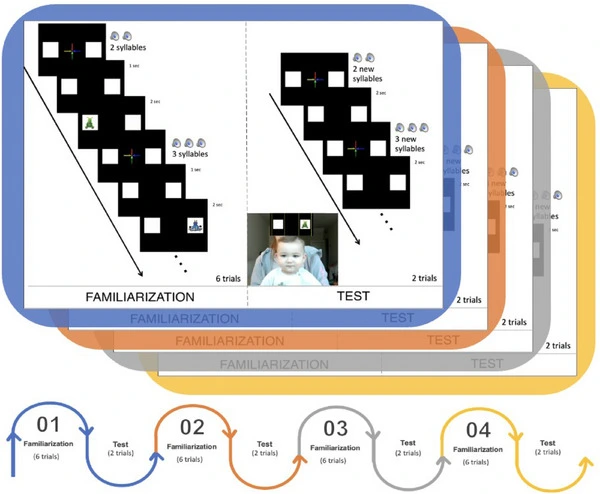
Image from a study design that followed best practices when administering a webcam eye tracking study to infants and toddlers
Two‐alternative‐looking paradigm design implemented in Labvanced with webcam eye tracking for infants and toddlers; (Reoyo‐Serrano, N., et al., 2025).

4. Participant Privacy

Webcam eye tracking, in order for it to be secure, needs to run client-side. There is a lot of technology out there that will actually record and store facial data, so be careful when considering your options.

Labvanced’s webcam eye tracking was created from the beginning to run client-side which means all calibration, neural network training and computations run locally on the participant’s device (Kaduk, T., Goeke, C., Finger, H., & König, P., 2024). By design, no sensitive data or participant-identifiable files like face data are stored.

PGP Encryption

In some cases, a video is recorded of the participant (in addition to webcam eye tracking). With such an approach, privacy becomes an important consideration once more. Ensure that you have the proper safeguards in place in order to secure and protect participants’ data and privacy. In such instances, Labvanced can offer the option of PGP encryption.

5. Avoid Third-Party Software

Since the browser and computer processing power are not of infinite capacity, it is advisable to avoid activating third-party software to run in parallel with the Labvanced experiment, especially when webcam eye tracking is involved, in remote research scenarios. Such factors can influence results since multiple powerful programs are forced to divide resources.

Such cases (eg., Grosse Wiesmann, C., et al., 2025). , especially dating back to research that was conducted before 2022, when the latest release of Labvanced’s webcam eye tracking was released and was peer-reviewed, can be seen through this lens.


Join Labavnced today and add webcam eye tracking to your next study with infants and toddlers

6. Ask Participants to Prepare in Advance

Success is in the details and includes considering the environment in which the participants are in when taking part in the study.

For example, this can include providing specific instructions to parents and caregivers to:

  • Switch off any additional programs or apps running on the computer
  • Turning cell phones to silent to avoid interruptions
  • Turn off any other machines or devices in the house (like TV)
  • Remove any immediate toys or objects from nearby surroundings which could draw the infant’s or toddler’s attention

Such instructions take an actionable role of foreseeing factors that can influence performance and subsequent data collection and are thus a great best-practice tip (Reoyo‐Serrano, N., et al., 2025).

References

Grosse Wiesmann, C., Rothmaler, K., Hasan, E., Habdank, K., Yang, C., Yeung, E., & Southgate, V. (2025). The self-reference memory bias is preceded by an other-reference bias in infancy. Nature Communications, 16(1), 6311.

Kaduk, T., Goeke, C., Finger, H., & König, P. (2024). Webcam eye tracking close to laboratory standards: Comparing a new webcam-based system and the EyeLink 1000. Behavior research methods, 56(5), 5002-5022.

Reoyo‐Serrano, N., Dimakou, A., Nascimben, C., Bastianello, T., Lucangeli, D., & Benavides‐Varela, S. (2025). Crossing the Boundary: No Catastrophic Limits on Infants’ Capacity to Represent Linguistic Sequences. Developmental Science, 28(3), e70015.

Prev
Generative AI in Educational Psychology Research
Next
Types of Stimuli in Delay Discounting Tasks