
The Lexical Decision Task: Accessing the Mental Lexicon
The Lexical Decision Task (LDT) is one of the classic and most popular linguistic experiment tasks when it comes to understanding how humans process language. The main purpose of the Lexical Decision Task is to measure both the accuracy and speed of which participants can identify presented strings as being either words or nonwords (pseudowords).
Overview
How does it work?
- Stimulus Presentation: Participants see words (strings of letters) that are either real words or made-up words (ie., non-words). For example the string “sun” is a word, but the string “xog” is not a word.
- Response: Participants must quickly decide whether the word is a real word or not.
- Results / Measurement: Whether the answer was correct or not, as well as response times.
Major Use Cases: Lexical Decision Task Purpose
- Lexical Access: How the brain accesses information from its mental lexicon (ie. their mental dictionary).
- Word Frequency: Understanding how frequent (or common) a word is will affect recognition.
- Semantic Priming: How related words influence target words. For example, presenting the word ‘chair’ before the word ‘table’ will improve the reaction for the word ‘table.’
- Clinical Assessments: The Lexical Decision Task is also popular in the field of psychology in the context of clinical assessments, understanding the language proficiency of patients and vulnerable populations.
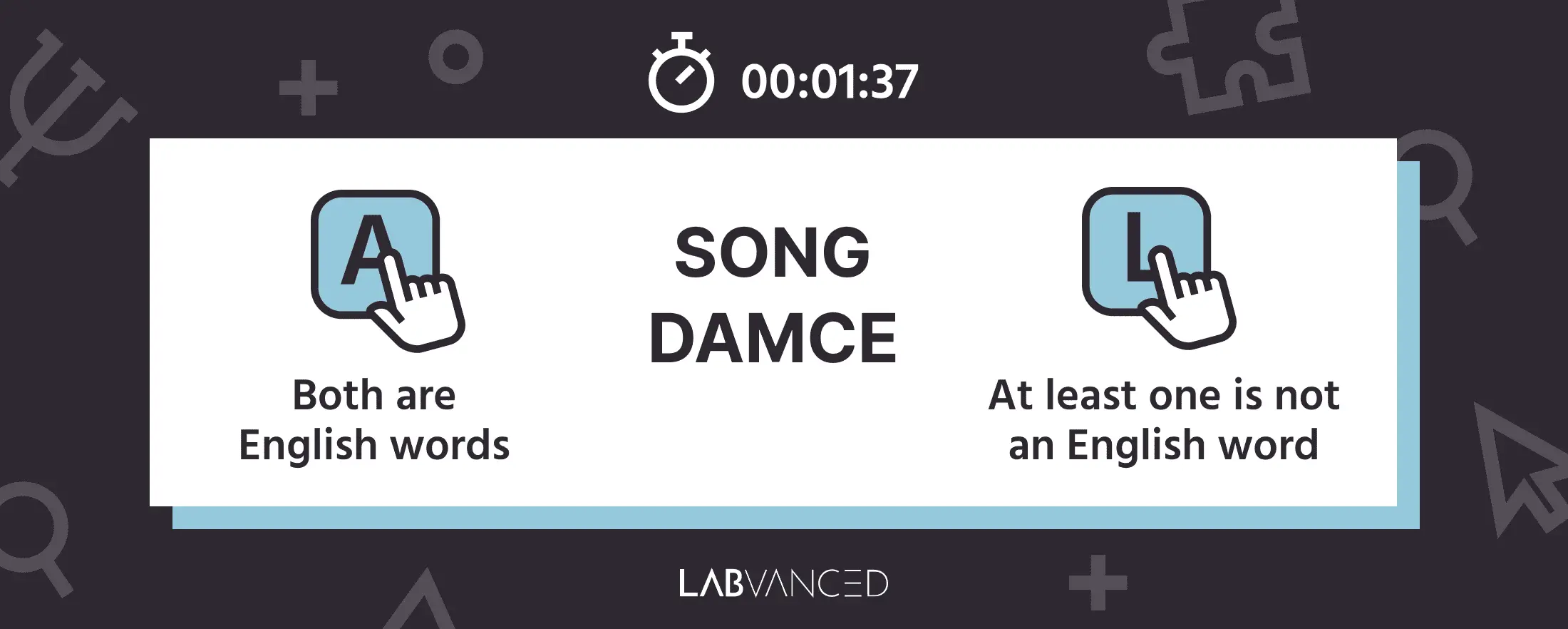
The image above is an illustration of the Dual Lexical Decision Task with reaction time and choice selection, a well known variation of the Lexical Decision Task.
Task Details
Below, we will discuss in greater detail the Lexical Decision Task, including what kind of pseudowords (fake words) are used, as well as what kind of factors are considered for the task, as well as variations of the task.
Stimuli Presentation
Participants are shown a series of strings and they must indicate whether they are actual words in the specified language or not.
- DOG (real word)
- MOP (real word)
- ZXTU (non-word, phonologically implausible)
- PLARP (non-word, but phonologically plausible)
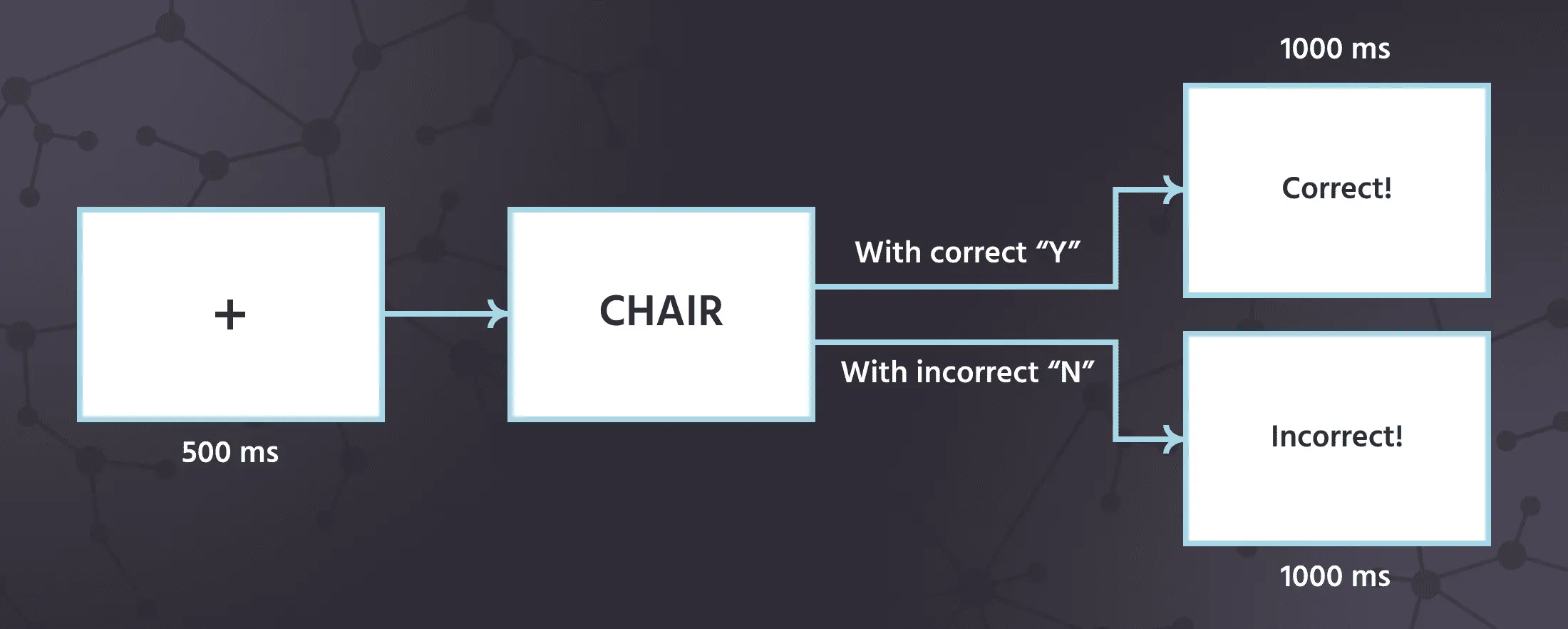
Participants respond to each string by pressing a key to submit their answer (ie. whether it’s a real word or not). Oftentimes, feedback is presented on the screen indicating whether the answer provided was corrected or incorrect, as indicated by the image of the task flow below.
Types of Stimuli / Nonwords
Researchers often vary the types of stimuli to explore different aspects of word recognition and there is some variation in the terms used in the literature, but here are a few examples:
- Real Words: Strings that are actual words in the target language for which the participant is anticipated to identify correctly.
- Plausible Non-Words: Non-words that phonologically sound like real words, such as "bort." Pseudomorphemes may fall in this category. For example, taking the word ‘CRANBERRY’ the portion ‘CRAN’ may seem like a morpheme (the smallest meaningful unit of a language), but in reality it is not a word (Gagné, C. L., Spalding, T. L., Nisbet, K. A., & Armstrong, C., 2018).
- Implausible Non-Words: Non-words that do not sound like real words, such as ‘KLTZ’, these are typically strings of consonants or symbols (Fernández-López, M., Marcet, A., & Perea, M., 2023).
- High frequency Non-Words: High frequency pseudowords refer to fake words based on actual words that appear a lot in everyday language. For example ‘PEOGLE’ is a pseudoword based on ‘PEOPLE.’
- Low frequency Non-words: Low frequency pseudowords refer to fake words based on actual words that are not so frequent in everyday language. For example ‘DIURMAL’ is a pseudoword based on ‘DIURNAL’ (Perea, M., Rosa, E., & Gómez, C., 2005).

Factors Impacting Word Recognition
Below are examples of factors that are known to impact word recognition in the Lexical Decision Task. They are important to consider when setting up your Lexical Decision Task. experiment
| Factor | Description |
|---|---|
| Frequency | Words that are more frequent (or common) in daily use, typically result in lower reaction times as they are easily recognizable (Hudson, P. T., & Bergman, M. W., 1985). |
| Word Length | Longer (lengthier) words typically have higher reaction times (Hudson, P. T., & Bergman, M. W., 1985). |
| Age of Acquisition | The earlier in life that a word is acquired, the faster it is retrieved from semantic memory, as opposed to words that are acquired later in life (Juhasz, B. J., Yap, M. J., Raoul, A., & Kaye, M., 2019). |
| Neighborhood Density | Orthographic or phonological neighborhood density (calculated as the number or words which differ by one grapheme or phoneme from the target word). In other words, orthographic neighborhood density refers to how many words are related to a target word by changing one letter. Phonological neighborhood density refers to how many words sound similar to the target word (Meade, G., Grainger, J., & Declerck, M., 2021; Karimi, H., & Diaz, M., 2020). |
| Concreteness | A word’s concreteness is related to sensorimotor-based experiences. Concreteness is usually on one side of the continuum and ‘abstractness’ is on the other (Khanna, M. M., & Cortese, M. J., 2021). |
| Imageability | Also captures a word’s perceptual or sensory features and refers to how easy or difficult it is to imagine a word using the mind’s eye. Words that are higher in perceptual strength also tend to be more imageable (Khanna, M. M., & Cortese, M. J., 2021). |
It is important to note that there is some fuzziness in the boundaries of these factors. For example, words that are acquired earlier in life also tend to be more concrete. Also, ‘concreteness’ and ‘imageability’ overlap in terms of how they are defined and there is quite a body of research centered around these two topics and their relationship (Khanna, M. M., & Cortese, M. J., 2021).
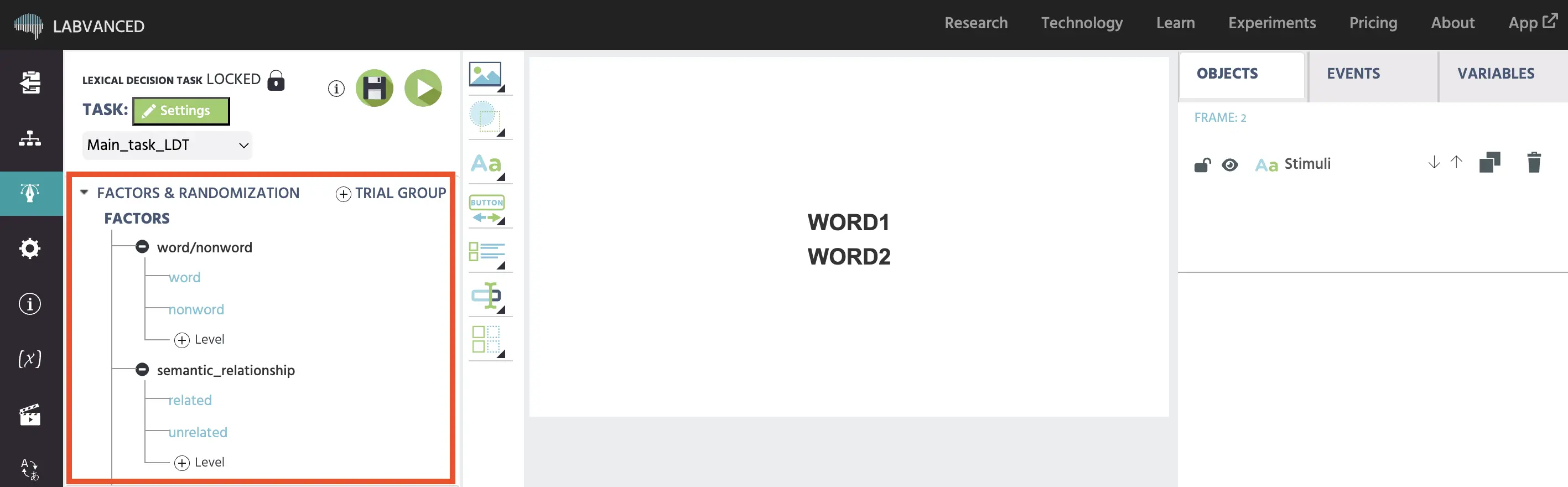
The image below shows how factors can be handled in Labvanced utilizing the Trial System:
Variations of the Lexical Decision Task
The Lexical Decision Task, being the popular task that it is, comes with a lot of variations. Here is a list of a few interesting variations:
- Double Lexical Decision Task or Dual Lexical Decision Task: A pair of strings is presented and the participant must decide whether both strings are real words or not, as shown in the video below (Meyer, D.E. & Schvaneveldt, R.W., 1971).
- Auditory Lexical Decision Task: As opposed to seeing the stimuli in a written / visual format, this variation of the task presents stimuli in an auditory format (Barrios, S., & Hayes-Harb, R., 2021). In a recent study assessing the influence of face masks during the COVID-19 epidemic, researchers implemented the Auditory Lexical Decision Task in Labvanced and found that cloth masks had a more negative effect than Kn95 masks on word recognition tasks with only audio presentation (Cox, B. G., Tuft, S. E., Morich, J. R., & McLennan, C. T., 2024).
- Priming: There are many ways to approach this method, but the basic principle behind priming is that it refers to how a very quick presentation of a string of letters can influence the subsequent performance on the Lexical Decision Task (Soares, A. P., Velho, M., & Oliveira, H. M., 2020).
- Lexical Decision Task in American Sign Language (ASL): A relatively new approach to the traditional Lexical Decision Task, this variation uses picturable signs (Caselli, N. K., Emmorey, K., & Cohen-Goldberg, A. M., 2021).
- Flankers: Some studies have also utilized flankers to indicate the target word, suggesting that the distribution of spatial attention in a lexical decision task with flankers mimics natural reading behavior (Meade, G., Grainger, J., & Declerck, M., 2021).
- Bilingual Lexical Decision: This variation mixes the stimulus list to include target words in a second language (Vanlangendonck, F., Peeters, D., Rueschemeyer, S. A., & Dijkstra, T., 2020).
The video below captures the Dual Lexical Decision Task experiment in Labvanced. You can import it to your account and use it for your next study. You can also edit it (of course) to have different stimuli or instead of two strings, you can just have one.
Data Collection
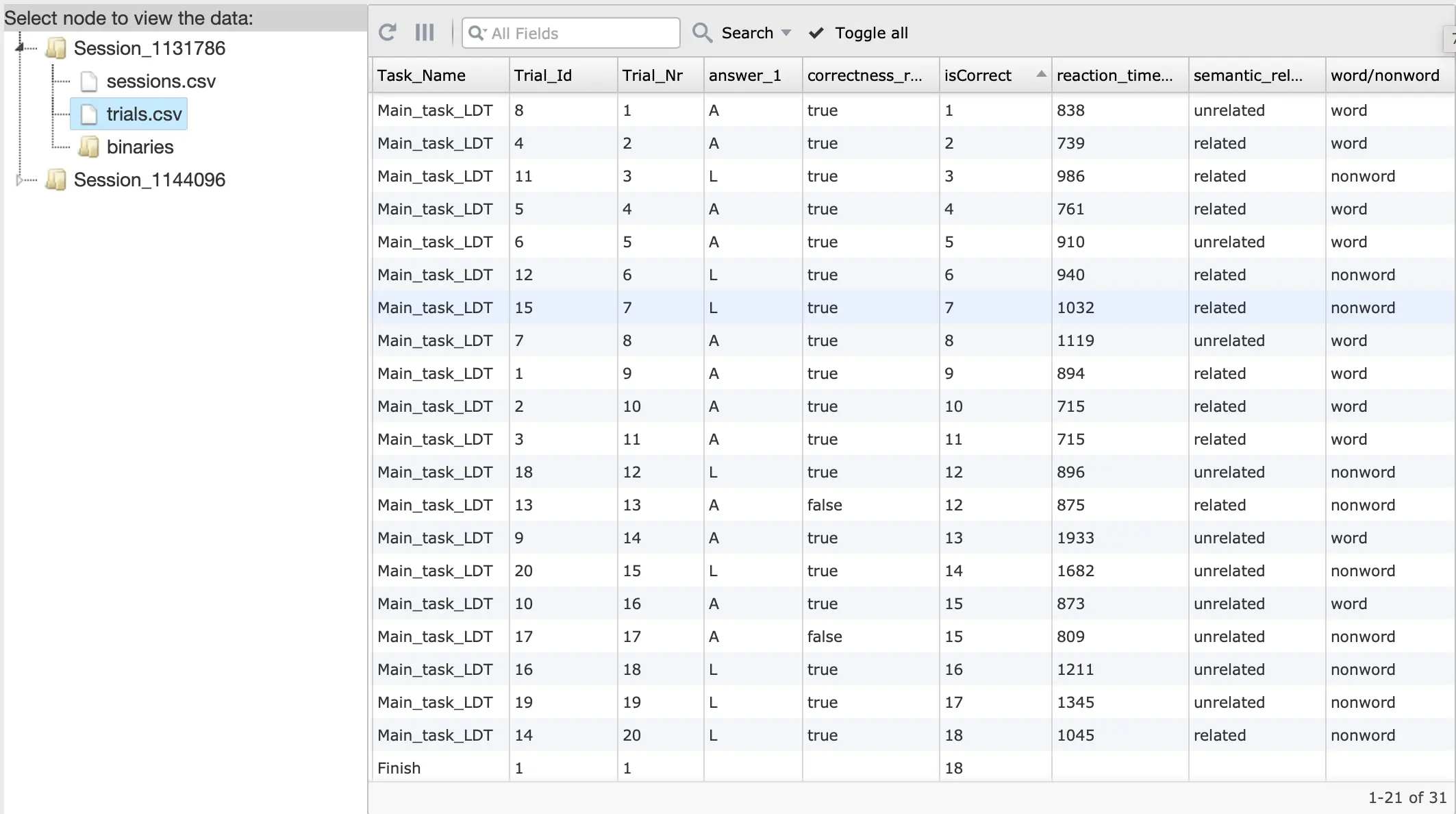
As mentioned previously, the measurements that are most commonly collected from the Lexical Decision Task are correctness of response and reaction times.
In the image below, we show how Lexical Decision Task results look like collected from an online experiment in Labvanced.
Advanced Methods
Advanced methods can be combined with the above approaches of data collection, including:
- fMRI: Studies combining the Lexical Decision Task with functional magnetic resonance imaging (fMRI) aim to find neural correlates and brain activation patterns when processing words, including specific aspects associated with the task like semantic and morphologic processing (Kim, J., Kim, S., & Nam, K., 2024).
- EEG: Research utilizing the Lexical Decision Task may also utilize an electroencephalogram (EEG) as an additional stream of data to measure electrical activity of cognitive processes throughout the task with high temporal precision (Silva, P. B., et al. 2022).
- Eye Tracking: By adding eye tracking to a Lexical Decision Task, researchers aim to gain insights on visual processing and eye movement patterns (Premeti, A., Isel, F., & Bucci, M. P., 2024).
Simply enable the webcam eye tracking option in Labvanced and start collecting gaze data in your Lexical Decision Task. Webcam-based eye tracking is an innovative and quickly growing method for measuring attention. Labvanced’s technology is peer-reviewed and complies with GDPR by not collecting the participant’s facial data ✅ ✅
Clinical Applications of the Lexical Decision Task
The Lexical Decision Task is utilized in a lot of clinical application settings, including the following areas:
Language Development Disorders
- Dyslexia: As the Lexical Decision Task is used to study word recognition it is relevant in this patient base as dyslexics have impaired word recognition. The Lexical Decision Task can measure sensitivity to orthographic and phonological deficits, used in conjunction with advanced methods to identify neurophysiological correlates and isolate lexical access by understanding the process of lexical retrieval (Silva, P. B., et al. 2022).
- Specific Language Impairment: Specific Language Impairment (SLI) is a neurogenetic condition wherein language production and comprehension are affected. The Lexical Decision Task is used as a means of providing a direct measure on lexical-phonological processing (Evans, J. L., Maguire, M. J., & Sizemore, M. L., 2022).
Cognitive Disorders
- Alzheimer’s Disease: Elderly people with Alzheimer’s disease experience changes in their language and ways of communicating. The Lexical Decision Task offers a window to their lexicon and a means of assessing specific components such as lexical-semantic processing which reveals their ability to understand the meaning of words (Miceli, A., et al., 2023).
- TBI: Traumatic Brain Injury (TBI) impacts cognitive processing. Researchers that utilize the Lexical Decision Task to study TBI, cognition and language aim to understand how these processes and mechanisms are intertwining (Russell, K. C., et al., 2012).
Neurodevelopmental Disorders
- ASD: Autism spectrum disorder (ASD) is a neurodevelopmental disorder that is characterized by main distinct behaviors, including impairments in communication. The Lexical Decision Task is administered to this population in order to capture the profile of language processing (Wilkinson, M., et al., 2022).
- ADHD: Attention Deficit Hyperactivity Disorder (ADHD) is associated with language and speech problems in several ways. The Lexical Decision Task is used in this group as a means of understanding the cognitive profile and language processing (Metzner, I. P., et al., 2021).
Psychiatric Disorders
- Schizophrenia: The linguistic profile in schizophrenic patients is quite distinct. The Lexical Decision Task is thus a useful task for researchers to assess semantic memory and language comprehension in these patients (Li, F. & Xu, X., 2022).
- Bipolar: In this paper, the researchers performed the first study where the Lexical Decision Task was administered in Bipolar patients. Results showed that while the bipolar and control groups did not have statistically significant differences in linguistic processing network activities, there was a higher activation in the motor response network in the bipolar group (Kusi, M. et al. 2022)
Other
- The Lexical Decision Task can be used for a variety of experiments . In this example, the Lexical Decision Task was administered in Labvanced to patients who have lost their sense of smell in order to assess whether their understanding of olfactory-related words remained intact (Speed, L. J., Iravani, B., Lundström, J. N., & Majid, A., 2022).

Conclusion
Overall, the Lexical Decision Task is a powerful experiment that can be performed online or in the lab to gain a greater understanding of language proficiency. There are several variations and examples of the Lexical Decision Task, including the auditory Lexical Decision Task. Overall, the purpose of this task is to gain insights on language across different populations.

Learn more about our webcam eye-tracking feature, its accuracy and how it can be implemented into your study in Labvanced.

Integrate AI right into your experiment. Utilize text-to-text, image and audio generation to study human-AI interaction and perception.
References
- Barrios, S., & Hayes-Harb, R. (2021). L2 processing of words containing English/æ/-/ɛ/and/l/-/ɹ/contrasts, and the uses and limits of the auditory lexical decision task for understanding the locus of difficulty. Frontiers in Communication, 6, 689470.
- Caselli, N. K., Emmorey, K., & Cohen-Goldberg, A. M. (2021). The signed mental lexicon: Effects of phonological neighborhood density, iconicity, and childhood language experience. Journal of Memory and Language, 121, 104282.
- Cox, B. G., Tuft, S. E., Morich, J. R., & McLennan, C. T. (2024). Examining listeners’ perception of spoken words with different face masks. Quarterly Journal of Experimental Psychology, 77(3), 478-491.
- Evans, J. L., Maguire, M. J., & Sizemore, M. L. (2022). Neural patterns elicited by lexical processing in adolescents with specific language impairment: support for the procedural deficit hypothesis?. Journal of Neurodevelopmental Disorders, 14(1), 20.
- Fernández-López, M., Marcet, A., & Perea, M. (2023). Investigating the Role of Response Codes in Masked Priming Lexical Decision Tasks: The Case of Repeated Presentations. Brain Sciences, 13(3), 452.
- Gagné, C. L., Spalding, T. L., Nisbet, K. A., & Armstrong, C. (2018). Pseudo-morphemic structure inhibits, but morphemic structure facilitates, processing of a repeated free morpheme. Language, Cognition and Neuroscience, 33(10), 1252-1274.
- Hudson, P. T., & Bergman, M. W. (1985). Lexical knowledge in word recognition: Word length and word frequency in naming and lexical decision tasks. Journal of memory and language, 24(1), 46-58.
- Juhasz, B. J., Yap, M. J., Raoul, A., & Kaye, M. (2019). A further examination of word frequency and age-of-acquisition effects in English lexical decision task performance: The role of frequency trajectory. Journal of Experimental Psychology: Learning, Memory, and Cognition, 45(1), 82.
- Karimi, H., & Diaz, M. (2020). When phonological neighborhood density both facilitates and impedes: Age of acquisition and name agreement interact with phonological neighborhood during word production. Memory & Cognition, 48, 1061-1072.
- Khanna, M. M., & Cortese, M. J. (2021). How well imageability, concreteness, perceptual strength, and action strength predict recognition memory, lexical decision, and reading aloud performance. Memory, 29(5), 622-636.
- Kim, J., Kim, S., & Nam, K. (2024). Neural Dynamics of Processing Inflectional Morphology: An fMRI Study on Korean Inflected Verbs. Brain Sciences, 14(8), 752.
- Kusi, M., Wong, S. T. S., Percival, C. M., Zurrin, R., Roes, M. M., Woodward, T. S., & Goghari, V. M. (2022). Altered activity in functional brain networks involved in lexical decision making in bipolar disorder: An fMRI case-control study. Journal of Affective Disorders, 317, 59-71.
- Li, F., & Xu, X. (2022). Impairment of semantic composition in schizophrenia: An ERP study with lexical stimuli. Neuropsychologia, 171, 108241.
- Meade, G., Grainger, J., & Declerck, M. (2021). Friend or foe? Flankers reverse the direction of orthographic neighbourhood effects. Language, cognition and neuroscience, 36(5), 535-542.
- Metzner, I. P., Capellini, S. A., D’Angelo, I., Del Bianco, N., & Giaconi, C. (2021). Visual-Motor Perceptual and Reading Processes of Schoolchildren With Attention Deficit Hyperactivity Disorder. Psychology Research, 11, 236-247.
- Meyer, D.E. & Schvaneveldt, R.W. (1971). Facilitation in recognizing pairs of words: Evidence of a dependence between retrieval operations. Journal of Experimental Psychology, 90, 227-234.
- Miceli, A., Wauthia, E., Arachchige, K. K., Lefebvre, L., Ris, L., & Loureiro, I. S. (2023). Perceptual strength influences lexical decision in Alzheimer's disease. Journal of Neurolinguistics, 68, 101144.
- Perea, M., Rosa, E., & Gómez, C. (2005). The frequency effect for pseudowords in the lexical decision task. Perception & Psychophysics, 67(2), 301-314.
- Premeti, A., Isel, F., & Bucci, M. P. (2024). Visuo-Attentional and Phonological Deficits Explored in French Students with Dyslexia: Eye Movements Recorded during a Phonological Lexical Decision Task. Neurology International, 16(2), 312-326.
- Russell, K. C., Arenth, P. M., Scanlon, J. M., Kessler, L., & Ricker, J. H. (2012). Hemispheric and executive influences on low-level language processing after traumatic brain injury. Brain Injury, 26(7-8), 984-995.
- Silva, P. B., Oliveira, D. G., Cardoso, A. D., Laurence, P. G., Boggio, P. S., & Macedo, E. C. (2022). Event-related potential and lexical decision task in dyslexic adults: Lexical and lateralization effects. Frontiers in Psychology, 13, 852219.
- Soares, A. P., Velho, M., & Oliveira, H. M. (2020). The role of letter features on the consonant-bias effect: Evidence from masked priming. Acta Psychologica, 210, 103171.
- Speed, L. J., Iravani, B., Lundström, J. N., & Majid, A. (2022). Losing the sense of smell does not disrupt processing of odor words. Brain and language, 235, 105200.
- Vanlangendonck, F., Peeters, D., Rueschemeyer, S. A., & Dijkstra, T. (2020). Mixing the stimulus list in bilingual lexical decision turns cognate facilitation effects into mirrored inhibition effects. Bilingualism: Language and Cognition, 23(4), 836-844.
- Wilkinson, M., Keehn, R. J., Linke, A. C., You, Y., Gao, Y., Alemu, K., ... & Müller, R. A. (2022). fMRI BOLD and MEG theta power reflect complementary aspects of activity during lexicosemantic decision in adolescents with ASD. Neuroimage: Reports, 2(4), 100134.