
Team Dynamics Research
In today’s collaborative environments, whether in organizations, classrooms, or any setting involving more than one person working together to meet a goal, the performance of a team often outweighs individual contributions. But what makes some teams thrive while others don't? The answer lies in understanding team dynamics. This blog explores team dynamics, the key components of it, the factors that shape it, and how virtual dynamics work.
What are team dynamics?
Team dynamics refers to the evolving relationships and interactions among team members that influence the overall performance and behaviour of the team. Team dynamics are not fixed or static; instead, they shift and adapt over time depending on the context, goals, and composition of the team. A range of factors shape team dynamics, among those most commonly discussed are communication, roles, decision-making patterns, and trust. Understanding these elements is crucial not only for leaders and team members to build effective teams, but also for researchers aiming to study and improve collaborative performance (Magana et al., 2023).
Key Components
While team dynamics can be influenced by a variety of factors, certain components are consistently recognized across research and applied frameworks as central to how teams function. The following are among the most emphasized and are especially critical in shaping how a team operates to achieve its goals:
- Communication: Effective communication ensures that information, ideas, and feedback flow freely and clearly among team members. It encompasses not just the words spoken or written, but also active listening, non-verbal cues, and the channels used for interaction. Open and honest communication fosters understanding, reduces misunderstandings, and builds stronger relationships within the team. Conversely, poor communication can lead to errors, conflict, and a breakdown in collaboration (Wang, 2024; Bilotta et al., 2021).
- Roles: Within a team, each member typically holds specific roles and responsibilities. Clearly defined roles ensure that everyone understands their individual contributions and how they fit into the larger team objective. When roles are ambiguous or overlap significantly, it can lead to confusion, inefficiency, and even resentment. Effective teams ensure that roles are aligned with individual skills and strengths, and that members understand and respect each other's responsibilities (Latorre-Navarro & Meier, 2024; Chong, 2007).
- Decision Making: Teams make countless decisions, large and small, that impact their progress and outcomes. The process by which these decisions are made significantly influences team dynamics. Effective teams often engage in collaborative decision-making, where diverse viewpoints are considered, and consensus is built. Poor decision-making structures can lead to domination by a few voices or indecisiveness (Carmeliet al., 2009).
- Trust: Trust is the belief that team members are reliable, competent, and have positive intentions. When team members trust each other, they are more likely to communicate openly, support each other, and work collaboratively towards shared goals (Hao et al., 2022).
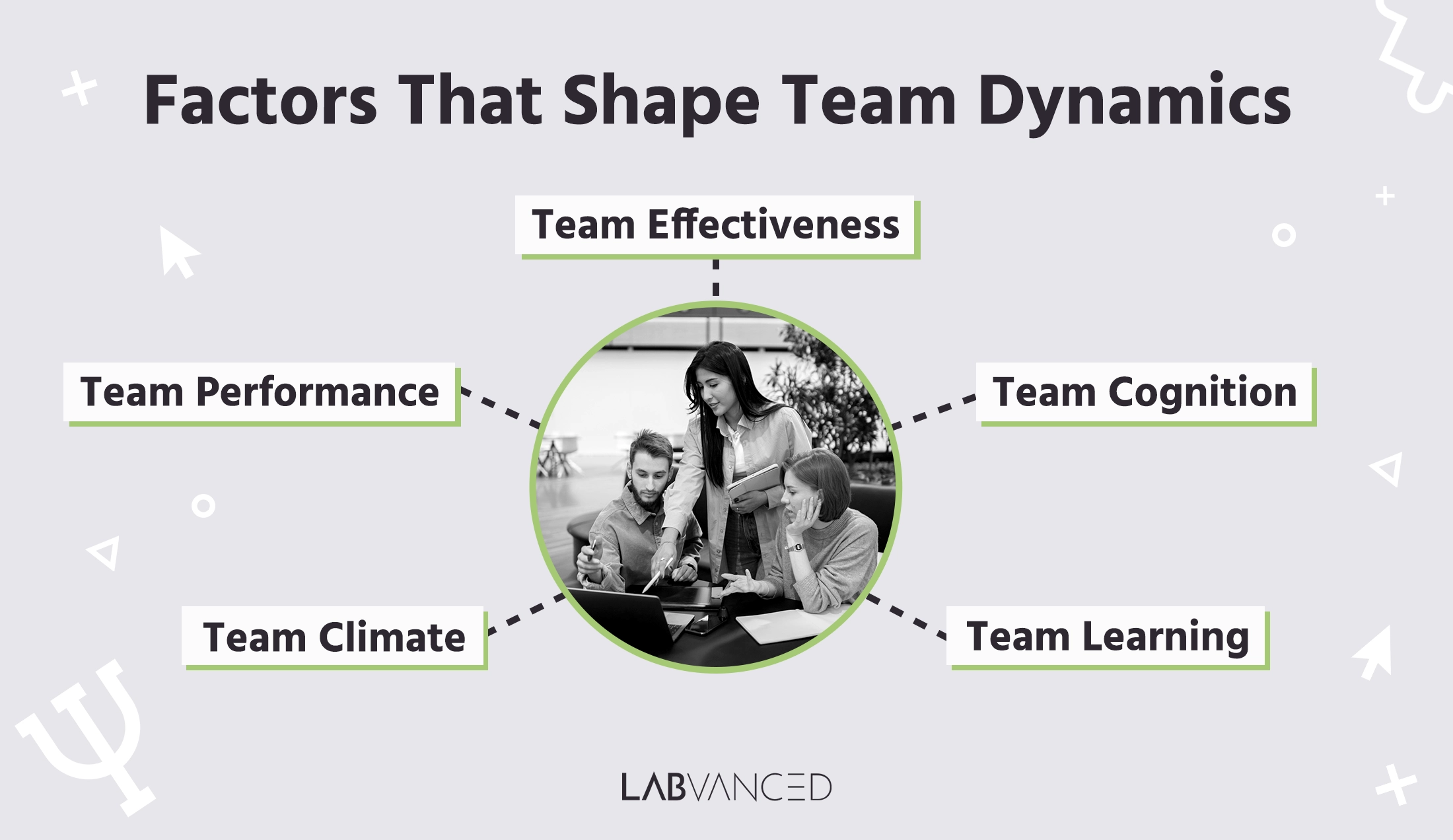
Factors That Shape Team Dynamics
Several interconnected factors significantly influence how a team functions, interacts, and ultimately achieves its goals. Let's discuss the key factors that influence team dynamics:
- Team Effectiveness: This encompasses the overall capacity of a team to achieve its objectives and the quality of its outcomes. It's not just about results but also includes member satisfaction, the team's ability to adapt, and its long-term viability. Effective teams typically exhibit clear goals, shared understanding, efficient processes, and the ability to leverage individual strengths (Richter et al., 2011).
- Team Cognition: This refers to how a team thinks collectively. It includes shared mental models (common understandings of how the team operates and its tasks) and transactive memory systems (awareness of who knows what within the team). Strong team cognition enables better coordination, problem-solving, and decision-making (Levine, 2018).
- Team Performance: This is the observable output and accomplishments of the team that has been made by respecting the standards set by the organization. It can be measured in various ways depending on the team's goals, such as the quality and quantity of work produced, speed of delivery, or customer satisfaction (Meyers et al., 2023).
- Team Learning: This involves the team's capacity to acquire, share, and apply new knowledge and skills. Learning teams are adaptable, innovative, and continuously improve their processes and outcomes. This includes reflecting on past experiences, experimenting with new approaches, and fostering a culture of knowledge sharing (Balzano & Marzi, 2023).
- Team Climate: This refers to the shared perceptions of the team environment among its members. A positive team climate is characterized by trust, psychological safety (feeling safe to take risks and express opinions), supportiveness, and a sense of shared purpose. A positive climate fosters better communication, collaboration, and overall well-being within the team (MacInnes et al., 2020).
Team Dynamics in Virtual Teams
With the rise of remote work and global collaboration, understanding team dynamics in virtual settings has become crucial. Virtual team dynamics describes how people in a team communicate, collaborate, and work together when they are spread out geographically and primarily use technology to connect. Because they aren't face-to-face, the way they build trust, share understanding, make decisions, and handle their different roles becomes especially important for the team to be successful (Topaloglu & Anac, 2021).
Understanding Virtual Team Performance
Virtual team performance refers to how effectively a virtual team achieves its goals and completes its tasks. The literature categorizes performance outcomes into three primary classes:
- Actual task performance (such as efficiency, quality, and duration),
- Affective reactions (including team members' emotional states, commitment, and satisfaction).
- Behaviors (such as interactions, conflict, and turnover).
Moreover, perceptions of effectiveness and self-efficacy also influence how performance is evaluated, encompassing individual, team, and project-level outcomes. Overall, it encompasses both the tangible results of the team's work and the psychological and behavioral aspects that contribute to or hinder success (Clark et al., 2019).

Conclusion
Team dynamics play a foundational role in determining group success across a variety of settings. In an increasingly digital world, studying these dynamics through online experiments offers valuable insights for improving virtual collaboration. Labvanced makes it possible to explore these complex behaviors with precision, paving the way for more effective and resilient teams!
References
Balzano, M., & Marzi, G. (2023). Exploring the pathways of learning from project failure and success in new product development teams. Technovation, 128, 102878.
Bilotta, I., Cheng, S. K., Ng, L. C., Corrington, A. R., Watson, I., Paoletti, J., Hebl, M. R., & King, E. B. (2021). Remote communication amid the coronavirus pandemic: Optimizing interpersonal dynamics and team performance. Industrial and Organizational Psychology, 14(1–2), 36–40.
Carmeli, A., Sheaffer, Z., & Yitzack Halevi, M. (2009). Does participatory decision‐making in top management teams enhance decision effectiveness and firm performance? Personnel Review, 38(6), 696–714.
Clark, D. A., Marnewick, A. L., & Marnewick, C. (2019). Virtual team performance factors: A systematic literature review. 2019 IEEE International Conference on Industrial Engineering and Engineering Management (IEEM), 40–44.
Hao, Q., Zhang, B., Shi, Y., & Yang, Q. (2022). How trust in coworkers fosters knowledge sharing in virtual teams? A multilevel moderated mediation model of psychological safety, team virtuality, and self-efficacy. Frontiers in Psychology, 13.
Levine, J. M. (2018). Socially-shared cognition and consensus in small groups. Current Opinion in Psychology, 23, 52–56.
MacInnes, J., Gadsby, E., Reynolds, J., Mateu, N. C., Lette, M., Ristl, C., & Billings, J. (2020). Exploring the team climate of health and social care professionals implementing integrated care for older people in Europe. International Journal of Integrated Care, 20(4).
Magana, A. J., Amuah, T., Aggrawal, S., & Patel, D. A. (2023). Teamwork dynamics in the context of large-size software development courses. International Journal of STEM Education, 10(1).
Meyers, M. C., van Woerkom, M., & Bauwens, R. (2023). Stronger together: A multilevel study of collective strengths use and team performance. Journal of Business Research, 159, 113728.
Richter, A. W., Dawson, J. F., & West, M. A. (2011). The effectiveness of teams in organizations: A meta-analysis. The International Journal of Human Resource Management, 22(13), 2749–2769.
Topaloglu, M., & Anac, A. S. (2021). Exploring major factors affecting virtual team performance. European Journal of Business and Management Research, 6(5), 107–114.
Wang, H. (2024). The impact of communication skills on work performance in team collaboration. Advances in Economics, Management and Political Sciences, 121(1), 99–106.