
Dyadic Effect in Psychology
The dyadic effect refers to the mutual influence that occurs in interpersonal communication or interaction between two individuals (a dyad). It highlights that communication is not a one-way process where one person acts and the other passively receives. Instead, the behavior and communication of each person directly affect and are affected by the other.
Key Aspects of Dyadic Effect
The Dyadic Effect is central to understanding the complexities of interpersonal life in psychology. Here's a breakdown of key aspects of the dyadic effect:
- Reciprocity: The dyadic effect emphasizes the reciprocal nature of communication. One person's actions or messages tend to elicit a response from the other, and this response, in turn, influences the first person's subsequent behavior (Koul et al., 2023).
- Interdependence: The behaviors of the two individuals in a dyad are interdependent. What one person says or does is contingent on and influences what the other person says or does (Solomon et al, 2023).
- Emergent Properties: The interaction between two people can create something that is more than just the sum of their individual behaviors (Koul et al., 2023).
- Positive and Negative Exchanges: The dyadic effect applies to both positive and negative interactions (Landolt et al., 2023).
- Importance in Relationships: Understanding the dyadic effect is crucial for developing and maintaining healthy relationships (Ştefǎnuţ et al., 2021).
Stimuli and Tasks for Dyadic Effect Research
Dyadic Effect Research investigates how the characteristics, behaviors, and experiences of each person in the dyad mutually influence the other, as well as the relationship as a whole. There are carefully designed stimuli and tasks available for this research. The selection of appropriate stimuli and tasks is driven by the specific research question and the theoretical framework being tested.
Here are some common categories of dyadic effect tasks:
- Resource Allocation Dilemmas: Tasks where dyad members need to decide how to divide limited resources can elicit conflict and reveal negotiation strategies and fairness considerations.
- Competitive Games: Games with clear winners and losers can be used to study competitive dynamics and their impact on the relationship.
- Disagreement Manipulations: Researchers might introduce pre-programmed disagreements or conflicting information to observe how dyads manage and resolve conflict.
- Joint Problem-Solving Tasks: Tasks that require dyad members to work together to find a solution (e.g., puzzles, logic problems) allow for the observation of communication, collaboration, and shared decision-making.
- Interdependent Motor Tasks: Activities requiring synchronized physical movements or coordinated actions (e.g., moving an object together) can reveal aspects of nonverbal coordination.
- Shared Goal Tasks: Tasks where both individuals benefit from successful joint completion encourage cooperation and highlight the importance of shared intentions.
Here are some examples of stimuli used in the research of dyadic effect:
- Verbal Prompts and Scenarios: Researchers might provide specific topics for discussion, role-playing scenarios, or instructions for how participants should interact.
- Visual Stimuli: These could include images, videos, or objects that the dyad needs to discuss, evaluate, or work with.
- Emotional Stimuli: Researchers might use films, music, or tasks designed to evoke specific emotions in the participants to see how these emotions are shared or influence the interaction (emotional contagion).
Furthermore, experimental manipulations can be made through:
- Feedback and Reinforcement: Researchers might provide positive or negative feedback to one or both members of the dyad to see how it affects their subsequent behavior.
- Priming: Subtly exposing participants to certain concepts or emotions before the interaction to see if it influences their behavior.
Multi-User Studies in Dyadic Research
Many dyadic studies involve a multi-user study design, where two or more participants interact with each other. This approach allows researchers to examine real-time social interactions. Here are two common scenarios in multi-user research:
- Real Interaction: In this scenario, two actual participants interact. For example, researchers might study how couples communicate during a conflict resolution task. This approach allows for the observation of genuine social dynamics and the analysis of how both individuals contribute to the interaction. With Labvanced, you can set up this kind of study without having to code.
- Interaction with a virtual Partner: In some cases, a participant may interact with what they believe is another real participant, but is actually a computer-controlled agent. This approach helps in precise control of the kind of information that the participant receives. For instance, a study conducted in Labvanced had participants interact with automated agents to test if they preferred cooperating with partners who shared their natural syntactic preferences (Matzinger et al., 2024). The participant's belief that they are interacting with a real person is crucial in these studies.
Using Labvanced you can set up your multi-user study, including those with virtual partners, allowing for flexible and controlled experimentation. For more information on setting up these types of studies, you can visit the Labvanced Multi-User Technology page.

Examples of Dyadic Studies
Researchers employ a variety of experimental paradigms to elicit and observe dyadic effects. The following section gives some common examples of such dyadic studies.
Image Description with Chat
In the Image description with chat task, one participant sees an image and must describe it to another participant without using specific words. This study tests cooperation and the ability to understand a partner's descriptions.
Ultimatum Game
The Ultimatum Game is a study in which 2 participants examine an amount of money and decide how it should be split amongst themselves. This study examines cooperation and sharing behavior.
Common Research Areas for Understanding the Dyadic Effect
The Dyadic Effect is used extensively in various areas of psychology research. Here are a few examples:
Interpersonal Relationships
- Romantic Relationships: Researchers use the dyadic effect to examine how partners influence each other's emotions, behaviors, and relationship satisfaction (Shrout et al., 2024).
- Parent-Child Relationships: The dyadic effect helps understand the reciprocal influences between parents and children on various aspects of development, such as attachment, emotional regulation, behavioral problems, and more (Lunkenheimer et al., 2021).
- Friendships: Dyadic research examines the mutual influence between friends on aspects like social support, shared activities, and even health behaviors (Wang et al., 2021).
- Therapeutic Relationships: Studies explore how the therapist's empathy and the client's engagement mutually influence the therapeutic alliance and treatment outcomes (Lavik et al., 2022).
Social Behavior
- Communication: Dyadic research focuses on how verbal and nonverbal cues from one person elicit responses from the other, shaping the flow and outcome of the interaction. This can include studies on conflict resolution, persuasion, and more (Solomon et al., 2021).
- Social Influence: Researchers investigate how individuals in a dyad influence each other's attitudes, beliefs, and behaviors (Francis et al., 2024).
- Emotional Processes: The dyadic effect is used to examine how individuals co-regulate each other's emotions and regulate emotions within dyads (Horn et al., 2023).
- Cooperation and Competition: Experimental paradigms like the Prisoner's Dilemma are used to study how individuals in a dyad make decisions about cooperation and competition, considering the other person's potential actions (Yin et al., 2025).
The dyadic effect underscores the fundamental interconnectedness of individuals in interpersonal interactions across a wide range of psychological domains.
Peer-Reviewed Multi-User Research using Labvanced
These peer-reviewed, multi-user studies utilized Labvanced to simulate interactive scenarios between real and automated partners:
Inherent linguistic preference outcompetes incidental alignment in cooperative partner choice; Matzinger et al., 2024.
In this study, researchers wanted to see how language affects the choices of cooperation partners in a sample of 100 participants. The participants were expected to select sentences that described cartoon images presented to them, and then they were shown the responses from their supposed partners. The study, however, was designed using Labvanced to make it seem as if the participants were communicating with other real participants when they were, in fact, automated. Some partners used language styles similar to what the participants naturally preferred, while others used styles that the fictional participants did not favor. This helped researchers see if linguistic similarity influenced who participants chose to work with.
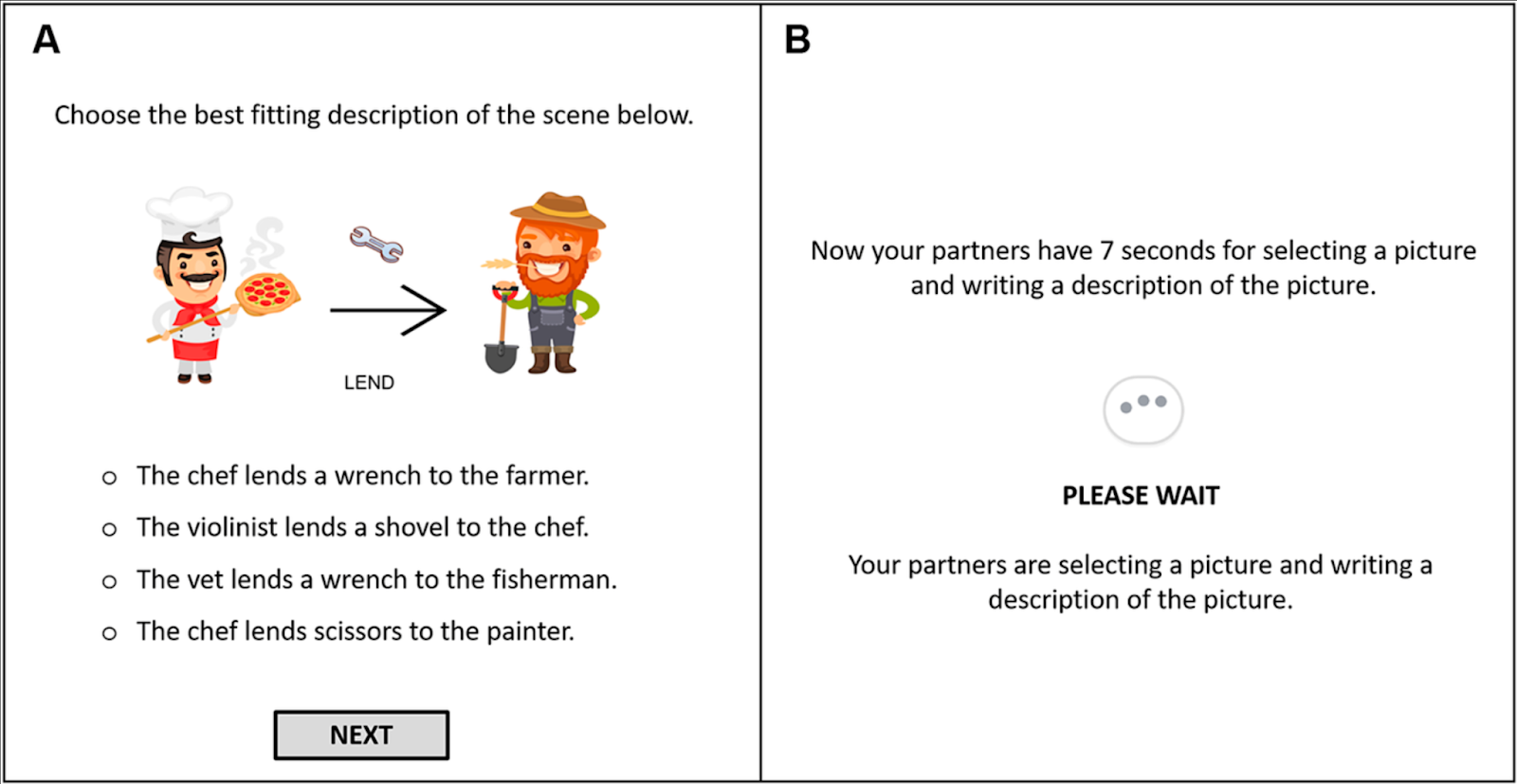
Snapshots of the experimental interface: (a) participants describe a cartoon and (b) participants wait for their fictive partners’ response.
The Evolution of Ambiguity in Sender—Receiver Signaling Games; Mühlenbernd et al., 2022.
In this study on sender-receiver signaling games, researchers utilized Labvanced to explore how communication evolves between participants playing interactive games and to see if participants preferred clear signaling over ambiguous cues. Each pair played a context-signaling game where they took turns as sender and receiver, trying to convey information about specific items, like fruits, to maximize their points. They played 30 rounds, adapting their strategies based on what they learned from each other.
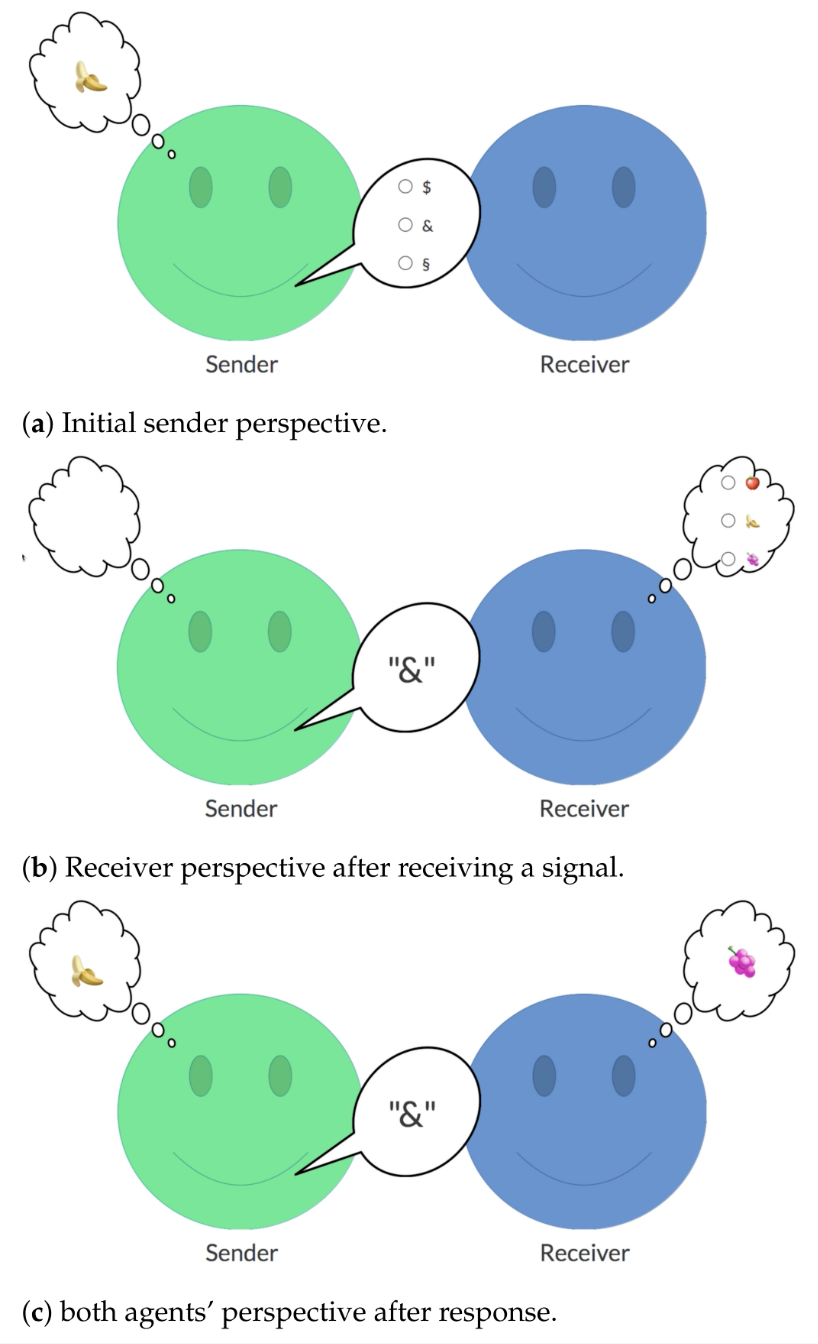
Depiction of the communication game; (a) the game begins with the green agent being given the target (a banana) and only the green agent (sender) knows this target - based on this, the sender has to select one of the three signals / symbols ($, & or §); (b) the blue agent (receiver) now has to pick, based on this input, between three options (’apple’, ’banana’ or ’grapes’); (c) finally, both players see the target of the sender and the choice of the receiver, concluding the round. In this example, communication has failed and no points were awarded.
Superordinate referring expressions in abstraction: Introducing the concept-level reference game; Kobrock et al., 2024.
In this recent study, researchers used a "concept-level reference game". The study involves a communication game between a speaker and a listener. The speaker views a set of images, with two marked as targets, and gives a clue in the format "Select all images with____". The speaker has to fill in the gap with a word or phrase and the listener, seeing the same images and receiving the clue, must identify the two target images. Labvanced has enabled the researchers to show the pictures to the players, let the speaker type in their clues, let the listener click on the pictures and to keep track of how long it took people to answer.
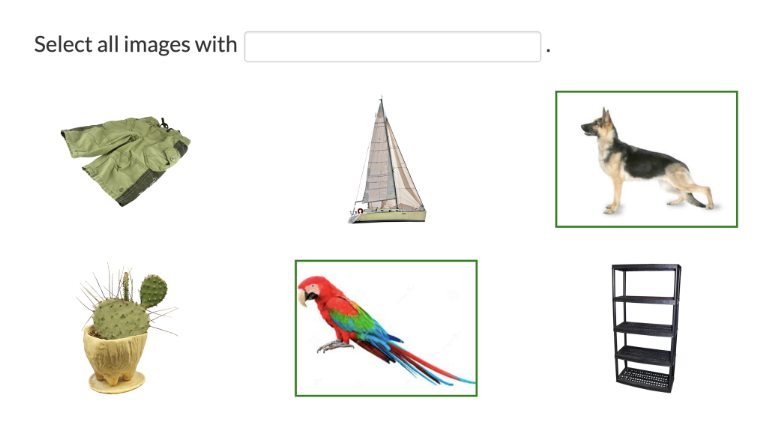
The speaker-display with the target images. For example, in this trial, the speaker may prompt the listener to ‘Select all images with… animals.’
References
Francis, Z., Weidmann, R., Bühler, J. L., Burriss, R. P., Wünsche, J., Grob, A., & Job, V. (2024). My willpower belief and yours: Investigating dyadic associations between willpower beliefs, social support, and relationship satisfaction in couples. European Journal of Personality, 38(5), 778–792.
Horn, A. B., Zimmerli, L., Maercker, A., & Holzer, B. M. (2023). The worse we feel, the more intensively we need to stick together: A qualitative study of couples’ emotional co-regulation of the challenge of multimorbidity. Frontiers in Psychology, 14, 1213927.
Kobrock, K., Uhlemann, C., & Gotzner, N. (2024). Superordinate referring expressions in abstraction: Introducing the concept-level reference game. In Proceedings of the Annual Meeting of the Cognitive Science Society (Vol. 46).
Koul, A., Ahmar, D., Iannetti, G. D., & Novembre, G. (2023). Spontaneous dyadic behavior predicts the emergence of interpersonal neural synchrony. NeuroImage, 277, 120233.
Landolt, S. A., Weitkamp, K., Roth, M., Sisson, N. M., & Bodenmann, G. (2023). Dyadic coping and mental health in couples: A systematic review. Clinical Psychology Review, 106, 102344.
Lavik, K. O., McAleavey, A. A., Kvendseth, E. K., & Moltu, C. (2022). Relationship and alliance formation processes in psychotherapy: A dual-perspective qualitative study. Frontiers in Psychology, 13, 915932.
Lunkenheimer, E., Skoranski, A. M., Lobo, F. M., & Wendt, K. E. (2021). Parental depressive symptoms, parent–child dyadic behavioral variability, and child dysregulation. Journal of Family Psychology, 35(2), 247.
Matzinger, T., Placiński, M., Gutowski, A., Lewandowski, M., Żywiczyński, P., & Wacewicz, S. (2024). Inherent linguistic preference outcompetes incidental alignment in cooperative partner choice. Language and Cognition, 16(4), 1834-1851.
Mühlenbernd, R., Wacewicz, S., & Żywiczyński, P. (2022). The evolution of ambiguity in sender—receiver signaling games. Games, 13(2), 20.
Shrout, M. R., Wilson, S. J., Farrell, A. K., Rice, T. M., Weiser, D. A., Novak, J. R., & Monk, J. K. (2024). Dyadic, biobehavioral, and sociocultural approaches to romantic relationships and health: Implications for research, practice, and policy. Social and Personality Psychology Compass, 18(2), e12943.
Solomon, D. H., Brinberg, M., Bodie, G. D., Jones, S., & Ram, N. (2021). A dynamic dyadic systems approach to interpersonal communication. Journal of Communication, 71(6), 1001–1026.
Solomon, D. H., Brinberg, M., Bodie, G., Jones, S., & Ram, N. (2023). A dynamic dyadic systems perspective on interpersonal conversation. Communication Methods and Measures, 17(4), 273–292.
Ştefǎnuţ, A. M., Vintilǎ, M., & Tudorel, O. I. (2021). The relationship of dyadic coping with emotional functioning and quality of the relationship in couples facing cancer—A meta-analysis. Frontiers in Psychology, 11, 594015.
Wang, L., Liang, L., Liu, Z., Yuan, K., Ju, J., & Bian, Y. (2021). The developmental process of peer support networks: The role of friendship. Frontiers in Psychology, 12, 615148.
Yin, Q., Wen, J., Chen, S., Hou, T., Liu, Y., Yang, D., ... & Dong, W. (2025). Uncovering the neural basis of risk preferences in cooperative dyads: A fNIRS study. NeuroImage, 121167.