Simon Task
The Simon Task measures cognitive control by examining how spatial location influences response selection even when it is irrelevant to the task. Participants respond to a non-spatial feature of a stimulus while ignoring its spatial location, allowing researchers to measure interference between stimulus position and stimulus-response mapping. It is widely used in cognitive psychology and neuroscience to study attention, response conflict, and stimulus-response compatibility.
Table of Contents
Task Format | Simon Task Online & In-Lab
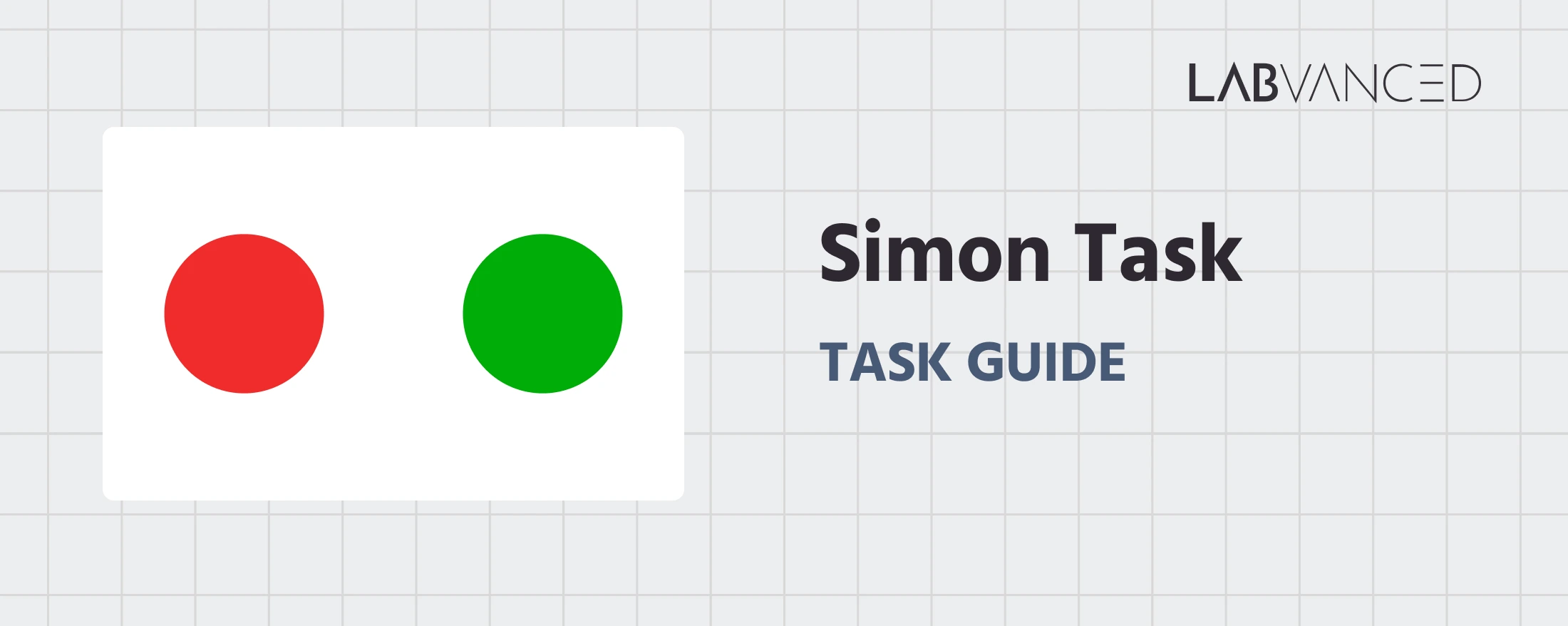
In the Simon Task, participants respond to a relevant stimulus feature (such as color or shape) while ignoring an irrelevant spatial attribute (such as its location on the screen). In this version, participants respond to the color of circles (red or green) while ignoring their spatial position.
The task measures stimulus–response compatibility by presenting circles on the left or right side of the screen, creating congruent and incongruent trials. Participants press the A or L key based on the color of the circle, with the red–green key mapping counterbalanced across participants. Congruent trials occur when the stimulus appears on the same side as the response key associated with its color, while incongruent trials occur when the stimulus appears on the opposite side.
Each session begins with practice trials that include feedback to help participants learn the response rules. After practice, participants continue to the main experimental block where no feedback is provided. Participants are instructed to respond as quickly and accurately as possible.
Simon Task Metrics and Data Collected
The Simon Task captures a range of behavioral measurements that reveal how spatial stimulus–response compatibility influences attention and response selection. The variables recorded enable researchers to assess reaction times, response accuracy, error patterns, and performance differences between congruent and incongruent trials. These measures help quantify cognitive control, interference effects, and the ability to resolve spatial response conflict. All variables can be viewed and customized within the task’s Variables Tab.
Below are examples of variables collected in the Labvanced version of the Simon Task:
| Variable Name | Description |
|---|---|
accuracy | Trial-level accuracy (1 = correct, 0 = incorrect) |
accuracy_total | Running count of correct responses |
assigned_mapping | Group assignment for key randomization |
choice | Response key selected (A or L) |
error | Indicates whether the response was incorrect (1 = error, 0 = correct) |
errors_total | Total number of incorrect responses |
reaction_time | Reaction time in milliseconds |
target_colour | Color of the target stimulus (red or green) |
trial_type | Indicates whether the trial is congruent or incongruent |
simon_effect | Difference between mean RTs of incongruent and congruent trials |
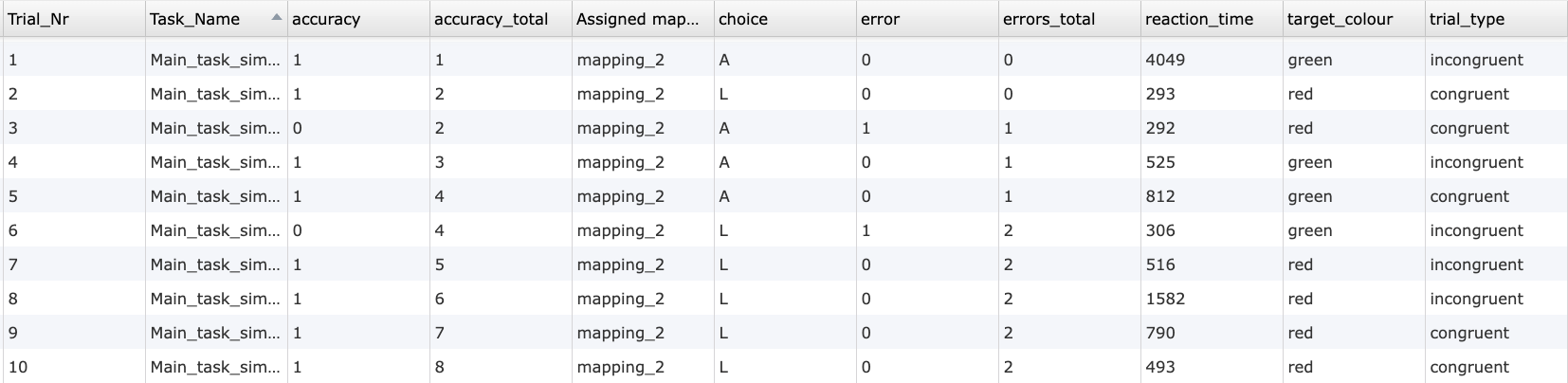
Data table showing an excerpt of individual trial-level outputs from the Simon Task, including accuracy, response choice, error metrics, reaction time, target colour, and trial congruency.
This study measures cognitive control and stimulus-response compatibility using the Simon Task. Participants respond to stimulus color while ignoring spatial position, allowing measurement of the Simon effect through reaction time and accuracy.
Technology Driving the Simon Task for Online & In-Lab Research
Labvanced includes several technologies that make the Simon Task highly accurate, flexible, and suitable for both laboratory and online research:
Precise Spatial Layout Control: Stimuli can be positioned on the left or right side with exact coordinate control, ensuring consistent visual presentation.
Condition-Based Response Mapping: Congruent and incongruent trials can be defined through
FactorsandTrials & Conditions, allowing flexible experimental design.High Precision Timing: Reaction times are recorded with millisecond accuracy, enabling detection of subtle compatibility effects.
Web Based and Desktop Deployment: The task can be run online or in controlled lab environments via the desktop app.
Webcam Eye Tracking Integration: Eye tracking can be added to analyze gaze behavior and attentional processes.
Remote and Longitudinal Deployment: The task can be administered remotely and repeated across sessions for longitudinal studies.

Webcam Eye Tracking
Capture gaze patterns and attentional dynamics during response conflict tasks.
Timing Precision
Measure reaction times with millisecond accuracy for detecting Simon effects.

Desktop App
Run controlled experiments with support for EEG and other lab hardware integrations.
Customization of the Simon Task
There are many ways to adapt this Simon Task template to meet specific research questions. Below are several customization themes researchers commonly explore when modifying this task.
Stimulus Placement and Spatial Conditions
Stimuli are positioned as individual objects that can be moved directly within the editor. Researchers can adjust coordinates or define placement through trial conditions to create congruent and incongruent trials.
Response Mapping and Counterbalancing
Keyboard keys can be reassigned by editing input Events. Response mappings can be counterbalanced across participants using the Factors & Randomization panel.
Congruency Logic and Correctness
Correct responses are determined by comparing participant input with the current trial condition rather than stimulus position. Event logic should be updated if labels change.
Timing and Trial Flow
Fixation timing, stimulus onset, and response windows can be adjusted through frame durations or Delayed Action (Time Callback) events. Feedback and trial transitions can also be customized.
If you need help customizing this task, please feel welcome to write to us and ask:
Recommended Use and Applications of the Simon Task
The Simon Task is widely used to investigate response conflict and attentional control across research domains.
Cognitive Control and Attention Research: Examines how irrelevant spatial information interferes with response selection.
Developmental and Aging Studies: Used to study changes in spatial compatibility effects across the lifespan.
Clinical and Neuropsychological Research: Applied in studies of attention deficits and executive functioning.
Neurocognitive Research: Combined with neuroimaging or electrophysiological methods to study neural mechanisms of response conflict.
References
Simon JR, Rudell AP. Auditory S-R compatibility: the effect of an irrelevant cue on information processing. J Appl Psychol. 1967 Jun;51(3):300-4.
Cespón, J., Hommel, B., Korsch, M. et al. (2020). The neurocognitive underpinnings of the Simon effect: An integrative review of current research. Cognitive, Affective, & Behavioral Neuroscience, 20, 1133–1172.
Related Tasks
The Simon Task pairs naturally with other stimulus-response compatibility and inhibitory control tasks in Labvanced's task library.
Stroop Test
Participants view color words presented in congruent or incongruent font colors and must respond based on the text color rather than the word meaning.
Flanker Task
This study measures selective attention and inhibitory control using the Flanker Task. Participants respond to the direction of a central arrow while ignoring surrounding distractors. Reaction time and accuracy are recorded as performance indicators.
Dot Probe Task
In this task, participants see pairs of images followed by a small dot and must respond as quickly as possible to the dot's location via key press (desktop) or button press (mobile).