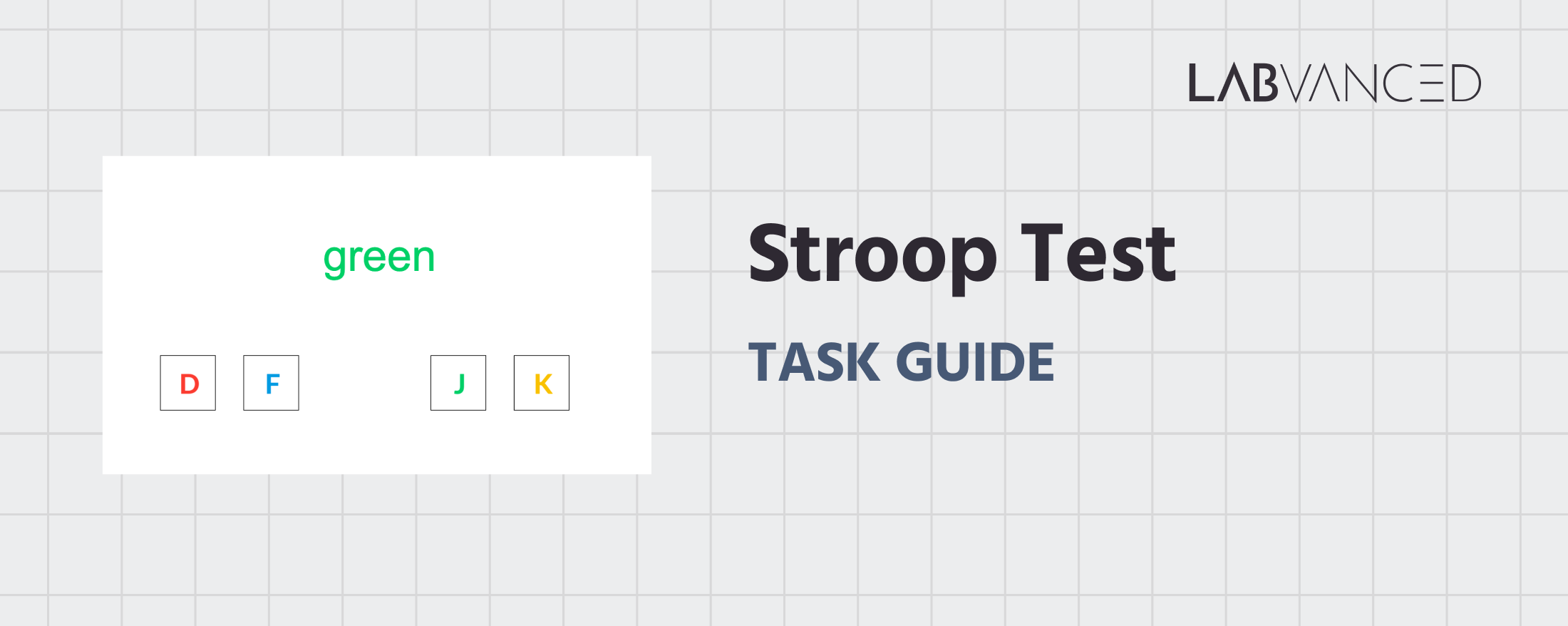
The Stroop Test Effect
The Stroop Test Effect is a classic cognitive task used to assess selective attention and cognitive interference. Participants must respond to one stimulus dimension while suppressing an automatic but conflicting response.
Table of Contents
Task Format | Stroop Test Online & In-Lab
In the Stroop Test Effect, participants are presented with color words displayed in colored text. Their task is to respond to the font color of the word while ignoring its semantic meaning. Trials can be congruent, where the word meaning and font color match, or incongruent, where they conflict. A practice block with congruent trials precedes the experimental trials to familiarize participants with the response rules.
Two versions of the Stroop test are available, each optimized for the type of device and input method being used:
Desktop Version
In the desktop version, a single color word appears at the center of the screen on each trial. Participants respond using the keyboard by pressing one of four keys (D, F, J, K) corresponding to the font color of the word. The color-to-key mapping is counterbalanced across participants. A training session is included before the main task.
Mobile Version
In the mobile version, the same task structure and response rules are used. Words are presented one at a time in colored text, and participants respond by tapping on on-screen buttons corresponding to the font color. The color-to-response mapping is counterbalanced across participants. This version uses a portrait (9:16) frame optimized for mobile devices.
Stroop Test Metrics and Data Collected
The Stroop Task captures a range of behavioral measurements that reveal how attention is regulated when automatic and controlled processes are in conflict. The variables recorded enable researchers to assess reaction times, response accuracy, and interference effects (e.g., differences between congruent and incongruent trials). These measures help quantify cognitive control, response inhibition, and the ability to suppress automatic responses in favor of task-relevant information. All variables can be viewed and customized within the task’s Variables Tab.
Below are examples of variables collected in the Labvanced version of the Stroop Task:
| Variable Name | Description |
|---|---|
accuracy | Whether the participant's answer was correct (1) or incorrect (0) |
accuracy_total | Total number of correct answers given |
Assigned mapping | The group assignment for key randomization |
error | Whether the participant's answer was an error (1) or not (0) |
errors_total | Total number of incorrect responses |
reaction time | Time in milliseconds taken by the participant to respond |
response | The selected response key (D, F, J, K) |
text_ | The text written / displayed on the screen |
text_color_ | The color of the text written / displayed on the screen |
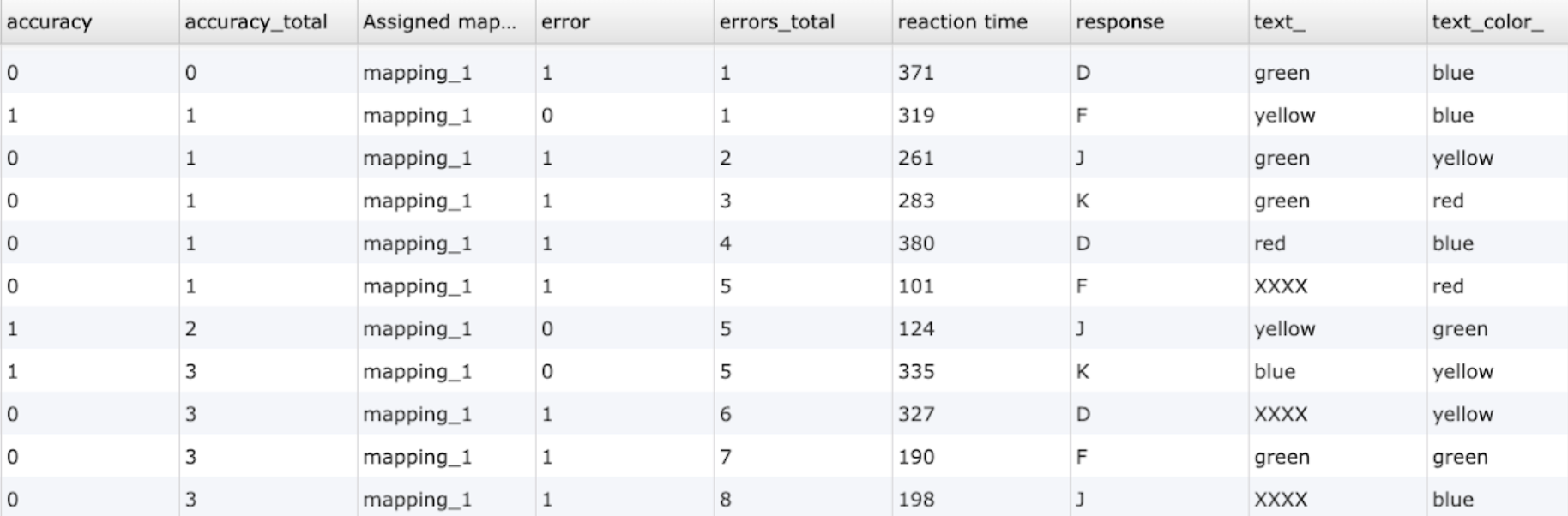
Data table showing individual trial level outputs from the online Stroop Test in Labvanced.
Participants view color words presented in congruent or incongruent font colors and must respond based on the text color rather than the word meaning.
Technology Driving the Stroop Test for Online & In-Lab Research
The Stroop Test Effect requires precise control over stimulus presentation, response handling, and trial logic. The following features provide the technical flexibility needed to run the task reliably across different study designs and participant environments.
High Precision Timing: The Stroop Test relies on millisecond level timing to detect subtle differences in reaction time between trial types. Labvanced ensures precise stimulus presentation and response logging for reliable cognitive measurement, even in online testing environments.
Flexible Response Mapping Across Devices: Responses can be collected through keyboard input on desktop devices or through on screen buttons on touch enabled devices. The same task logic can be used across platforms, ensuring consistent response evaluation while adapting the interface to the available input method.
Desktop App Support for Controlled Environments: When tighter experimental control or hardware integration is required, the task can be deployed using the Labvanced desktop app. This setup supports stable timing and compatibility with external systems such as EEG or other LSL based equipment commonly used in lab studies.
Remote and Longitudinal Study Support: The Stroop task can be delivered consistently across multiple sessions, making it suitable for longitudinal designs that track changes in inhibitory control over time. Remote and online deployment options allow researchers to collect data from distributed samples while maintaining standardized task behavior.
Optional Webcam Eye Tracking Integration: The task can be extended with peer-reviewed webcam based eye tracking to examine gaze behavior, fixation patterns, and visual attention during congruent and incongruent trials. This enables richer analysis of attentional processes without requiring specialized hardware.

Webcam Eye Tracking
Capture gaze patterns and visual attention with built-in, code-free and peer-reviewed webcam eye-tracking.
Timing Precision
Capture reaction times, task performance, and more with millisecond accuracy for time-sensitive tasks.

Desktop App
Run in-lab studies using the Desktop App, compatible with EEG and other LSL-connected lab hardware.
Customization of the Stroop Test
There are many ways to adapt the Stroop Test online and in-lab task template to meet specific research questions. Below are a few themes researchers commonly ask when it comes to modifying this task.
Text and Color Configuration
Words and font colors are implemented as editable text objects. Researchers can change the word set, color palette, font type, or text size by directly editing the text on frame or through the Object Properties panel. This allows easy creation of language specific versions or perceptual manipulations.
Congruency and Condition Logic
Congruent and incongruent trials of the Stroop Task are defined through condition values that control which word and color combinations appear on each trial. These values are read during runtime to determine expected responses. The Trials & Conditions panel could be utilized to set up the required stimuli logic.
Response Mapping and Evaluation
Response keys or on screen buttons can be reassigned to different colors by editing input Events. Researchers can modify how correct responses are defined, how errors are logged, and whether responses are accepted after stimulus offset. All this could be achieved through simple modifications to the relevant events in the Stroop Test tasks.
Trial Flow and Practice Design
Practice trials are typically implemented as a separate block, allowing timing, feedback, and trial count to be adjusted independently from the main task. Frame transitions and feedback display throughout the Stroop test are controlled through Events and can be modified to suit different study designs.
If you need help customizing this task, please feel welcome to write to us and ask:
Recommended Use and Applications of the Stroop Test
The Stroop Test Effect is widely applicable across research, clinical, and applied settings, in online and in-lab administration settings, making it valuable for studying inhibitory control and attentional conflict.
Executive Function and Cognitive Control Research: Frequently used in cognitive psychology and neuroscience to study response inhibition, interference resolution, and attentional control mechanisms.
Developmental and Lifespan Studies: Applied to examine how inhibitory control develops across childhood and adolescence and how it changes in later adulthood.
Clinical and Neuropsychological Populations: Used in research involving ADHD, depression, anxiety disorders, substance use disorders, and neurological conditions where inhibitory control may be impaired.
Emotion and Stress Research: Often included in studies investigating how emotional states, stress, or fatigue influence cognitive control and attentional regulation.
Neuroimaging and Brain Function Studies: Commonly paired with neuroimaging or electrophysiological methods to investigate neural correlates of conflict processing.
References
Stroop, J. R. (1935). Studies of interference in serial verbal reactions. Journal of Experimental Psychology, 18(6), 643–662.
Elcin, D., Velasquez, M., & Colombo, P. J. (2024). Effects of acute and long-term mindfulness on neural activity and the conflict resolution component of attention. Frontiers in Human Neuroscience, 18, 1359198.
Related Tasks
The Stroop Test pairs naturally with other inhibitory control and response conflict tasks in Labvanced's task library.
Flanker Task
This study measures selective attention and inhibitory control using the Flanker Task. Participants respond to the direction of a central arrow while ignoring surrounding distractors. Reaction time and accuracy are recorded as performance indicators.
Simon Task
This study measures cognitive control and stimulus-response compatibility using the Simon Task. Participants respond to stimulus color while ignoring spatial position, allowing measurement of the Simon effect through reaction time and accuracy.
Dot Probe Task
In this task, participants see pairs of images followed by a small dot and must respond as quickly as possible to the dot's location via key press (desktop) or button press (mobile).