Stroop Task | History, Task Description, Data and Psychology
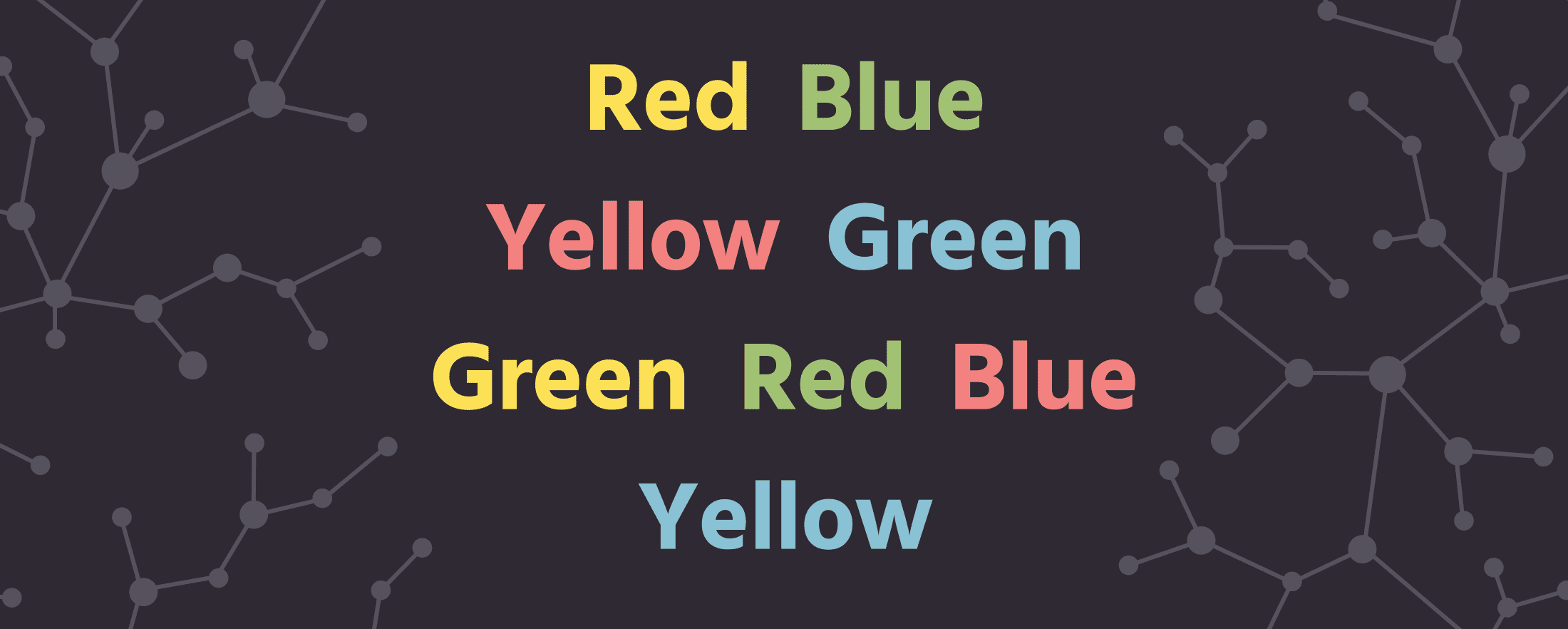
The Stroop Task is one of the most widely known tasks in psychology, making it a classic cognitive task. When presented with the Stroop Task,participants are typically shown with the names of colours printed in different colours and asked to report the visual color while ignoring the written color / semantic meaning of the word. It has been demonstrated that participants take a longer time to name the colour of the word and also commit more errors when presented with a mismatched word and print colour.
Thus, the Stroop task is a simple, yet effective, way to measure an individual's executive functioning and the cognitive interferences that arise upon being presented with conflicting information. Here, we will discuss the essence of this task, the cognitive functions that are implicated, as well as the kind of data that is collected.
In this task, participants are asked to respond to the font color of a word instead of the meaning of the word, while ignoring the word that they hear spoken during each trial.
Key Sections:
History of the Stroop Task
The Stroop Task was first introduced by John Ridley Stroop in 1935 in his paper titled “Studies of Interferences in Serial Verbal Reactions” and thus the name for the task. In his seminal paper, Stroop utilized two types of stimuli: a congruent condition and an incongruent condition. He demonstrated that individuals take longer to name the ink color of a word when the word itself denotes a different color (e.g., the word "red" printed in blue ink), a phenomenon now known as the "Stroop Effect". The Stroop task was originally designed to assess cognitive interference skills in patients with ventromedial prefrontal cortex damage. Since its development, the role of the Stroop task has been expanded and applied to study many aspects of cognitive function across various domains and applications. The Stroop task was later modified to include a third type of stimuli condition: neutral (Chung et al., 2024; Mitchell & Potenza, 2017).
Task Description
In a standard Stroop task, the participants are presented with the names of different colors (color-words) that are printed in various ink colors. The participants are then asked to name the ink color in which a word is printed, disregarding the word’s semantic meaning.
The stimuli are usually divided into three conditions:
- Congruent condition: The stimulus consists of color-words printed or written in the same ink colour as the word. The ink color matches the semantic meaning of the word (e.g., the word "YELLOW" printed in yellow ink).
- Incongruent condition: The stimulus consists of color-words printed or written in different colors other than that of the color-word. There is no match between the ink color and the semantic meaning of the word(e.g., the word "GREEN" printed in red ink and the participant is expected to report ‘red’ as the correct choice).
- Neutral condition: The stimuli are either color-words printed in black ink, non-color words (e.g., "TABLE") or shapes/symbols (e.g., "XXXX") printed in colored ink.
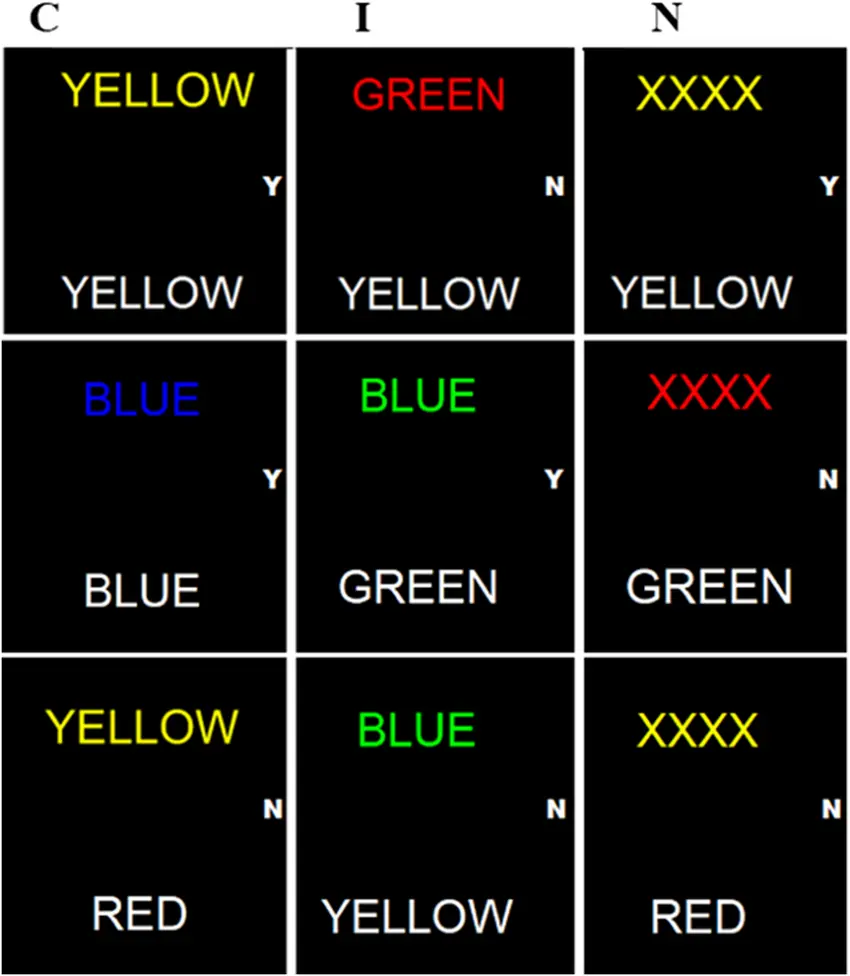
Examples of each of the three categories of the colour-word Stroop task stimulus: ‘C’ congruent:‘I’ incongruent: and ‘N’ neutral; Smith & Ulrich, 2023.
The Stroop Task Online
In online setups, participants are often required to identify the color of the word presented to them or respond to questions by button presses on the keyboard. For example, in the Multimodal Stroop task online in Labvanced, are prompted to press “D” if the font color is red, “F” if the font color is blue, “J” if the font color is green and “K” if the font color is yellow.
Data Collected
During the Stroop Task, several data are collected to evaluate cognitive performance:
- Response Latency: The time taken to respond to each stimulus, indicating processing speed and cognitive load (Epp et al., 2012).
- Interference Index: The difference in response times between incongruent and congruent trials, reflecting the level of cognitive interference (Epp et al., 2012).
- Errors (Rezaei, 2019):
- Commission Errors: Incorrect responses, such as naming the wrong ink color.
- Omission Errors: Failures to respond within the allotted time or the correct target.
- Physiological Data: Some studies collect physiological markers like heart rate variability, pupil dilation, or skin conductance to assess stress or arousal during task performance (Chang et al., 2024).
- Neuroimaging Data: Techniques like fMRI and EEG are used to observe brain regions activated during the task (Fang et al., 2022).
- Eye Movements: Eye tracking metrics collected data such as gaze patterns, fixation duration, fixation sequence, areas of interest, saccades and more (Meyer et al., 2023). For online versions, it is also possible to activate Labvanced’s peer-reviewed webcam-based eye tracking to collect gaze data.
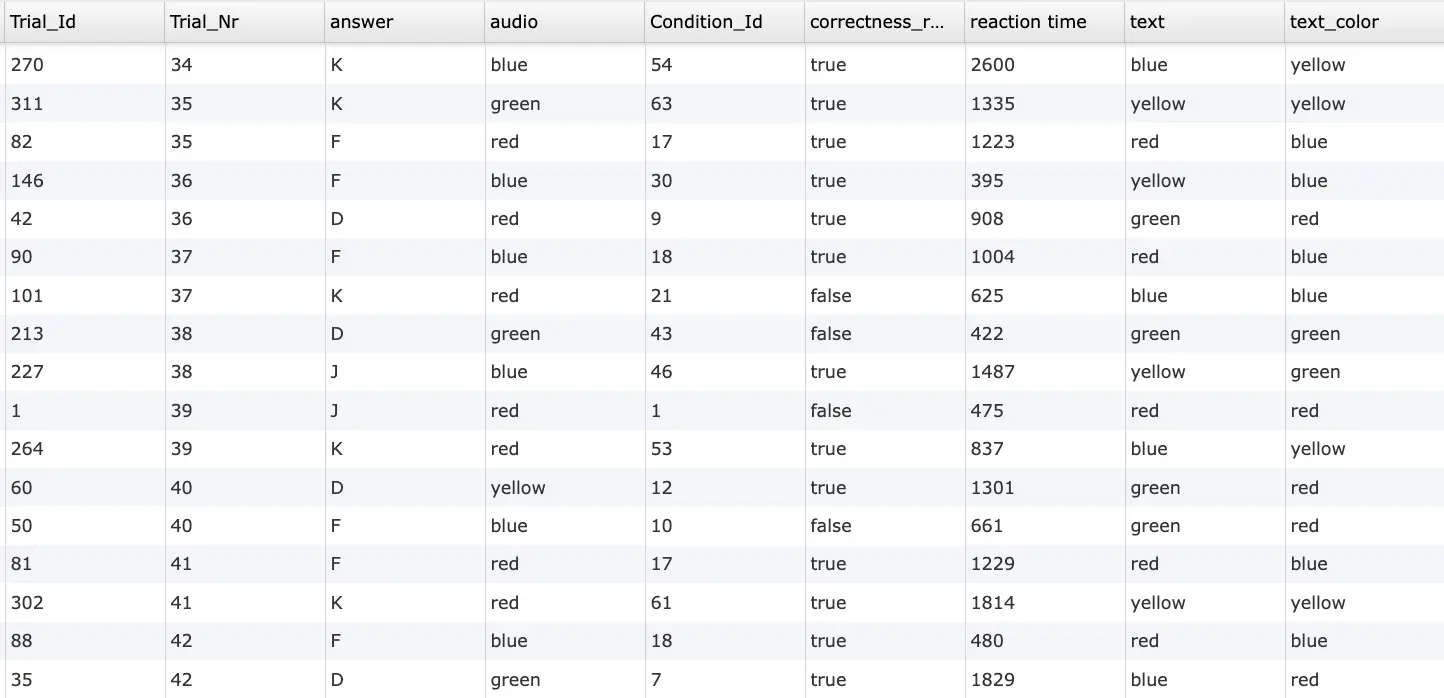
In the image below, you could see what the data collected looks like when it is being recorded in Labvanced. The data shows the basic details of the task such as the trial id, number and condition ID. Additionally, further task-specific data is collected such as the answer (key press) by the participant, audio (the color word the participants heard during the trial), correctness (if the correctness of the answer given by the participant is true or false), the reaction time in milliseconds, the text displayed during the trial and the text color.
Possible Confounds to Consider
Performance on the Stroop task can be influenced by various extraneous variables that need to be taken into consideration while utilizing the task in research. Here are a few:
- Sex: Differences in sex have shown to influence Stroop performance. Women tend to exhibit superior color naming ability and often outperform men in the stroop task (Sjoberg et al., 2022).
- Age: Ageing is often associated with a decrease in cognitive performances such as cognitive control and processing speed. In stroop tasks, the older the participants are, the lower their performance was (Braga et al., 2022).
- Priming Effects: The priming or sequential effect is the most occurring confound in stroop tasks. It is the condition in which exposure to one stimulus/ trial influences a response to a subsequent stimulus/ trial (Viviani et al., 2023).
- Social Comparison: Being observed or compared to others may alter task performance. In Stroop tasks, people made fewer errors or responded faster (i.e., the Stroop effect was reduced) when they felt threatened by social comparison. (for example, if they thought they were being judged or might be seen as worse than others) (Dumas et al., 2005).
- Functional Fitness: Individuals with better physical functional capacity, particularly muscle strength, tend to perform better on cognitive tasks like the Stroop test (Braga et al., 2022).
Associated Cognitive Functions
The Stroop Task engages and measures a wide range of cognitive functions. Let us discuss a few:
- Inhibition control: Inhibitory control refers to the cognitive ability to deliberately suppress automatic or dominant responses. In the Stroop task, the participants resist the impulse to respond immediately, especially when presented with incongruent stimuli (Scarpina & Tagini, 2017).
- Selective Attention: Selective attention is the ability to focus on relevant stimuli while ignoring irrelevant information. During the Stroop task, participants must selectively attend to the ink color of a word while ignoring the interfering semantic content of the word itself (Lamers et al., 2010).
- Processing Speed: Processing speed is the rate at which cognitive tasks are performed. In the Stroop task, it is assessed by measuring how quickly participants can process the visual (ink color) and semantic information of the word and produce an accurate response (Heflin et al., 2011).
- Working Memory: Working memory is the capacity to hold and manipulate information over short periods. When performing the Stroop task, participants are expected to continuously maintain the task rule (e.g., name the color, not the word) in working memory while applying it across different types of stimuli (Entel & Tzelgov, 2020).
Conclusion
The Stroop Task remains a classic tool in psychology for its ability to assess executive functioning through simple yet powerful paradigms. With its adaptability and application in various fields of research it continues to provide valuable insights into cognitive control, attention, and interference processing, making it an enduring instrument for understanding the complexities of human cognition!
References
Braga, P. L. G., Henrique, J. S., Almeida, S. S., Arida, R. M., & Gomes da Silva, S. (2022). Factors affecting executive function performance of Brazilian elderly in the Stroop test. Brazilian Journal of Medical and Biological Research, 55.
Chang, Y., Yep, R., & Wang, C. (2024). Pupil size correlates with heart rate, skin conductance, pulse wave amplitude, and respiration responses during emotional conflict and Valence Processing. Psychophysiology, 62(1). https://doi.org/10.1111/psyp.14726
Chung, R. S., Cavaleri, J., Sundaram, S., Gilbert, Z. D., Del Campo-Vera, R. M., Leonor, A., Tang, A. M., Chen, K.-H., Sebastian, R., Shao, A., Kammen, A., Tabarsi, E., Gogia, A. S., Mason, X., Heck, C., Liu, C. Y., Kellis, S. S., & Lee, B. (2024). Understanding the human conflict processing network: A review of the literature on direct neural recordings during performance of a modified Stroop task. Neuroscience Research, 206, 1–19.
Dumas, F., Huguet, P., & Ayme, E. (2005). Social context effects in the Stroop task: When knowledge of one’s relative standing makes a difference. Current Psychology Letters, 16(2).
Entel, O., & Tzelgov, J. (2020). When working memory meets control in the Stroop effect. Journal of Experimental Psychology: Learning, Memory, and Cognition, 46(7), 1387–1406.
Epp, A. M., Dobson, K. S., Dozois, D. J. A., & Frewen, P. A. (2012). A systematic meta-analysis of the Stroop task in depression. Clinical Psychology Review, 32(4), 316–328. https://doi.org/10.1016/j.cpr.2012.02.005
Heflin, L. H., Laluz, V., Jang, J., Ketelle, R., Miller, B. L., & Kramer, J. H. (2011). Let’s inhibit our excitement: The relationships between Stroop, behavioral disinhibition, and the frontal lobes. Neuropsychology, 25(5), 655–665.
Fang, Z., Lynn, E., Huc, M., Fogel, S., Knott, V. J., & Jaworska, N. (2022). Simultaneous EEG + fmri study of brain activity during an emotional Stroop task in individuals in remission from depression. Cortex, 155, 237–250. https://doi.org/10.1016/j.cortex.2022.07.010
Lamers, M. J., Roelofs, A., & Rabeling-Keus, I. M. (2010). Selective attention and response set in the Stroop task. Memory & Cognition, 38(7), 893–904.
Meyer, T., Favaro, A., Cao, T., Butala, A., Oh, E., Motley, C., Irazoqui, P., Dehak, N., & Moro-Velázquez, L. (2023). Deep Stroop: Using Eye Tracking and Speech Processing to Characterize People with Neurodegenerative Disorders While Performing the Stroop Test. https://doi.org/10.1101/2023.05.30.23290742
Mitchell, M. R., & Potenza, M. N. (2017). Stroop, cocaine dependence, and intrinsic connectivity. In The Neuroscience of Cocaine (pp. 331–339).
Rezaei, M. (2019). Neuropsychological decomposing Stroop interference into different cognitive monitoring: An exploratory factor analysis. Basic and Clinical Neuroscience Journal, 475–484. https://doi.org/10.32598/bcn.9.10.265
Scarpina, F., & Tagini, S. (2017). The Stroop color and word test. Frontiers in Psychology, 8.
Sjoberg, E. A., Wilner, R. G., D’Souza, A., & Cole, G. G. (2022). The Stroop task sex difference: Evolved inhibition or color naming? Archives of Sexual Behavior, 52(1), 315–323.
Smith, P., & Ulrich, R. (2023). The neutral condition in conflict tasks: On the violation of the midpoint assumption in Reaction time trends. Quarterly Journal of Experimental Psychology, 77(5), 1023–1043.
Stroop, J. R. (1935). Studies of interference in serial verbal reactions. Journal of Experimental Psychology, 18(6), 643–662.
Viviani, G., Visalli, A., Montefinese, M., Vallesi, A., & Ambrosini, E. (2023). The Stroop legacy: A cautionary tale on methodological issues and a proposed spatial solution. Behavior Research Methods, 56(5), 4758–4785.