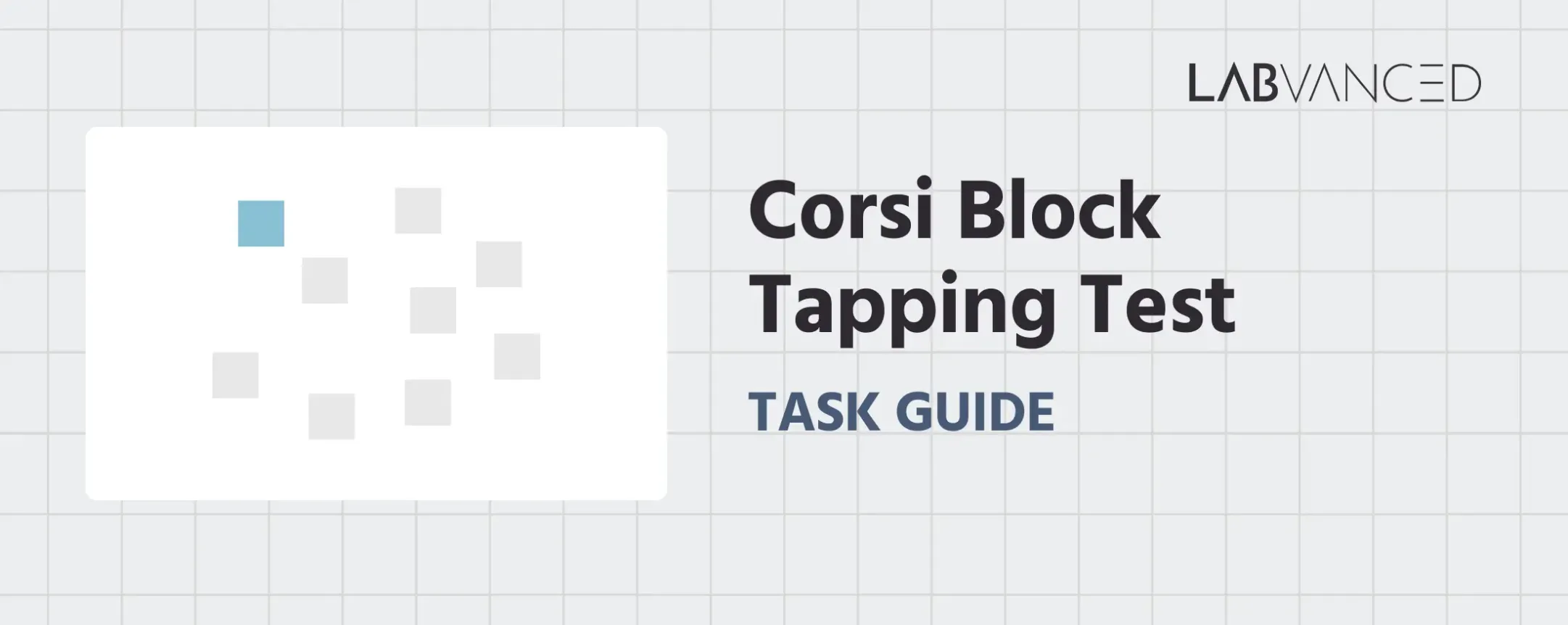
Corsi Block Tapping Test
The Corsi Block Tapping Test is a classic neuropsychological paradigm that measures visuospatial working memory span. Participants observe a sequence of blocks lighting up one at a time and must reproduce the sequence by clicking the blocks in the exact order they appeared. Span length increases progressively until the participant's memory limit is reached.
Table of Contents
Table of Contents
Task Structure of the Corsi Block Tapping Test
Nine blocks are arranged in an irregular spatial layout on screen, each assigned a fixed position. At the start of each trial, a fixation cross appears briefly, followed by the sequence display phase in which blocks light up one at a time in a predetermined order. Each block highlights for 500 ms and then dims before the next block in the sequence activates. Once the full sequence has been shown, participants are prompted to click the blocks in the same order. Span length begins at 2 and increases progressively from 2 to 9 blocks, with 2 trials per span level, for a total of 16 trials. Following Kessels et al. (2000), at least one trial per span level must be completed correctly in order for the task to advance to the next span length; if this threshold is not met, the task ends and results are displayed.
Desktop Version
In the desktop version, participants use a standard mouse to click on blocks. After observing the sequence, participants click the blocks in the order they were lit. Once all selections have been made, participants press the S key to submit their response and advance to the next trial. The task proceeds automatically based on whether the minimum span threshold was met.
Mobile Version
The mobile version is fully optimized for touchscreen use. The spatial block layout is identical to the desktop version. Participants tap each block to register their selections and then tap the Submit button to record their response. The interface is sized for reliable touch detection across different screen sizes and orientations, and both portrait and landscape modes are supported.
Data Collected with the Corsi Block Tapping Test
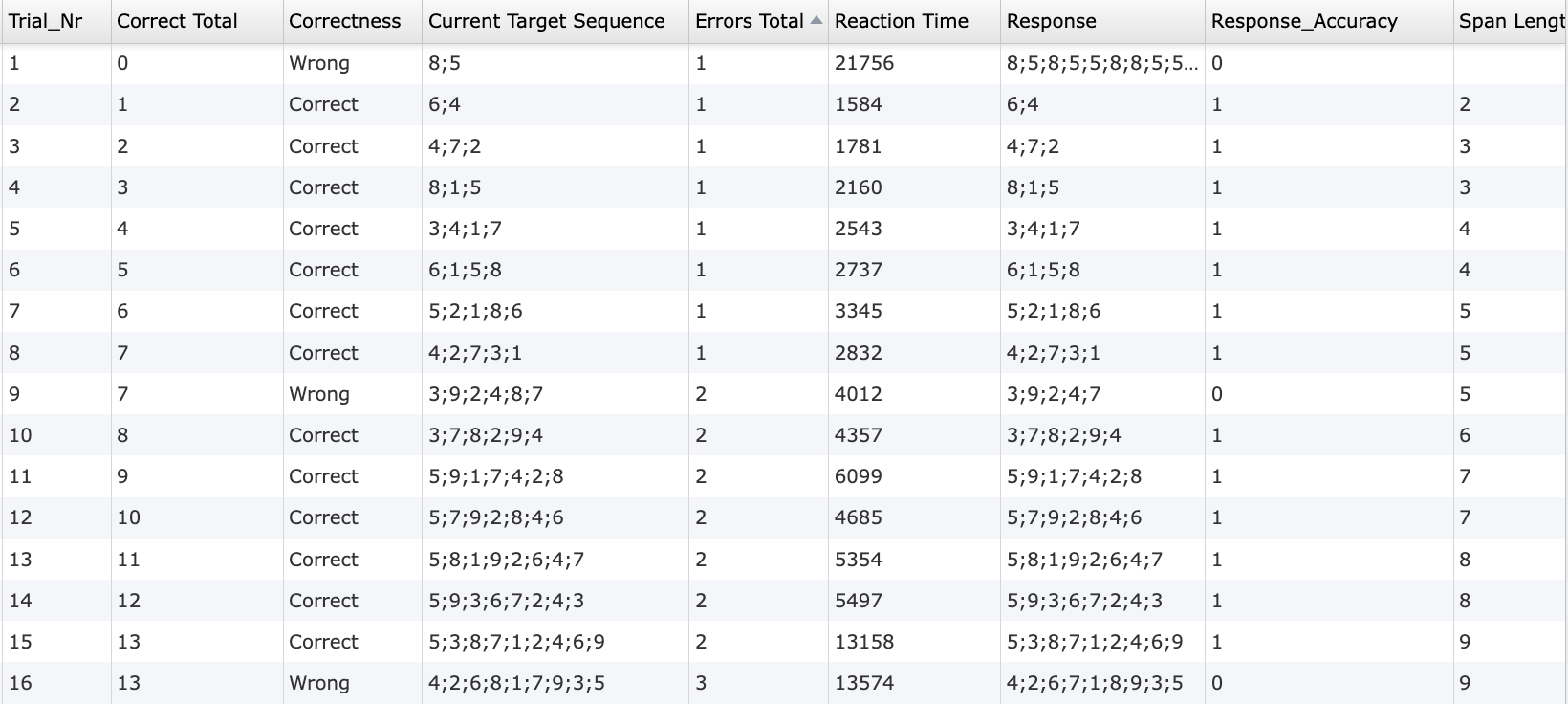
The Corsi Block Tapping Test captures a range of behavioral measurements that reveal the capacity and precision of visuospatial working memory. The variables recorded help researchers measure response accuracy, memory span, error patterns, and response latency across progressively longer sequences. All variables can be viewed and customized within the task's Variables Tab.
| Variable Name | Description |
|---|---|
Response | Array of block IDs clicked by the participant, representing the recalled sequence in order |
Correctness | Categorical outcome of the trial: "Correct" if the full sequence was recalled accurately, "Wrong" otherwise |
Response_Accuracy | Binary accuracy score per trial: 1 = sequence recalled correctly, 0 = sequence recalled incorrectly |
Reaction Time | Time in milliseconds from the start of the response phase to the participant's submission |
Length of Sequence | Number of blocks in the target sequence for the current trial (span level) |
Span Length Accomplished | The highest span length successfully completed by the participant across all trials |
Total_Score | Performance score calculated as Span Length Accomplished × Correct Total, following Kessels et al. (2000) |
Correct Total | Cumulative number of trials answered correctly across the session |
Errors Total | Cumulative number of incorrect trials across the session |
This study measures visuospatial working memory span using the Corsi Block Tapping Test. Participants observe a sequence of blocks lighting up on screen and reproduce the order by clicking. Span level, accuracy, and reaction time are recorded as primary performance indicators.
Technologies Supporting the Corsi Block Tapping Test
Labvanced provides a precise and flexible environment for running the Corsi Block Tapping Test in online and in-lab settings. Several platform capabilities are particularly well suited to this task:
Millisecond Timing Precision: Accurate control over block flash duration and inter-stimulus intervals is critical for the Corsi paradigm. Labvanced's timing engine ensures each block lights up and dims with consistent precision, and records response latency to the millisecond.
Touchscreen and Desktop Support: The task includes two purpose-built versions — one optimized for mouse-based desktop interaction and one for touchscreen devices — so researchers can collect data from a wide range of participants without adapting the design manually.
Desktop App for In-Lab Studies: The Corsi Block Tapping Test can be run through the Labvanced Desktop App in controlled lab environments. The app supports integration with EEG systems and other LSL-compatible hardware, enabling synchronized behavioral and physiological data collection.
Adaptive Task Logic: The built-in progression system automatically adjusts which span level is presented and whether the task should continue or terminate, based on each participant's performance — no manual reconfiguration is needed between participants.

Webcam Eye Tracking
Capture gaze patterns and visual attention with built-in, code-free and peer-reviewed webcam eye-tracking.
Timing Precision
Capture reaction times, task performance, and more with millisecond accuracy for time-sensitive tasks.
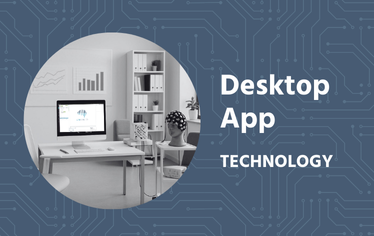
Desktop App
Run in-lab studies using the Desktop App, compatible with EEG and other LSL-connected lab hardware.
Human review list: make sure the anchors work in the table of contents update with correct images (header, data) read through all content make sure there is no false infomration, specifically: under task format - desktop and/or mobile version are correctly described cross reference variables listed with the variables tab of the study Technologies listed make sense
Customizing the Corsi Block Tapping Test Template
There are many ways to go about customizing this template. Below are a few themes researchers commonly ask when it comes to modifying this task.
Sequence Timing and Flash Duration
The duration for which each block remains highlighted and the interval between flashes are controlled by timed event actions within the Sequence Display frame. You can adjust the on-time (currently 500 ms) and the inter-stimulus gap (currently 1000 ms) by editing the Delayed Action (Time Callback) values in the Light Square and Dim Square events. Shortening these intervals increases task difficulty; lengthening them gives participants more encoding time.
Span Range and Number of Trials per Level
The template currently runs span levels 2 through 9 with 2 trials per level. You can extend or shorten this range by adding or removing conditions in the Trials & Conditions panel of the main task loop. The number of trials per span level is set by adjusting how many trial rows are assigned to each condition group, and the target sequences are stored in the Sequence_Info data frame variable, where you can edit or add sequences directly.
Progression Criteria
The task uses the minimum span threshold from Kessels et al. (2000): participants must answer at least one trial correctly per span level to advance. This logic is encoded in the Minimum Span Threshold variable and the conditional check in the Correctness Check event. If you want to apply stricter or more lenient criteria — for example, requiring both trials per level to be correct — you can adjust the comparison logic within that event's conditional actions.
Block Layout and Appearance
The nine blocks are placed at fixed positions in an irregular spatial arrangement that mirrors the classic Corsi board. Their positions can be moved by adjusting X and Y values in the object properties for each block element. Background color, block size, and highlight color (currently #78c3d8) can also be changed in the Object Properties panel or within the Light Square event action that sets the background color on activation.
If there is something else you'd like to know, please feel welcome to write to us and ask:
Recommended Use and Applications of the Corsi Block Tapping Test
The Corsi Block Tapping Test is one of the most widely administered measures of visuospatial working memory and short-term memory span in both research and clinical settings.
Cognitive Aging and Lifespan Research: Used to track age-related changes in visuospatial working memory from childhood through late adulthood, often alongside verbal span tasks to assess domain-specific memory trajectories.
Clinical Neuropsychological Assessment: Routinely administered to individuals with Alzheimer's disease, mild cognitive impairment, stroke, and traumatic brain injury as a sensitive index of spatial memory deficits and treatment response.
Developmental and Pediatric Research: Applied in child development research to characterize the growth of working memory capacity across school age years, and in studies of neurodevelopmental conditions including ADHD and dyslexia.
Schizophrenia and Psychiatric Populations: Frequently used to document visuospatial memory deficits in schizophrenia and related conditions, providing a non-verbal complement to verbal span measures in cognitive battery assessments.
Rehabilitation and Intervention Studies: Employed as an outcome measure in cognitive rehabilitation programs to evaluate whether training, pharmacological, or non-invasive brain stimulation interventions improve working memory span.
Comparative Cross-modal Memory Research: Often paired with digit span tasks to compare verbal and visuospatial memory capacities within the same participants, helping researchers investigate the separability of working memory subsystems.
References
Corsi, P. M. (1972). Human memory and the medial temporal region of the brain. Dissertation Abstracts International, 34, 819B.
Kessels, R. P., Van Zandvoort, M. J., Postma, A., Kappelle, L. J., & De Haan, E. H. (2000). The Corsi block-tapping task: Standardization and normative data. Applied Neuropsychology, 7(4), 252–258. https://doi.org/10.1207/S15324826AN0704_8
Arce, T., & McMullen, K. (2021). The Corsi Block-Tapping Task: Evaluating methodological practices with an eye towards modern digital frameworks. Computers in Human Behavior Reports, 4, 100099. https://doi.org/10.1016/j.chbr.2021.100099
Related Tasks
The Corsi Block Tapping Test pairs naturally with other working memory tasks in Labvanced's task library.
N-Back (2-back) Task
This task examines working memory capacity using the 2-back task. Participants complete a series of trials where they must indicate if the current stimulus matches the one presented two steps earlier. Training trials and immediate feedback are provided to support learning and engagement.
Trail Making Test
In Part A, the participant connects numbers in ascending order (1-2-3...) while in Part B, numbers and letters alternate (1-A-2-B...), in this classic task for measuring cognitive flexibility.
Digit Span Task
This study measures verbal working memory using the Digit Span Task. Participants recall digit sequences of increasing length in the same order they were shown or in reverse order. Accuracy, reaction time, and the longest span successfully recalled are captured as performance indicators.
Tower of London Test
This study measures planning and executive function using the Tower of London Test. Participants rearrange colored balls across three pegs to match a target configuration in as few moves as possible. Initial thinking time, movement execution time, and accuracy against the optimal solution are captured as performance indicators.