Dot Probe Task
The Dot Probe Task is a widely used cognitive and affective attention paradigm designed to measure how quickly individuals orient their attention toward emotional or neutral stimuli. It provides fast, reliable insight into attentional biases, particularly in anxiety, mood, and threat-related processing.
Table of Contents
Task Format | Dot Probe
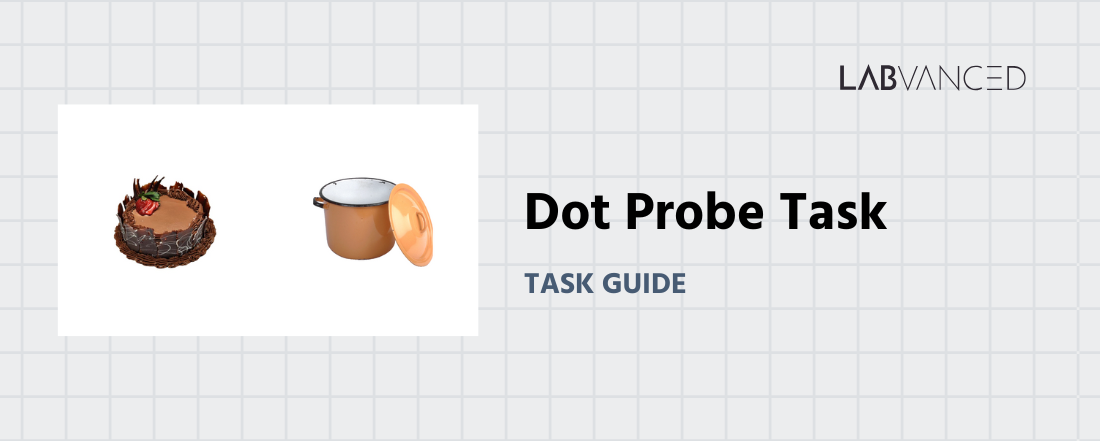
The Dot Probe Task begins with a fixation cross displayed for 500 ms, followed by a pair of images (target vs. neutral) presented for 500 ms. After the images disappear, the dot probe appears in the exact location of one of the images. The probe then remains on the screen until the participant responds. An intertrial interval of 500 ms is added before the next trial begins.
Two versions of the task are available, each optimized for the type of device and input method being used, allowing researchers to administer the dot probe task online or in in-lab settings:
Desktop Version
In the desktop version, the two images are shown on the left and right sides of the screen. When they disappear, a dot appears behind either the left or the right image. Participants respond using keyboard keys: the D key if the dot was behind the left image and the K key if the dot was behind the right image. These timings and response mappings can be adjusted in the task settings.
Mobile Version
In the mobile version, the images are arranged vertically, with one at the top of the screen and one at the bottom. After the images disappear, a probe letter such as E or F appears in either the top or bottom position. Participants respond by tapping the on screen E or F button that corresponds to the letter shown. This version is optimized for mobile devices.
Dot Probe Task Metrics and Data Collected
The Dot Probe Task captures a range of behavioral measurements that reveal how attention is allocated to emotional or salient stimuli. The variables recorded help researchers measure reaction times, accuracy, bias patterns, and trial specific characteristics that influence attentional processing. All variables can be viewed and customized within the task’s Variables Tab.
Below are the key variables collected in the Labvanced version of the Dot Probe Task:
| Variable Name | Description |
|---|---|
Reaction time | The time (in ms) the participant takes to respond to the probe |
Accuracy | Total number of correct responses (correct identification of the probe) across the trials |
Errors | Total number of wrong responses (wrong identification of the probe) across the trials |
Trial_type | Type of trial (e.g., congruent, incongruent, neutral) |
Key Pressed | Key (D/ K) the participant pressed on a keyboard in a trial (computer version) |
right_image_desktop | File name of image shown on the right side of the trial frame (computer version) |
left_image_desktop | File name of image shown on the left side of the trial frame (computer version) |
button_pressed_mobile | On-screen button (E/ F) clicked by participant (mobile version). |
top_image_mobile | File name of image shown at the top of the trial frame (mobile version) |
bottom_image_mobile | File name of image shown at the bottom of the trial frame (mobile version) |
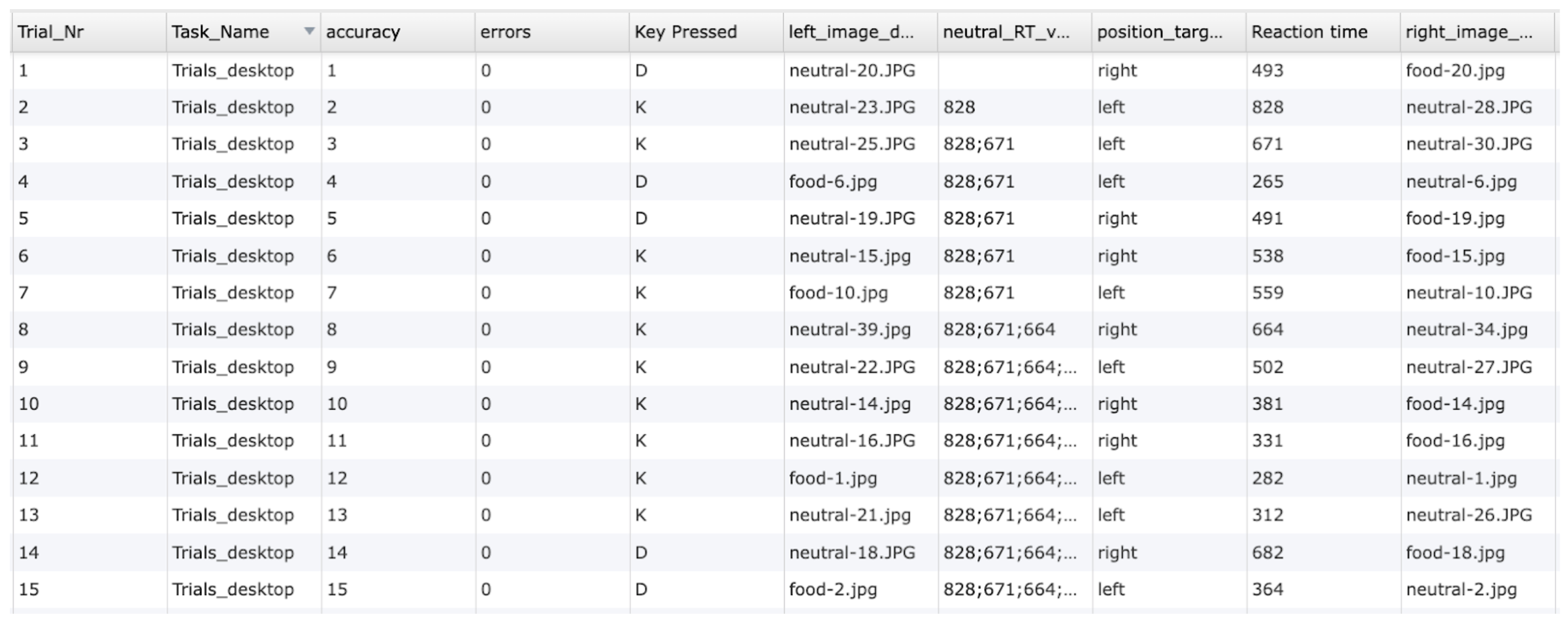
Data table showing individual trial level outputs from the Dot Probe Task, including accuracy, reaction time, key responses, image pair presented, and target (probe)position for each desktop trial.
In this task, participants see pairs of images followed by a small dot and must respond as quickly as possible to the dot’s location via key press (desktop) or button press (mobile).
Technology for the Dot Probe Task
Labvanced includes several technologies that make the Dot Probe Task highly accurate, flexible, and suitable for both laboratory and online / remote research:
High Precision Timing: Millisecond level timing ensures that stimulus presentation and reaction time recording are accurate enough for attention research. This level of precision allows small differences in processing speed to be detected reliably across sessions.
Webcam Eye Tracking: Webcam based eye tracking can be enabled to capture gaze direction, fixation duration, and visual scanning patterns during the task. This provides deeper insight into how participants attend to emotional or neutral cues without the need for dedicated hardware.
Cross Device Input Support: Works seamlessly with mouse, keyboard, and touchscreen devices. This makes it accessible across desktops, laptops, tablets, and mobile phones. This flexibility allows participants to complete the task using whichever device is available.
Desktop App Mode: A desktop application can be used when stronger control over the task or hardware integration is required. This mode supports offline testing and compatibility with equipment such as EEG and other LSL based systems.
Longitudinal and Remote Testing: The Dot Probe task can be delivered consistently across multiple time points, which is ideal for monitoring changes in attentional bias over longer intervals. Online administration of the dot probe task / remote testing options make it possible to reach wider and more diverse participant samples while maintaining data integrity.

Webcam Eye Tracking
Capture gaze patterns and visual attention with built-in, code-free and peer-reviewed webcam eye-tracking.
Timing Precision
Capture reaction times, task performance, and more with millisecond accuracy for time-sensitive tasks.
Desktop App
Run in-lab studies using the Desktop App, compatible with EEG and other LSL-connected lab hardware.
Customization of the Dot Probe Task
There are many ways to go about customizing this template. Below are a few themes researchers commonly ask when it comes to modifying this task.
Stimulus Design
Replace the emotional and neutral images with your own stimuli. You can upload new image files and edit stimulus information directly in the ‘Object Properties’ panel.
Timing and Trial Parameters
Adjust stimulus duration, probe timing, inter trial intervals, and feedback settings. These can be modified through Delayed Action or frame specific timing controls.
Trial Structure and Conditions
Add or remove blocks, change the number of congruent or incongruent trials, or modify the randomization scheme to suit your research question. You can achieve this through the Trials and Conditions panel
Response Options
Update keyboard keys, button positions, button labels, or add new response types depending on the design you want to test. The events with mouse trigger or button trigger could be edited and set up to match your research needs and target population requirements.
If you need help customizing this task, please feel welcome to write to us and ask:
Recommended Use of the Dot Probe Task
The Dot Probe Task can easily be administered online or in-lab and is widely applied in affective science, clinical psychology, and cognitive research, making it a valuable tool for assessing attentional bias toward emotional information across diverse populations.
Anxiety and Stress-Related Populations: DPT is most robustly validated in research on anxiety disorders, trauma exposure, and stress-related conditions. Attentional bias toward threat cues, such as fearful or angry faces, often emerges in individuals with anxiety or post-traumatic stress symptoms.
Children and Adolescents: Modified versions of the task are used in developmental studies to understand how attentional biases emerge or change during childhood, adolescence and in youth with clinical anxiety or after adverse experiences.
Depression and Mood Disorders: Some studies explore attentional biases toward sad or negative stimuli in depressed or mood-disordered individuals.
Behavioral and Eating-Related Research: Researchers have adapted the Dot Probe Task with non-emotional stimuli (e.g., food images) to examine attentional bias or automatic processing tendencies linked to eating behaviors, weight, or body-image concerns.
Baseline & Control Groups in Attention Studies: Using DPT with general healthy populations allows mapping normative attentional responses, which can then be compared against clinical or high-risk groups. This helps in understanding variability and establishing baselines in attentional bias research.
Intervention and Training Studies: Because Dot Probe has been used not only for assessment but also for attentional retraining where the probe consistently replaces neutral or salient stimuli. It can be useful in cognitive-behavioral interventions targeting anxiety or bias modification.
References
MacLeod, C., Mathews, A., & Tata, P. (1986). Attentional bias in emotional disorders. Journal of Abnormal Psychology, 95(1), 15–20.
Rubin, M., Niles, A., Evans, T., Tripp, P., Neylan, T. C., Woolley, J., & O’Donovan, A. (2024). Measuring and modifying threat‐related attention bias in posttraumatic stress disorder: An attention bias modification study. Depression and Anxiety, 2024(1). https://doi.org/10.1155/2024/3683656
Related Tasks
The Dot Probe Task pairs naturally with other visual attention tasks in Labvanced's task library.
Visual Search Task
This study measures attentional selection and search efficiency using a conjunction visual search paradigm. Participants decide whether a predefined target is present or absent among distractors, while reaction time and accuracy are recorded.
Flanker Task
This study measures selective attention and inhibitory control using the Flanker Task. Participants respond to the direction of a central arrow while ignoring surrounding distractors. Reaction time and accuracy are recorded as performance indicators.
Posner Cueing Task
This study measures spatial attention and attentional orienting using the Posner Cueing Task. Participants respond to the location of a target while a preceding cue indicates its location validly, invalidly, or not at all. Reaction time and accuracy are recorded as performance indicators.
Celebrity Endorsement Toy Preference Task
In this task, children are randomly assigned to a control or celebrity-endorsement group, then choose between two toys while webcam eye tracking records their gaze. Choice, reaction time, and fixation measures are recorded as outcome indicators.