BKB Sentence Test
The Bamford-Kowal-Bench sentences or simply the BKB Stentence Test is a tool used to measure how well someone can understand speech. The BKB sentences were first developed in 1979 by Joan Bamford, Diane Kowal, and Joseph Bamford. The test was originally designed to assess speech recognition in partially hearing children, particularly those using hearing aids or cochlear implants (Bench et al., 1979.) It uses everyday sentences that are simple and easy to understand, making it especially suitable for children or individuals who may struggle with more complex language.
Over time, the BKB sentences have been adapted for use in other languages and contexts. For example, the Hearing in Noise Test (HINT) was based on the BKB sentence structure to evaluate hearing aid performance in noisy environments (Nilsson et al.,1994).
BKB Stimuli and Experimental Task
The BKB Sentence Task is a speech recognition task designed to evaluate a person's ability to understand simple sentences. The participant hears a simple sentence and then is asked to repeat the sentence back or indicate what the last word they heard was.
The BKB is a commonly used tool across various fields, including audiology, clinical psychology, developmental psychology, and cognitive psychology for assessing various aspects of auditory processing and speech comprehension.
BKB-SIN (Speech-in-Noise)
When BKB sentences are administered with background noise (eg., multi-talker babble) this is referred to as BKB-SIN (Speech-in-Noise).
What are the stimuli?
The stimuli in the BKB Sentence Test are lists of short, simple sentences spoken clearly.
Example stimuli / spoken sentences:
- The clown had a funny face
- The car engine’s running
Depending on the mode of testing, the participant is asked to repeat back the entire sentence or simply indicate the last word that was spoken:
- Repeating the full sentence: The performance is scored based on correctly repeating keywords (underlined in the example above) and for each correctly spoken keyword the participant is awarded with one point.
- Indicating the last word spoken: This approach can be seen in research as a means for screening auditory abilities and determining with ‘Yes/No’ whether participants can hear well before progressing to the actual experimental tasks (Requena-Komuro et al., 2022).
What are the key features of BKB Sentence Test stimuli?
These sentences have several key characteristics (Moossavi et al., 2017; Xi et al., 2023)
- Simple Vocabulary: The sentences use a limited and common vocabulary, making them easier to understand across different age groups and language backgrounds (though tests are typically administered in the participant's native language).
- Short Length: The sentences are brief, usually containing only a few words.
- Key Words: Each sentence contains a specific number of "keywords" that are scored for accuracy when the participant repeats the sentence. The other words in the sentence provide context but are not typically scored.
- Multiple Lists: There are multiple equivalent lists of BKB sentences available. This allows for repeated testing without the risk of participants memorizing the specific sentences.
Sample Population
The BKB can be administered to:
- Partially hearing children aged eight and above (Bench et al., 1979).
- Cochlear implant users (Vickers et al., 2009).
- Children with normal hearing, aged 5 and above (Holder et al., 2016).
- Adults with normal hearing (aged 22-28 yr) (Ng et al., 2011).
- Adults with hearing loss (aged 18 to 30 years) (Wilson et al., 2007).
BKB Sentence Test in Psychology Research
BKB sentences are used in various areas of psychology research, including:
Auditory Perception and Speech Understanding: This is the primary application. Researchers use BKB sentences to understand the level at which speech can be understood and the impact of noise on speech perception (Billings et al., 2024, February).
Cognitive Psychology: Studies have shown that speech perception is linked to cognitive functions in an individual. BKB sentences can be used to explore the cognitive skills and processes in different populations (Chen et al., 2022).
Developmental Psychology: As discussed earlier, the BKB task has been utilized to track and compare speech perception abilities in children and across different age groups (Gavin et al., 2021).
Clinical Psychology and Neuropsychology: The BKB sentences can be used to understand auditory processing and speech perception in the clinical population and also in neurological conditions, such as traumatic brain injury (James et al., 2022). (Papesh et al., 2021).
Linguistics: Researchers use BKB sentences with specific linguistic properties to study how sentence structure and linguistic context affect speech perception (Xu et al., 2021).
Value of the BKB Test in Research
BKB sentences are a valuable tool in psychology research. There are several features that makes it particularly effective:
- Standardized: The BKB test is a well-established and standardized measure, allowing for comparisons across studies and populations.
- Ecologically Valid: Testing speech understanding in noise using sentences is more representative of real-world communication than using isolated words or syllables.
- Versatile: It can be adapted for different populations and research questions by varying the presentation conditions (e.g., noise type, signal-to-noise ratio).
Research with BKB Sentences & Labvanced: Case studies
Labvanced has enabled researchers to carry out feasible online BKB tasks. Let us look into few examples of how researchers used Labvanced for their BKB task research:
Relationships Between Subjective and Objective Measures of Listening Accuracy and Effort in an Online Speech-in-Noise Study; Wiggins et al., 2025
In this speech-in-noise study, researchers asked participants to take part in an experiment in Labvanced to determine subjective and objective measures of listening accuracy and effort. 67 participants, including 42 with normal hearing and 25 with hearing loss, completed the Effort Assessment Scale (EAS) and a sentence recognition task. BKB sentences were presented in speech-shaped noise at signal-to-noise ratios (SNRs) of -8, -4, 0, +4, +8, and +20 dB. Participants repeated the sentences aloud, and their responses were recorded via webcam and scored by research assistants. The study used several outcome measures to assess accuracy and listening effort, including objective intelligibility, subjective intelligibility, subjective listening effort, subjective tendency to give up listening, and verbal response time (VRT). Subjective listening effort was the first measure to show sensitivity to worsening SNR, followed by subjective intelligibility, objective intelligibility, subjective tendency to give up listening, and VRT.
Remote versus face-to-face neuropsychological testing for dementia research: a comparative study in people with Alzheimer’s disease, frontotemporal dementia and healthy older individuals; Requena-Komuro et al., 2022
In certain cases, it may be important to check the basic audibility of auditory stimuli before proceeding to the main experiment trials. In this study comparing the feasibility of remote versus face-to-face neuropsychological testing for dementia research, the research began by asking participants to listen to a set of 10 sentences from the Bamford-Kowal-Bench (BKB) list in Labvanced.
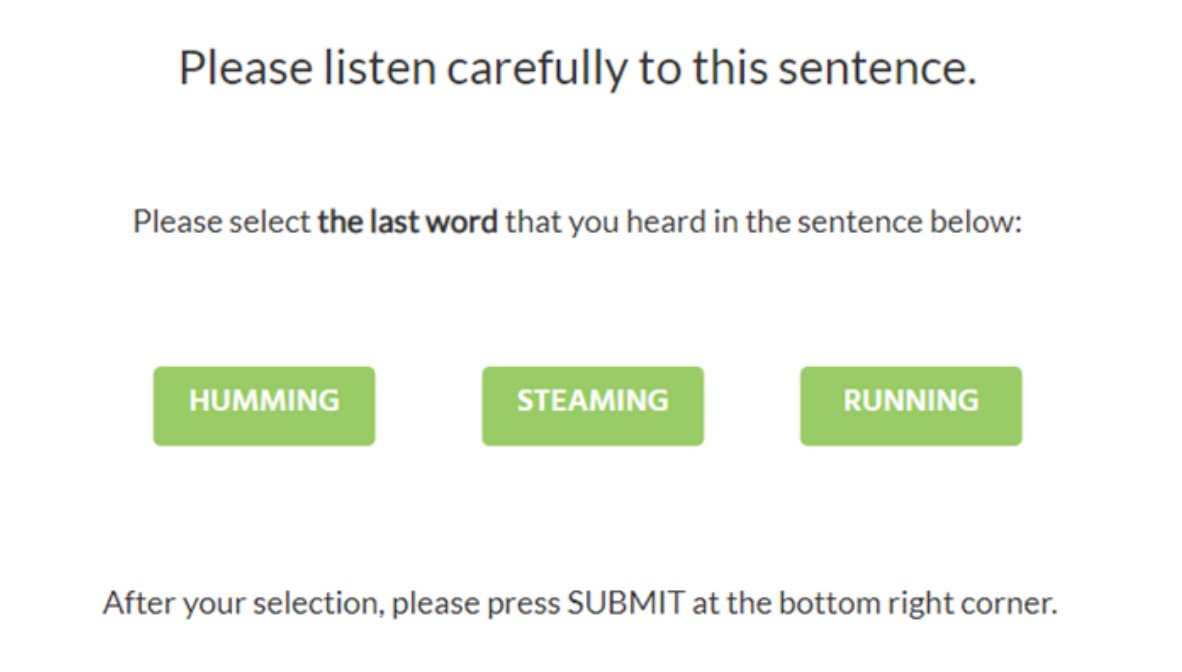
In the example above, the sentence spoken was “The car engine’s running” and the participants had to indicate the last word that was heard. For each sentence, there were two foils displayed alongside the target, both of which made sense in the sentence when replacing the target. Also, one of the foils was also selected to loosely rhyme with the target word (for example here that would be “humming”).
Check out this modified BKB task published in the Labvanced library!
References
Bench, J., Kowal, Å., & Bamford, J. (1979). The BKB (Bamford-Kowal-Bench) sentence lists for partially-hearing children. British Journal of Audiology, 13(3), 108–112.
Billings, C. J., Olsen, T. M., Charney, L., Madsen, B. M., & Holmes, C. E. (2024, February). Speech-in-noise testing: An introduction for audiologists. In Seminars in Hearing (Vol. 45, No. 01, pp. 055–082). Thieme Medical Publishers, Inc.
Chen, Y., Wong, L. L., Chan, S. S., & Yu, J. (2022). Speech perception in noise is associated with different cognitive abilities in Chinese-speaking older adults with and without hearing aids. Frontiers in Psychology, 12, 640300.
Gavin, K., Eckert, A., & Gural-Toth, V. (2021). Incorporating Speech-in-Noise Testing in the Pediatric Test Battery. The Hearing Journal, 74(7), 16.
Holder, J. T., Sheffield, S. W., & Gifford, R. H. (2016). Speech understanding in children with normal hearing: Sound field normative data for BabyBio, BKB-SIN, and QuickSIN. Otology & Neurotology, 37(2), e50–e55.
Moossavi, A., Mehrkian, S., Karami, F., Biglarian, A., & Bakhtiari, B.M. (2017). Developing of Persian version of the BKB sentences and content validity assessment. Auditory and Vestibular Research, 26, 27–33.
Nilsson, M., Soli, S. D., & Sullivan, J. A. (1994). Development of the Hearing in Noise Test for the measurement of speech reception thresholds in quiet and in noise. The journal of the acoustical society of America, 95(2), 1085-1099.
Papesh, M. A., Stefl, A. A., Gallun, F. J., & Billings, C. J. (2021). Effects of signal type and noise background on auditory evoked potential N1, P2, and P3 measurements in blast-exposed veterans. Ear and Hearing, 42(1), 106–121.
Requena-Komuro, M. C., Jiang, J., Dobson, L., Benhamou, E., Russell, L., Bond, R. L., ... & Hardy, C. J. (2022). Remote versus face-to-face neuropsychological testing for dementia research: a comparative study in people with Alzheimer’s disease, frontotemporal dementia and healthy older individuals. BMJ Open, 12(11), e064576.
Vickers, D., Eyles, J., Brinton, J., Glasberg, B., & Graham, J. (2009). Conversion of scores between Bamford, Kowal and Bench (BKB) sentences and Arthur Boothroyd (AB) words in quiet for cochlear implant patients. Cochlear Implants International, 10(3), 142–149.
Wiggins, I. M., Stacey, J. E., Naylor, G., & Saunders, G. H. (2025). Relationships between subjective and objective measures of listening accuracy and effort in an online speech-in-noise study. Ear and Hearing, 10–1097.
Xi, X., Li, J. N., Yuen, K. C., Chen, A. T., Li, S. Q., Hong, M. D., ... & Ching, T. Y. (2023). List equivalency and critical differences of a Mandarin Bamford-Kowal-Bench sentence in babble noise test for adults and preschool children with normal hearing. Journal of Speech, Language, and Hearing Research, 66(12), 5061–5070.
Xu, J., & Cox, R. M. (2021). Interactions between cognition and hearing aid compression release time: Effects of linguistic context of speech test materials on speech-in-noise performance. Audiology Research, 11(2), 129–149.