Beads Task
The Beads Task is a probabilistic reasoning paradigm that measures how much evidence people gather before making a decision under uncertainty. Participants view a sequence of beads drawn from one of two jars and decide which jar the beads are coming from, choosing when they have seen enough. The number of beads requested before deciding, known as draws to decision, is a validated index of the jumping-to-conclusions (JTC) reasoning bias widely studied in psychosis research.
Table of Contents
Table of Contents
Task Structure of the Beads Task
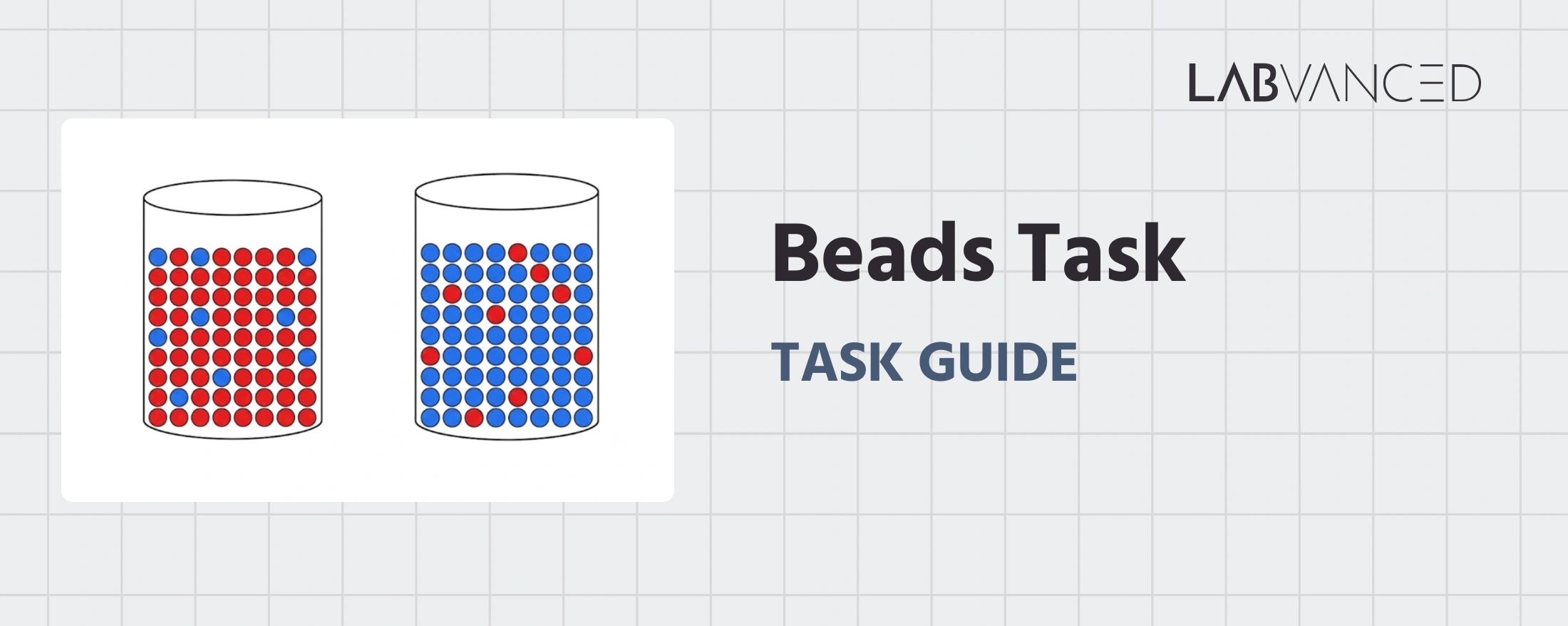
Participants are shown two jars, each containing a mix of two bead colors in a fixed ratio. The computer randomly selects one jar without revealing which, then draws beads from it one at a time, showing each bead to the participant before replacing it, so the ratio in the jar never changes. After each bead, the participant decides whether to see another bead or to commit to a jar. There is no time limit and no advantage to responding quickly: participants are instructed to decide only when they feel sure.
A practice round precedes the main task, using black and white beads in a 90:10 ratio with a maximum cap of 10 draws, so participants can confirm they understand the response mapping before data collection begins; participants can repeat the practice round if needed. The main task then runs in two scored phases. A Standard phase (Task 1) uses red and blue beads in an 85:15 ratio, and a Difficult phase (Task 2) uses yellow and purple beads in a 60:40 ratio. Both phases draw from a fixed bead sequence sourced from Díaz-Cutraro et al. (2022), with bead-color-to-jar assignment and jar position (left or right) counterbalanced across participants. Each phase caps at a maximum number of draws (18 beads in the Standard phase, 19 in the Difficult phase); if a participant reaches the cap without deciding, the trial ends and is logged accordingly. After each phase, participants rate their confidence in their decision on a 0 to 100 certainty scale.
Two versions of the task are available, each optimized for the type of device and input method being used:
Desktop Version
In the desktop version, responses are made using the keyboard. Participants press Space to request another bead, D to choose Jar A, and K to choose Jar B.
Mobile Version
The mobile version is optimized for touchscreen interaction. Participants tap the New Bead button to request another bead, and the Jar A or Jar B button to make their decision.
Data Collected with the Beads Task
The Beads Task captures the sequence of decisions that make up a probabilistic reasoning assessment: how many beads a participant requests, how confident they are in their final choice, and whether that choice was correct. These variables let researchers quantify data-gathering behavior and classify participants along the jumping-to-conclusions spectrum. All variables can be viewed and customized within the task's Variables Tab, and the full set of recorded data for each session can be inspected and exported from the Dataview & Export tab.
Below are examples of variables collected in the Labvanced version of the Beads Task, shown for the Standard phase (Task 1). The Difficult phase (Task 2) records the same set of variables under a _T2 suffix (e.g. DTD_T2, JTC_classification_T2).
| Variable Name | Description |
|---|---|
DTD_T1 | Draws to Decision for the Standard phase: the number of beads viewed before the participant commits to a jar. |
JTC_classification_T1 | Derived classification for the Standard phase: Jumping-to-Conclusions if DTD_T1 is 2 or fewer, otherwise Conservative. |
jar_chosen_T1 | Which jar (A or B) the participant selected for the Standard phase. |
correctness_T1 | Whether jar_chosen_T1 matched the jar the fixed bead sequence was actually built to represent. |
decision_certainity_T1 | Post-decision certainty rating (0 to 100 slider) for the Standard phase. |
TimeToDecision_T1 | Total elapsed time in the Standard phase, from the first bead shown to the final decision. |
reaction_time | Time between each bead appearing and the participant's next response. |
choice | The participant's response to each bead (Desktop: D, K, or Space; Mobile: New Bead, Jar A, or Jar B). |
Task_type | The current phase of the session (Practice, Standard (T1), or Difficult (T2)). |
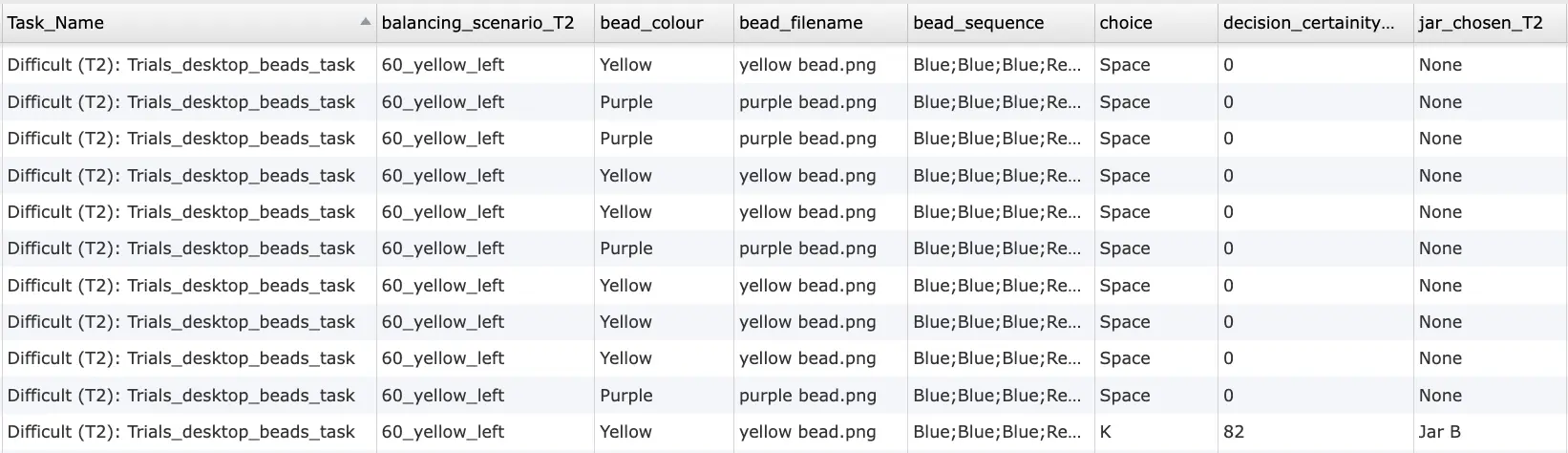
Data table showing individual trial level outputs from the Difficult phase (Task 2) of the online Beads Task in Labvanced.
This study measures probabilistic reasoning and the jumping-to-conclusions bias using the Beads Task. Participants decide which of two jars a sequence of beads is being drawn from, requesting as many or as few beads as they need before choosing. Draws to decision, jar choice, and confidence are recorded as outcome measures.
Technologies Supporting the Beads Task
Labvanced supports the layered trial logic and derived scoring the Beads Task requires, without any custom code:
Millisecond Accurate Timing: Every bead presentation and participant response is timestamped, giving researchers a precise per-draw reaction time alongside the total time to decision.
Desktop App for Clinical and Lab Settings: Probabilistic reasoning tasks like this one are frequently administered to clinical populations in controlled lab or hospital settings. The desktop app supports offline administration with optional LSL-compatible hardware integration.
Code-free Derived Variables: The draws-to-decision count, correctness check, and JTC classification are computed automatically through Labvanced's event system and data frames, letting researchers implement a validated scoring rule without writing code.
Cross-Device Response Handling: The task supports keyboard input for desktop administration and button-based input for touchscreen and mobile use, while keeping the underlying data structure identical across devices.

Timing Precision
Capture reaction times, task performance, and more with millisecond accuracy for time-sensitive tasks.

Desktop App
Run in-lab studies using the Desktop App, compatible with EEG and other LSL-connected lab hardware.

Code-free Editor
Build powerful experiments with advanced technologies, without having to write a single line of code.
Customizing the Beads Task Template
There are many ways to go about customizing this template. Below are a few themes researchers commonly ask when it comes to modifying this task.
Bead Ratios and Jar Conditions
The bead ratio for each jar, currently 85:15 for the Standard phase and 60:40 for the Difficult phase, is set in the task's underlying data frame and can be adjusted to create additional difficulty levels or match a specific published protocol.
Sequence Length and Decision Cap
The maximum number of beads a participant can view before the task forces a decision, currently 18 in the Standard phase and 19 in the Difficult phase, is set in the task's Trials & Conditions panel and can be shortened or extended depending on how much data-gathering behavior a study needs to capture.
Response Input and Instructions
Response mapping (which key or button corresponds to which jar) and the on-screen instructions can be edited directly, which is useful for adapting the task's language or reading level for different populations.
Certainty Rating and Feedback
The post-decision certainty slider can be adjusted in range or removed, and feedback about whether the participant's choice was correct can be shown or withheld depending on the study design.
If you need help customizing this task, please feel welcome to write to us and ask:
Recommended Use and Applications of the Beads Task
The Beads Task is best known as a measure of the jumping-to-conclusions (JTC) reasoning bias and is used across clinical and cognitive research to study how people gather evidence before deciding under uncertainty.
Psychosis and Delusion Research: The task originates from Huq et al.'s (1988) work comparing deluded and non-deluded participants, and remains a standard measure for studying data-gathering bias and overconfidence in psychosis and delusion-proneness.
First-Episode Psychosis and Clinical Populations: Used to characterize reasoning biases in first-episode psychosis and their relationship to social cognition, informing cognitive models of symptom formation (Díaz-Cutraro et al., 2022).
General Cognitive and Decision-Making Research: Applied beyond clinical populations to study probabilistic reasoning, data-gathering behavior, and confidence calibration under uncertainty in general-population samples (Freeman et al., 2008).
Individual Differences and Delusion-Proneness Studies: Used with non-clinical samples to examine how delusion-proneness and related traits relate to decision-making speed, including findings that this relationship is more complex outside clinical populations than within them (So & Kwok, 2015).
References
- Díaz-Cutraro, L., López-Carrilero, R., García-Mieres, H., Ferrer-Quintero, M., Verdaguer-Rodriguez, M., Barajas, A., Grasa, E., Pousa, E., Lorente, E., Barrigón, M. L., Ruiz-Delgado, I., González-Higueras, F., Cid, J., Mas-Expósito, L., Corripio, I., Birulés, I., Pélaez, T., Luengo, A., Beltran, M., Torres-Hernández, P., Palma-Sevillano, C., Moritz, S., Garety, P., & Ochoa, S. (2022). The relationship between jumping to conclusions and social cognition in first-episode psychosis. Schizophrenia, 8, 39.
- Freeman, D., Pugh, K., & Garety, P. (2008). Jumping to conclusions and paranoid ideation in the general population. Schizophrenia Research, 102(1-3), 254-260.
- Huq, S. F., Garety, P. A., & Hemsley, D. R. (1988). Probabilistic judgements in deluded and non-deluded subjects. Quarterly Journal of Experimental Psychology Section A, 40(4), 801-812.
- So, S. H., & Kwok, N. T. (2015). Jumping to conclusions style along the continuum of delusions: Delusion-prone individuals are not hastier in decision making than healthy individuals. PLoS ONE, 10(3), e0121347.
Related Tasks
The Beads Task pairs naturally with other decision-making-under-uncertainty tasks in Labvanced's task library.
Balloon Analog Risk Task (BART)
Participants pump a virtual balloon to accumulate earnings with each pump, balancing potential reward against the risk of the balloon popping and losing all gains for that trial.
Ultimatum Game
In this interactive 2-player game, one player proposes a split of money and the other decides to accept or reject.