AI Can Predict Where You'll Look. It Still Doesn't Know What You'll Do.
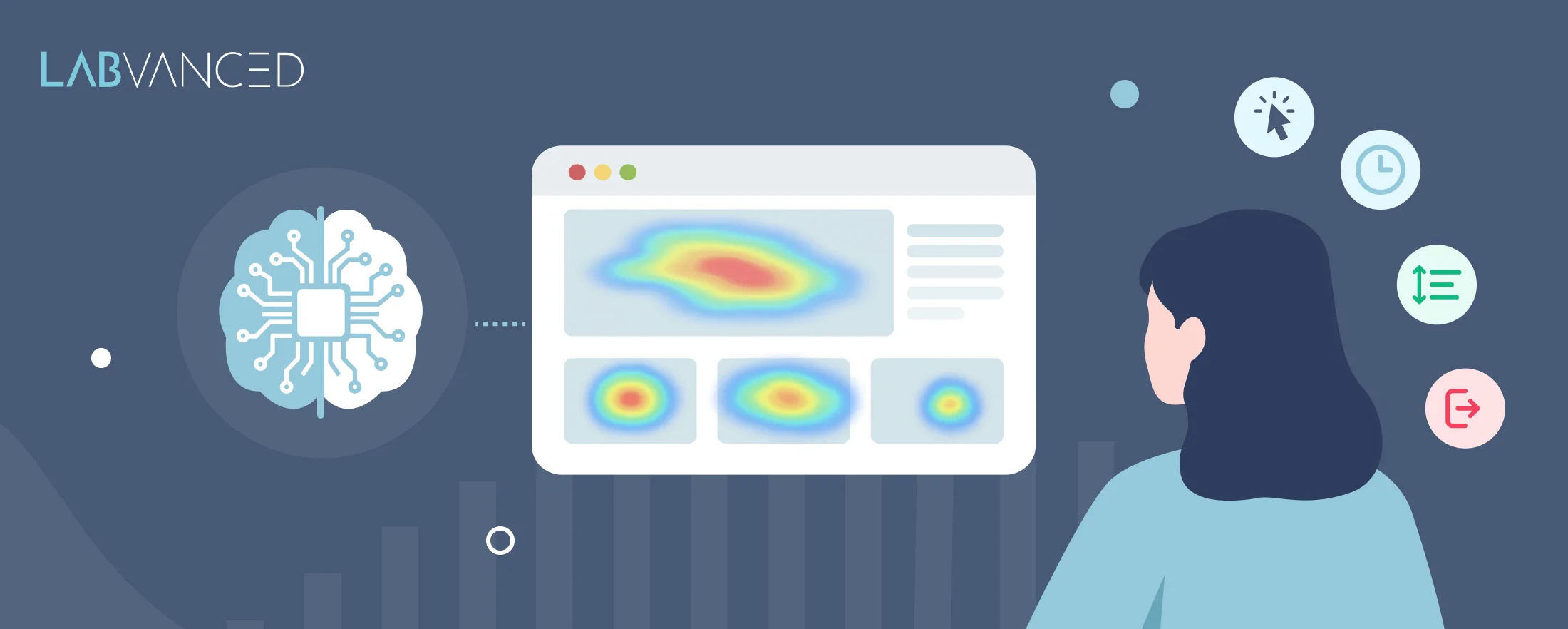
AI tools can now predict where people will look on a webpage in about a minute, without a single real visitor. What they can't tell you is what that visitor would have done next: clicked, hesitated, scrolled on, or left.
Picture a team redesigning a pricing page. They upload the new design to an attention-prediction tool, and the heatmap comes back glowing red over the "Start free trial" button. The design draws the eye. Good news, it seems.
But the heatmap can't answer the question the team actually cares about. Did anyone click that button? Or did people look at it, scroll down to check the price, and close the tab?
That gap is the difference between a prediction and a measurement.
A Heatmap in About a Minute
Tools like Attention Insight and expoze.io work without participants. You upload a design, and a model trained on earlier eye-tracking studies predicts where attention will land. Attention Insight says its model learned from more than 5.5 million recorded eye fixations and returns a result in about 60 seconds (Attention Insight, n.d.).
The predictions hold up well. On the MIT/Tuebingen Saliency Benchmark, a public academic test that compares predicted heatmaps with real eye-tracking data, Attention Insight reports 92.5% accuracy for general images and expoze.io reports 95% (Attention Insight, n.d.; expoze.io, n.d.).
One caveat: each vendor picked its own test images, so these are vendor-run results rather than independent audits. An outside study did find expoze.io's predictions close to real eye tracking, using 30 photographs viewed by 110 participants (Ahtik, 2023).
For early design work, that's genuinely useful. You can compare five layout ideas before lunch without recruiting anyone.
What No Prediction Can Show You
A predicted heatmap shows where attention is likely to go, on average. It can't show what a person does with that attention, because no person was there.
That leaves out the moments that usually decide whether a page works:
- The click, or the missing click, on the button everyone looked at
- The pause before a form field that asks for a phone number
- The scroll right past the section you spent weeks on
- The tab closed halfway through checkout
Attention is where a visit starts. Behavior tells you how it ended.
Predict Early, Measure Before You Decide
Most teams will end up using both, so the useful question is when each one earns its place.
Prediction fits the early, fast stage: sorting rough drafts, catching a layout that buries the key message, or checking a banner before it goes out for review. It's quick, it's cheap, and it's good at describing the average viewer.
Real behavior fits the moments when a decision carries weight: launching the redesign, choosing between two final versions, or explaining to stakeholders why sign-ups dropped. At that point, "people will probably look here" isn't enough. You need to see what people actually did.
Teams that use both get the speed of prediction and the confidence of evidence.
Recording Real Behavior on a Live Website
Go back to the team with the pricing page. The heatmap told them their "Start free trial" button gets noticed. What they still need is to watch real people use the page, and that's the stage Labvanced Web Bridge is built for.
To set up the study, the team pastes the pricing page's web address into a Labvanced study, then clicks on the parts of the page they want to follow: the headline, the price table, the trial button. Nothing on the website itself has to change.
Participants then take part from their own computer. They see the real, live pricing page and use it the way anyone would: reading, scrolling, hovering, and clicking. While they do, their webcam shows where they're looking, and Labvanced records every click, hover, and scroll on the parts the team marked. Participants need Google Chrome and a free browser extension, and Labvanced walks them through installing it if they don't have it yet.
That combination is what makes the study so revealing. Eye tracking and behavior tracking run at the same time and are recorded on the same parts of the page, so for every element the team marked, they can see both whether people looked at it and what they did next. Either measure on its own tells half the story. Together, they show how a look turned into an action, or didn't.
Now the team can answer the questions the heatmap couldn't. Did the people who looked at the trial button go on to click it? Did some hover over it, scroll down to the price, and leave? Where did attention and action pull in different directions?
Because Web Bridge is part of Labvanced's full experiment platform, the same study can also show different participants different versions of the page. That lets the team put their two final designs side by side and see which one people actually act on.
The webcam eye tracking behind all of this has been tested against the EyeLink 1000, a lab-grade eye tracker, in an independent, peer-reviewed study that found it performs close to laboratory standards (Kaduk et al., 2024).
Frequently Asked Questions
Are AI-predicted attention heatmaps accurate? They score well on a public benchmark. Against the MIT/Tuebingen Saliency Benchmark, Attention Insight reports 92.5% accuracy for general images and expoze.io reports 95%. Each vendor chose its own test images, so treat these as vendor-run results rather than independent audits.
What's the difference between predicted attention and real behavioral data? Predicted attention is a model's estimate of where an average viewer would probably look, produced without anyone seeing the page. Real behavioral data is recorded from actual people using the page: where they looked, what they clicked, how far they scrolled, and whether they left.
Can you eye track a live website without special hardware? Yes. Labvanced Web Bridge uses the participant's own webcam to record where they look on a real, live website, along with their clicks, hovers, and scrolling. Participants need Google Chrome and a free browser extension, and the website itself doesn't need any changes.
Is webcam eye tracking accurate enough for research? Labvanced's webcam eye tracking was compared with the EyeLink 1000, a lab-grade eye tracker, in an independent, peer-reviewed study. It reached an overall accuracy of 1.4° and a precision of 1.1°, which the authors describe as close to laboratory standards (Kaduk et al., 2024).
Key Takeaways
- AI attention tools predict where people will look in about a minute, with no participants, and score well on a public academic benchmark.
- A prediction can't show behavior: clicks, hesitation, scrolling, or abandonment.
- Use prediction to iterate early, and real behavioral data when a decision depends on it.
References
Ahtik, J. (2023). Using artificial intelligence for predictive eye-tracking analysis to evaluate photographs. Journal of Graphic Engineering and Design, 14(1), 29–35. https://doi.org/10.24867/JGED-2023-1-029
Attention Insight. (n.d.). Technology. Retrieved 2026-09-26 from https://attentioninsight.com/technology/
expoze.io. (n.d.). Meet expoze.io. expoze.io Knowledge Base. Retrieved 2026-09-26 from https://support.expoze.io/article/62-meet-expoze-io
Kaduk, T., Goeke, C., Finger, H., & König, P. (2024). Webcam eye tracking close to laboratory standards: Comparing a new webcam-based system and the EyeLink 1000. Behavior Research Methods, 56(5), 5002–5022. https://doi.org/10.3758/s13428-023-02237-8
What is Labvanced? Labvanced is a no-code platform for building and running behavioral experiments online, in-lab, and on mobile, with peer-reviewed measurement like webcam eye tracking and millisecond timing built in. Explore the platform · Start free