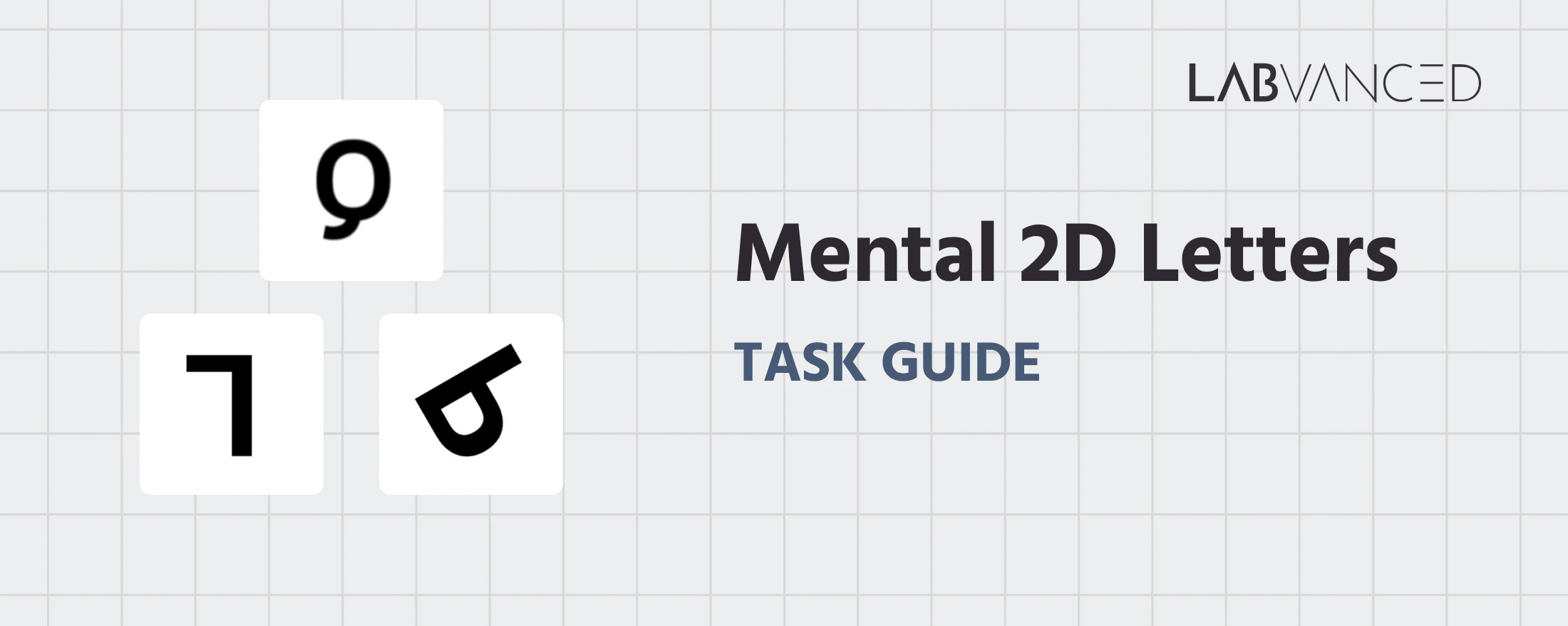
The Mental Rotation Task 2D
The Mental Rotation Task 2D assesses spatial reasoning by requiring participants to compare rotated two-dimensional (2D) objects. It is widely used in cognitive psychology and neuroscience to study visual transformation, spatial ability, and decision making under rotation.
Table of Contents
Task Format | Mental Rotation Task 2D Online & In-Lab
In the Mental Rotation Task 2D, participants are presented with flat visual stimuli displayed at varying rotation angles. In this importable and customizable version of Mental Rotation 2D Task, participants view letters presented at different orientations and decide whether each letter appears in its normal (canonical) form or as a mirror-reversed version. Participants first complete a practice block with feedback and must reach at least 90% accuracy before moving on to the main trials. During the experimental block, letters remain on screen for a limited time and no feedback is provided. Participants are instructed to respond as quickly and accurately as possible.
Two versions of the Mental Rotation Task (2D Letters) are available, each optimized for the type of device and input method being used:
Desktop Version
In the desktop version, a rotated letter appears at the center of the screen on each trial. Participants respond using the F and J keys to indicate whether the letter is normal or mirror-reversed, with the key-to-response mapping counterbalanced across participants. Practice trials provide correctness feedback, while experimental trials use a fixed presentation duration (e.g., 2000 ms) and record missed responses with an accuracy value of 0.
Mobile Version
In the mobile version, letters are presented one at a time in the same format. Participants respond by tapping Normal or Mirror buttons displayed on the screen. Practice trials provide correctness feedback, while experimental trials use a fixed presentation duration (e.g., 2000 ms) and record missed responses with an accuracy value of 0. This version is optimized for touchscreen interaction and includes practice trials before the main task begins.
Mental Rotation Task 2D Data Collected & Metrics
The Mental Rotation Task 2D captures a range of behavioral measurements that reveal how individuals mentally transform and compare rotated visual stimuli. The variables recorded enable researchers to assess reaction times, response accuracy, error patterns, and performance differences across rotation angles and stimulus types (e.g., normal vs. mirror trials). These measures help quantify visuospatial processing efficiency, mental rotation speed, and decision accuracy under varying levels of spatial transformation demand. All variables can be viewed and customized within the task’s Variables Tab.
Below are several of the most informative indicators that researchers frequently analyze in this version of the task:
| Variable Name | Description |
|---|---|
accuracy | Trial-level accuracy (1 = correct, 0 = incorrect) |
accuracy_total | Total number of correct responses across trials |
Assigned mapping | The group assignment for key randomization |
choice | Response given by the participant (keypress = F/J or button click = "Normal"/"Mirror") |
error | Trial-level error (0 = correct, 1 = wrong) |
errors_total | Total number of incorrect responses |
letter | Letter shown on the screen (F, P, Q, G, L, R) |
reaction_time | Time taken (in milliseconds) by the participant to respond to the stimulus presented |
rotation_angle | Rotation angle of the letter (0°, 60°, 120°, 180°, 240°, 300°) |
stimulus_type | Category that the stimulus belongs to (normal or mirror) |
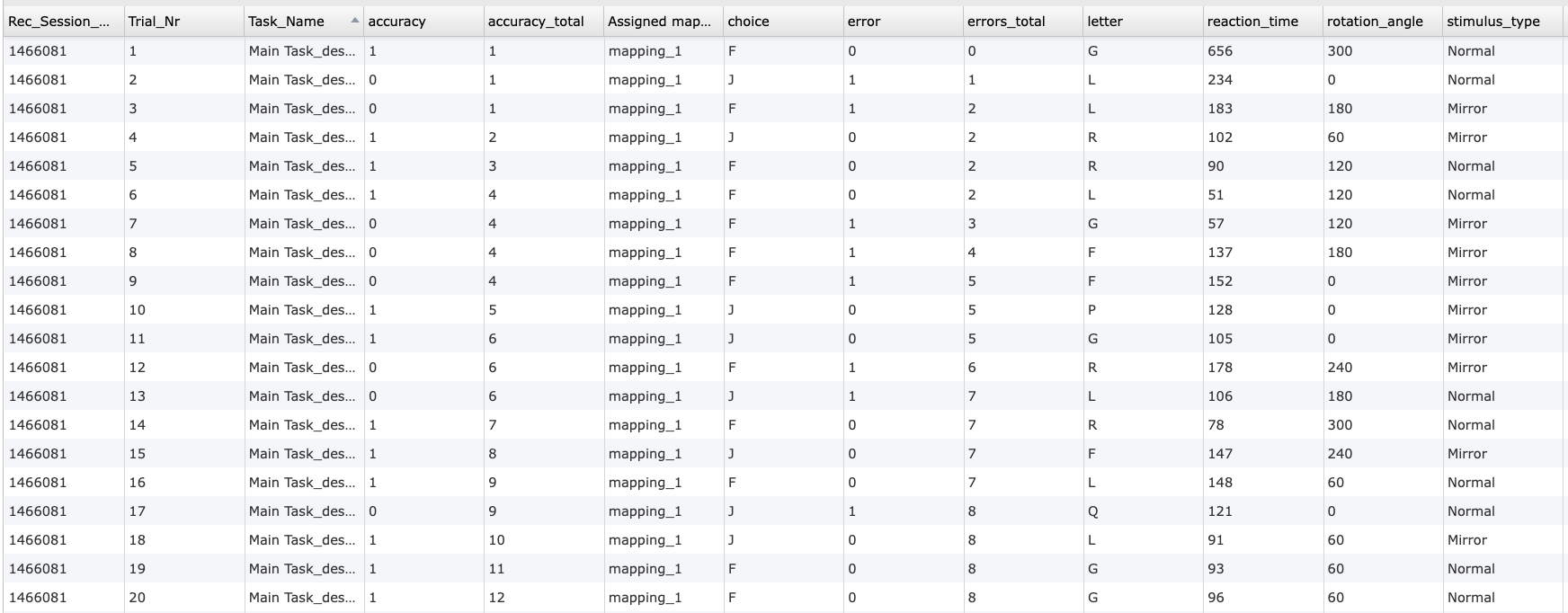
Data table showing an excerpt of individual trial-level outputs from the Mental Rotation Task 2D, including accuracy, assigned response mapping, participant choice, reaction time, rotation angle, and stimulus type.
In this experiment, letters are presented at different orientations. The participant must decide whether each letter is normal or mirror-reversed.
Technology Driving the Mental Rotation Task 2D for Online & In-Lab Research
The Mental Rotation Task 2D requires precise control over stimulus orientation, timing, and response handling. Labvanced provides flexible tools that support these requirements across different study environments.
Precise Control of Orientation Values: Stimuli can be presented as visual objects with adjustable rotation settings. Researchers can define multiple angles and distribute them across trials using condition based logic.
Flexible Input Across Devices: Responses can be collected via keyboard input on desktop devices or through on screen buttons on touch enabled devices. The same experimental logic can be reused while adapting the response interface to the available input method.
Desktop App Support for Controlled Experiments: For lab-based studies requiring stable timing or integration with external hardware, the task can be deployed using the Labvanced desktop app. This supports compatibility with EEG or other LSL based systems.
Remote and Longitudinal Deployment: The task can be delivered remotely and repeated across multiple sessions, making it suitable for studies examining spatial ability development or training effects over time.
Optional Webcam Eye Tracking Integration: Researchers can integrate webcam based eye tracking to analyze gaze behavior and visual search strategies during mental rotation trials.

Webcam Eye Tracking
Capture gaze patterns and visual attention during mental rotation trials.

Timing Precision
Capture reaction times, task performance, and more with millisecond accuracy for time-sensitive tasks.

Desktop App
Run in-lab studies using the Desktop App, compatible with EEG and other LSL-connected lab hardware.
Customization of the Mental Rotation Task 2D
There are many ways to adapt the task template to meet specific research questions. Below are a few themes researchers commonly ask when it comes to modifying this task.
Stimulus Presentation and Orientation Settings
Mental Rotation Task 2D studies can use a variety of stimulus types. Researchers can replace or edit stimuli directly in the editor by adding a Text Object for text based stimuli, an Image Object for image stimuli, or other visual forms using shape or SVG based objects from the Objects panel. Visual properties such as size, spacing, rotation angle, and appearance can then be adjusted through the Object Properties panel.
Condition Logic and Trial Variations
Rotation angles and stimulus configurations are typically defined through trial conditions that determine which setup appears on each trial. The Trials & Conditions panel could be utilized to assign varied values. These values are read during runtime to control orientation and presentation.
Trial Flow and Practice Structure
Practice blocks, feedback timing, and task progression are controlled through frames and Events. Researchers can adjust trial counts, timing parameters, and progression rules to fit specific study designs.
Response Handling and Trial Flow
Participant selections are captured through clicks/taps, or key presses and evaluated using Event logic. Researchers can modify how responses are logged, how missed responses are handled, and how trials progress, all through the event system. Simply modify the triggers or actions specific to your needs.
If there is something else you’d like to know, please feel welcome to write to us and ask:
Recommended Use and Applications of the Mental Rotation Task 2D
The Mental Rotation Task 2D is widely used in cognitive psychology and neuroscience to study spatial reasoning, visual imagery, and mental transformation processes. Researchers often use it to examine how reaction time and accuracy change with rotation angle, as well as to investigate individual differences in spatial ability across developmental, educational, and neurocognitive contexts.
Spatial Cognition Research: Researchers use this task to study how individuals mentally transform flat visual objects across different rotation angles. Performance patterns, particularly reaction time increases with greater angular disparity, provide insight into underlying spatial processing mechanisms.
Developmental Studies: The task is frequently applied to examine how two dimensional spatial reasoning evolves across childhood, adolescence, and adulthood. Differences in speed and accuracy help researchers understand changes in cognitive strategy and visual processing efficiency over time.
Education and Skill Acquisition Research: Mental Rotation Task 2D paradigms are used to explore relationships between spatial ability and performance in academic or technical domains. Because the task isolates planar transformations, it allows researchers to assess foundational spatial skills without added depth complexity.
Neurocognitive Research: The task is included in studies examining visual imagery, attentional control, and decision making under spatial transformation demands. Researchers often combine behavioral data with eye tracking or neural measures to better understand how spatial judgments are formed.
References
Xiang, Z., Huang, Y., Luo, G., Ma, H., & Zhang, D. (2021). Decreased event-related desynchronization of mental rotation tasks in young Tibetan immigrants. Frontiers in Human Neuroscience, 15.
Cooper, L. A. (1975). Mental rotation of random two-dimensional shapes. Cognitive psychology, 7(1), 20-43.
Related Tasks
The Mental 2D Rotation Task pairs naturally with other spatial cognition tasks in Labvanced's task library.
Mental Rotation Task (3D Body Rotation)
This study investigates how people mentally rotate images of human bodies. Participants view figures from different angles and decide if a raised limb is right limb or left limb.
Corsi Block Tapping Test
Blocks flash sequentially on screen. Participants must repeat the sequence by clicking the blocks in the exact order shown.