
Stock Market Game
The Stock Market Game is an economic decision-making task in which participants act as investors, buying and selling shares across multiple funds as prices fluctuate from round to round, with the goal of maximizing total portfolio value. Labvanced offers both a single-player version and a real-time 2-player version, in which one participant receives insider price hints and decides whether to share them accurately, share false information, or withhold them entirely.
Table of Contents
Task Format | Stock Market Game Online & In-Lab
On each round, participants see the current price of four funds alongside how many shares of each they currently own, and can buy or sell any quantity using a number input and Buy/Sell buttons per fund. Portfolio value is calculated live from current holdings and prices, and displayed alongside remaining cash so participants can track their standing throughout the game. Prices update at the start of each round via a random walk, so no two playthroughs follow the same price path. The task provides on-screen feedback for invalid actions (insufficient funds, attempting to sell more shares than owned, or submitting a trade with no quantity entered) so participants always understand why an action didn't go through.
Single-Player Version
Participants start with $10,000 in cash and play 10 rounds. At the start of each round, every fund's price shifts by a random amount drawn from a Gaussian distribution, producing realistic, unpredictable price movement rather than a fixed up-or-down pattern. At the end of the game, participants see their final portfolio value, remaining cash, and total gain or loss relative to their $10,000 starting point.
Multiplayer Version (2 Players)
The multiplayer version pairs two participants in a real-time synchronous session over 5 rounds, each with a 30-second countdown to act before the round advances. One participant is assigned the inside investor role and receives a hint each round naming a specific fund and the probability and direction (increase or decrease) it is likely to move, a hint that is generated from the same underlying price-update logic driving that round's actual price change, so the information is genuinely predictive, not decorative. The inside investor then chooses to Share the hint accurately, Deceive by sharing the opposite direction, or withhold it entirely by choosing Don't Share. Both players see each other's live portfolio value and cash throughout the game, and the winner is whichever player ends with the higher combined portfolio and cash total.
Data Collected with the Stock Market Game
The Stock Market Game captures a range of behavioral measurements that reveal how participants make investment decisions under price uncertainty, and, in the multiplayer version, how they handle strategic information sharing. The variables recorded help researchers quantify trading behavior, portfolio outcomes, and, in the 2-player version, honesty and deception patterns in the information shared between participants. All variables can be viewed and customized within the task's Variables Tab.
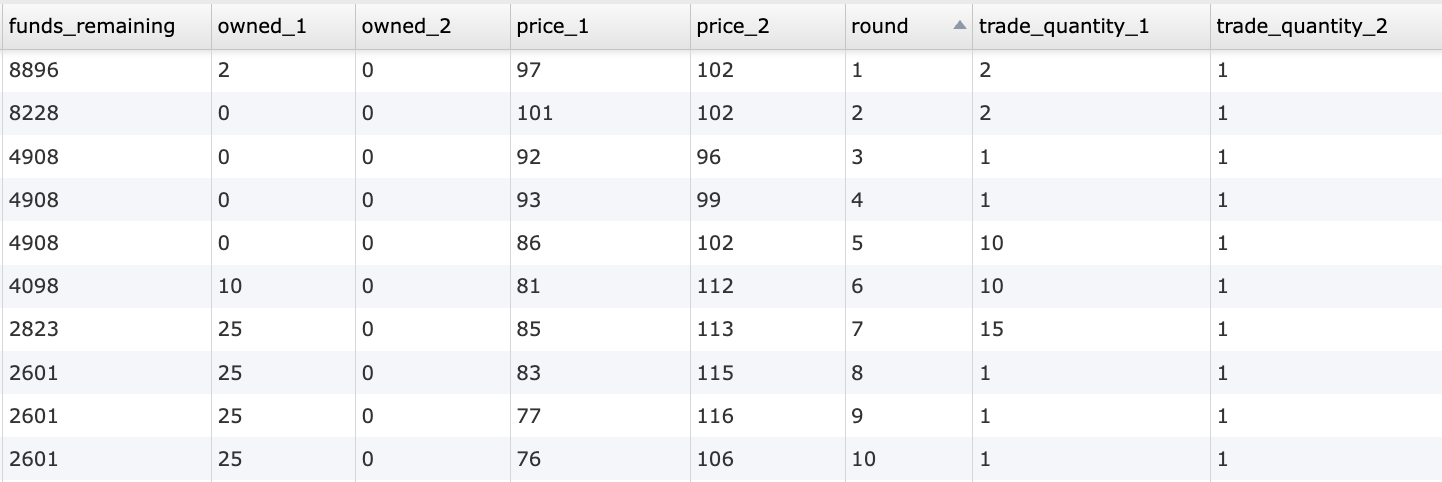
Below are key variables collected in the Labvanced version of the Stock Market Game:
| Variable Name | Description |
|---|---|
price_1–price_4 | Current price of each of the four funds on that round |
owned_1–owned_4 | Number of shares of each fund the participant currently holds |
trade_quantity_1–trade_quantity_4 | Quantity entered for a buy or sell action on each fund |
funds_remaining | Participant's remaining uninvested cash |
portfolio_value | Total current value of all shares owned, calculated live from current prices |
round | Current round number |
stockForHint | Multiplayer only. Which fund the inside investor's hint that round refers to |
increaseOrDecrease | Multiplayer only. The price direction shared with the other player (accurate or deceptive) |
playerSharesHint | Multiplayer only. Whether the inside investor chose to share, withhold, or deceive on that round |
p1Won | Multiplayer only. Whether the participant's combined portfolio and cash total was higher than their partner's at game end |
This study measures economic decision-making under price uncertainty using the Stock Market Game. Participants buy and sell shares across multiple funds as prices fluctuate each round, aiming to maximize portfolio value. A real-time 2-player version adds strategic information sharing between an insider investor and a second participant.
Technologies Supporting the Stock Market Game
Multi-User Research: The 2-player version runs as a real-time synchronous session with distinct roles (inside investor and second player), live cross-participant variable exchange (hints, portfolio values), and no networking or server code required to set up.
Timing Precision: Round-based countdowns and price updates are driven by Labvanced's timing system, ensuring both players in the multiplayer version experience rounds advancing in sync.
Desktop App: For in-lab or paired-session deployments, the task can be run using the Labvanced Desktop App, compatible with EEG and other LSL-connected lab hardware.

Multi-user Research
Run synchronous, real-time multi-participant studies without having to write any networking or server code.

Timing Precision
Capture reaction times, task performance, and more with millisecond accuracy for time-sensitive tasks.

Desktop App
Run in-lab studies using the Desktop App, compatible with EEG and other LSL-connected lab hardware.
Customizing the Stock Market Game Template
There are many ways to go about customizing this template. Below are a few themes researchers commonly ask when it comes to modifying this task.
Starting Capital, Number of Funds, and Rounds
The $10,000 starting cash, the four funds, and the round count (10 rounds single-player, 5 rounds multiplayer) are all editable. Round count is set in the task's trial loop settings, and additional funds can be added by extending the price and ownership variable set following the existing price_1–price_4 / owned_1–owned_4 pattern.
Price Volatility
Round-to-round price movement is drawn from a Gaussian distribution (currently mean 0, standard deviation 5) via a Draw Random Number action. Researchers can widen or narrow this distribution to make the market more or less volatile, or replace the random-walk logic with a different price model entirely.
Insider Hint Mechanics (Multiplayer)
The probability threshold that determines how often the inside investor's hint is accurate, and the Share/Deceive/Don't Share options themselves, are controlled through conditional logic and button events. Researchers studying strategic communication or trust can adjust the hint accuracy rate, add more response options, or track additional variables around the decision to share.
Round Timing (Multiplayer)
The 30-second per-round countdown in the multiplayer version is implemented as a repeating countdown action and can be lengthened, shortened, or removed if untimed rounds better suit a given study design.
If there is something else you'd like to know, please feel welcome to write to us and ask:
Recommended Use and Applications of the Stock Market Game
The Stock Market Game is well suited to research on economic decision-making, risk-taking, and, in its multiplayer form, strategic communication under information asymmetry.
Behavioral Economics and Risk Research: The single-player version provides a controlled setting for studying portfolio allocation, loss aversion, and risk tolerance under fluctuating asset prices.
Game Theory and Strategic Communication Research: The multiplayer version's insider-hint mechanic maps directly onto classic information-asymmetry and cheap-talk paradigms in experimental economics, where researchers study when and why people share accurate information, deceive, or stay silent when it benefits them.
Multi-Participant and Social Decision-Making Research: The real-time synchronized 2-player session supports studies of trust, cooperation, and competition between participants who can observe each other's outcomes as the game unfolds.
Financial Literacy and Investment Behavior Studies: Both versions offer an accessible, gamified setting for studying how novice versus experienced participants approach investment decisions.
Related Tasks
The Stock Market Game pairs naturally with other economic decision-making tasks in Labvanced's task library.
Ultimatum Game
In this interactive 2-player game, one player proposes a split of money and the other decides to accept or reject.
Balloon Analog Risk Task (BART)
Participants pump a virtual balloon to accumulate earnings with each pump, balancing potential reward against the risk of the balloon popping and losing all gains for that trial.
Delay Discounting Task (DDT)
Participants choose between a smaller reward available now and a larger reward available later, across a range of delay intervals and discount rates, measuring impulsivity and time preference.