Delay Discounting Task (DDT)
The Delay Discounting Task (DDT) measures how the value of a reward diminishes the longer a person has to wait for it. On each trial, participants choose between a smaller reward available immediately and a larger reward delayed by an interval ranging from one day to ten years, and the resulting discounting rate is a standard behavioral measure of time preference and impulse control.
Table of Contents
Task Format | Delay Discounting Task (DDT)
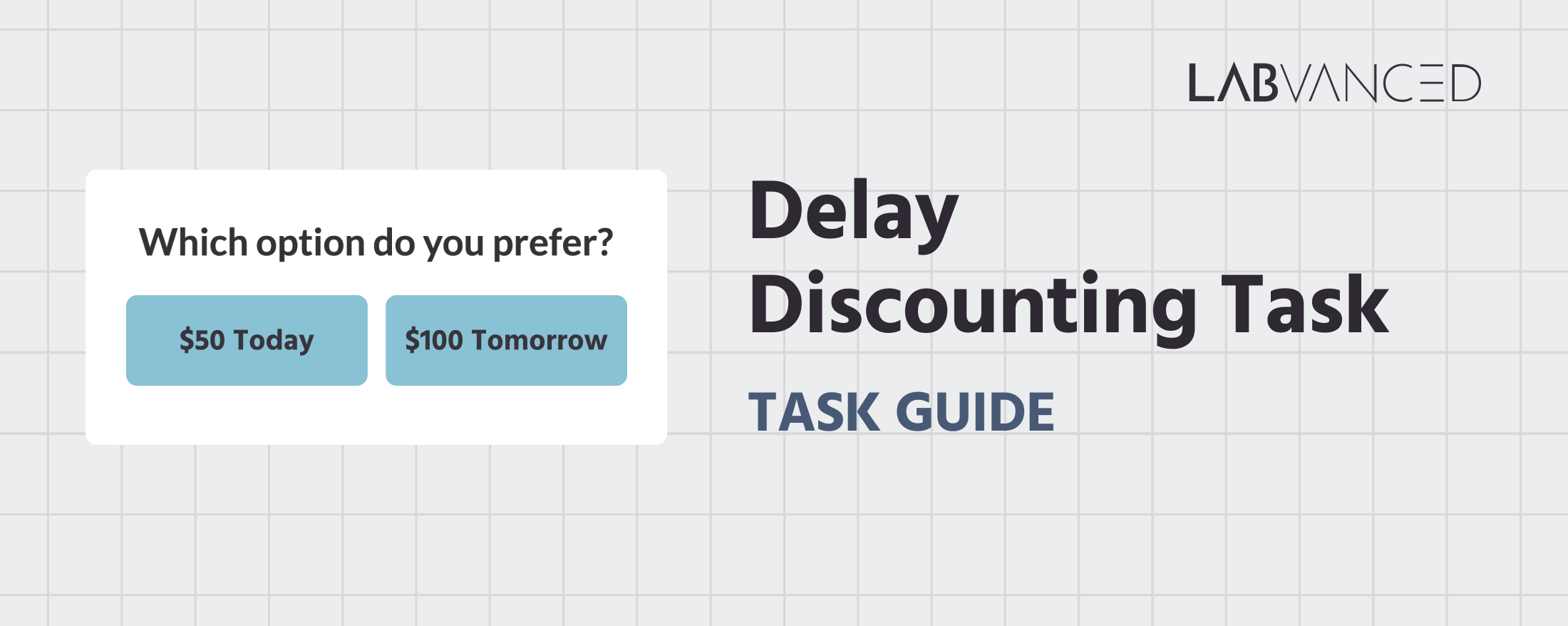
Each trial presents two options side by side: an Immediate Reward button showing a fixed smaller amount available today, and a Delayed Reward button showing a larger amount available after a specified delay. The delay is drawn from 12 intervals ranging from 1 day to 10 years, crossed with three hypothetical discount rates (k = 0.1, k = 0.05, and k = 0.005) that determine how much larger the delayed reward is, producing 36 discounting trials in total. Two catch trials are interspersed to check response consistency, and the side of the screen showing each option is randomized on every trial to control for a left or right response bias. Two practice trials precede the main task so participants understand the choice format before their responses are recorded.
Desktop Version
The task runs in fullscreen and participants respond with mouse clicks on the on-screen Immediate Reward and Delayed Reward buttons. A brief fixation cross precedes each trial, followed by the choice screen showing both options with their respective dollar amount and delay. The time between trial onset and the participant's click is recorded in milliseconds, alongside which option was selected.
Mobile Version
The DDT is fully compatible with mobile and tablet devices. Because the task is entirely click and touch based with no keyboard input required, the same button layout, fixation cross, and choice screen are presented on touchscreens without modification.
Data Collected with the Delay Discounting Task (DDT)
The DDT captures a range of behavioral measurements that reveal how participants weigh reward magnitude against delay length. The variables recorded help researchers quantify discounting behavior, decision timing, and trial-level choice patterns across all delay and discount-rate conditions. All variables can be viewed and customized within the task's Variables Tab.
Below are key variables collected in the Labvanced version of the DDT:
| Variable Name | Description |
|---|---|
Condition_Id | Numeric identifier of the trial's condition, a specific delay interval and discount rate combination, within the task |
d (days)_value | The delay interval presented on that trial, converted to a numeric day count (for example 7 for "1 week", 365 for "1 year") |
Delay Duration_value | The delay interval presented on that trial (for example "1 day", "6 months", "10 years") |
delayed_reward | Binary indicator (1/0) of whether the participant chose to wait for the larger, delayed reward on that trial |
k_value | The hypothetical discount rate applied to that trial (0.1, 0.05, or 0.005) |
Position of Delay_value | The side of the screen the delayed-reward option appeared on for that trial ("Left" or "Right") |
reaction_time | Time in milliseconds between trial onset and the participant's choice |
Reward Amount_value | Dollar amount of the larger, delayed reward offered on that trial |
SV_value | Dollar amount of the smaller, immediate reward offered on that trial (fixed at $10, or $20 on catch trials) |
click_choice | Which option the participant selected on that trial ("Immediate Reward" or "Delayed Reward") |

This study measures intertemporal choice and impulsivity using the Delay Discounting Task. Participants choose between a smaller reward available now and a larger reward available later, across a range of delay intervals and discount rates. Choice, delay condition, and reaction time are recorded as performance indicators.
Technologies Supporting the Delay Discounting Task (DDT)
Timing Precision: Reaction time (
reaction_time) is captured with millisecond accuracy on every trial, enabling analyses of decision latency and how deliberation time shifts as the delay or discount rate changes.Desktop App: The DDT can be run in controlled lab settings using the Labvanced Desktop App, which supports offline testing and integration with LSL-compatible hardware such as EEG, a common pairing in neuroeconomics research on intertemporal choice.
Webcam Eye Tracking: Optional gaze recording can be layered onto the DDT to capture how participants visually attend to the reward amount versus the delay length before choosing, adding a window into the decision process without dedicated hardware.

Webcam Eye Tracking
Capture gaze patterns and visual attention with built-in, code-free and peer-reviewed webcam eye-tracking.

Timing Precision
Capture reaction times, task performance, and more with millisecond accuracy for time-sensitive tasks.

Desktop App
Run in-lab studies using the Desktop App, compatible with EEG and other LSL-connected lab hardware.
Customizing the DDT Template
There are many ways to go about customizing this template. Below are a few themes researchers commonly ask when it comes to modifying this task.
Delay Intervals and Discount Rates
The 12 delay levels (1 day through 10 years) and the three hypothetical discount rates (k = 0.1, 0.05, and 0.005) are stored in the Delay Duration and k variables within the task's data frame. You can shorten or extend the range of delays, add or remove discount-rate levels, or replace the full 12-interval design with a smaller, faster-to-administer set if your study calls for it.
Reward Amounts and Currency
The immediate reward is fixed at $10 per trial (SV_value), and the delayed reward is calculated from the discount rate and delay length (Reward Amount_value). You can adjust the base immediate amount, change the currency symbol in the button text, or substitute a different discounting formula if your design calls for one.
Number of Trials and Catch Trials
The main task presents 36 discounting trials plus 2 catch trials, defined in the Delay Discounting Task_DDT trial loop. You can adjust the number of trials per condition in the Trials & Conditions panel, remove the catch trials, or add additional discount-rate levels to the design.
Practice Trials and Instructions
Two practice trials introduce the choice format before data collection begins, in the Instructions / Practice Trials_DDT task. You can edit the practice examples, the on-screen instructions, or skip the practice block entirely if your participant pool is already familiar with the paradigm.
If there is something else you'd like to know, please feel welcome to write to us and ask:
Recommended Use and Applications of the DDT
The Delay Discounting Task is one of the most widely used behavioral measures of impulsivity and time preference, applied across clinical, developmental, and economic research to quantify how individuals value future outcomes.
Addiction and Substance Use Research: Delay discounting is extensively studied in alcohol, nicotine, and drug use research, where a steeper preference for smaller immediate rewards over larger delayed rewards is commonly linked to substance use and relapse risk.
Impulsivity and ADHD Research: Used to quantify impulsive choice in ADHD and other conditions characterized by difficulty deferring gratification, alongside other behavioral and self-report measures of impulsivity.
Aging and Lifespan Decision-Making: This template is adapted from a study examining how delay discounting changes across adulthood, making it well suited to developmental and aging research on time preference (Leverett, Garza, & Seaman, 2022).
Neuroeconomics and Decision Neuroscience: Paired with the Desktop App and EEG or other LSL-connected hardware to study the neural correlates of intertemporal choice and reward valuation.
Financial Decision-Making and Behavioral Economics: Applied in individual difference research to examine how time preference relates to saving, spending, and other real-world financial decisions.
References
- Leverett, S., Garza, C., & Seaman, K. (2022). The effect of delay duration on delay discounting across adulthood. The Journals of Gerontology: Series B, 77(3), 467-471. https://doi.org/10.1093/geronb/gbab198
Related Tasks
The Delay Discounting Task pairs naturally with other decision-making and behavioral economics tasks in Labvanced's task library.
Balloon Analog Risk Task (BART)
Participants pump a virtual balloon to accumulate earnings with each pump, balancing potential reward against the risk of the balloon popping and losing all gains for that trial.
Ultimatum Game
In this interactive 2-player game, one player proposes a split of money and the other decides to accept or reject.
Information Sampling Task (IST)
Participants open boxes from a grid to gather evidence before deciding which of two colours is in the majority, across a fixed-reward and a decreasing-reward condition, measuring reflection impulsivity.