Mindfulness-Based Self Efficacy Scale - Revised (MSES-R)
The Mindfulness-Based Self-Efficacy Scale – Revised (MSES-R) is a 22 item self-report tool designed to measure an individual's perceived self-efficacy in applying mindfulness skills in their everyday life. Self-efficacy refers to an individual's belief in their ability to perform specific behaviors or actions to attain specific goals. With its good validity and reliability, the MSES-R stands out to be a widely used scale in clinical and non-clinical settings.
History of the the MSES-R
The MSES-R was derived from the original Mindfulness-Based Self-Efficacy Scale (MSES) which was a 35-item self-report questionnaire developed by Cayoun et al. (2012). The MSES is a tool that provides a comprehensive assessment of self efficacy within the scope of mindfulness training and other mindfulness-based interventions. These interventions had been widely used across various populations, which led the researchers to identify the need for a reliable measure that could capture how effectively individuals internalize and use mindfulness in real-life contexts. The MSES was designed to measure changes in self-efficacy before, during, and after participation in mindfulness-based therapy programs, particularly among clinical populations.
The scale was later revised by Cayoun et al. with the recognition that mindfulness-based practices include a varying set of skills and attitudes, and that individuals might differ in their ability to effectively use these practices. The MSES-R was thus aimed to better reflect the multidimensional aspects of mindfulness self-efficacy. Since its development, the scale has been widely used in clinical and research settings (Cayoun & Elphinstone, 2022; Sheikh & Dawood, 2023).
Structure of the MSES-R
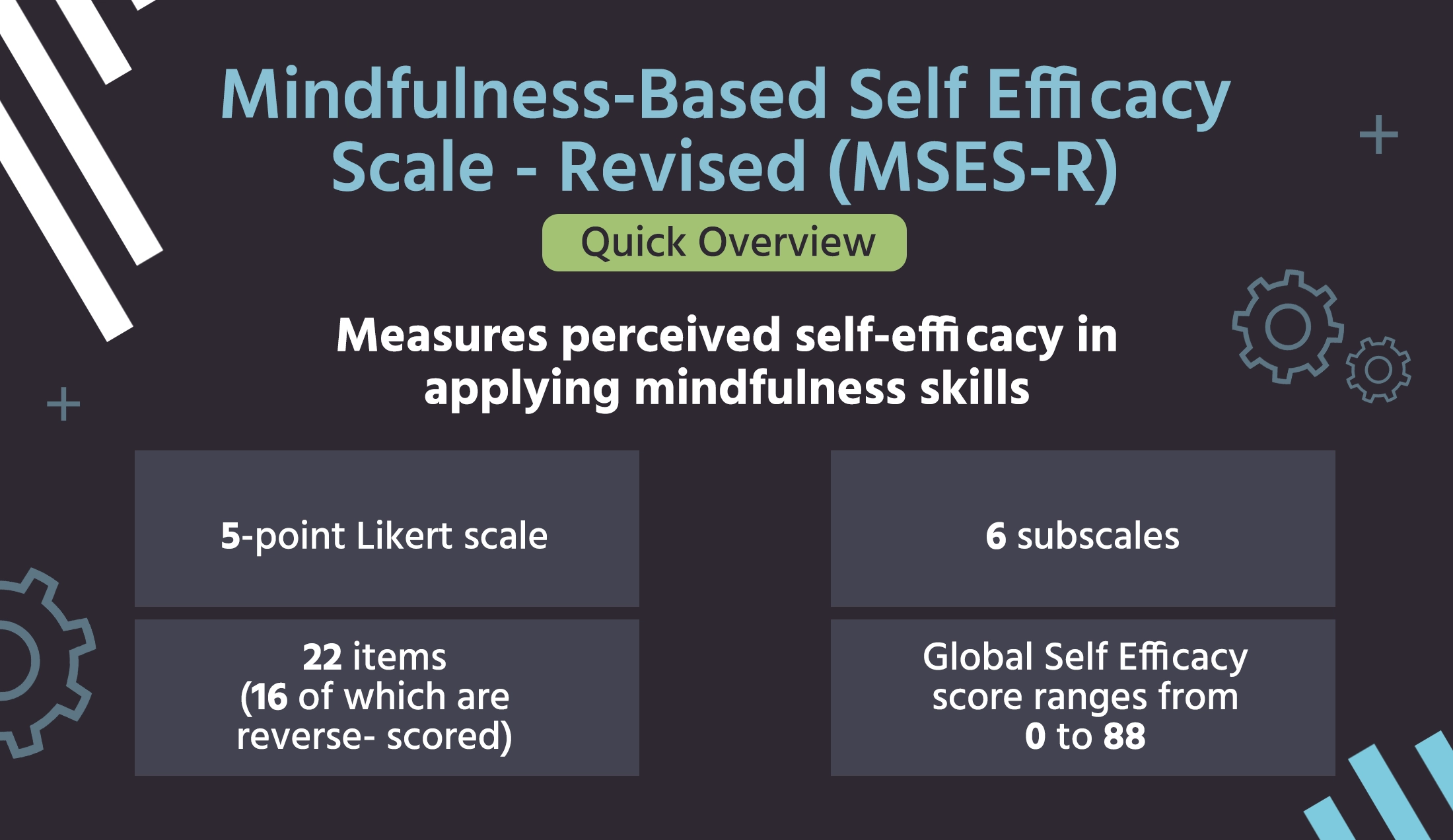
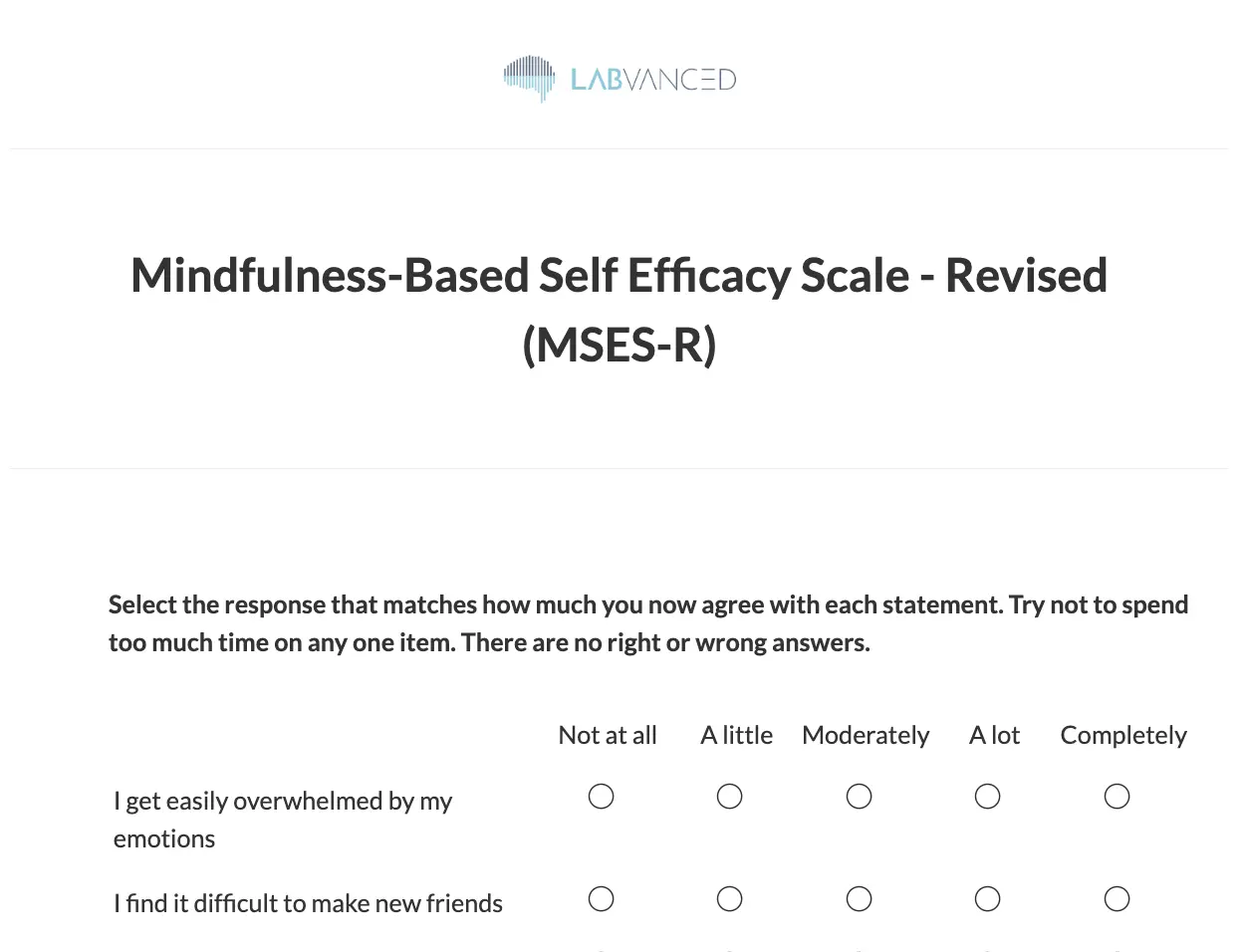
The MSES-R consists of 22 items rated on a 5-point Likert scale. The respondents are expected to indicate how much they agree with each statement. The response options are “not at all,” “a little,” “moderately,” “a lot,” and “completely” with each scored as 0, 1, 2, 3 and 4 respectively (Cayoun & Elphinstone, 2022).
The MSES-R scale is available in the Labvanced Public Library of experiments. If you'd like to use or customize it for your own research, simply click Import to add a copy to your own Labvanced account.
Types of Items in the Mindfulness-Based Self-Efficacy Scale
Here are a few examples of the questions featured in the MSES-R (Cayoun, 2020):
- I get easily overwhelmed by my emotions.
- I find it difficult to make new friends.
- I avoid uncomfortable situations, even when they are important.
- When I feel strong emotions, it takes me a long time to recover.
- I feel comfortable apologizing when I know I am wrong.
For the full list of items simply click the Inspect option here.
Subscales of the MSES-R
The MSES-R has a 6-factor structure. The subscales comprise the following (Cayoun, 2020):
| Subscale of the MSES-R | Items | Description |
|---|---|---|
| Emotion Regulation | 1, 4, 6, 7, 12, 18 | Assesses how well a person can stay calm and manage their emotions, without getting overwhelmed. |
| Equanimity | 5, 10, 13, 19 | Assesses normalise difficulties and not overreact when things go wrong or become difficult. |
| Social Skills | 2, 3, 20 | Assesses how well a person interacts with others in everyday social situations, like talking, listening, and showing empathy. |
| Distress Tolerance | 8, 16, 17 | Assesses the ability to stay with uncomfortable feelings instead of trying to avoid or escape them. |
| Taking Responsibility | 11, 21, 22 | Assesses how clearly a person understands what they are responsible for in relationships and how much control they feel over their actions. |
| Interpersonal Effectiveness | 9, 14, 15 | Assesses the ability to build and maintain close, meaningful relationships. |
Scoring the Mindfulness-Based Self-Efficacy Scale - Revised (MSES-R)
The Mindfulness-Based Self-Efficacy Scale – Revised (MSES-R) includes a total of 22 items. Out of these, 16 items (items 1, 2, 3, 4, 6, 7, 8, 11, 12, 14, 15, 16, 17, 18, 21, and 22) are reverse-scored. To reverse score an item, simply subtract the raw score from 4. For example, if a participant selects the option “a little”, the raw score for that item would be 1 and the reverse score would be 3 (i.e., 4-1).
After applying the reverse scoring, the score for each subscale is calculated by summing up the item scores that belong to that specific subscale. This gives a domain-specific score representing the respondent’s mindfulness self-efficacy in that area. Finally, the Global Self Efficacy (GSE) score is obtained by adding the scores of all subscales, resulting in a score ranging from 0 to 88, with higher scores indicating greater mindfulness-based self-efficacy (Cayoun, 2020).
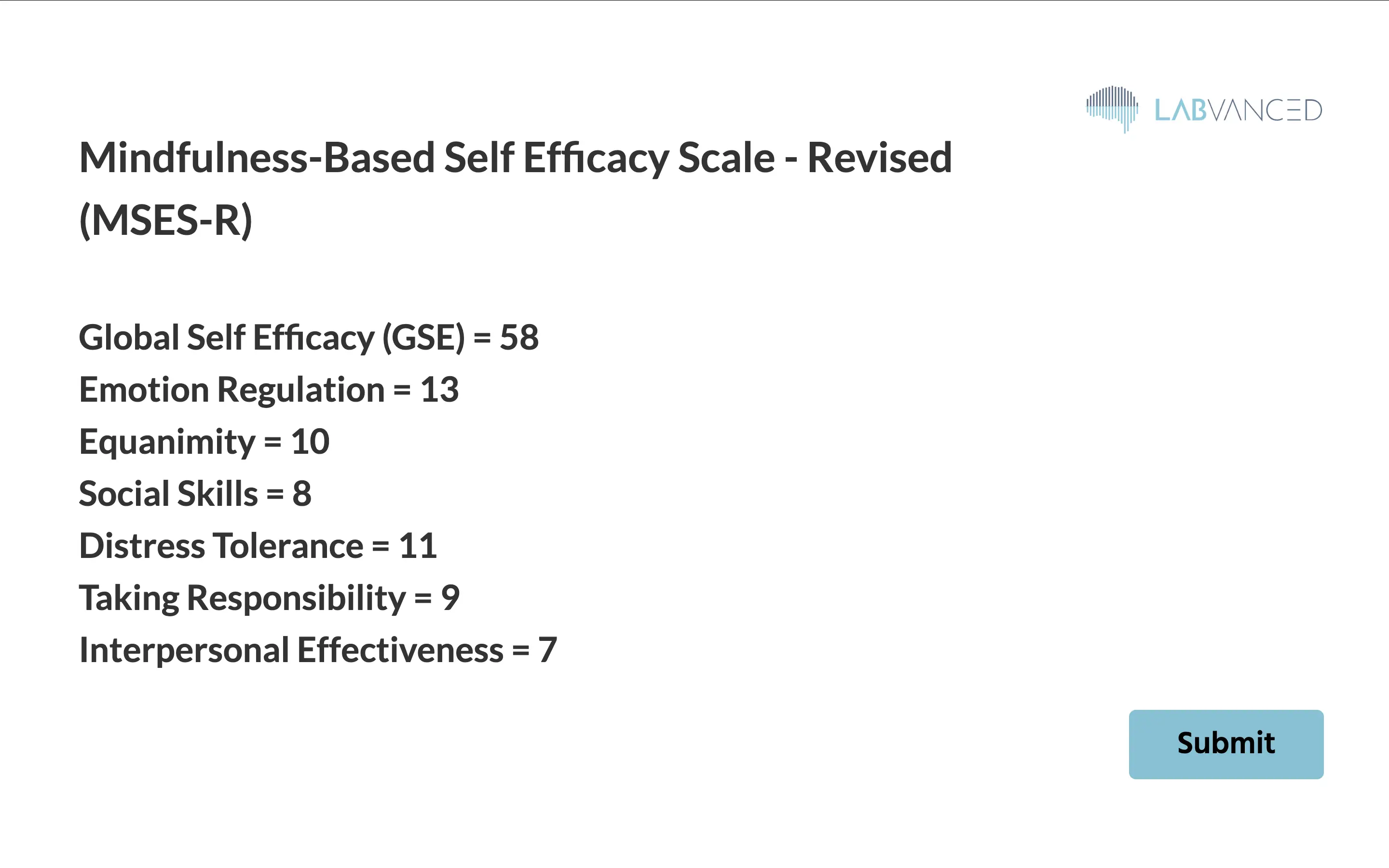
Final scoring screen of the Mindfulness-Based Self-Efficacy Scale – Revised (MSES-R) as implemented in Labvanced, displaying subscale scores and the overall Global Self-Efficacy (GSE) score.
Applying the MSES-R in Psychology Research
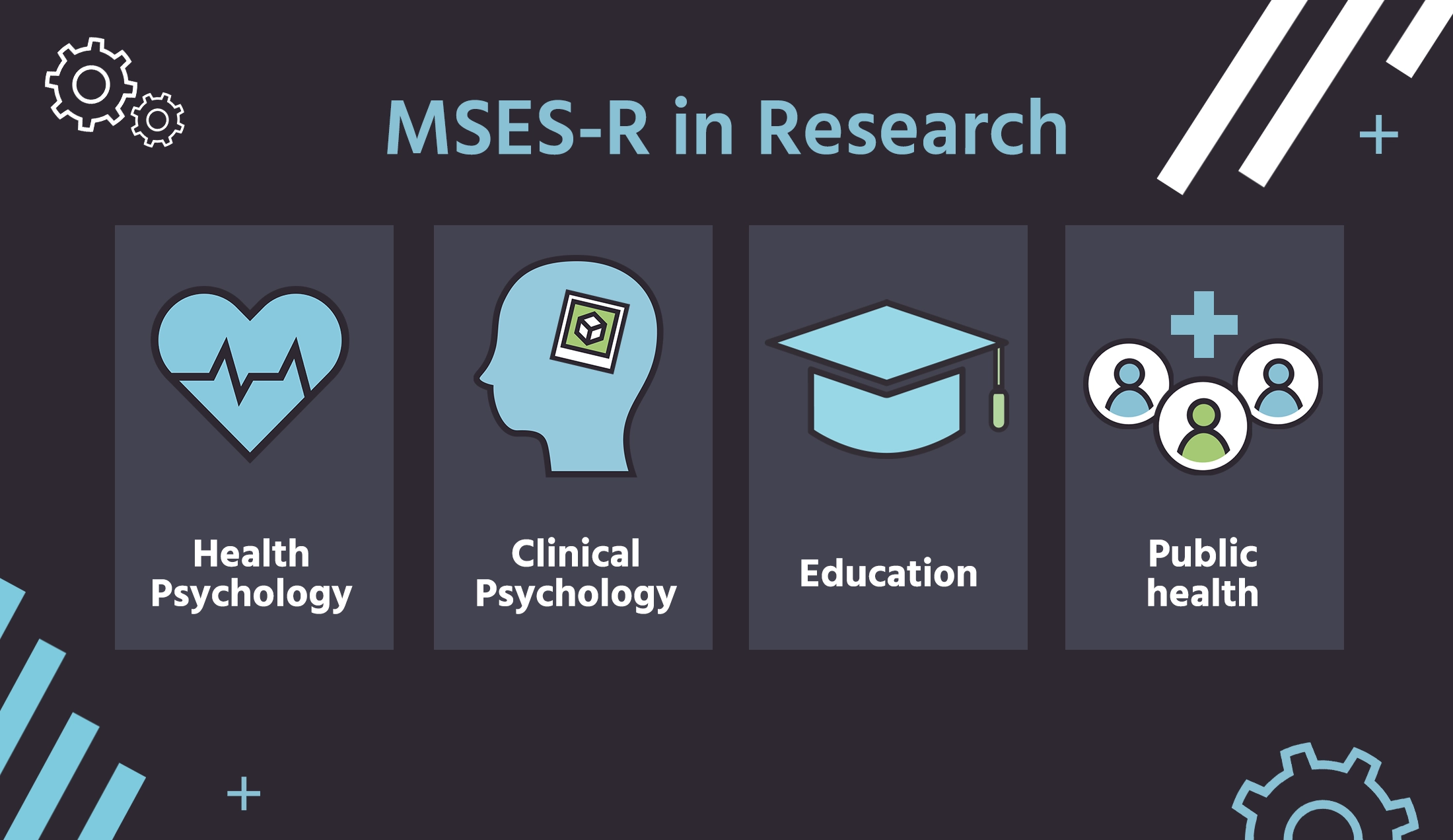
The MSES-R is a valid and efficient tool for assessing the level of self efficacy in applying mindfulness skills. Since its development, researchers have tested and applied the scale in various domains, and it continues to be widely used. Here are a few examples:
- Health Psychology: In a study, MSES-R is used to evaluate the mindfulness and emotional regulation of adolescents participating in the mindfulness-integrated reproductive health (Mind-RH) intervention. The study assesses how this intervention impacts the psychological well-being and knowledge retention of adolescents with parental HIV infection, aiming to enhance their reproductive health education through mindfulness practices (Mon et al., 2017).
- Clinical Psychology: The Mindfulness-based Self-Efficacy Scale-Revised (MSES-R) was utilized to assess the self-efficacy of individuals in relation to mindfulness practices, which is a key aspect of therapeutic interventions aimed at improving mental health outcomes. The research examines the relationships between mindfulness, self-efficacy, and self-esteem among patients with severe psychological problems, emphasizing the relevance of these constructs in psychiatric care and therapy (Sohrabi & Yousefi, 2021).
- Education: A study was conducted in the realm of secondary school education, with a concentrated focus on physics as a subject. It employs the MSES-R to assess how confident students feel about their capabilities in learning physics. By doing so, the research explores how this self-efficacy impacts students' motivation and performance in physics, specifically when the flipped classroom method is implemented (Okokon et al., 2023).
- Public health: The study by Huang et al., (2021) looked at how Adverse Childhood Experiences (ACEs) impacted participants' scores on the MSES-R. By measuring mindfulness self-efficacy, researchers were able to examine whether those who had experienced ACEs felt less confident in their mindfulness abilities.
Conclusion
The MSES‑R is a 22-item, reliable, and valid tool for evaluating individuals' confidence in applying mindfulness skills. With a clear 6-factor structure, it’s suitable for both clinical and non-clinical research settings. It aids in monitoring outcomes and mechanisms underlying mindfulness training.
References
Cayoun, B. A. (2020, February). Mindfulness-Based Self‑Efficacy Scale – Revised (MSES‑R) PDF. MiCBT Institute.
Cayoun, B. A., & Elphinstone, B. (2022). Mindfulness-based self-efficacy scale-revised (mses-R). In the Handbook of Assessment in Mindfulness Research (pp. 1–15).
Cayoun, B. A., Francis, S. E., Kasselis, N., & Skilbeck, C. (2012). The validity, reliability and factor structure of mindfulness-based self-efficacy scale. Presentation at National Conference of New Zealand Psychological Society.
Huang, C., Yang, M., Geng, Y., Chen, Y., Cheung, S. P., Deng, G., Dong, Q., Hu, H., Hua, K., Liao, J., Tan, Y., Tu, B., Wang, E., Yu, Z., Zhang, C., Zhang, S., & Zhuo, G. (2021). Adverse childhood experiences and mindfulness in Chinese college students during the COVID-19 pandemic. Frontiers in Psychiatry, 12.
Mon, M.-M., Liabsuetrakul, T., McNeil, E. B., & Htut, K.-M. (2017). Mindfulness-Integrated Reproductive Health Package for adolescents with parental HIV infection: A group-randomized controlled trial. Vulnerable Children and Youth Studies, 12(2), 147–159.
Okokon, E., Ojar, J. U., Ayuba, J. B., Eyeneka, F. D., Okoli, M. O., & Bassey, E. B. (2023). Influence of self‑efficacy on secondary school students’ interest and academic achievement in physics in Calabar Education Zone, Nigeria. Inter‑Disciplinary Journal of Science Education (IJ‑SED), 5(1), 153–165.
Sheikh, A. S., & Dawood, S. (2023). Reliability, validity and CFA for mindfulness self efficacy scale-R (mses-R) in Urdu language. Human Nature Journal of Social Sciences, 4(3), 94–104.
Sohrabi, F., & Yousefi, F. (2021). Self-efficacy and self-esteem in relationship with mindfulness in psychiatric patients: A descriptive study. Scientific Journal of Kurdistan University of Medical Sciences, 26(2), 103–113.