Information Sampling Task (IST)
The Information Sampling Task (IST) measures reflection impulsivity, the tendency to gather and weigh information before committing to a decision. On each trial, participants uncover boxes from a 5x5 grid one at a time and decide which of two colors is in the majority, and how many boxes they choose to open before deciding is the primary behavioral measure.
Table of Contents
Table of Contents
Task Format | Information Sampling Task (IST)
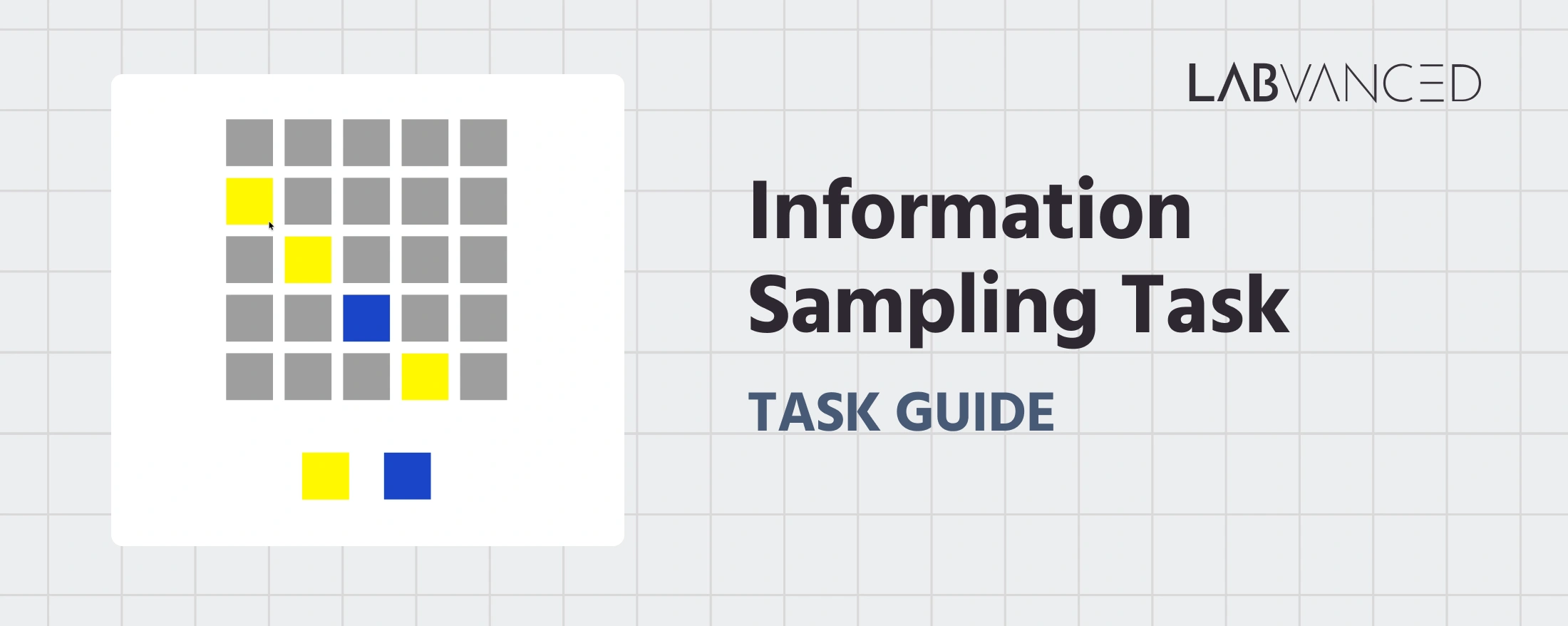
Each trial presents a 5x5 grid of 25 grey boxes above two larger colored panels. Touching a box reveals one of two colors underneath, and the box stays revealed for the rest of the trial. Participants can open as many boxes as they wish before deciding which color they believe is in the majority, then declare their choice by tapping the matching color panel. Once a decision is made, every remaining unopened box reveals its color at once, and a feedback message reports whether the choice was correct.
The task runs across two conditions of 10 trials each, with condition order counterbalanced across participants. In the Fixed Win condition, a correct decision is worth 100 points regardless of how many boxes were opened. In the Decreasing Win condition, a correct decision starts at 250 points and drops by 10 points for every box opened, so deciding earlier yields more points if the answer is right. An incorrect decision costs 100 points in both conditions, regardless of how many boxes were opened. This structure follows the paradigm established by Clark et al. (2006) and used in subsequent reflection impulsivity research (Hauser et al., 2017).
Feedback on the decision is displayed for 2 seconds before the trial ends. The delay leading into the next trial is calculated so that the whole trial, from the first box opened through feedback, takes roughly 30 seconds regardless of how quickly the participant decided, so that responding faster never increases the rate of reward.
Desktop Version
Participants respond with mouse clicks on the grid and the two color panels. Box reveals, the majority-color decision, and the automatic reveal of remaining boxes all render identically to the touch version, and decision time is recorded from trial onset to the moment a color panel is tapped.
Mobile Version
The IST is fully touch-compatible. Because the task requires only tapping boxes and color panels with no keyboard input, the same grid layout and choice mechanic run on touchscreens without modification.
Data Collected with the Information Sampling Task (IST)
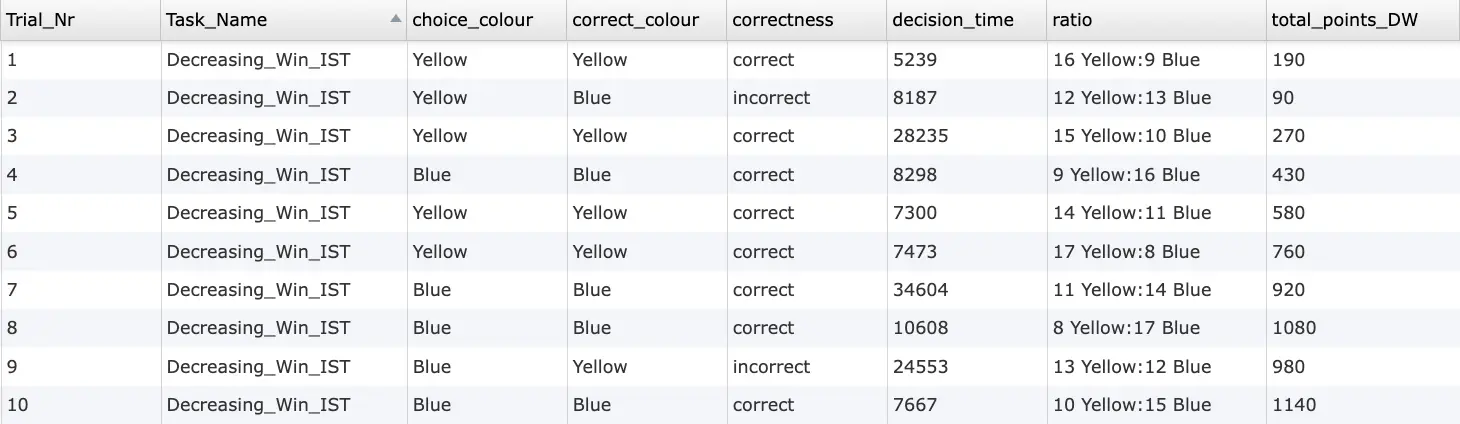
The IST captures a range of behavioral measurements that reveal how much evidence a participant needs before committing to a decision. The variables recorded help researchers quantify information-gathering behavior, decision accuracy, and response timing across both conditions. All variables can be viewed and customized within the task's Variables Tab.
Below are key variables collected in the Labvanced version of the IST:
| Variable Name | Description |
|---|---|
draws_total | Number of boxes the participant opened before declaring a decision on that trial |
ratio | The color composition of that trial (for example "16 Yellow:9 Blue") |
Task_type | Which condition that trial belongs to ("Fixed Win" or "Decreasing Win") |
choice_colour | The color the participant selected as the majority ("Yellow" or "Blue") |
correct_colour | The true majority color for that trial, used to score the decision |
correctness | Whether the participant's decision was correct or incorrect on that trial |
points | Points awarded or deducted for that trial's decision |
total_points_FW / total_points_DW | Cumulative running score for the Fixed Win and Decreasing Win conditions respectively |
decision_time | Time in milliseconds from trial onset to the participant's decision |
condition_order | Whether the participant completed the Fixed Win or Decreasing Win condition first ("FW_first" or "DW_first") |
colour_history | Ordered list of every color revealed as the participant opened boxes on that trial |
grid_selected_history | Ordered list of which grid box was tapped at each draw on that trial |
grid_click_time_history | Ordered list of the timestamp of each box tap on that trial |
inter_trial_interval | Duration of the delay before the next trial began |
The full list of variables collected can be viewed in the study's Data View & Export tab.
This study measures reflection impulsivity using the Information Sampling Task. Participants open boxes from a grid to gather evidence before deciding which of two colors is in the majority, across a fixed-reward and a decreasing-reward condition. Boxes opened, decision accuracy, and points are recorded as performance indicators.
Technologies Supporting the Information Sampling Task (IST)
Timing Precision: Decision time (
decision_time) is captured with millisecond accuracy on every trial, enabling analyses of how deliberation speed relates to the number of boxes opened and to the reward condition in play.Desktop App: The IST can be run in controlled lab settings using the Labvanced Desktop App, which supports offline testing and integration with LSL-compatible hardware such as EEG, a common pairing in decision-making and impulsivity research.
Webcam Eye Tracking: Optional gaze recording can be layered onto the IST to capture where attention lands on the grid before each box is opened, adding a window into the sampling process without dedicated hardware.

Webcam Eye Tracking
Capture gaze patterns and visual attention with built-in, code-free and peer-reviewed webcam eye-tracking.
Timing Precision
Capture reaction times, task performance, and more with millisecond accuracy for time-sensitive tasks.

Desktop App
Run in-lab studies using the Desktop App, compatible with EEG and other LSL-connected lab hardware.
Customizing the IST Template
There are many ways to go about customizing this template. Below are a few themes researchers commonly ask when it comes to modifying this task.
Color Ratios and Difficulty
Each trial's box composition is drawn from a predetermined sequence stored in a data frame, spanning ratios from a near-even split to a heavily skewed majority. You can widen or narrow this difficulty range, add more trials at a specific ratio, or build an entirely custom sequence set if your design calls for a different evidence-strength distribution, by editing the associated data frame.
Reward Structure
The Fixed Win and Decreasing Win point values, and the rate at which the Decreasing Win condition's reward drops per box opened, are configurable. You can adjust the starting point value, the per-box decrement, or the flat penalty for an incorrect decision to match your study's incentive design.
Trial Count and Condition Order
The template runs 10 trials per condition with order counterbalanced across participants. You can adjust the number of trials per condition, or fix the condition order if counterbalancing is not needed for your design.
Feedback and Timing
Feedback duration and the delay before the next trial begins are both configurable, allowing you to match the pacing used in a specific published protocol or adapt it for your own study length.
If there is something else you'd like to know, please feel welcome to write to us and ask:
Recommended Use and Applications of the IST
The Information Sampling Task measures reflection impulsivity across clinical, addiction, and decision-making research, quantifying how much evidence individuals gather before committing to a choice.
Substance Use and Addiction Research: Reflection impulsivity measured with the IST has been linked to reduced information sampling in current and former substance users, making it a common cognitive marker in addiction research (Clark et al., 2006).
Obsessive-Compulsive Disorder Research: Used to study excessive or insufficient evidence-gathering behavior in OCD, including how decision thresholds shift under uncertainty (Hauser et al., 2017).
Attention Deficit Hyperactivity Disorder (ADHD) Research: Applied alongside other impulsivity measures to characterize reduced reflection before decision-making in ADHD populations (DeVito et al., 2009; Jepsen et al., 2017).
Psychosis and Schizophrenia Spectrum Research: Used to test whether reflection impulsivity is a core deficit in first-episode psychosis. Research links IST-measured reflection impulsivity to comorbid cannabis use rather than to psychosis itself (Huddy et al., 2013), and an adolescent comparison similarly finds the deficit specific to ADHD rather than early-onset schizophrenia (Jepsen et al., 2017).
General Impulsivity and Decision-Making Research: Used as a standalone behavioral measure of reflection impulsivity in healthy populations, often alongside self-report impulsivity questionnaires such as the Barratt Impulsiveness Scale for convergent validity (Clark et al., 2006).
References
- Clark, L., Robbins, T. W., Ersche, K. D., & Sahakian, B. J. (2006). Reflection impulsivity in current and former substance users. Biological Psychiatry, 60(5), 515-522. https://doi.org/10.1016/j.biopsych.2005.11.007
- DeVito, E. E., Blackwell, A. D., Clark, L., Kent, L., Dezsery, A. M., Turner, D. C., Aitken, M. R. F., & Sahakian, B. J. (2009). Methylphenidate improves response inhibition but not reflection-impulsivity in children with attention deficit hyperactivity disorder (ADHD). Psychopharmacology, 202(1-3), 531-539. https://doi.org/10.1007/s00213-008-1337-y
- Hauser, T. U., Moutoussis, M., Iannaccone, R., Brem, S., Walitza, S., Drechsler, R., Dayan, P., & Dolan, R. J. (2017). Increased decision thresholds enhance information gathering performance in juvenile Obsessive-Compulsive Disorder (OCD). PLOS Computational Biology, 13(4), e1005440. https://doi.org/10.1371/journal.pcbi.1005440
- Huddy, V. C., Clark, L., Harrison, I., Ron, M. A., Moutoussis, M., Barnes, T. R. E., & Joyce, E. M. (2013). Reflection impulsivity and response inhibition in first-episode psychosis: relationship to cannabis use. Psychological Medicine, 43(10), 2097-2107. https://doi.org/10.1017/S0033291712003054
- Jepsen, J. R. M., Rydkjaer, J., Fagerlund, B., Pagsberg, A. K., Jespersen, R. a. F., Glenthøj, B. Y., & Oranje, B. (2017). Overlapping and disease specific trait, response, and reflection impulsivity in adolescents with first-episode schizophrenia spectrum disorders or attention-deficit/hyperactivity disorder. Psychological Medicine, 48(4), 604-616. https://doi.org/10.1017/S0033291717001921
Related Tasks
The Information Sampling Task pairs naturally with other decision-making and impulsivity tasks in Labvanced's task library.
Delay Discounting Task (DDT)
Participants choose between a smaller reward available now and a larger reward available later, across a range of delay intervals and discount rates, measuring impulsivity and time preference.
Balloon Analog Risk Task (BART)
Participants pump a virtual balloon to accumulate earnings with each pump, balancing potential reward against the risk of the balloon popping and losing all gains for that trial.