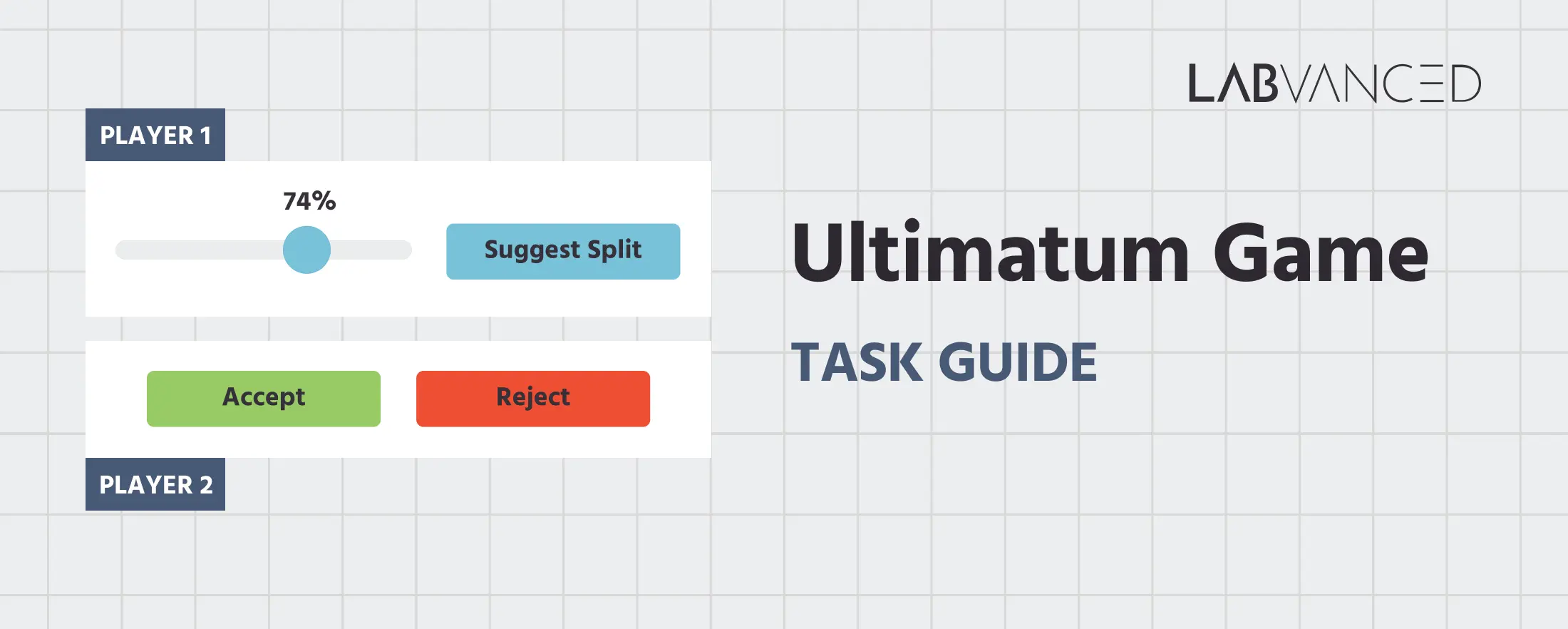
The Ultimatum Game
The Ultimatum Game measures fairness related decision making by asking participants to accept or reject offers that divide a shared resource. It is widely used in psychology, economics, and neuroscience research to study social preferences and norm enforcement.
Table of Contents
Task Format | Ultimatum Game Online & In-Lab
In the Ultimatum Game, participants take part in a two-player, multi-participant economic decision-making task. On each trial, a fixed amount of money is available to be split between the two players. Depending on the role assigned for the trial, participants either propose a division of the money or decide whether to accept or reject a proposed split.
If a proposal is accepted, both players receive the proposed amounts. If it is rejected, neither player receives any money for that trial. The task begins with a short practice round to familiarize participants with the task structure and decision rules. Practice trials are not included in the final data analysis. At the end of the task, participants are shown the total amount of money they have earned across all trials.
Ultimatum Game Metrics and Data Collected
The Ultimatum Game captures a range of behavioral measurements that reveal how individuals make decisions in social and economic contexts involving fairness and reciprocity. The variables recorded enable researchers to assess acceptance and rejection rates, response times, offer amounts, and patterns of decision-making across different proposal conditions. These measures help quantify fairness preferences, sensitivity to inequity, and strategic or emotional influences on social decision-making. All variables can be viewed and customized within the task’s Variables Tab.
Below are examples of variables collected in the Labvanced version of the Ultimatum Game:
| Variable Name | Description |
|---|---|
amount_proposer | Amount allocated to the proposer |
amount_responder | Amount allocated to the responder |
amountToSplit | Total amount available for split in a trial |
responder_choice | Indicates if the responder has “accepted” or “rejected" the amount suggested by the proposer |
split_share_responder | The percentage of the available funds in the trial (amountToSplit) suggested for the responder |
split_share_proposer | The percentage of the available funds in the trial (amountToSplit) suggested for the proposer |
total_balance_proposer | Cumulative earnings of the proposer across trials |
total_balance_responder | Cumulative earnings of the responder across trials. |
Role_ID | The participant-specific ID assigned in multi-user studies |

Data table showing individual trial level outputs from the online Ultimatum Game in Labvanced.
In this interactive 2-player game, one player proposes a split of money and the other decides to accept or reject.
Technology Driving the Ultimatum Game for Online & In-Lab Research
The Ultimatum Game requires flexible trial logic, clear stimulus presentation, and reliable response recording. Labvanced provides the tools needed to implement these features across a range of experimental designs.
Multi-Participant Study Support: Supports multi participant study designs where two or more participants are linked within the same experiment. This makes it possible to assign distinct roles such as proposer and responder, synchronize task flow across participants, and exchange decision related information during the task.
Participation From Different Locations: The task can be completed by participants joining from different locations, allowing real time or asynchronous social interaction studies without requiring in person sessions.
Desktop App Support for Controlled Studies: For lab based experiments requiring stable timing or hardware integration, the task can be deployed using the Labvanced desktop app. This allows compatibility with external systems such as EEG or other LSL based setups.
Remote and Longitudinal Deployment: The Ultimatum Game can be delivered remotely and repeated across multiple sessions, making it suitable for longitudinal designs that track changes in social decision making over time.

Webcam Eye Tracking
Capture gaze patterns and visual attention with built-in, code-free and peer-reviewed webcam eye-tracking.

Timing Precision
Capture reaction times, task performance, and more with millisecond accuracy for time-sensitive tasks.

Multi-user Research
Run synchronous, real-time multi-participant studies without having to write any networking or server code.
Customization of the Ultimatum Game
There are many ways to adapt the Ultimatum Game Task template to meet specific research questions. Below are a few themes researchers commonly ask when it comes to modifying this task.
Offer Structure and Presentation
Offer amounts and stake sizes can be adjusted by editing the variables or condition events that control how the split is displayed. You could achieve this by editing and modifying the relevant events.
Visual Presentation
Researchers can adjust attributes such as size, color, position, orientation, and text content to match specific experimental requirements. Visual representations, numerical formats, or contextual labels can be modified through the task editor and/or Object Properties panel.
Trial Flow and Feedback Design
Practice trials, feedback screens, and block transitions are typically implemented as separate frames. Researchers can adjust the number of trials, or progression rules by editing frame navigation and associated Events.
If you need help customizing this task, please feel welcome to write to us and ask:
Recommended Use and Applications of the Ultimatum Game
The Ultimatum Game is widely used across research, clinical, and applied settings to study social decision making and fairness related behavior.
Social and Economic Decision Making Research: Commonly used to examine fairness preferences, altruism, and norm enforcement in healthy adult populations. Prosocial behavior in economic games has also been found to correlate with eudaimonic well-being (Koch, 2024), giving the paradigm a genuine construct link to self-report well-being measures like the Flourishing Scale.
Developmental and Lifespan Studies: Applied to study how fairness sensitivity and social norms develop across childhood and adolescence and change in later adulthood.
Clinical and Neuropsychological Populations: Used in research involving mood disorders, personality disorders, autism spectrum conditions, and neurological populations where social cognition may be altered.
Cultural and Cross Cultural Research: Frequently employed to compare fairness norms and decision strategies across cultural or societal groups.
Neuroimaging and Brain Function Studies: Often paired with neuroimaging or electrophysiological methods to investigate neural mechanisms underlying social decision making.
References
Deldoost, M. H., & Saeedi, M. T. (2021, June). Investigating Role of Social Value Orientation in Individual’s Decision-Making Evidence from the Ultimatum Game. In Eurasian Business and Economics Perspectives: Proceedings of the 31st Eurasia Business and Economics Society Conference (pp. 63-74). Cham: Springer International Publishing.
Güth, W., Schmittberger, R., & Schwarze, B. (1982). An experimental analysis of ultimatum bargaining. Journal of Economic Behavior and Organization, 3(4), 367–388.
Koch, C. (2024). Is there a nexus between pro-social behavior and well-being? Correlational evidence. Journal of the Economic Science Association, 10(2), 279-293. https://doi.org/10.1007/s40881-023-00156-0
Related Tasks
The Ultimatum Game pairs naturally with other economic decision-making tasks in Labvanced's task library.
Delay Discounting Task (DDT)
Participants choose between a smaller reward available now and a larger reward available later, across a range of delay intervals and discount rates, measuring impulsivity and time preference.
Balloon Analog Risk Task (BART)
Participants pump a virtual balloon to accumulate earnings with each pump, balancing potential reward against the risk of the balloon popping and losing all gains for that trial.
Beads Task
This study measures probabilistic reasoning and the jumping-to-conclusions bias using the Beads Task. Participants decide which of two jars a sequence of beads is being drawn from, requesting as many or as few beads as they need before choosing. Draws to decision, jar choice, and confidence are recorded as outcome measures.