
labvanced logoLabVanced
  • Research
    • Publications
    • Researcher Interviews
    • Use Cases
      • Developmental Psychology
      • Linguistics
      • Clinical & Digital Health
      • Educational Psychology
      • Cognitive & Neuro
      • Social & Personality
      • Arts Research
      • Sports & Movement
      • Marketing & Consumer Behavior
      • Economics
      • HCI / UX
      • Commercial / Industry Use
    • Labvanced Blog
    • Services
  • Technology
    • Feature Overview
    • Code-Free Study Building
    • Eye Tracking
    • Mouse Tracking
    • Generative AI Integration
    • Multi User Studies
    • More ...
      • Reaction Time/Precise Timing
      • Text Transcription
      • Heart Rate Detection (rPPG)
      • Emotion Detection
      • Questionnaires/Surveys
      • Experimental Control
      • Data Privacy & Security
      • Desktop App
      • Mobile App
  • Learn
    • Guide
    • Videos
    • Walkthroughs
    • FAQ
    • Release Notes
    • Documents
    • Classroom
  • Experiments
    • Cognitive Tests
    • Sample Studies
    • Public Experiment Library
  • Pricing
    • Licenses
    • Top-Up Recordings
    • Subject Recruitment
    • Study Building
    • Dedicated Support
    • Checkout
  • About
    • About Us
    • Contact
    • Downloads
    • Careers
    • Impressum
    • Disclaimer
    • Privacy & Security
    • Terms & Conditions
    • Third-Party Licenses
  • Appgo to app icon
  • Logingo to app icon
Research
Publications
Tasks
Questionnaires & Scales
Methodology
Researcher Interviews
Use Cases
Labvanced Blog
Comparisons
Services
  • 中國人
  • Deutsch
  • Français
  • Español
  • English
  • 日本語
Publications
Tasks
Questionnaires & Scales
Methodology
Researcher Interviews
Use Cases
Labvanced Blog
Comparisons
Services
  • 中國人
  • Deutsch
  • Français
  • Español
  • English
  • 日本語
  • Publications
  • Tasks
  • Questionnaires & Scales
  • Methodology
  • Researcher Interviews
    • Comparing Online Webcam- and Laboratory-Based Eye-Tracking for the Assessment of Infant Audio-Visual Synchrony Perception
    • Finding Goldilocks Influencers- How Follower Count Drives Social Media Engagement
    • The semantic interference in 9- to 36-month old infants: An at-home eye-tracking study on infants' lexical abilities
    • Song Is More Memorable Than Speech Prosody - Discrete Pitches Aid Auditory Working Memory
    • Orthographic Relatedness and Transposed-word Effects in the Grammatical Decision Task
    • Emotion Modulation through Music after Sadness Induction
    • Children Learning Non-Adjacent Dependencies
    • Personality Hear in Noise
    • Are All Eyes the Same?
    • Verbal Priming in Infants
  • Use Cases
    • Research Areas

      • Developmental Psychology
      • Linguistics
      • Clinical & Digital Health
      • Educational Psychology
      • Cognitive & Neuro
      • Social & Personality Psychology
      • Arts, Music & Digital Media
      • Sports & Movement Psychology
      • Marketing & Consumer Behavior
      • Economics
      • HCI / UX
      • Commercial / Industry Use
    • Researchers

      • Students
      • Researchers
      • Groups
  • Blog
    • Generative AI in Educational Psychology Research
    • Best Practices for Webcam Eye Tracking Research with Infants and Toddlers
    • Types of Stimuli in Delay Discounting Tasks
    • Delay Discounting Task
    • Mindfulness-based Self-Efficacy Scale - Revised (MSES-R)
    • Team Dynamics and Research
    • Stroop Task | History, Task Description, Data and Psychology
    • BKB Sentence Test | Procedure & Research
    • Dyadic Effect in Psychology | Overview & Research
    • Navon Task: Task Setup, Research & More
    • Peer-reviewed Webcam Eye Tracking
    • Corsi Block-Tapping Test: From cubes to online design
    • Dot-Probe Task | Full Guide
    • Types of Memory: Concepts to Research
    • Ultimatum Game
    • The Visual Search Task
    • Attention Tasks in Psychology Research
    • Generalized Anxiety Disorder Scale-7 (GAD-7)
    • Decision Making Tasks in Psychology
    • The Obsessive Compulsive Inventory – Revised (OCI-R)
    • Assessing Executive Function Skills | Tasks & Batteries
    • The Flourishing Scale (FS) Questionnaire
    • Labvanced and the Spirit of Open Science
    • The Psychology of the Incubation Effect
    • The Bouba-Kiki Effect and Task
    • Lexical Decision Task: Accessing the Mental Lexicon
    • Image Description Task and Game with a Chatbox
    • Smooth Data Collection Process | 6 Tips for Research
    • Music Research with Labvanced
    • 7 Classic Cognitive Tasks & Examples
    • Mental Rotation Test | A Spatial Processing Task
    • XY Coordinates in Labvanced
    • 5 Famous Social Psychology Experiments
    • The Power of Remote & Infant-friendly ET
    • The Wisconsin Card Sorting Test
    • 13 Head Tracking Use Cases for Research
    • 5 Tips for Improving Your Perception Skills
    • Introduction to the Preferential Looking Paradigm
    • Researching Cognition in Migraine & Headache Patients
    • The Landing Page - More Info Than You Think!
    • Headphone Checks - Then and Now
    • Sample Studies - Helpful Templates and Demos!
    • What Is Neuroplasticity?
    • 15 Famous Developmental Theories
    • Visual Attention and Eye Tracking
    • What Is Eye Tracking Technology?
    • Eye Tracking in Applied Linguistics Research
    • 10 Popular Linguistic Experiments
    • The Placebo Effect
    • 6 Key Concepts of Experimental Design
    • Conditioned Play Audiometry
    • Ebbinghaus Illusion
  • Comparisons
  • Services
    • Overview
    • Joint Grant Applications
    • Subject Recruitment
    • Study Building
    • Dedicated Support
    • License Comparison
Labvanced vs Pavlovia comparison page hero graphic, showing both platform names side by side

Labvanced vs Pavlovia

Part of Labvanced's platform comparisons.

Labvanced and Pavlovia serve researchers from different starting points. Pavlovia is Open Science Tools' online hosting layer, most commonly used by PsychoPy researchers, letting researchers with an existing Python-based paradigm run it with remote participants. Labvanced is a no-code platform built for the browser from the start, with peer-reviewed webcam eye tracking, emotion detection, remote heart rate measurement, embedded speech-to-text transcription, AI-based translation into 50 languages, and an AI assistant for experiment building all built in natively. Both can collect data from remote participants online. Only one does it without writing code, and without splitting a study across two separate tools when a lab needs both in-lab hardware integration and online deployment.

Table of Contents

  • At a Glance
  • Where Pavlovia Is Strong
  • Where Labvanced Differs
  • Choose Which Fits Your Study
  • Migration Note
  • FAQ

At a Glance

CapabilityPavlovia (PsychoPy)Labvanced
No-code visual builderPartial: the Builder GUI generates a Python script for desktop use, with a separate JavaScript (PsychoJS) version created for online use; designs beyond simple paradigms can require direct editing of eitherYes: full no-code builder, no scripting required for standard or complex designs
Online deploymentRequires exporting or syncing the Python experiment to PsychoJS (JavaScript) before it can run in a browserYes: built browser-native; no export step or translation layer required
Webcam eye tracking (online studies)Possible via WebGazer.js, an officially documented PsychoPy/Pavlovia integration requiring custom code (not the no-code Builder)Yes: native, peer-reviewed webcam eye tracking (Kaduk et al., 2024, Behavior Research Methods). No custom code required
Emotion detection (online studies)Possible only as a custom third-party integration (Face API), documented as an advanced/custom-code technique rather than a no-code Builder feature; not independently validated for emotion classificationYes: emotion detection above 90% accuracy averaged across emotions (varies by individual emotion)
Remote heart rate / rPPG (online studies)NoYes: expected within 1–3% of actual heart rate (validation against gold-standard devices ongoing)
Eye tracking / EEG hardware integration (in-lab)Yes, via PsychoPy's desktop application (Tobii, SR Research EyeLink, and other trackers via ioHub; EEG triggering via parallel port or LabJack); not available through Pavlovia's online studiesYes: via the Labvanced desktop app, with EEG/Lab Streaming Layer (LSL) integration, using the same visual builder as the online version
Multi-user / group studiesPossible via the Shelf (documented, code-based); not native/no-code and not equivalent to real-time infrastructureYes: up to 20 players, WebSocket-based infrastructure with lobby management, role assignment, and group formation
Mobile accessBrowser-accessible on mobile devices; no native app, no offline modeYes: native iOS/Android apps with full offline data collection
Version control and collaborationYes: full Git/GitLab-based version history, issue tracking, and forkable experiments for lab groupsShared study editing with permission-based collaborator access; no git-style version history
Pricing modelPer-participant credits (£0.24/credit), or a £1,800/year site license (50% reduction for institutions in emerging economies)Flat, tier-based subscription across individual, lab, teaching, campus, and commercial license categories; not billed per participant

Where Pavlovia Is Strong

PsychoPy has a substantial academic footprint: the original platform paper (Peirce, 2007, Journal of Neuroscience Methods) has over 4,900 citations (OpenAlex, accessed 2026-07-17), and PsychoPy publishes live monthly usage statistics at usage.psychopy.org. Pavlovia itself is maintained by Open Science Tools Ltd., closely tied to the University of Nottingham, where PsychoPy's creator and core development team are based.

Its timing precision is independently verified, not just self-reported. The timing mega-study (Bridges et al., 2020, PeerJ) found PsychoPy/PsychoJS to achieve close to millisecond precision on several browser and operating system combinations, though the authors themselves noted this represented "something approaching a best-case scenario" and recommended testing timing on the specific hardware a study will actually use.

Pavlovia's GitLab-based project structure is a genuine reproducibility asset: every experiment gets full version history, issue tracking, and the ability to fork a lab's canonical experiment for adaptation by other members, all under a shared namespace. For labs that value an auditable change history on their experiment code, this is real infrastructure.

For researchers who already have a working PsychoPy paradigm, the Builder's one-click sync to Pavlovia removes a real barrier, and free pilot credits mean testing a study costs nothing up front. PsychoPy's desktop application also has mature, well-documented integration with hardware eye trackers and EEG systems for in-lab research, developed and refined since 2002.

Where Labvanced Differs

Standard study creation in Labvanced does not require writing any code. PsychoPy's Builder generates Python underneath its visual interface, and PsychoPy's own documentation acknowledges that its browser-hosted engine, PsychoJS, has existed only since 2016 and is maintained by a much smaller team than the Python desktop version; components can "behave differently online or have rough edges" as a result (PsychoPy, "Caveats and cautions," psychopy.org/online/cautions.html).
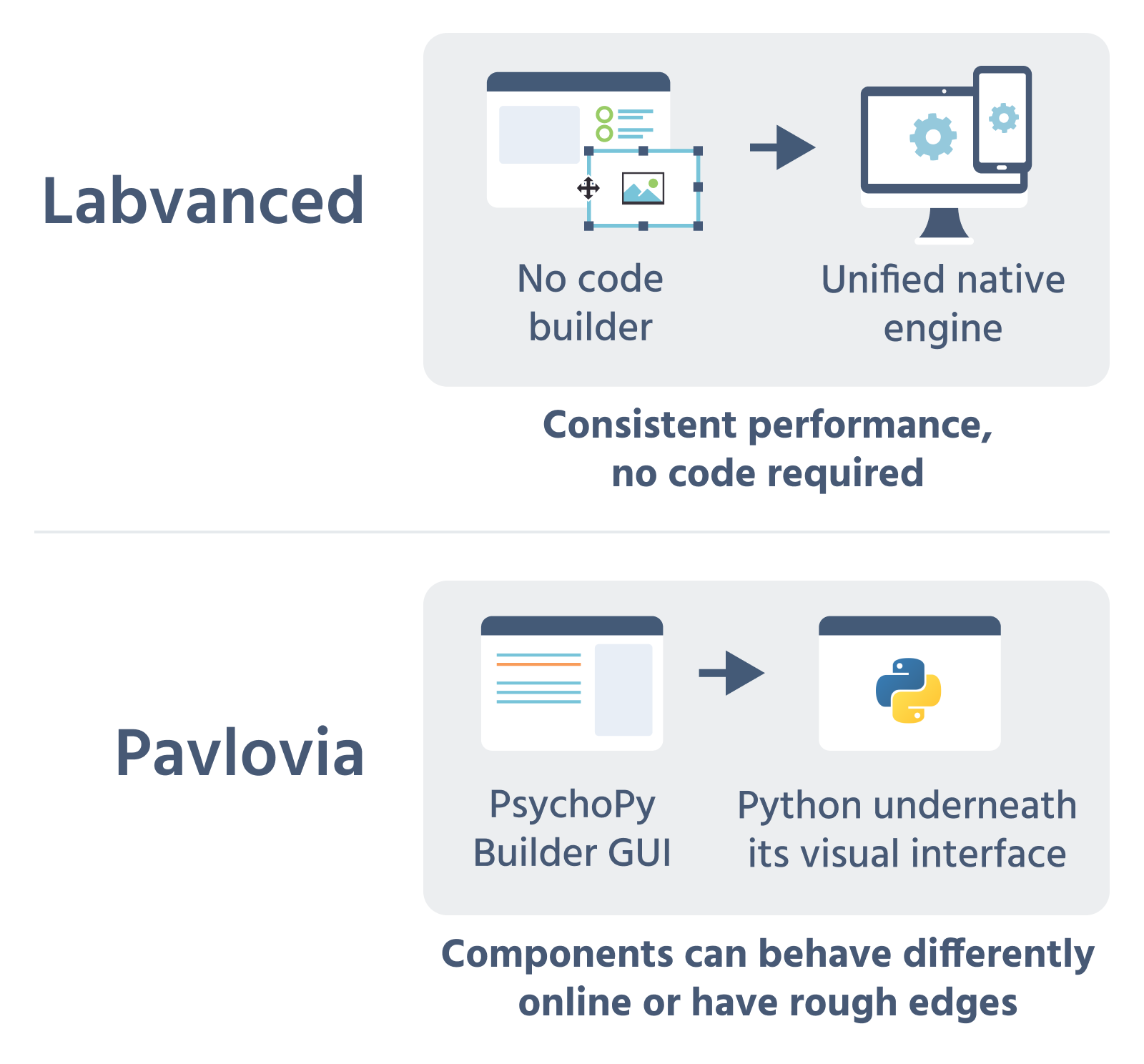
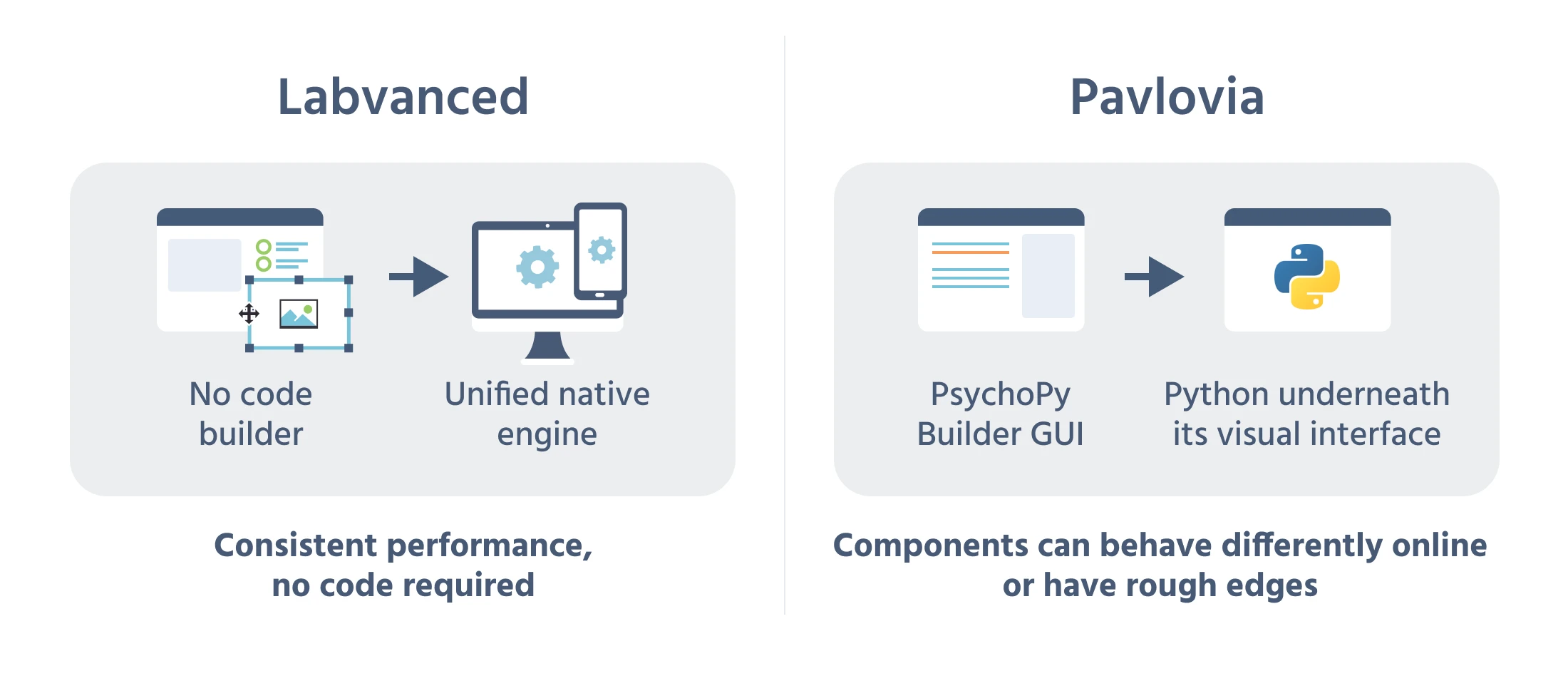
Comparison showing Labvanced's no-code builder producing a unified native engine with consistent performance, versus Pavlovia's PsychoPy Builder GUI generating Python underneath, where components can behave differently online or have rough edgesComparison showing Labvanced's no-code builder producing a unified native engine with consistent performance, versus Pavlovia's PsychoPy Builder GUI generating Python underneath, where components can behave differently online or have rough edges

That gap also shapes deployment. A PsychoPy user who wants both a hardware-integrated lab version and an online version of the same study works across two separate tools, PsychoPy desktop and Pavlovia, connected by an export-and-upload step. Labvanced's webcam eye tracking, emotion detection, and remote heart rate all run natively inside the same online study a participant is already taking. There is no separate authoring workflow to maintain: the same visual builder is used whether the study runs online or through the desktop app for in-lab hardware integration, with no export step connecting them.
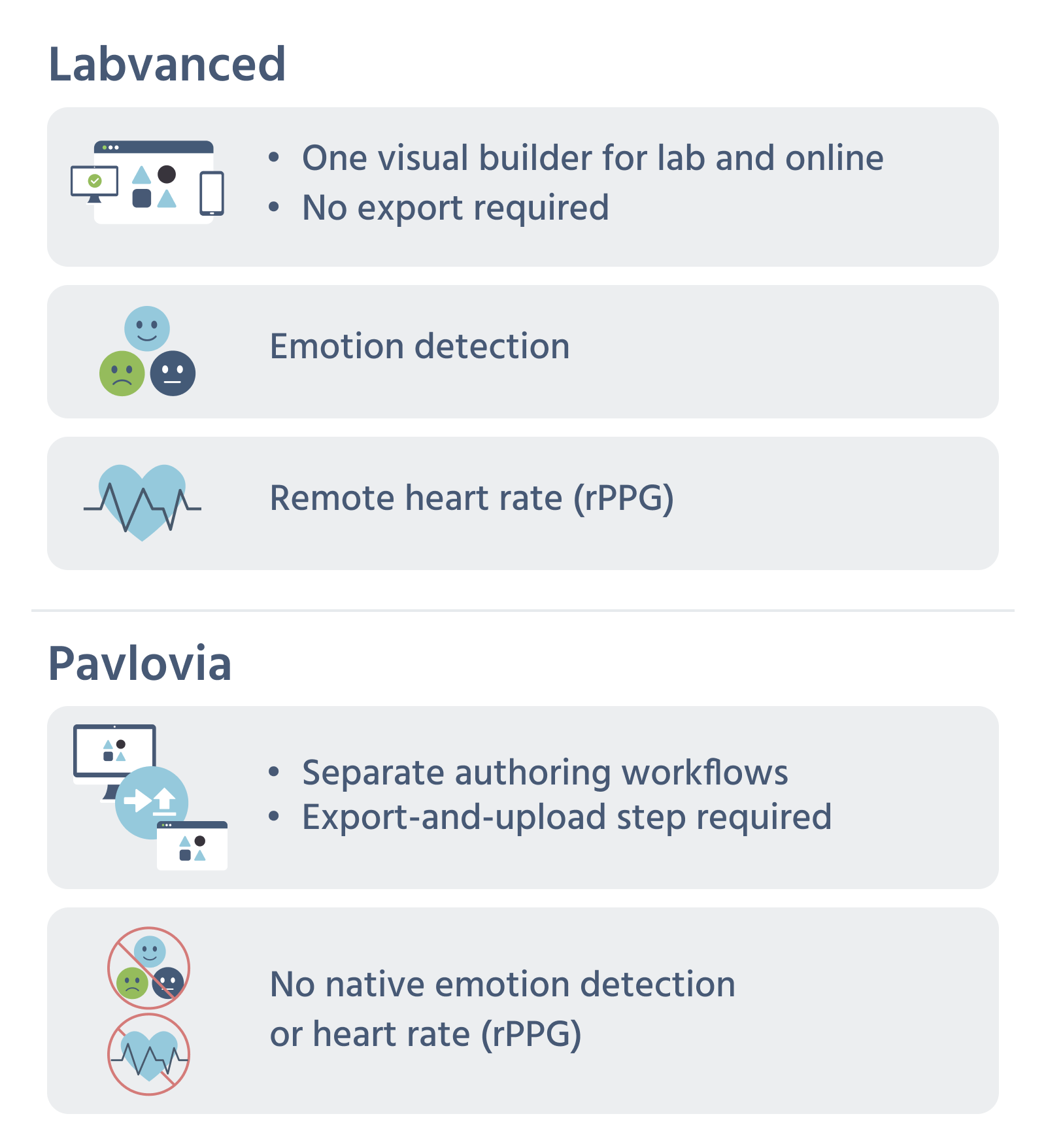
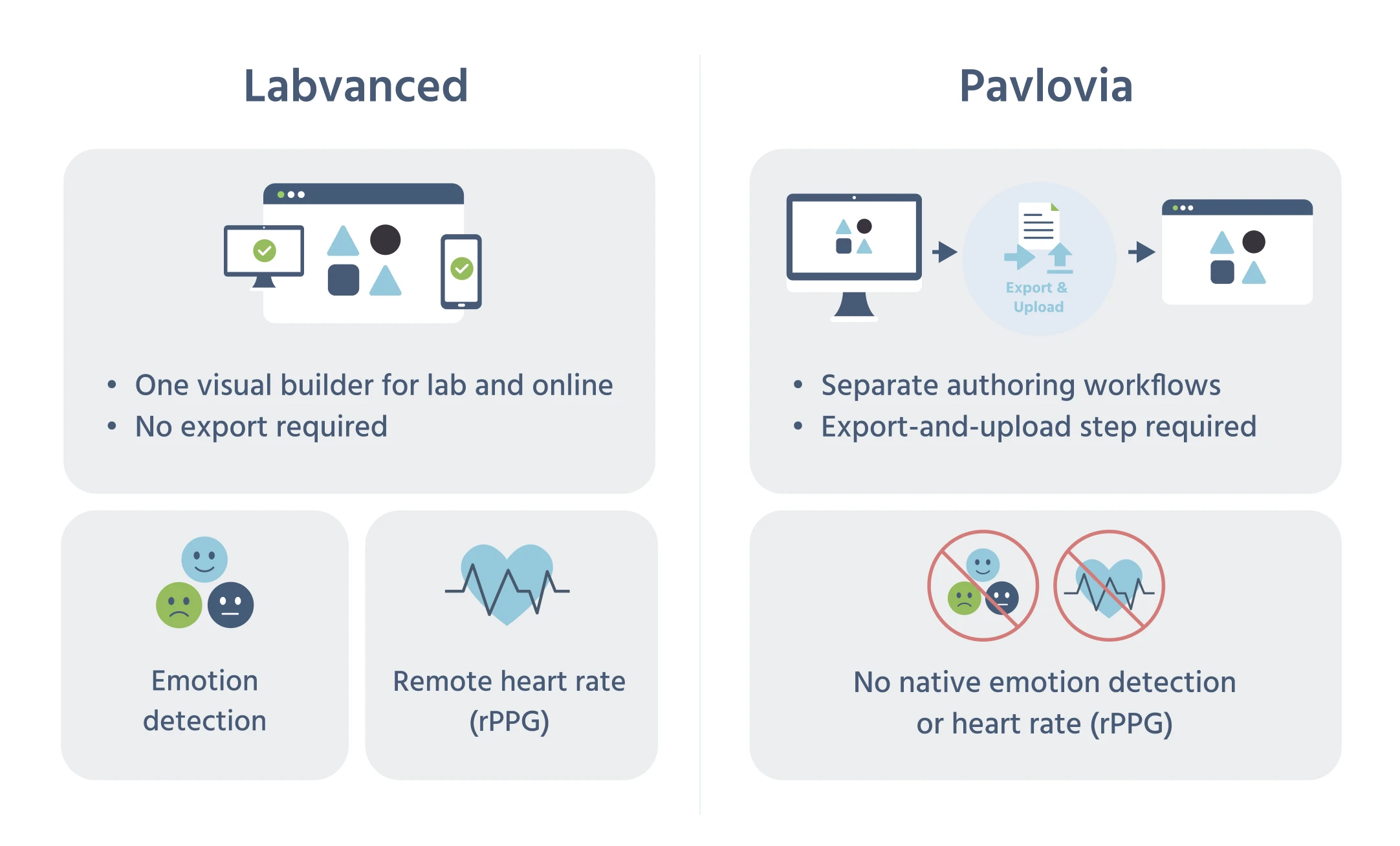
Comparison showing Labvanced's single visual builder for lab and online with no export step, plus native emotion detection and remote heart rate, versus Pavlovia's separate authoring workflows requiring an export-and-upload step and no native emotion detection or heart rateComparison showing Labvanced's single visual builder for lab and online with no export step, plus native emotion detection and remote heart rate, versus Pavlovia's separate authoring workflows requiring an export-and-upload step and no native emotion detection or heart rate

The two platforms also part ways on group studies: Pavlovia's Shelf mechanism can share data between participants through custom code, but PsychoPy's own documentation states this can take up to 60 seconds to propagate an update from one participant to another, with no built-in matchmaking or session management. Labvanced provides native, real-time multi-user infrastructure instead of requiring researchers to build that coordination themselves. And where Pavlovia charges per participant credit, or requires a flat annual site license regardless of study volume, Labvanced's tier-based subscriptions make cost predictable without a per-session meter running, so the relative cost advantage grows as a study's sample size increases.

For UX and web-based research, Labvanced's Web Bridge Chrome extension lets researchers track eye movements, clicks, and scroll behavior directly on a live, external website inside a controlled study session.
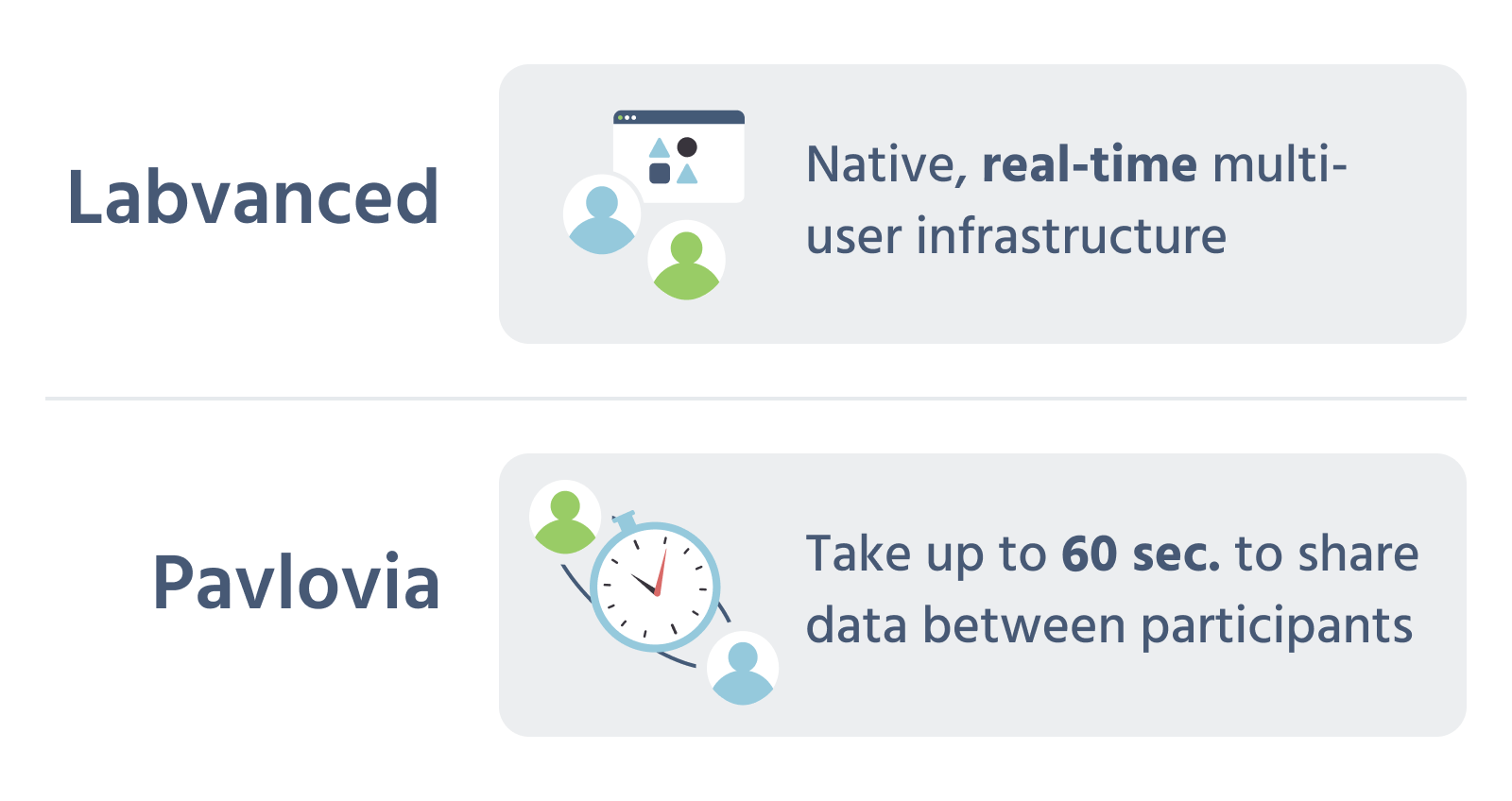
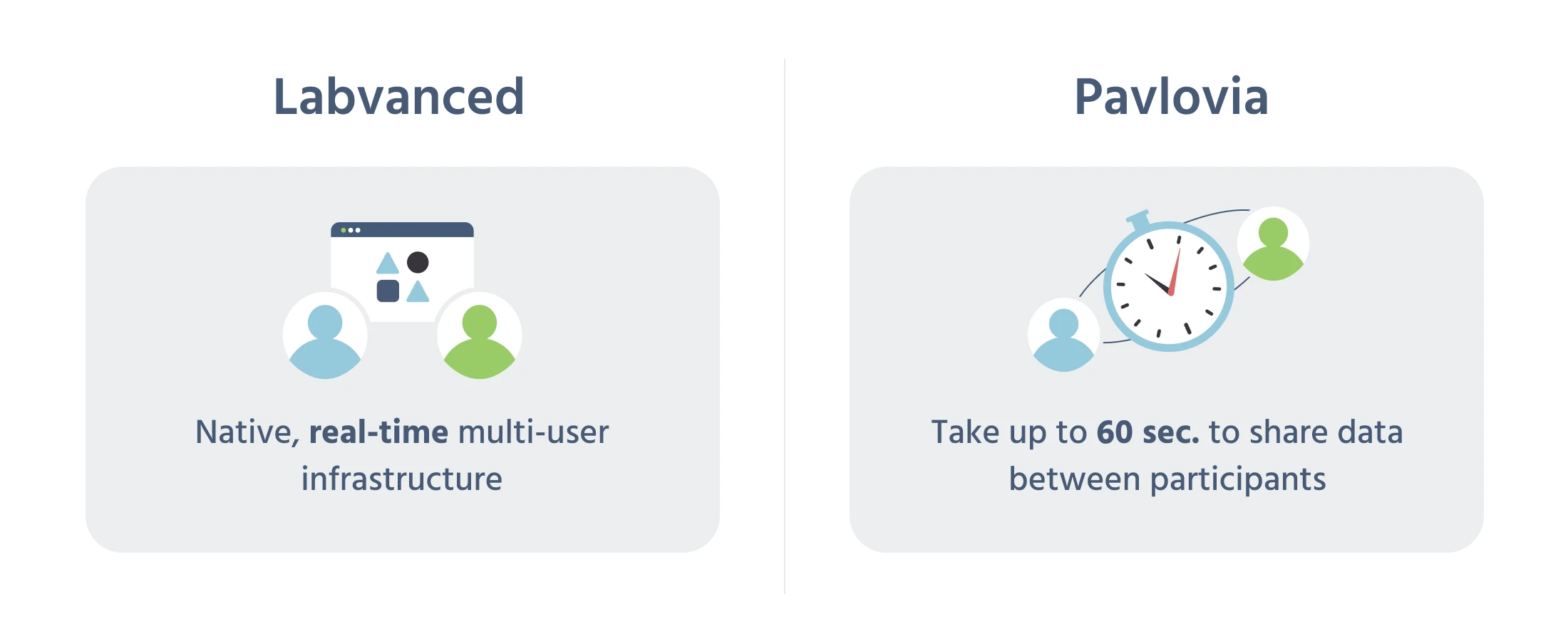
Comparison showing Labvanced's native, real-time multi-user infrastructure versus Pavlovia's Shelf mechanism, which can take up to 60 seconds to share data between participantsComparison showing Labvanced's native, real-time multi-user infrastructure versus Pavlovia's Shelf mechanism, which can take up to 60 seconds to share data between participants

Choose Which Fits Your Study

If you already have a working PsychoPy paradigm, are comfortable in Python, and your study doesn't need webcam-based physiological measurement or multi-user support online, Pavlovia is a clean fit. Its citation depth, GitLab-based version control, and independently verified timing are real strengths, and rebuilding a working paradigm elsewhere has a real cost.

Labvanced's advantage grows as studies move beyond a traditional single-participant PsychoPy workflow. Webcam eye tracking, emotion detection, remote heart-rate measurement, and multi-participant studies can all be built directly within Labvanced's visual interface, whereas comparable functionality in Pavlovia often depends on custom Python or JavaScript, third-party libraries, or additional infrastructure. That difference becomes more noticeable as studies grow more sophisticated: Labvanced lets researchers extend their experiments while staying within the same no-code workflow. Built by a team of PhD researchers, the platform reflects how studies are conducted in practice while keeping coding optional.
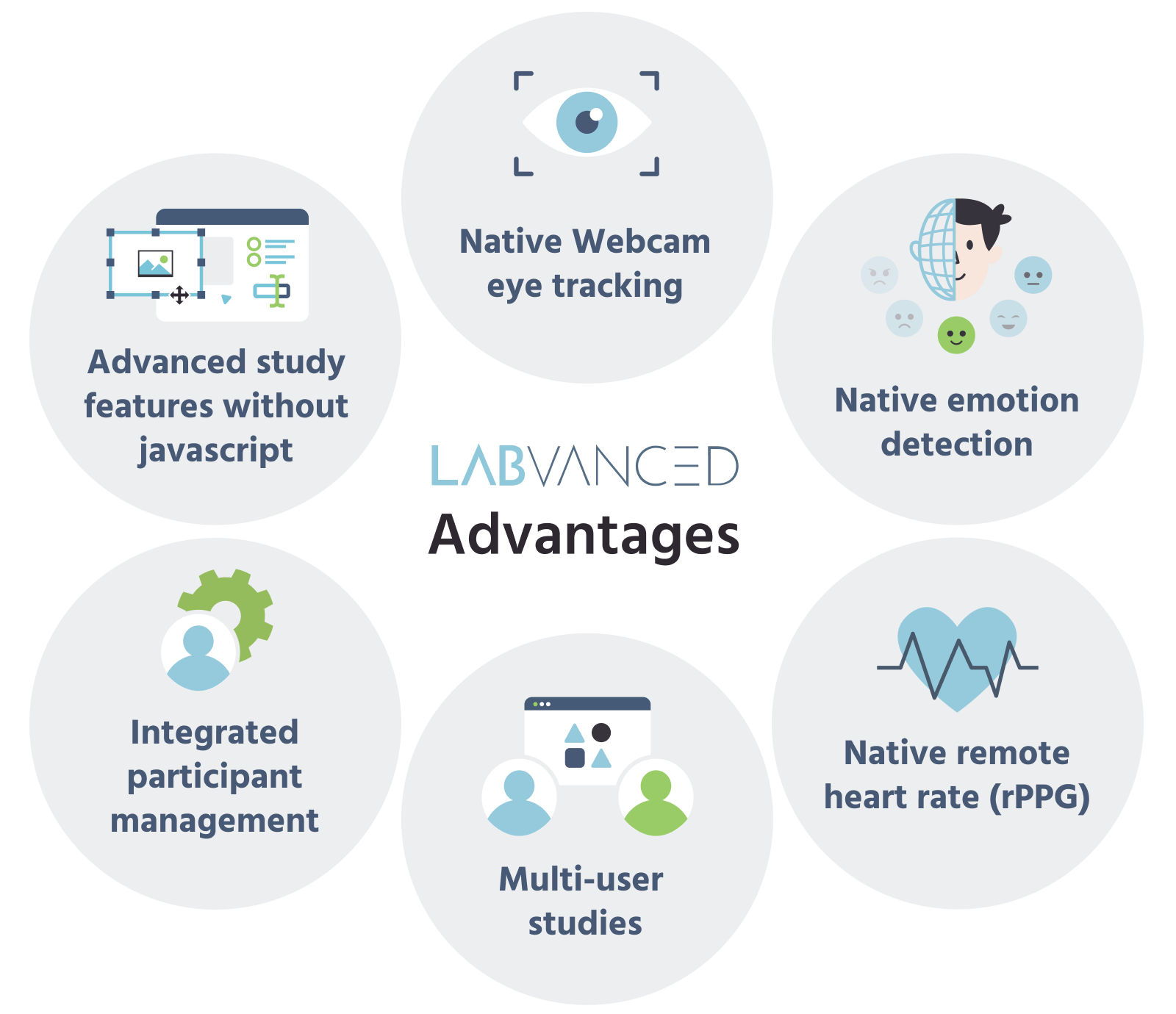
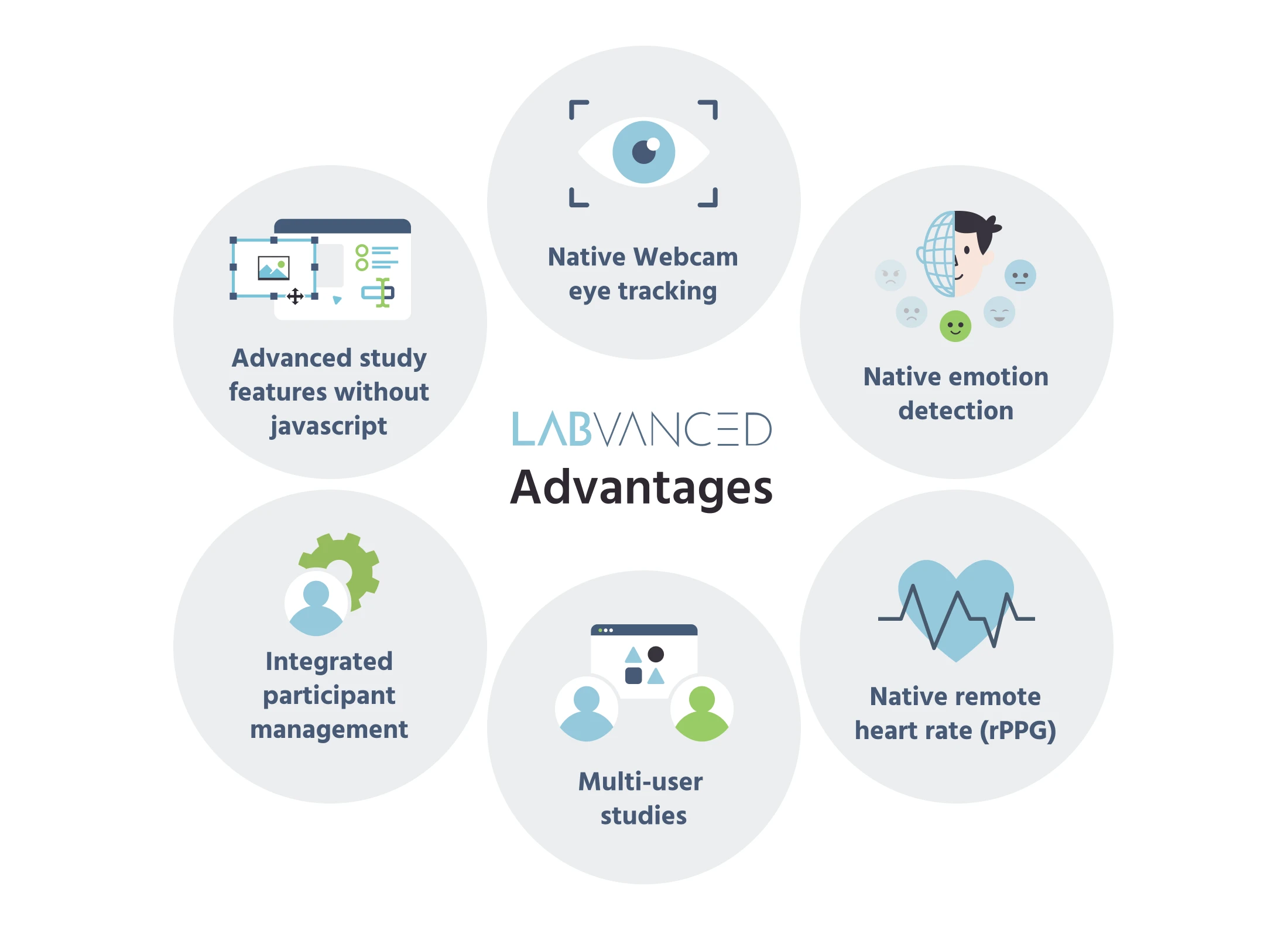
Six-icon summary of Labvanced advantages: advanced study features without JavaScript, native webcam eye tracking, native emotion detection, integrated participant management, multi-user studies, and native remote heart rate (rPPG)Six-icon summary of Labvanced advantages: advanced study features without JavaScript, native webcam eye tracking, native emotion detection, integrated participant management, multi-user studies, and native remote heart rate (rPPG)

Migration Note

Researchers moving an existing PsychoPy/Pavlovia study to Labvanced will typically recreate it using Labvanced's visual builder. While this involves rebuilding the study rather than importing it directly, it also provides an opportunity to consolidate separate desktop and online workflows into a single platform. For researchers or labs moving existing paradigms, Labvanced also offers the study building service that can assist with rebuilding experiments.

FAQ

Is Labvanced a good alternative to Pavlovia?
Yes, particularly for studies that need webcam-based physiological measurement, multi-user designs, or a single tool for both online and in-lab, hardware-integrated deployment. Pavlovia remains a strong fit for researchers with an existing PsychoPy paradigm who value its academic citation base and independently verified timing precision.
Does Pavlovia support eye tracking or EEG?
It depends on the deployment mode. PsychoPy's desktop application has mature integration with hardware eye trackers (Tobii, SR Research EyeLink, and others via ioHub) and EEG systems (via parallel port or LabJack triggers) for in-lab studies. Pavlovia's browser-hosted online studies do not support these hardware integrations. Webcam-based eye tracking is possible in Pavlovia's online studies through WebGazer.js, an officially documented PsychoPy integration, though it requires writing custom code rather than using the no-code Builder. Unlike Labvanced's native implementation, PsychoPy does not report peer-reviewed validation of its WebGazer integration. Labvanced provides webcam eye tracking, emotion detection, and remote heart rate natively in its online studies, plus EEG/LSL integration through its desktop app for in-lab sessions, using the same visual builder for both.
Do I need to know Python or JavaScript to use Labvanced?
No. Labvanced studies are built entirely through a visual, no-code interface. PsychoPy's Builder also has a visual interface, but it generates Python code underneath, and designs beyond simple paradigms commonly require direct editing of that code, or of the JavaScript it's exported to for online use.
Pavlovia vs Labvanced: which is cheaper?
It depends on participant volume. Pavlovia charges £0.24 per participant credit, or a flat £1,800/year site license (50% reduction for institutions in emerging economies) for unrestricted use. Labvanced uses flat, tier-based subscriptions across individual, lab, teaching, campus, and commercial categories, so cost does not increase with participant count within a plan's limits. Which is cheaper depends on your study's scale; see Labvanced's license plans or Pavlovia's pricing page directly for current rates.
Start Your Free Trial

Last Reviewed

Last reviewed: 2026-07-17

Competitor features, pricing, and platform capabilities on this page were verified against Pavlovia's and PsychoPy's official documentation and pricing pages as of this date. Peer-reviewed research citations are referenced inline throughout.