
Labvanced vs Gorilla
Part of Labvanced's platform comparisons.
Labvanced and Gorilla are both no-code platforms for behavioral research. They support many of the same experimental paradigms, but differ in the quality and range of physiological measurements, AI and technology integrations, as well as deployment options they offer.
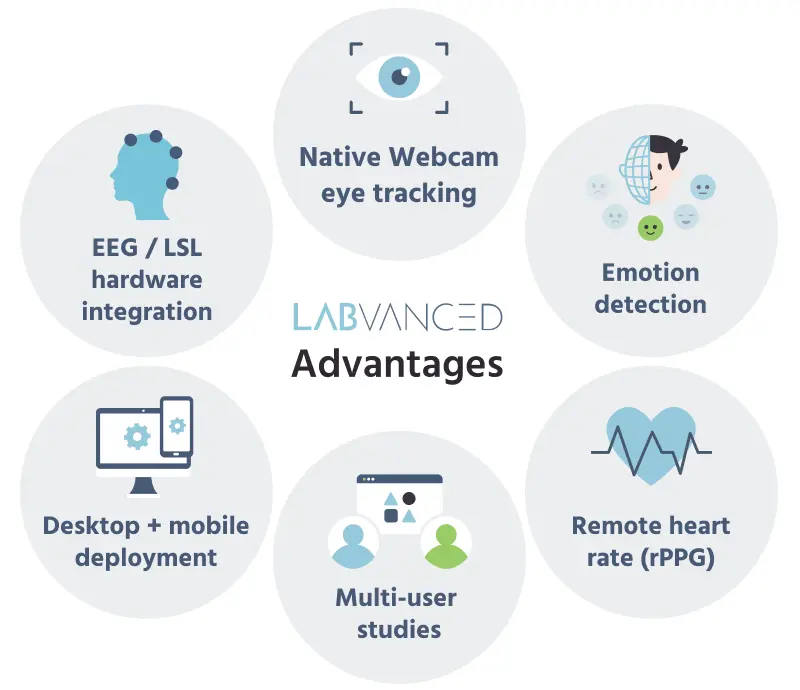
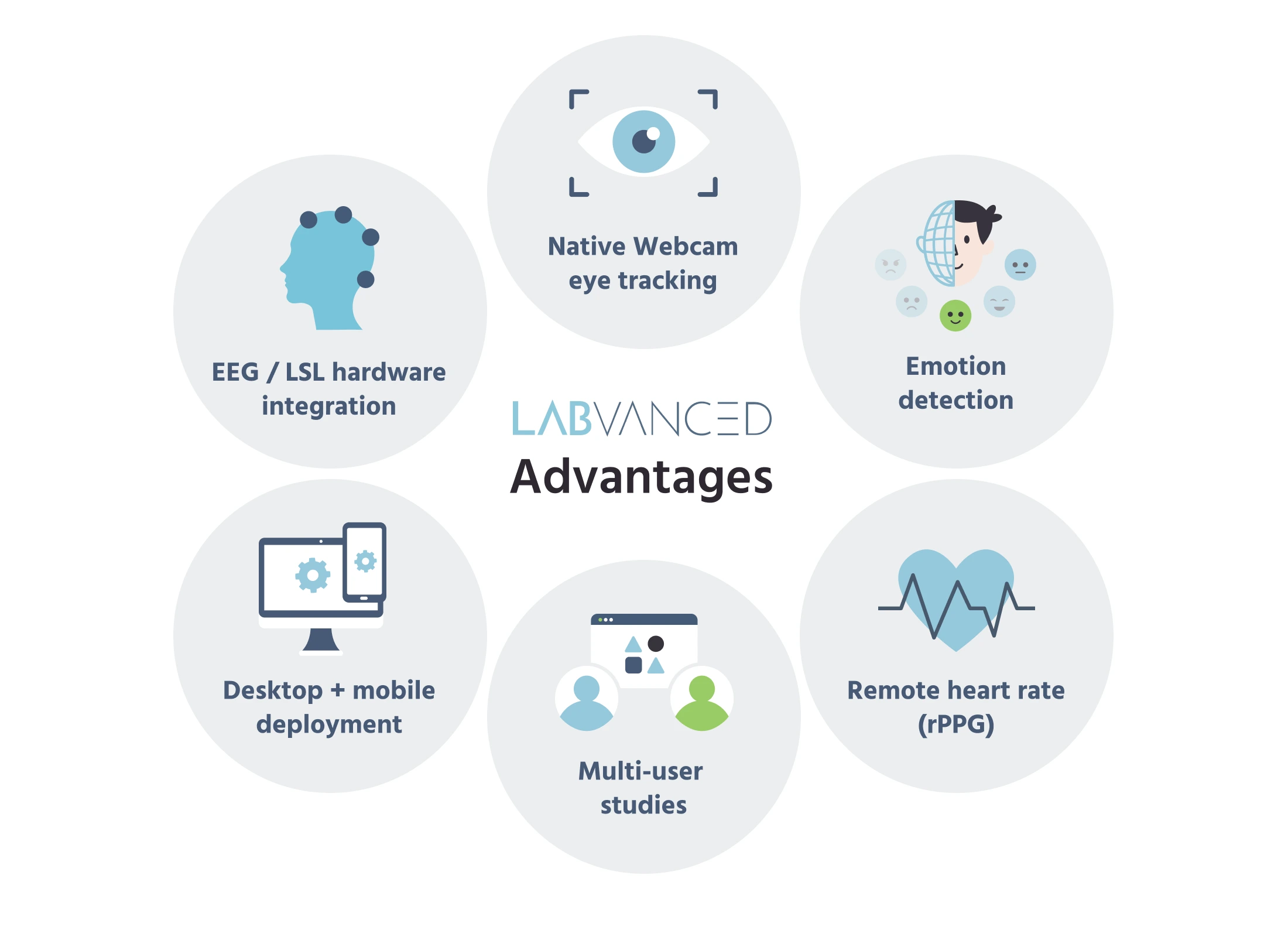
As eye-tracking is one of the most important physiological measures in cognitive psychology, neuroscience and related disciplines, a lot of Labvanced’s research work is dedicated towards creating the most accurate webcam eye-tracking solution worldwide. Therefore, differences in eye-tracking capabilities and accuracy are particularly pronounced. Gorilla uses the widely adopted, but older and less accurate WebGazer library with a reported accuracy of about 4.3 visual degrees. At Labvanced, we created our own modern neural network architecture for webcam eye tracking, with a peer-reviewed confirmed accuracy of 1.4 visual degrees (about 3 times as accurate as Gorilla's WebGazer option). Additionally, Labvanced provides native emotion and heart rate detection (rPPG), embedded speech to text models, AI based text translations into 50 languages, and even a powerful AI assistant helping with many aspects of experiment implementation. In terms of deployment option, Gorilla focuses purely on online studies running on their own website, whereas Labvanced can run online in the browser, but also via a dedicated phone app (Android, iOS), or even offline via a desktop app (Windows, MacOS, Linux). The desktop app supports native EEG and other recordings through a Lab Streaming Layer (LSL) integration. Labvanced eye-tracking and mouse tracking can additionally run on external websites through a Chrome browser extension. In summary, both platforms support a great range of experimental paradigms to study human behavior and remove the coding and ease of use barrier through no-coding interfaces. However, only Labvanced provides reliable physiological signals such as accurate eye-tracking, and goes beyond pure browser based testing.
Table of Contents
At a Glance
| Capability | Gorilla | Labvanced |
|---|---|---|
| No-code visual experiment builder | Yes | Yes |
| Flexibility to build any paradigm | Yes | Yes |
| Peer-reviewed evidence | Yes: Anwyl-Irvine et al. (2020), Behavior Research Methods | Yes: Kaduk et al. (2024), Behavior Research Methods |
| Webcam eye tracking | Yes, but limited by WebGazer's accuracy of 4.3° | Yes: proven accuracy of 1.4° vs. EyeLink 1000 |
| Emotion detection | No | Yes: above 90% accuracy averaged across emotions |
| Remote heart rate (rPPG) | No | Yes: expected within 1 to 3% of actual heart rate; gold-standard validation ongoing |
| EEG / LSL hardware integration | No | Yes: via the desktop app |
| Multi-user / multiplayer studies | Yes up to 8 players | Yes up to 20 players, lobby management, role assignment, and group formation |
| Desktop app (offline) | No | Yes |
| Mobile app | No | Yes |
| Works on External Websites | No | Yes |
| Pricing model | Per-participant token: €1.28/token academic, €2.67/token public sector, 25-token minimum; lab, team, department, and institutional subscriptions also available | Flat, tier-based subscription across individual, lab, teaching, campus, and commercial license categories; not billed per participant (see Labvanced license plans) |
| Support-Channels | Email, Office Hours, Onboarding-Calls | Email, Office Hours, Onboarding-Calls, Live-Chat |
Where Gorilla Is Strong
Gorilla's platform paper, Anwyl-Irvine et al. (2020), "Gorilla in our midst: An online behavioral experiment builder," published in Behavior Research Methods, documented adoption across 5,000+ users and 400+ academic institutions at the time of publication. Three of the paper's five authors are members of Gorilla's development team at Cauldron Science, including founder and CEO Jo K. Evershed. That peer-reviewed citation gives researchers a ready-made methods-section reference, and it is a genuine reason labs choose Gorilla: a supervisor or department that has already adopted it, or a paper that already cites it, lowers the switching cost to zero for the next researcher in that group.
Like Labvanced, Gorilla also integrates directly with Prolific and other platforms for participant recruitment, which simplifies the recruitment-workflow step for researchers already using that panel. Its multiplayer tool ships with ready-to-clone templates, including the Dictator Game and Ultimatum Game, so common paradigms can be running with a same-day setup. And its token-based pricing has no subscription floor: a small pilot study can be run for the cost of a handful of tokens, which is a lower barrier to entry than a subscription for a researcher who only needs to test a paradigm once.
Where Labvanced Differs
Gorilla's webcam eye tracking runs on WebGazer, an open-source library available to any developer, not a Gorilla-specific measurement pipeline. Labvanced's webcam eye tracking is peer-reviewed against a hardware benchmark, reaching 1.4° accuracy and a Pearson correlation above 0.9 against the EyeLink 1000, for free-viewing and smooth-pursuit tasks (Kaduk et al., 2024, Behavior Research Methods). Facial and eye processing run entirely client-side, so no raw image or video ever leaves the participant's device, i.e. data private by design.
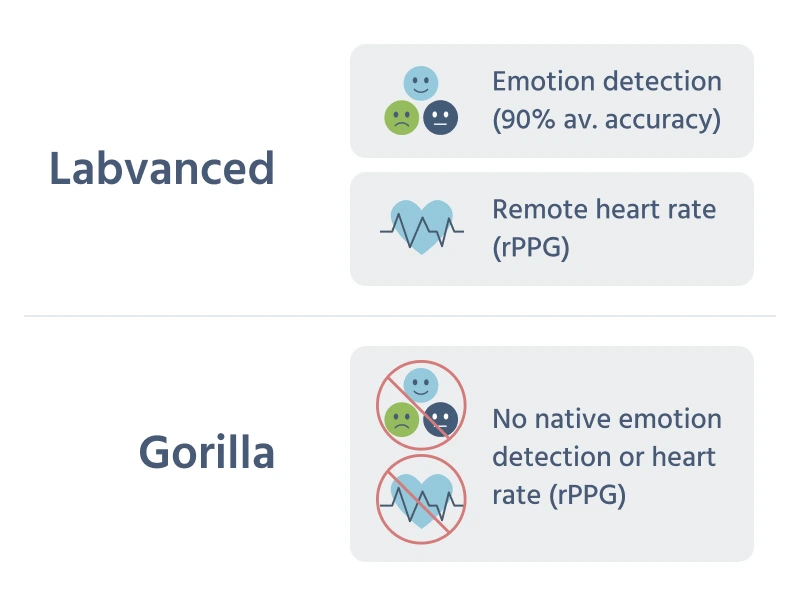
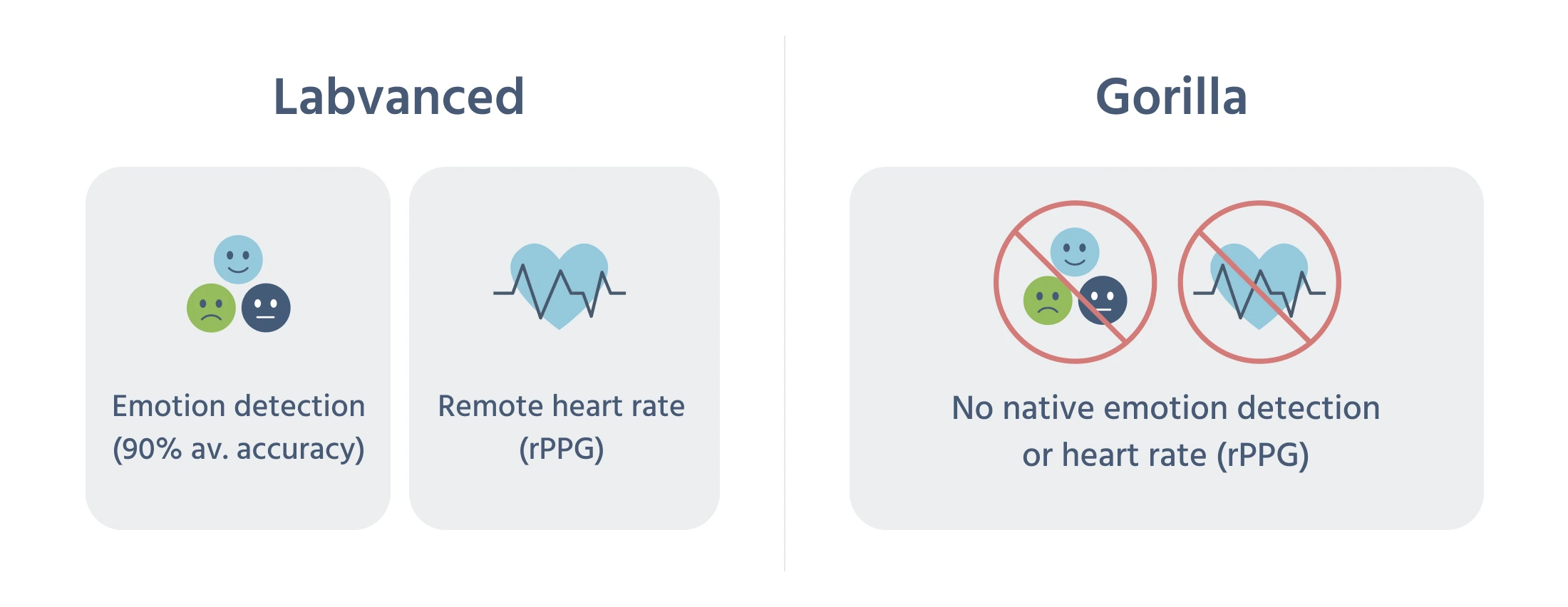
Gorilla has no equivalent for emotion detection: the capability is simply not part of its feature set. Labvanced runs it natively from the same webcam session used for eye tracking, with accuracy above 90% averaged across emotions, though accuracy varies between individual emotions. That same session can also capture remote heart rate, expected to be within 1 to 3% of actual heart rate; a comparison study against gold-standard medical devices is still ongoing.
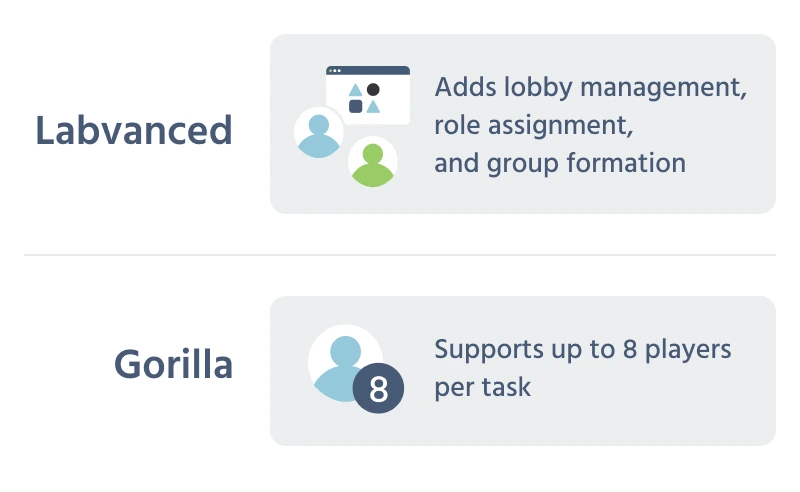
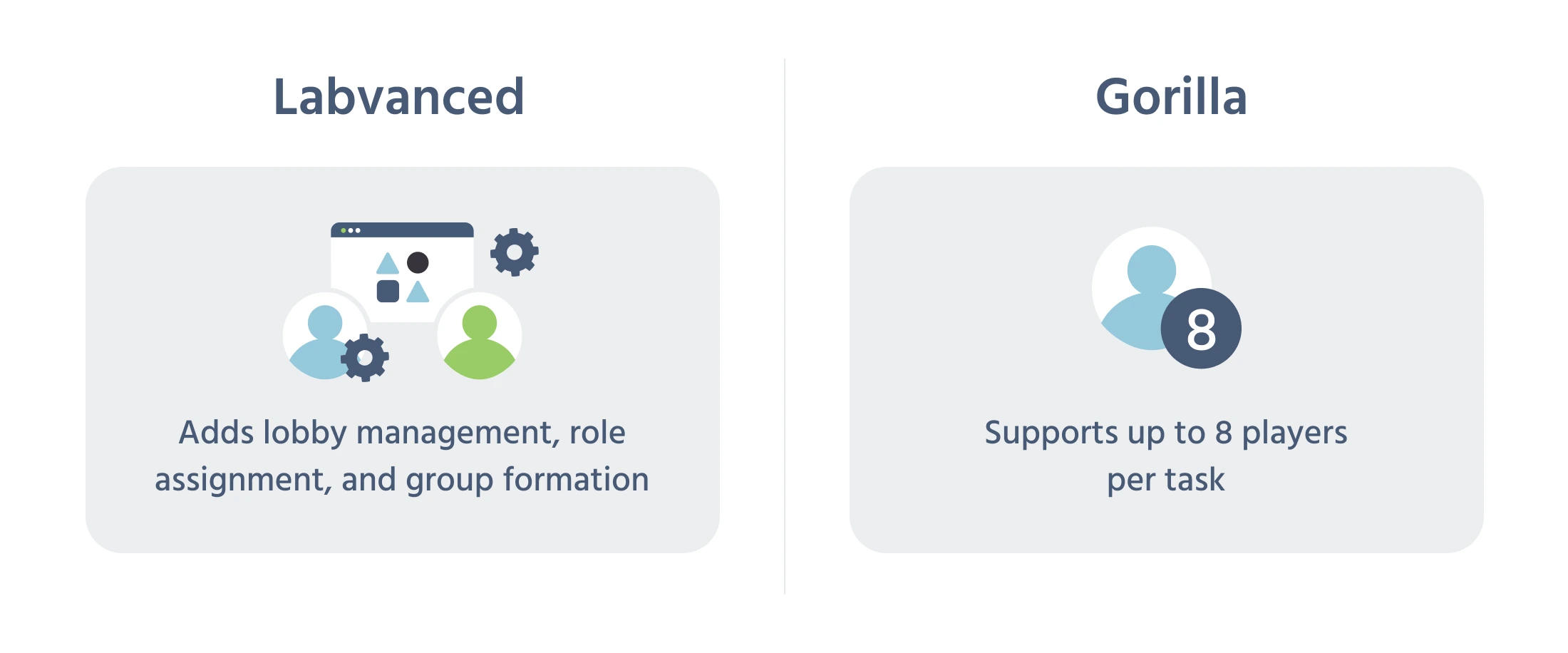
The two platforms also part ways on group studies. Gorilla's Multiplayer tool supports up to 8 players per task. Labvanced's multi-user infrastructure allows for more players and adds lobby management, role assignment, and group formation on top of its WebSocket-based synchronization.
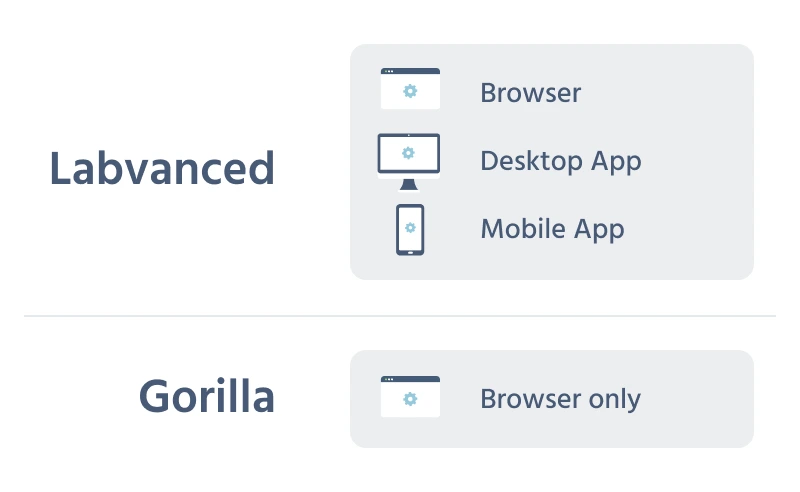
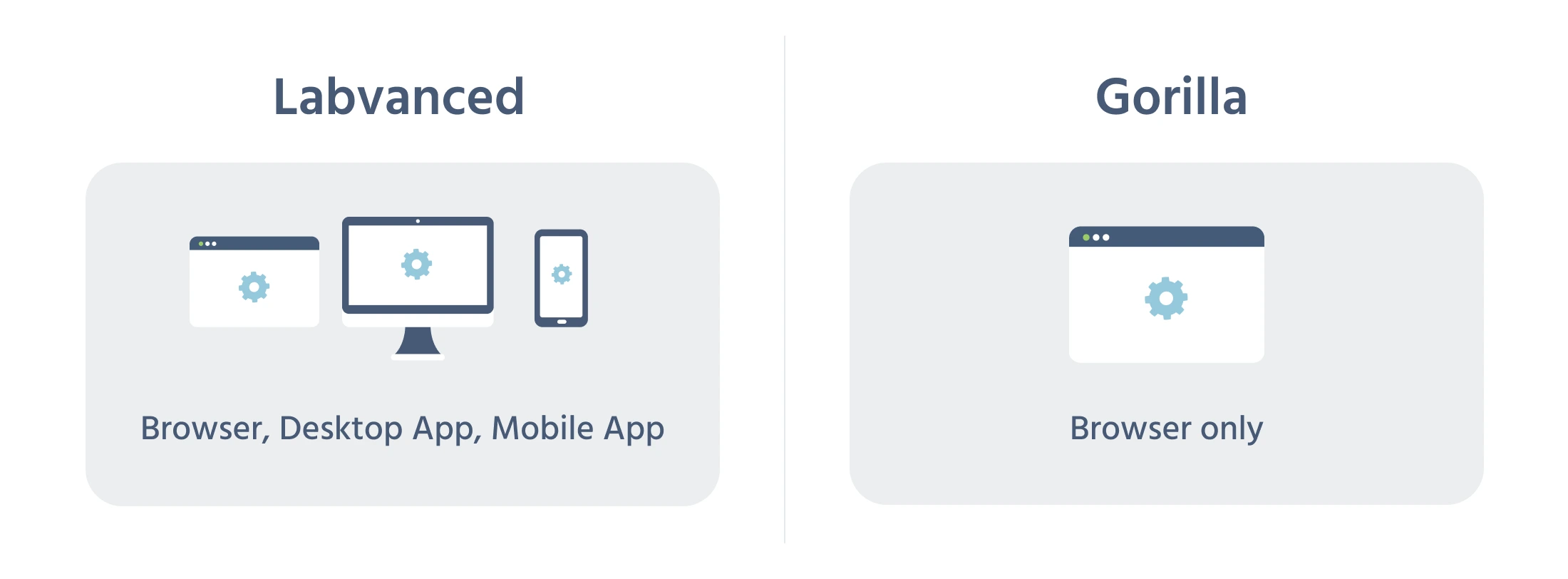
Deployment is the other structural difference. Gorilla runs in the browser only. Labvanced runs the same study on the web, on a native desktop app with EEG/LSL hardware integration for in-lab sessions, and on native iOS/Android apps for offline field collection. Labvanced even allows to collect data from external (3rd party websites), by utilizing a Chrome browser extension; this feature can be extremely useful if you plan to record eye-tracking and mouse tracking data on your own website, but still want to use Labvanced's cutting edge eye-tracking technology
Labvanced's timing is grounded in peer-reviewed methods for precise JavaScript display timing (Lukács & Gartus, 2022, Behavior Research Methods). And where Gorilla bills per participant token, Labvanced uses flat, tier-based subscriptions, which makes cost predictable regardless of how many participants a study ultimately recruits.
Choose Which Fits Your Study
If your study is a standard cognitive or survey-style paradigm with just a low number of subjects (e.g. n < 30) and your lab already has Gorilla tokens or an existing subscription, Gorilla's approach is a clean fit; there is no meaningful usability gap between the two platforms for that kind of design, and switching cost is a real cost, not just an inconvenience.
Labvanced's advantage becomes clearer as a study moves beyond a simple browser-based paradigm with only behavioral measures or when a larger number of subjects need to be recorded. While both platforms handle common experimental designs well, Labvanced is built to support studies that demand physiological measurement capabilities, more sophisticated experimental designs, and broader deployment options. As research requirements become more complex, those differences become increasingly meaningful and this is where Labvanced stands as a better choice. Due to the differences in pricing structure, Labvanced also becomes increasingly cheaper the more subjects you need for your study.
Migration Note
Migrating a study typically involves recreating the experiment in the Labvanced editor. For researchers or labs moving existing paradigms, Labvanced also offers the study building service that can assist with rebuilding experiments.
FAQ
Last Reviewed
Last reviewed: 2026-07-08
Competitor features, pricing, and platform capabilities on this page were verified against Gorilla's official documentation and pricing pages as of this date. Peer-reviewed research citations are referenced inline throughout.