Obsessive-Compulsive Inventory-Revised (OCI-R)
The OCI-R is a self-report instrument that measures the severity of obsessive-compulsive disorder (OCD) symptoms across six symptom dimensions. It was developed by Foa et al. (2002) as a shortened revision of the original 42-item Obsessive-Compulsive Inventory (Foa et al., 1998), and remains one of the most widely used self-report OCD screening instruments in clinical and research settings.
Table of Contents
Items and Structure of the OCI-R
The OCI-R consists of 18 statements describing how much a person has been bothered or distressed by an obsessive-compulsive experience over the past month, each rated on a 5-point scale: Not At All (0), A Little (1), Moderately (2), A Lot (3), or Extremely (4). Completion typically takes 7-10 minutes (Abramovitch et al., 2020).
The 18 items are evenly split across six 3-item subscales: Washing, Checking, Hoarding, Ordering, Obsessing, and Neutralizing (Foa et al., 2002). No items are reverse-worded; all items are scored in the same direction.
Each subscale targets a distinct symptom dimension (Foa et al., 2002): Washing captures contamination concerns and compulsive washing or cleaning behavior. Checking captures repeated checking of objects, such as locks or appliances, to prevent harm or correct a perceived mistake. Hoarding captures difficulty discarding possessions and the accumulation of items with little practical value. Ordering captures the need for symmetry, exactness, or arranging objects in a particular way. Obsessing captures intrusive, unwanted thoughts and difficulty controlling them. Neutralizing captures mental acts, such as counting or repeating words, performed to cancel out an intrusive thought or prevent a feared outcome, distinct from the overt compulsive behaviors the other subscales capture.
Scoring Summary
The 18 item scores are summed into a single total score ranging from 0 to 72, with higher scores indicating greater obsessive-compulsive symptom severity. Each of the six 3-item subscales can also be summed separately, producing a subscale score ranging from 0 to 12.
For the full scoring procedure and severity interpretation, see the OCI-R Scoring and Interpretation guide.
Psychometric Properties of the OCI-R
- Reliability: In the original validation study's confirmatory sample (N = 338: 118 OCD, 75 generalized social phobia, 71 PTSD, 74 nonanxious controls), the full-scale total score showed good to excellent internal consistency, with group-specific α ranging from .81 (OCD) to .93 (generalized social phobia), and α = .89 in the nonanxious control group specifically (Foa et al., 2002). Two-week test-retest reliability of the total score was r = .82 in an OCD sample (Foa et al., 2002). Subscale-level internal consistency is more variable: in a separate clinical sample of 186 OCD patients, subscale alphas ranged from .57 (Neutralizing, the lowest) to .93 (Hoarding), with a comparison sample of 17 generalized anxiety disorder patients also collected (Huppert et al., 2007).
- Validity: In a combined sample of OCD patients and nonanxious controls, the OCI-R total score correlated strongly with the Maudsley Obsessive-Compulsive Inventory (r = .85, N = 34) and moderately with the Yale-Brown Obsessive-Compulsive Scale (r = .53, N = 124) (Foa et al., 2002). In an independent sample of 167 OCD patients, the OCI-R correlated more modestly with the Yale-Brown Obsessive-Compulsive Scale (r = .41) (Abramowitz & Deacon, 2006). The OCI-R also shows the expected pattern of known-groups validity: it discriminates OCD patients from those with other anxiety disorders (Foa et al., 2002; Abramowitz & Deacon, 2006) and from nonclinical individuals (Foa et al., 2002). A confirmatory six-factor structure matching the six subscales has been independently replicated (Foa et al., 2002; Abramowitz & Deacon, 2006; Huppert et al., 2007).
- Normative Information: Severity bands (see the Scoring and Interpretation guide) were derived by Abramovitch et al. (2020) from a large clinical OCD sample benchmarked against the Yale-Brown Obsessive-Compulsive Scale. The scale's Hoarding subscale in particular has been found to behave as a distinct construct from the other five subscales, consistent with hoarding disorder's reclassification as a separate diagnosis from OCD in the DSM-5: splitting the OCI-R into a 15-item non-hoarding scale and a separate 3-item hoarding scale produced a better model fit than treating all six subscales as one structure (Wootton et al., 2015).
Technologies Supporting the OCI-R
If you have access to the OCI-R and want to implement it in Labvanced for research, the platform's Questionnaire page structure lets you configure per-subscale and total scoring without writing code, and additional data streams can be layered onto the study for deeper analysis beyond the item responses themselves.
- No-Code Scoring Configuration: Per-subscale and total summation can be configured through Labvanced's Questionnaire page structure without writing code. Once set up, scores are computed as responses come in, rather than requiring manual calculation from the raw data afterward.
- Response Behavior via Mouse Tracking: Cursor movement toward and away from response options can reveal hesitation or indecision while a participant is completing an obsessive-compulsive symptom item, adding a behavioral layer beyond the selected answer itself.
- Webcam-Based Eye Tracking: Gaze patterns while reading and answering each item can be captured with built-in, code-free webcam eye tracking, useful for attention-check analysis or studying how participants engage with items across the six symptom subscales.
- Audio and Video Recording: Sessions can be recorded alongside item responses, useful when a researcher wants a qualitative record of participant behavior during an OCD symptom assessment.
- Desktop App for Controlled Administration: For clinical or lab settings administering an OCD symptom battery, the Labvanced desktop app supports standardized, offline-capable administration on dedicated in-lab machines.

Mouse Tracking
Capture cursor movement and response hesitation alongside standard questionnaire answers.

Webcam Eye Tracking
Capture gaze patterns and visual attention with built-in, code-free and peer-reviewed webcam eye-tracking.

Desktop App
Run in-lab, controlled administration using the Desktop App, ideal for clinical intake settings.
Administration Options for the OCI-R
If you have access to the OCI-R and want to implement it in Labvanced, there are several ways it could be configured.
- Standard Questionnaire Setup: A scale like the OCI-R could be implemented using a
Canvas Framein Labvanced, with items freely positioned on the page. See the Questionnaires implementation guide for how Canvas Frames, question objects, and scoring are set up in Labvanced. - Repeated Administration: The OCI-R is frequently administered at multiple timepoints to track OCD symptom change over the course of a psychological intervention or longitudinal study. Labvanced supports repeated, scheduled administration with automated participant reminders.
- Multi-Language Deployment: The OCI-R has been independently translated and validated in numerous languages, including Japanese, Korean, and Italian versions. Labvanced supports multi-lingual study deployment, allowing a translated version to be configured for the target population.
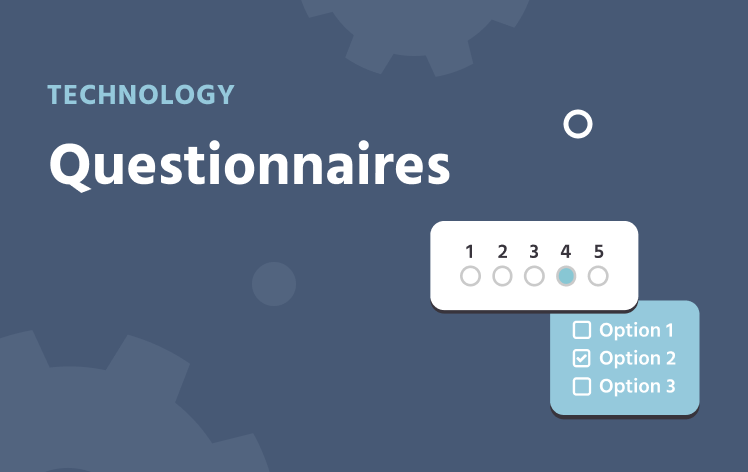
The card below covers the different ways researchers can build and analyze questionnaires in Labvanced. Beyond fixed Likert items, it supports image, video, and audio stimuli, drag-and-drop and slider-based interactions, branching logic and randomization, and real-time feedback. Layouts can be freely positioned on a canvas or auto-flowing in a page frame, and responses can be automatically scored, reverse-scored, and timed down to the individual item.
Recommended Use and Applications of the OCI-R
The OCI-R is used across clinical, research, and organizational settings to screen for and quantify obsessive-compulsive symptom severity.
- Mental health screening: Used in clinical and community settings as a brief screening measure for probable OCD, ahead of a full diagnostic evaluation using the clinician-administered Yale-Brown Obsessive-Compulsive Scale (Foa et al., 2002; Abramovitch et al., 2020).
- Treatment-outcome and longitudinal research: Administered repeatedly to track OCD symptom change over the course of psychological treatment, including in studies of eating-disorder inpatients where OCI-R scores were tracked from admission to discharge (Meule & Voderholzer, 2022).
- Comorbidity research: Used alongside other diagnostic measures to examine how obsessive-compulsive symptoms co-occur with other conditions, including obsessive-compulsive, schizotypal, and borderline personality disorders (Melca et al., 2015).
- Etiological and risk-factor research: Used as the outcome measure in studies examining developmental risk factors for OCD symptom severity, such as childhood maltreatment, where emotion regulation difficulties, rumination, insecure attachment, dissociation, and posttraumatic stress symptoms have each been found to mediate the relationship between maltreatment history and OCI-R-measured severity (Boger et al., 2020).
- Subclinical and non-clinical research: Used in general population and student samples to study obsessive-compulsive traits and symptom dimensions outside a formal clinical diagnosis, including validation work in an undergraduate sample of 395 students (Hajcak et al., 2004).
Explore Cognitive Tasks
Stroop Task
Measures attentional control and interference resolution through color-word conflict. The template's word set is fully customizable in Labvanced's editor: swapping in negatively valenced OCD-relevant words (contamination and disease words for washers, doubt and failure words for checkers) turns this into the emotional Stroop paradigm Rao et al. (2010) used with OCD patients (N = 50, washers and checkers combined). They showed significantly greater interference on these negatively valenced OCD-relevant words than controls, with no significant group difference on positively valenced OCD-relevant words, non-OCD emotional words of either valence, or the standard color-word Stroop, giving it a genuine construct link to the OCI-R once configured that way.
Flanker Task
Measures response inhibition and interference control from conflicting flanking stimuli. Hanna et al. (2024) found that pediatric OCD patients (N = 105) were significantly less accurate than matched healthy controls across all Flanker trial conditions, using the standard Flanker paradigm as-is, giving it a genuine construct link to the OCI-R without needing to reconfigure the built template.
N-Back Task
Measures working memory maintenance and updating. Heinzel et al. (2018) tested OCD patients (n = 51) and healthy controls (n = 49) on a numeric n-back task with four load levels (0- through 3-back). OCD patients responded significantly more slowly than controls at every load above 0-back, with the gap widening as load increased, and were significantly less accurate at the 3-back level specifically; accuracy did not differ at 1-back or 2-back. The load level is adjustable in Labvanced's editor: extending the built demo from a 2-back to a 3-back configuration reproduces the load level at which the accuracy deficit was confirmed, giving it a genuine construct link to the OCI-R once configured that way.
References
- Abramovitch, A., Abramowitz, J. S., Riemann, B. C., & McKay, D. (2020). Severity benchmarks and contemporary clinical norms for the obsessive-compulsive inventory-revised (OCI-R). Journal of Obsessive-Compulsive and Related Disorders, 27, 100557. https://doi.org/10.1016/j.jocrd.2020.100557
- Abramowitz, J. S., & Deacon, B. J. (2006). Psychometric properties and construct validity of the obsessive-compulsive inventory-revised: Replication and extension with a clinical sample. Journal of Anxiety Disorders, 20(8), 1016-1035. https://doi.org/10.1016/j.janxdis.2006.03.001
- Boger, S., Ehring, T., Schwarzkopf, W., & Werner, G. G. (2020). Potential mediators of the association between childhood maltreatment and obsessive-compulsive disorder in adulthood. Journal of Obsessive-Compulsive and Related Disorders, 27, 100587. https://doi.org/10.1016/j.jocrd.2020.100587
- Foa, E. B., Huppert, J. D., Leiberg, S., Langner, R., Kichic, R., Hajcak, G., & Salkovskis, P. M. (2002). The obsessive-compulsive inventory: Development and validation of a short version. Psychological Assessment, 14(4), 485-496. https://doi.org/10.1037/1040-3590.14.4.485
- Foa, E. B., Kozak, M. J., Salkovskis, P. M., Coles, M. E., & Amir, N. (1998). The validation of a new obsessive-compulsive disorder scale: The Obsessive-Compulsive Inventory. Psychological Assessment, 10(3), 206-214.
- Hajcak, G., Huppert, J. D., Simons, R. F., & Foa, E. B. (2004). Psychometric properties of the OCI-R in a college sample. Behaviour Research and Therapy, 42(1), 115-123. https://doi.org/10.1016/j.brat.2003.08.002
- Hanna, G. L., Liu, Y., Rentschler, L. G., Hanna, B. S., Arnold, P. D., & Gehring, W. J. (2024). Altered error monitoring and decreased flanker task accuracy in pediatric obsessive-compulsive disorder. Child Psychiatry & Human Development. https://doi.org/10.1007/s10578-024-01711-4
- Heinzel, S., Kaufmann, C., Grützmann, R., Hummel, R., Klawohn, J., Riesel, A., Bey, K., Lennertz, L., Wagner, M., & Kathmann, N. (2018). Neural correlates of working memory deficits and associations to response inhibition in obsessive compulsive disorder. NeuroImage: Clinical, 17, 426-434. https://doi.org/10.1016/j.nicl.2017.10.039
- Huppert, J. D., Walther, M. R., Hajcak, G., Yadin, E., Foa, E. B., Simpson, H. B., & Liebowitz, M. R. (2007). The OCI-R: Validation of the subscales in a clinical sample. Journal of Anxiety Disorders, 21(3), 394-406. https://doi.org/10.1016/j.janxdis.2006.05.006
- Melca, I. A., Yücel, M., Mendlowicz, M. V., de Oliveira-Souza, R., & Fontenelle, L. F. (2015). The correlates of obsessive-compulsive, schizotypal, and borderline personality disorders in obsessive-compulsive disorder. Journal of Anxiety Disorders, 33, 15-24. https://doi.org/10.1016/j.janxdis.2015.04.004
- Meule, A., & Voderholzer, U. (2022). Changes in obsessive-compulsive symptoms during inpatient treatment of anorexia nervosa. Journal of Eating Disorders, 10(1). https://doi.org/10.1186/s40337-022-00629-3
- Rao, N. P., Arasappa, R., Reddy, N. N., Venkatasubramanian, G., & Reddy, Y. C. J. (2010). Emotional interference in obsessive-compulsive disorder: A neuropsychological study using optimized emotional Stroop test. Psychiatry Research, 180(2-3), 99-104. https://doi.org/10.1016/j.psychres.2009.10.017
- Wootton, B. M., Diefenbach, G. J., Bragdon, L. B., Steketee, G., Frost, R. O., & Tolin, D. F. (2015). A contemporary psychometric evaluation of the Obsessive Compulsive Inventory-Revised (OCI-R). Psychological Assessment, 27(3), 874-882. https://doi.org/10.1037/pas0000075