Rosenberg Self-Esteem Scale (RSES)
The RSES is a self-report instrument that measures global self-esteem: a person's overall evaluation of their own worth. It was developed by Rosenberg (1965) and remains the most widely cited measure of self-esteem in the psychological literature (Donnellan, Trzesniewski, & Robins, 2015).
Table of Contents
Items and Structure of the RSES
The RSES consists of 10 statements about general feelings toward oneself, each rated on a 4-point scale: Strongly Agree, Agree, Disagree, or Strongly Disagree. Five items are positively worded and five are negatively worded; items 3, 5, 8, 9, and 10 are negatively worded and reverse-scored (University of Maryland Department of Sociology, n.d.; Schmitt & Allik, 2005).
The scale was originally designed and scored as a Guttman scale. Modern research instead typically scores it as a simple Likert-type sum: item responses are coded either 0-3 or 1-4 and summed, producing a total ranging from 0-30 or 10-40 depending on the coding used (University of Maryland Department of Sociology, n.d.; Sinclair et al., 2010). There is no formal subscale structure in the scale's original unidimensional design, though a Self-Competence (items 1-5) and Self-Liking (items 6-10) component split has been used in some studies (Tafarodi & Milne, 2002).
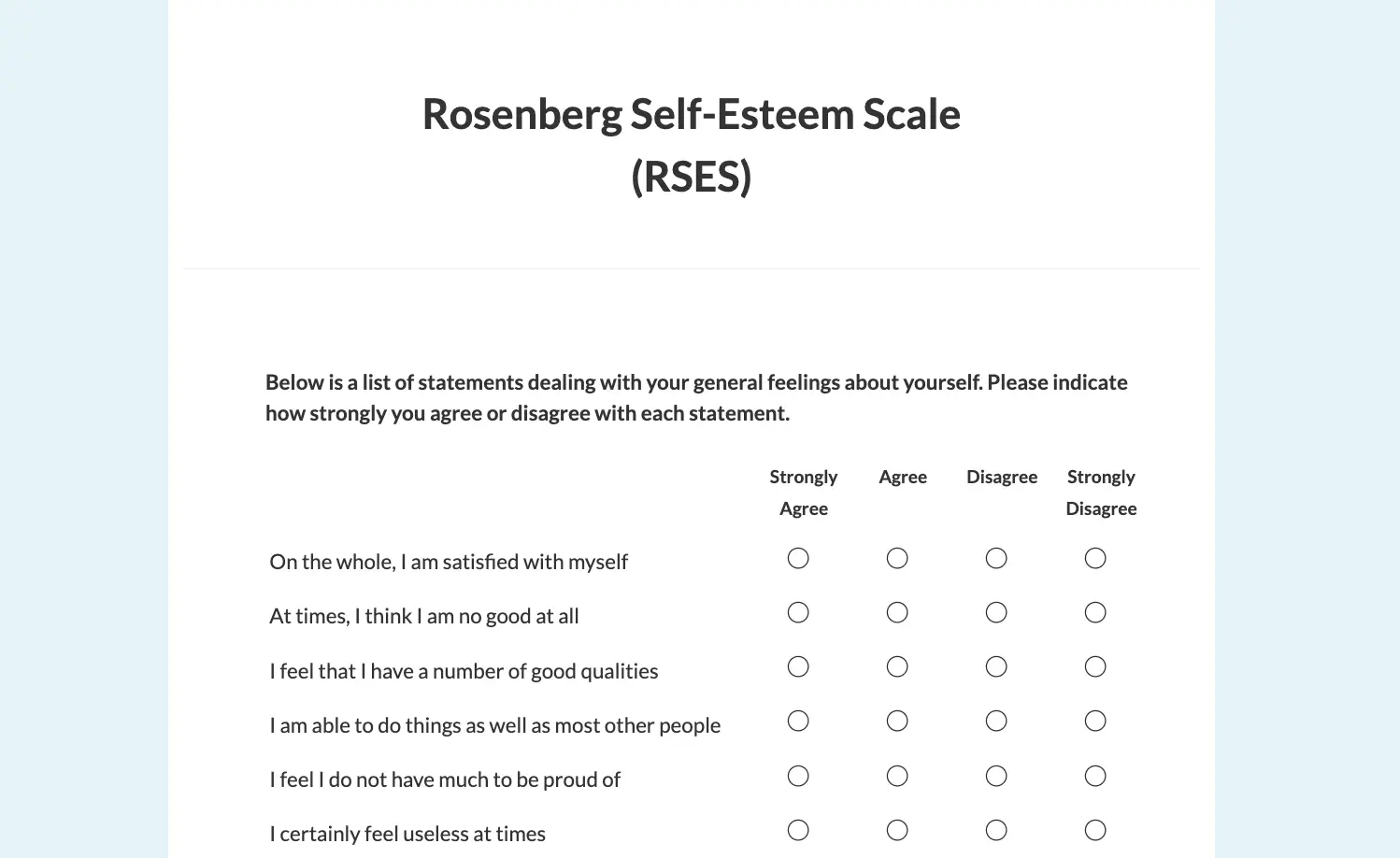
This study measures global self-esteem using the Rosenberg Self-Esteem Scale. Responses are automatically scored into a total score within Labvanced.
Click the card above to see the full item list and study structure on Labvanced. Use Inspect to view it directly, or Import to copy the study into your own account and customize it.
Scoring Summary
The 10 item scores, after reverse-scoring the five negatively worded items, are summed into a single total score. Depending on the coding convention used, the total ranges from 0-30 or 10-40, with higher scores indicating greater global self-esteem. There are no subscales in the standard scoring.
For the full scoring procedure and interpretation, see the Rosenberg Self-Esteem Scale Scoring and Interpretation guide.
Psychometric Properties of the RSES
- Reliability: Cronbach's alpha is consistently above .80 across studies: .88 in a sample of 1,234 college students (Gray-Little, Williams, & Hancock, 1997), .88 in a sample of 1,422 university students (Zeigler-Hill, 2010), and .91 in a US-representative internet sample (N = 503), ranging from .84 to .95 across demographic subgroups (Sinclair et al., 2010). Across 53 nations (N = 16,998), the average Cronbach's alpha was .81, ranging from .45 to .90 depending on the country (Schmitt & Allik, 2005). Two-week test-retest reliability of .80 has also been reported (N = 142; Ackerman & Donnellan, 2013).
- Validity: In a US-representative sample, RSES scores correlated -.62 with depression, -.47 with anxiety, and -.52 with stress on the DASS-21, and correlated more strongly with the mental health component of the SF-8 Health Survey (r = .51) than its physical health component (r = .24) (Sinclair et al., 2010). The RSES also correlates strongly with other global self-esteem measures, including the State Self-Esteem Scale (r = .71) and the Self-Liking (r = .90) and Self-Competence (r = .71) scales, and correlates with extraversion (r = .38) and neuroticism (r = -.50) in the expected directions (Donnellan et al., 2015). Across 53 nations, RSES scores correlated with neuroticism and extraversion in nearly all countries, and every national sample scored above the scale's theoretical midpoint (Schmitt & Allik, 2005).
- Factor Structure: The RSES is best characterized as a unidimensional construct that is contaminated by a method effect tied to its negatively worded items, rather than as two substantively distinct positive and negative dimensions. This was demonstrated across five separate samples of adolescents and adults, and the size of the method effect was found to diminish as verbal ability increased (Corwyn, 2000). A similar two-component pattern, attributable to item wording rather than substantive content, was independently observed in Sinclair et al. (2010).
- Predictive Validity: Lower adolescent self-esteem (averaged across ages 11, 13, and 15) predicts adult major depressive disorder (odds ratio = 1.21), adult anxiety disorder (odds ratio = 1.45), and violent criminal convictions in adulthood (odds ratio = 1.38) (Trzesniewski et al., 2006). A meta-analysis of 77 longitudinal studies confirmed that self-esteem prospectively predicts lower future depression and anxiety, controlling for prior symptom levels (Sowislo & Orth, 2013).
- Normative Information: In a US-representative sample (N = 503), the mean raw score was 22.62 (SD = 5.80) on the 0-30 scale (Sinclair et al., 2010). In an independent US sample (N = 2,782), the mean score was 32.21 (SD = 5.01) on the 10-40 scale (Schmitt & Allik, 2005); these two figures are consistent with each other once the 10-point offset between the two coding conventions is accounted for. The RSES does not have an established set of clinical severity cutoff bands; see the Scoring and Interpretation guide for a full normative comparison.
Data Collected with the RSES
The RSES captures item-level responses and a computed total score within Labvanced. All variables can be viewed and customized within the study's Variables Tab.
| Variable Name | Description |
|---|---|
Item 1 score – Item 10 score | Participant's raw response to each of the 10 individual items |
Self Esteem Items | Array combining all 10 individual item scores |
Self Esteem Score | Sum of all 10 item scores after reverse-scoring items 3, 5, 8, 9, and 10 (range 0-30) |


Technologies Supporting the RSES
The RSES is a self-report instrument, but Labvanced allows additional data streams to be layered onto the study for deeper analysis beyond the item responses themselves.
- Automatic Scoring, No-Code Setup: The RSES's reverse-scoring and summation are handled automatically within Labvanced's Questionnaire page structure, with no manual calculation required.
- Response Behavior via Mouse Tracking: Cursor movement toward and away from response options can reveal hesitation or indecision while a participant is completing a self-esteem item, adding a behavioral layer beyond the selected answer itself.
- Webcam-Based Eye Tracking: Gaze patterns while reading and answering each item can be captured with built-in, code-free webcam eye tracking, useful for attention-check analysis or studying how participants engage with negatively vs. positively worded items.
- Audio and Video Recording: Sessions can be recorded alongside item responses, useful when a researcher wants a qualitative record of participant behavior during a self-esteem assessment.
- Desktop App for Controlled Administration: For clinical or lab settings administering the RSES as part of a larger intake battery, the Labvanced desktop app supports standardized, offline-capable administration on dedicated in-lab machines.
Mouse Tracking
Capture cursor movement and response hesitation alongside standard questionnaire answers.

Webcam Eye Tracking
Capture gaze patterns and visual attention with built-in, code-free and peer-reviewed webcam eye-tracking.

Desktop App
Run in-lab, controlled administration using the Desktop App, ideal for clinical intake settings.
Administration Options for the RSES
There are several ways this instrument can be configured in Labvanced.
- Standard Questionnaire Setup: As a fixed-item Likert scale with no images, drag-and-drop, or slider inputs, the RSES is built using a standard
Page Frame, where items are listed top to bottom. See the Questionnaires implementation guide for how Page Frames, question objects, and scoring are set up in Labvanced. - Repeated Administration: The RSES is frequently administered at multiple timepoints to track self-esteem over the course of a developmental study or longitudinal study. Labvanced supports repeated, scheduled administration with automated participant reminders.
- Multi-Language Deployment: The RSES has been independently translated and validated in numerous languages, including large-scale cross-cultural administrations spanning dozens of countries. Labvanced supports multi-lingual study deployment, allowing a translated version to be configured for the target population.
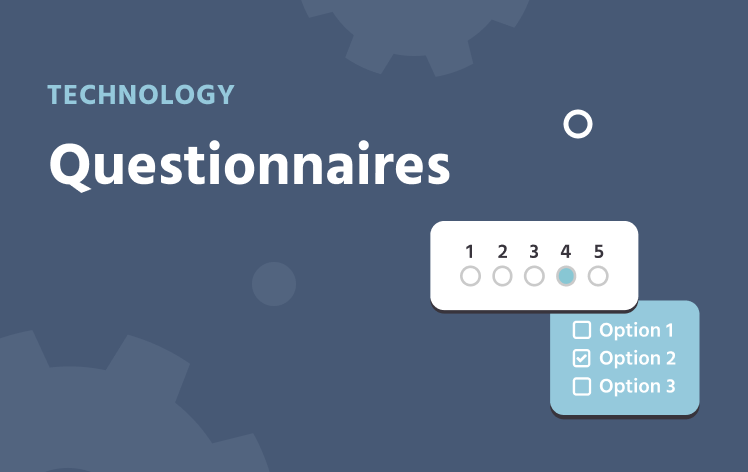
The card below covers the different ways researchers can build and analyze questionnaires in Labvanced. Beyond fixed Likert items, it supports image, video, and audio stimuli, drag-and-drop and slider-based interactions, branching logic and randomization, and real-time feedback. Layouts can be freely positioned on a canvas or auto-flowing in a page frame, and responses can be automatically scored, reverse-scored, and timed down to the individual item.
If there is something else you'd like to know, please feel welcome to write to us and ask:
Recommended Use and Applications of the RSES
The RSES is used across personality, social, developmental, and clinical research to assess global self-esteem.
- Personality and social psychology research: Used as the standard measure of global self-esteem in studies examining its relationship to personality traits, attachment, and social behavior (Schmitt & Allik, 2005; Donnellan et al., 2015).
- Developmental and longitudinal research: Administered repeatedly across adolescence and adulthood to track self-esteem trajectories and their downstream links to later mental health, relationship, and occupational outcomes (Trzesniewski et al., 2006).
- Cross-cultural research: Used in large-scale, multi-national studies to compare self-esteem levels and structure across languages and cultures (Schmitt & Allik, 2005).
- Mental health and wellbeing research: Used alongside depression, anxiety, and general health measures to examine self-esteem as a risk or protective factor (Sinclair et al., 2010; Sowislo & Orth, 2013).
Explore Related Cognitive Tasks
Implicit Association Test (IAT)
Measures the strength of automatic mental associations through reaction-time differences on a categorization task. The template's category and attribute stimuli are fully customizable in Labvanced's editor: reconfiguring it into a self vs. other, pleasant vs. unpleasant categorization turns this into the Self-Esteem IAT paradigm, an implicit measure of self-worth shown to correlate with the explicit RSES (Yovel et al., 2022), giving it a genuine construct link to the RSES once configured that way.
Stroop Task
Measures attentional control and interference resolution through color-word conflict. The template's word set is fully customizable in Labvanced's editor: swapping in rejection- and acceptance-themed words (e.g., "rejected," "unwanted" vs. "welcomed," "cherished") turns this into the Rejection Stroop paradigm, which Dandeneau and Baldwin (2004) used alongside the RSES itself and found produced significantly more interference on rejection words in low-self-esteem participants than high-self-esteem participants, giving it a genuine construct link to the RSES once configured that way.
References
- Ackerman, R. A., & Donnellan, M. B. (2013). Evaluating self-report measures of narcissistic entitlement. Journal of Psychopathology and Behavioral Assessment, 35, 460-474.
- Corwyn, R. F. (2000). The factor structure of global self-esteem among adolescents and adults. Journal of Research in Personality, 34, 357-379.
- Dandeneau, S. D., & Baldwin, M. W. (2004). The inhibition of socially rejecting information among people with high versus low self-esteem: The role of attentional bias and the effects of bias reduction training. Journal of Social and Clinical Psychology, 23(4), 584-602.
- Donnellan, M. B., Trzesniewski, K. H., & Robins, R. W. (2015). Measures of self-esteem. In G. J. Boyle, D. H. Saklofske, & G. Matthews (Eds.), Measures of Personality and Social Psychological Constructs (pp. 131-157). Elsevier.
- Gray-Little, B., Williams, V. S., & Hancock, T. D. (1997). An item response theory analysis of the Rosenberg Self-Esteem Scale. Personality and Social Psychology Bulletin, 23, 443-451.
- Rosenberg, M. (1965). Society and the Adolescent Self-Image. Princeton, NJ: Princeton University Press.
- Schmitt, D. P., & Allik, J. (2005). Simultaneous administration of the Rosenberg Self-Esteem Scale in 53 nations: Exploring the universal and culture-specific features of global self-esteem. Journal of Personality and Social Psychology, 89(4), 623-642.
- Sinclair, S. J., Blais, M. A., Gansler, D. A., Sandberg, E., Bistis, K., & LoCicero, A. (2010). Psychometric properties of the Rosenberg Self-Esteem Scale: Overall and across demographic groups living within the United States. Evaluation & the Health Professions, 33(1), 56-80.
- Sowislo, J. F., & Orth, U. (2013). Does low self-esteem predict depression and anxiety? A meta-analysis of longitudinal studies. Psychological Bulletin, 139, 213-240.
- Tafarodi, R. W., & Milne, A. B. (2002). Decomposing global self-esteem. Journal of Personality, 70, 443-483.
- Trzesniewski, K. H., Donnellan, M. B., Moffitt, T. E., Robins, R. W., Poulton, R., & Caspi, A. (2006). Low self-esteem during adolescence predicts poor health, criminal behavior, and limited economic prospects during adulthood. Developmental Psychology, 42, 381-390.
- University of Maryland Department of Sociology. (n.d.). Using the Rosenberg Self-Esteem Scale. Retrieved from https://socy.umd.edu/about-us/using-rosenberg-self-esteem-scale
- Yovel, I., Aviram, G., Kahana, N., & Katz, B. A. (2022). Testing a new indirect measure of general self-worth: The Self-esteem Questionnaire-based Implicit Association Test. British Journal of Social Psychology, 61(1), 100-120.
- Zeigler-Hill, V. (2010). The interpersonal nature of self-esteem: Do different measures of self-esteem possess similar interpersonal content? Journal of Research in Personality, 44, 22-30.