Celebrity Endorsement Toy Preference Task
The Celebrity Endorsement Toy Preference Task is a forced-choice paradigm that measures whether character or celebrity endorsement shifts children's toy preference. Each child is randomly assigned to see a toy either endorsed by an animated character or presented with no endorsement, then chooses between two toys. Built-in webcam eye tracking captures visual attention alongside the choice itself.
Table of Contents
Task Format | Celebrity Endorsement Toy Preference Task
At the start of the study, each participant is randomly and evenly split into one of two groups: celebrity-endorsed or non-endorsed. Participants in the non-endorsed group see a neutral introduction, while participants in the celebrity-endorsed group see an animated character introduce itself and endorse one of the toys as its favorite. Which group each participant landed in is recorded.
After the introduction, participants complete 8 trials in which two toy images appear side by side (for example, two robot designs) and they choose which one they want to play with by clicking or tapping their choice. Which side each toy appears on is swapped across trials, so left/right position does not influence which toy gets picked more often. Webcam eye tracking runs during each choice screen, recording where the child looks before responding.
Participants respond by clicking (or tapping, on touchscreen devices) directly on their chosen toy, so the same trial structure works across desktop and touchscreen devices without a separate input scheme.
Data Collected with the Celebrity Endorsement Toy Preference Task
The Celebrity Endorsement Toy Preference Task captures both the choice outcome and the visual attention that preceded it, letting researchers separate what a child picked from how they looked at each option beforehand. All variables can be viewed and customized within the task's Variables Tab.
Below are the key variables collected in the Labvanced version of the Celebrity Endorsement Toy Preference Task:
| Variable Name | Description |
|---|---|
assigned_group | The between-subjects group (e.g. control or celebrity-endorsed) the participant was randomly assigned to |
choice | Which toy the participant selected |
reaction time | Time from the choice screen onset to the participant's selection |
avg_boring_fix_dur | Participant-level average fixation duration on the non-endorsed toy across all trials |
avg_interesting_fix_dur | Participant-level average fixation duration on the endorsed/salient toy across all trials |
avg_boring_ttff | Participant-level average time-to-first-fixation on the non-endorsed toy |
avg_interesting_ttff | Participant-level average time-to-first-fixation on the endorsed/salient toy |
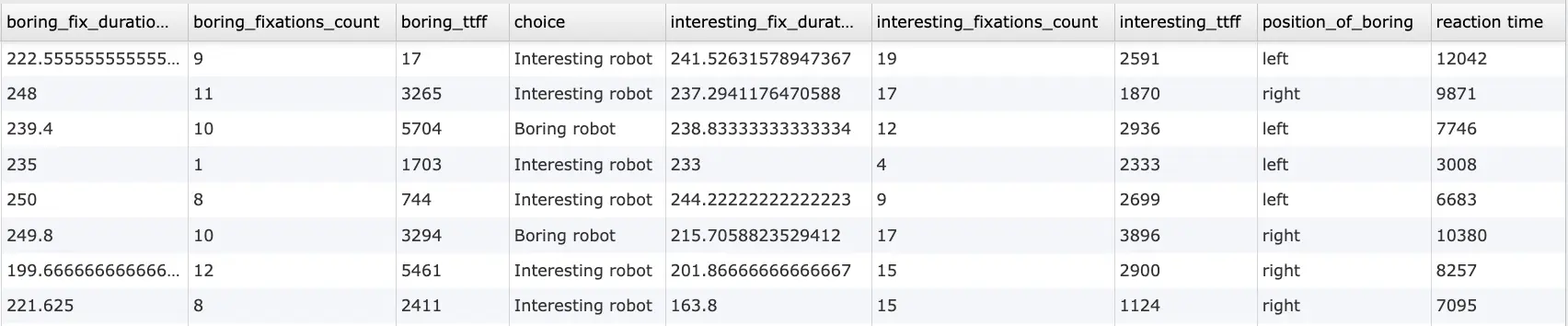
In this task, children are randomly assigned to a control or celebrity-endorsement group, then choose between two toys while webcam eye tracking records their gaze. Choice, reaction time, and fixation measures are recorded as outcome indicators.
Technology for the Celebrity Endorsement Toy Preference Task
Labvanced includes several technologies that make the Celebrity Endorsement Toy Preference Task well suited to both developmental research and consumer/marketing psychology:
Webcam Eye Tracking: Peer-reviewed, code-free webcam eye tracking captures where a child looks during the choice screen, revealing attention patterns that a choice outcome alone cannot show, without requiring dedicated hardware.
High Precision Timing: Millisecond level timing ensures that stimulus presentation and reaction time recording are accurate enough to detect small differences in decision speed between conditions.
Between-Subjects Factor Randomization: Participants are automatically and evenly assigned to the
not-endorsedorcelebrity-endorsedcondition at the start of the study, with the assignment recorded per participant, supporting clean control-versus-endorsement comparisons without manual group management.Cross-Device Input Support: The toy choice screen works with mouse click and touchscreen tap alike, so the same task can be deployed to children on a lab desktop, a tablet, or a home computer without redesigning the response method.
Desktop App Mode: A desktop application can be used when stronger control over the task or hardware integration is required. This mode supports offline testing and compatibility with equipment such as EEG and other LSL based systems.
Longitudinal Study Support: The task can be delivered consistently across multiple sessions or age groups, useful for tracking how susceptibility to endorsement changes as children's persuasion knowledge develops over time.

Webcam Eye Tracking
Capture gaze patterns and visual attention with built-in, code-free and peer-reviewed webcam eye-tracking.

Timing Precision
Capture reaction times, task performance, and more with millisecond accuracy for time-sensitive tasks.

Desktop App
Run in-lab studies using the Desktop App, compatible with EEG and other LSL-connected lab hardware.
Customization of the Celebrity Endorsement Toy Preference Task
There are many ways to go about customizing this template. Below are a few themes researchers commonly ask when it comes to modifying this task.
Stimulus and Product Set
Replace the toy images with a different product pair relevant to your research question. Stimulus files and labels can be edited directly in the Object Properties panel.
Endorser Character
Swap the animated character for a different character, a real presenter, or a static image, depending on whether the research question concerns animated spokes-characters, celebrity endorsers, or peer endorsement.
Condition Structure and Randomization
Adjust the group_randomization factor's levels or randomization balance in the Factors & Randomization panel, for example to add a third condition such as peer endorsement alongside not-endorsed and celebrity-endorsed.
Response Options
Extend the task beyond a two-item forced choice, or change the input from a click/tap choice to another response format, depending on the design.
If you need help customizing this task, please feel welcome to write to us and ask:
Recommended Use of the Celebrity Endorsement Toy Preference Task
The Celebrity Endorsement Toy Preference Task can be administered online or in-lab and applies across developmental, consumer, and media research contexts studying how endorsement shapes children's choices.
Developmental and Educational Psychology: Persuasion knowledge, the ability to recognize and resist advertising's intent, develops gradually through childhood and continues to be shaped into adolescence (Rozendaal & Buijzen, 2023). This task can help pinpoint the age at which a specific endorsement effect emerges or fades.
Marketing and Consumer Psychology: Character or celebrity endorsement has been shown to shift children's stated toy preference independent of the product's own features (Ross et al., 1984), an effect also documented more recently for animated spokes-characters used in food and beverage marketing (Mulligan et al., 2023).
Media and Communication Research: Eye tracking has already been used to show that how and when marketing content is disclosed to children changes their visual attention and their later understanding that the content was sponsored (Van Reijmersdal et al., 2020); this task extends that same eye-tracking approach to product endorsement specifically.
Public Health and Policy Research: Reviews spanning four decades of advertising-to-children research continue to inform regulatory debate over marketing characters and endorsement in child-directed advertising (Rozendaal & Buijzen, 2023), and behavioral outcome measures like this task provide evidence beyond self-report for that debate.
References
Mulligan, C., Remedios, L., Ramsay, T., Pauzé, E., Bagnato, M., & Potvin Kent, M. (2023). The impact of characters like Tony the Tiger and other child-targeted techniques used in food and beverage marketing. Frontiers in Nutrition, 10, 1287473. https://doi.org/10.3389/fnut.2023.1287473
Ross, R. P., Campbell, T., Wright, J. C., Huston, A. C., Rice, M. L., & Turk, P. (1984). When celebrities talk, children listen: An experimental analysis of children's responses to TV ads with celebrity endorsement. Journal of Applied Developmental Psychology, 5(2), 185-202.
Rozendaal, E., & Buijzen, M. (2023). Children's vulnerability to advertising: An overview of four decades of research (1980s-2020s). International Journal of Advertising, 42(1), 78-86. https://doi.org/10.1080/02650487.2022.2135349
Van Reijmersdal, E. A., Rozendaal, E., Hudders, L., Vanwesenbeeck, I., Cauberghe, V., & Van Berlo, Z. M. C. (2020). Effects of disclosing influencer marketing in videos: An eye tracking study among children in early adolescence. Journal of Interactive Marketing, 49, 94-106. https://doi.org/10.1016/j.intmar.2019.09.001
Related Tasks
The Celebrity Endorsement Toy Preference Task pairs naturally with other choice- and gaze-based tasks in Labvanced's task library.
Preferential Looking Paradigm
Participants view side-by-side of either images or videos, while gaze patterns, fixation durations and head orientation are recorded, as well as a video recording of the participant.
Dot Probe Task
In this task, participants see pairs of images followed by a small dot and must respond as quickly as possible to the dot's location via key press (desktop) or button press (mobile).