Flourishing Scale (FS)
The Flourishing Scale (FS) is an 8-item self-report measure of psychological well-being that captures a person's self-perceived success in areas such as relationships, self-esteem, purpose, and optimism. It was developed by Diener et al. (2010) and produces a single overall flourishing score.
Table of Contents
Items and Structure of the Flourishing Scale (FS)
The FS consists of 8 statements describing different domains of psychological flourishing, covering areas such as purpose and meaning, relationships, competence, and optimism. Each item is rated on a 7-point Likert scale from 1 ("strongly disagree") to 7 ("strongly agree"), with no reverse-scored items. All 8 statements are worded positively, and the scale produces a single overall score rather than separate subscales.
Scoring Summary
The 8 item scores, each ranging from 1 to 7, are summed into a single total score ranging from 8 to 56, with higher scores indicating greater self-perceived flourishing. There are no subscales.
For the full scoring procedure and interpretation guidance, see the FS Scoring and Interpretation guide.
Psychometric Properties of the Flourishing Scale (FS)
- Reliability: In the original validation sample, the FS showed excellent internal consistency (Cronbach's α = .87) and good test-retest reliability (r = .71) over a one-month interval (Diener et al., 2010).
- Validity: A single-factor structure accounted for 53% of the variance in the original sample (eigenvalue = 4.24). Convergent validity was supported by correlations with the Satisfaction with Life Scale (r = .62, n = 680, p < .001), Ryff's Scales of Psychological Well-Being (r = .64, n = 74, p < .001), and the Basic Needs Satisfaction in General scale (r = .62, n = 527-530, p < .001) (Diener et al., 2010).
- Normative Information: The original validation sample (combined university-student groups) had a mean score of 44.97 (SD = 6.56). A much larger, nationally representative New Zealand sample (n = 9,646, ages 18-110) found a similar mean of 43.82 (SD = 8.36), providing more robust population norms (see the Scoring and Interpretation guide for percentile-based bands) (Hone et al., 2014).
Technologies Supporting the Flourishing Scale (FS)
If you have access to the FS and want to implement it in Labvanced for research, the platform's Questionnaire page structure lets you configure sum-scoring without writing code, and additional data streams can be layered onto the study for deeper analysis beyond the item responses themselves.
- No-Code Scoring Configuration: Summation can be configured through Labvanced's Questionnaire page structure without writing code. Once set up, item scores are summed as responses come in, rather than requiring manual calculation from the raw data afterward.
- Response Behavior via Mouse Tracking: Cursor movement toward and away from response options can reveal hesitation or indecision while a participant is completing a well-being item, adding a behavioral layer beyond the selected answer itself.
- Webcam-Based Eye Tracking: Gaze patterns while reading and answering each item can be captured with built-in, code-free webcam eye tracking, useful for attention-check analysis or studying how participants engage with different flourishing domains, such as purpose versus social relationships.
- Audio and Video Recording: Sessions can be recorded alongside item responses, useful when a researcher wants a qualitative record of participant behavior during a well-being assessment.
- Desktop App for Controlled Administration: For clinical, coaching, or lab settings administering a well-being battery, the Labvanced desktop app supports standardized, offline-capable administration on dedicated in-lab machines.

Mouse Tracking
Capture cursor movement and response hesitation alongside standard questionnaire answers.

Webcam Eye Tracking
Capture gaze patterns and visual attention with built-in, code-free and peer-reviewed webcam eye-tracking.

Desktop App
Run in-lab, controlled administration using the Desktop App, ideal for clinical or coaching intake settings.
Administration Options for the Flourishing Scale (FS)
If you have access to the FS and want to implement it in Labvanced, there are several ways it could be configured.
- Standard Questionnaire Setup: As a fixed-item Likert scale with no images, drag-and-drop, or slider inputs, a scale like the FS could be implemented using a standard
Page Frame, where items are listed top to bottom. See the Questionnaires implementation guide for how Page Frames, question objects, and scoring are set up in Labvanced. - Repeated Administration: The FS is frequently administered at multiple timepoints to track well-being change over the course of a wellness program, coaching intervention, or longitudinal study. Labvanced supports repeated, scheduled administration with automated participant reminders.
- Multi-Language Deployment: The FS has been independently translated and validated in numerous languages and cultural contexts. Labvanced supports multi-lingual study deployment, allowing a translated version to be configured for the target population.
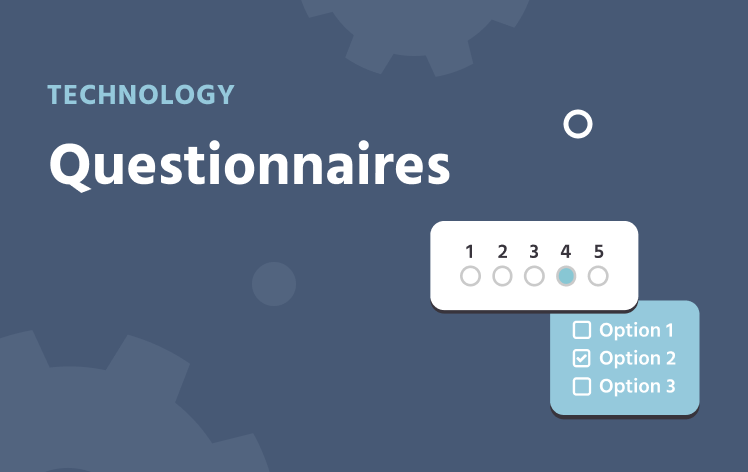
The card below covers the different ways researchers can build and analyze questionnaires in Labvanced. Beyond fixed Likert items, it supports image, video, and audio stimuli, drag-and-drop and slider-based interactions, branching logic and randomization, and real-time feedback. Layouts can be freely positioned on a canvas or auto-flowing in a page frame, and responses can be automatically scored, reverse-scored, and timed down to the individual item.
Recommended Use and Applications of the Flourishing Scale (FS)
The Flourishing Scale is used across a wide range of research areas to measure self-perceived psychological well-being as an outcome or correlate of interest.
- Organizational and Workplace Psychology: Used to track employee flourishing over time, including how organizational support and psychological capital predict well-being outcomes in a workplace setting (Ho & Chan, 2022).
- Clinical and Health Psychology: Used as a strengths-based outcome measure in clinical populations, such as validating the scale for people living with early-stage dementia to assess social-psychological well-being independent of cognitive impairment severity (Clarke et al., 2025).
- Cross-Cultural Validation Research: Used to examine whether the scale's structure and psychometric properties hold outside the original US/English-speaking validation context, including a recent confirmation of its validity and measurement invariance in a non-Western, Algerian sample (Mansouri, 2025).
- Longitudinal and Psychometric Stability Research: Used to examine whether flourishing behaves as a stable trait or a fluctuating state over time, tracked across three timepoints over an 8-month period (Varga et al., 2025).
- Sleep and Health Behavior Research: Used alongside physiological and behavioral health measures, such as examining the relationship between flourishing and sleep quality in a student sample (Mahmoud et al., 2026).
For examples of how the Flourishing Scale has been applied across different population groups, see how the Flourishing Scale has been used in research.
Explore Cognitive Tasks
Implicit Association Test (IAT)
Measures automatic associations through speeded key-press categorization. Labvanced's IAT template is fully customizable to the categories being compared. Researchers have adapted IAT methodology to build implicit well-being measures alongside explicit self-report scales in youths (García-Márquez et al., 2024, using the Psychological Well-Being Scales and WHO-5, not the FS itself), giving implicit and explicit well-being assessment a genuine methodological link worth exploring.
Ultimatum Game
Measures prosocial and fairness-related decision-making through an interactive proposer/responder game. Prosocial behavior in economic games has been found to correlate with eudaimonic well-being (Koch, 2024), giving it a genuine construct link to the FS's item on contributing to others' happiness.
References
- Clarke, C., Baird, K., Moniz-Cook, E., Mountain, G., Wolverson, E., Lee, E., & Hewitt, C. (2025). A psychometric study of the Flourishing Scale for people living with dementia. Alzheimer's & Dementia: Translational Research & Clinical Interventions, 11(2), e70097. https://doi.org/10.1002/trc2.70097
- Diener, E., Wirtz, D., Tov, W., Kim-Prieto, C., Choi, D. W., Oishi, S., & Biswas-Diener, R. (2010). New well-being measures: Short scales to assess flourishing and positive and negative feelings. Social Indicators Research, 97(2), 143-156. https://doi.org/10.1007/s11205-009-9493-y
- García-Márquez, R., Stavraki, M., Díaz, D., & Bajo, M. (2024). Development of an implicit well-being measure for youths using the Implicit Association Test. Child Indicators Research, 17(3), 1311-1328. https://doi.org/10.1007/s12187-024-10121-w
- Ho, H. C. Y., & Chan, Y. C. (2022). Flourishing in the workplace: A one-year prospective study on the effects of perceived organizational support and psychological capital. International Journal of Environmental Research and Public Health, 19(2), 922. https://doi.org/10.3390/ijerph19020922
- Hone, L., Jarden, A., & Schofield, G. (2014). Psychometric properties of the Flourishing Scale in a New Zealand sample. Social Indicators Research, 119(2), 1031-1045. https://doi.org/10.1007/s11205-013-0501-x
- Koch, C. (2024). Is there a nexus between pro-social behavior and well-being? Correlational evidence. Journal of the Economic Science Association, 10(2), 279-293. https://doi.org/10.1007/s40881-023-00156-0
- Mahmoud, N. F., Alghamdi, L., Almuaither, T., Alqabani, R., Alabdulathim, D., Alotaibi, M., Almuwais, A., & Atya, A. M. (2026). Association between psychological well-being, sleep quality, and academic performance among physical therapy students. Frontiers in Medicine, 13, 1704952. https://doi.org/10.3389/fmed.2026.1704952
- Mansouri, M. (2025). Psychometric validation and measurement invariance of the Flourishing Scale (FS) in the Algerian context. Measurement Instruments for the Social Sciences, 7, Article e15497. https://doi.org/10.5964/miss.15497
- Varga, B. A., Oláh, A., Urbán, R., & Vargha, A. (2025). How long do we flourish? A flourishing state or trait? A longitudinal examination of the Diener Flourishing Scale. Journal of Happiness Studies, 26(6), Article 87. https://doi.org/10.1007/s10902-025-00919-y