Depression Anxiety Stress Scales - 21 (DASS-21)
The DASS-21 is a self-report instrument that measures three related but distinct negative emotional states: depression, anxiety, and stress. It is the short form of the original 42-item DASS, developed by Lovibond and Lovibond (1995) at the University of New South Wales under an earlier working title, the Self-Analysis Questionnaire. The DASS has since been adapted into multiple versions and translated into numerous languages, with many of these translations undergoing independent validation.
Table of Contents
Items and Structure of the DASS-21
The DASS-21 consists of 21 items, split evenly across three 7-item subscales: Depression, Anxiety, and Stress. Each item describes a symptom experienced over the past week (e.g., "I found it hard to wind down"), and participants respond on a 4-point Likert scale: 0 ("Did not apply to me at all"), 1 ("Applied to me to some degree, or some of the time"), 2 ("Applied to me to a considerable degree, or a good part of time"), or 3 ("Applied to me very much, or most of the time"). Completion typically takes 5 to 10 minutes.
The three subscales assess related but distinct symptom domains (Lovibond & Lovibond, 1995; Brown et al., 1997): Depression captures dysphoria, hopelessness, devaluation of life, self-deprecation, lack of interest or involvement, anhedonia, and inertia. Anxiety captures autonomic arousal, skeletal muscle effects, situational anxiety, and subjective anxious affect. Stress captures chronic non-specific arousal: difficulty relaxing, nervous arousal, and being easily upset, agitated, irritable, or impatient.
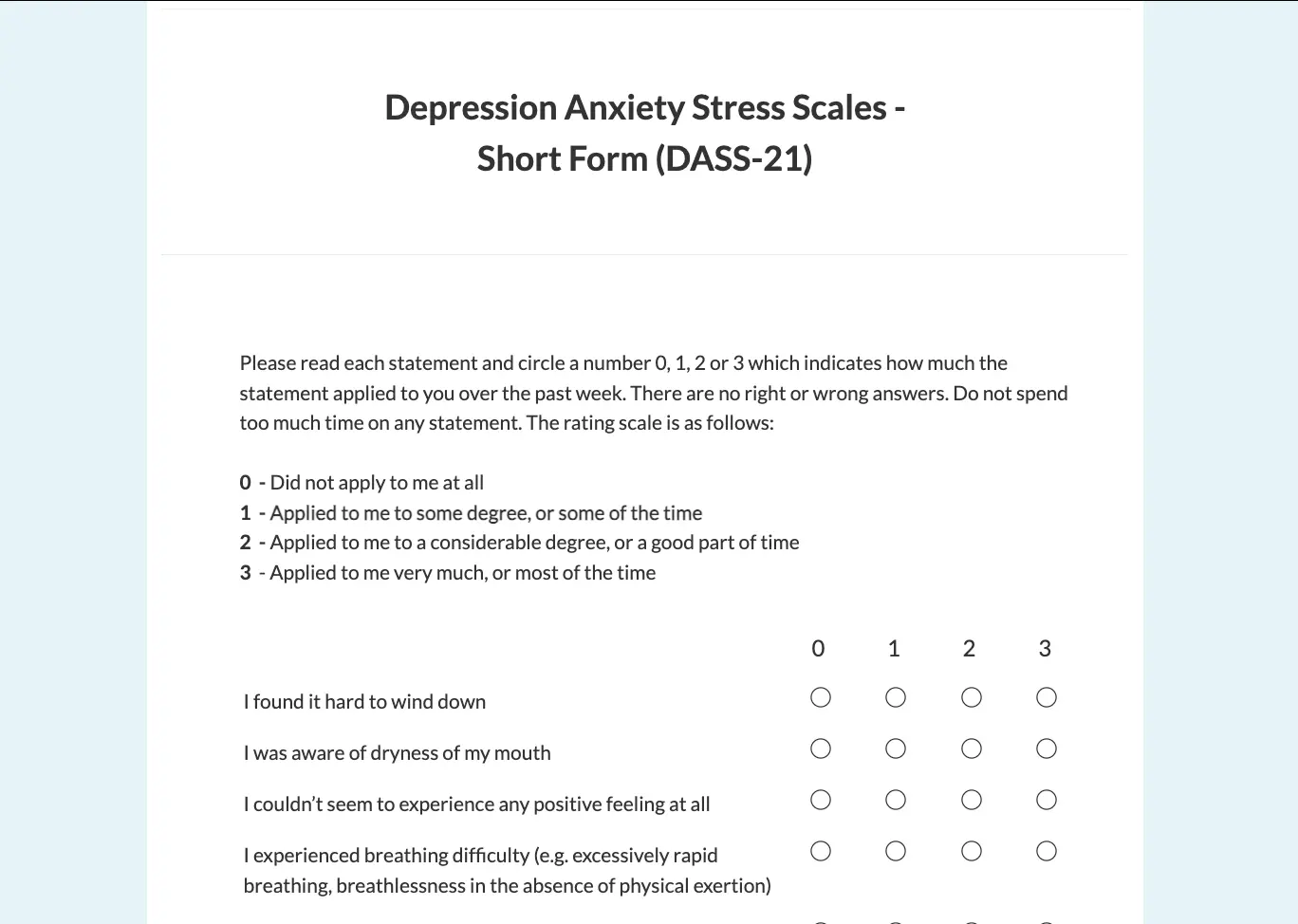
This study measures depression, anxiety, and stress symptom severity using the DASS-21. Responses are automatically scored into three subscale totals within Labvanced.
Click the card above to see the full item list and study structure on Labvanced. Use Inspect to view it directly, or Import to copy the study into your own account and customize it.
Scoring Summary
Each subscale's 7 items are summed and then doubled, so that DASS-21 scores align with the same severity bands as the original 42-item DASS. This gives each of the three subscales (Depression, Anxiety, Stress) a possible range of 0 to 42, with higher scores indicating greater symptom severity in that domain. There is no single combined total score across all three subscales.
For the full scoring procedure and severity interpretation, see the DASS-21 Scoring and Interpretation guide.
Psychometric Properties of the DASS-21
- Reliability: In the original DASS-21 validation sample, internal consistency was strong across all three subscales: Cronbach's α = .94 for Depression, .87 for Anxiety, and .91 for Stress (Antony et al., 1998).
- Validity: The DASS-21's three-factor structure, separating depression, anxiety, and stress as distinct (though correlated) dimensions, has been confirmed through factor analysis (Lovibond & Lovibond, 1995; Antony et al., 1998). In a clinical patient sample (N = 258), the DASS-21 Depression subscale correlated r = .79 with the Beck Depression Inventory, and the Anxiety subscale correlated r = .85 with the Beck Anxiety Inventory, supporting convergent validity (Antony et al., 1998). The three subscales are moderately intercorrelated with each other, as expected for related but distinct constructs: Depression-Anxiety r = .46, Stress-Depression r = .57, Stress-Anxiety r = .72 (Antony et al., 1998).
- Normative Information: Severity bands (see the Scoring and Interpretation guide) were derived from percentile distributions in the original Australian normative sample (Lovibond & Lovibond, 1995). Separate population-level percentile norms have since been published, most notably from a large UK non-clinical sample (N = 1,794; Henry & Crawford, 2005) and an Australian general adult population sample (N = 497) used to generate percentile and interval estimates (Crawford et al., 2011).
Data Collected with the DASS-21
The DASS-21 captures item-level responses and three computed subscale scores within Labvanced. All variables can be viewed and customized within the study's Variables Tab.
| Variable Name | Description |
|---|---|
Item 1 score – Item 21 score | Participant's raw response (0-3) to each of the 21 individual items |
Anxiety Items | Array variable of the raw scores for the 7 items making up the Anxiety subscale |
Anxiety Items Sum | Sum of the 7 raw Anxiety item scores, before doubling |
Anxiety Score | Computed Anxiety subscale score (Anxiety Items Sum × 2) |
Depression Items | Array variable of the raw scores for the 7 items making up the Depression subscale |
Depression Items Sum | Sum of the 7 raw Depression item scores, before doubling |
Depression Score | Computed Depression subscale score (Depression Items Sum × 2) |
Stress Items | Array variable of the raw scores for the 7 items making up the Stress subscale |
Stress Items Sum | Sum of the 7 raw Stress item scores, before doubling |
Stress Score | Computed Stress subscale score (Stress Items Sum × 2) |


Technologies Supporting the DASS-21
The DASS-21 is a self-report instrument, but Labvanced allows additional data streams to be layered onto the study for deeper analysis beyond the item responses themselves.
- Automatic Scoring, No-Code Setup: The DASS-21's per-subscale summation and doubling are handled automatically within Labvanced's Questionnaire page structure, with no manual calculation required.
- Response Behavior via Mouse Tracking: Cursor movement toward and away from response options can reveal hesitation or indecision while a participant is completing a depression, anxiety, or stress item, adding a behavioral layer beyond the selected answer itself.
- Webcam-Based Eye Tracking: Gaze patterns while reading and answering each item can be captured with built-in, code-free webcam eye tracking, useful for attention-check analysis or studying how participants engage with items across the three subscales.
- Audio and Video Recording: Sessions can be recorded alongside item responses, useful when a researcher wants a qualitative record of participant behavior during a depression, anxiety, and stress assessment.
- Desktop App for Controlled Administration: For clinical or lab settings administering the DASS-21 as part of a larger intake battery, the Labvanced desktop app supports standardized, offline-capable administration on dedicated in-lab machines.

Mouse Tracking
Capture cursor movement and response hesitation alongside standard questionnaire answers.

Webcam Eye Tracking
Capture gaze patterns and visual attention with built-in, code-free and peer-reviewed webcam eye-tracking.

Desktop App
Run in-lab, controlled administration using the Desktop App, ideal for clinical intake settings.
Administration Options for the DASS-21
There are several ways this instrument can be configured in Labvanced.
- Standard Questionnaire Setup: As a fixed-item Likert scale with no images, drag-and-drop, or slider inputs, the DASS-21 is built using a standard
Page Frame, where items are listed top to bottom. See the Questionnaires implementation guide for how Page Frames, question objects, and scoring are set up in Labvanced. - Repeated Administration: The DASS-21 is frequently administered at multiple timepoints to track change in depression, anxiety, and stress symptoms over the course of an intervention or longitudinal study. Labvanced supports repeated, scheduled administration with automated participant reminders.
- Multi-Language Deployment: The DASS-21 has been independently translated and validated in numerous languages. Labvanced supports multi-lingual study deployment, allowing a translated version to be configured for the target population.
The card below covers the different ways researchers can build and analyze questionnaires in Labvanced. Beyond fixed Likert items, it supports image, video, and audio stimuli, drag-and-drop and slider-based interactions, branching logic and randomization, and real-time feedback. Layouts can be freely positioned on a canvas or auto-flowing in a page frame, and responses can be automatically scored, reverse-scored, and timed down to the individual item.
If there is something else you'd like to know, please feel welcome to write to us and ask:
Recommended Use and Applications of the DASS-21
The DASS-21 is used across clinical, research, and organizational settings to screen for and quantify depression, anxiety, and stress symptoms.
- Mental health screening: Used in clinical and community settings as a brief screening measure for depression, anxiety, and stress symptom severity, ahead of a full diagnostic evaluation (Moska et al., 2023).
- Longitudinal and treatment-outcome research: Administered repeatedly to track symptom change over the course of a psychological intervention or clinical trial (Dwight et al., 2024).
- Occupational and student wellbeing research: Used in workplace and university studies examining stress, burnout-adjacent symptoms, and mental health in non-clinical populations (Alalalmeh et al., 2024).
- General psychological research: Included as a covariate or outcome measure in studies examining how depression, anxiety, or stress relate to other cognitive or behavioral variables (Del Brutto et al., 2015).
Explore Related Cognitive Tasks
Dot Probe Task
Measures attentional bias by tracking how quickly participants orient toward one of two paired images. The template's image set is fully customizable in Labvanced's editor: swapping in threat-related images turns this into the attentional-bias paradigm documented in anxiety research (Bar-Haim et al., 2007), giving it a genuine construct link to the DASS-21's Anxiety subscale once configured that way.
Stroop Test Effect
Measures cognitive control and interference resolution. Reduced cognitive control is a documented behavioral correlate of depression severity (Epp et al., 2012), giving this task a genuine construct link to the DASS-21's Depression subscale.
References
- Alalalmeh, S. O., Hegazi, O. E., Shahwan, M., Hassan, N., Alnuaimi, G. R. H., Alaila, R. F., Jairoun, A., Hamdi, Y. T., Abdullah, M. T., Abdullah, R. M., & Zyoud, S. H. (2024). Assessing mental health among students in the UAE: A cross-sectional study utilizing the DASS-21 scale. Saudi Pharmaceutical Journal, 32(4), 101987.
- Antony, M. M., Bieling, P. J., Cox, B. J., Enns, M. W., & Swinson, R. P. (1998). Psychometric properties of the 42-item and 21-item versions of the Depression Anxiety Stress Scales in clinical groups and a community sample. Psychological Assessment, 10(2), 176-181. https://doi.org/10.1037/1040-3590.10.2.176
- Bar-Haim, Y., Lamy, D., Pergamin, L., Bakermans-Kranenburg, M. J., & van IJzendoorn, M. H. (2007). Threat-related attentional bias in anxious and nonanxious individuals: A meta-analytic study. Psychological Bulletin, 133(1), 1-24.
- Brown, T. A., Chorpita, B. F., Korotitsch, W., & Barlow, D. H. (1997). Psychometric properties of the Depression Anxiety Stress Scales (DASS) in clinical samples. Behaviour Research and Therapy, 35(1), 79-89.
- Crawford, J. R., Cayley, C., Lovibond, P. F., Wilson, P. H., & Hartley, C. (2011). Percentile norms and accompanying interval estimates from an Australian general adult population sample for self-report mood scales (BAI, BDI, CRSD, CES-D, DASS, DASS-21, STAI-X, STAI-Y, SRDS, and SRAS). Australian Psychologist, 46(1), 3-14.
- Del Brutto, O. H., Mera, R. M., Del Brutto, V. J., Maestre, G. E., Gardener, H., Zambrano, M., & Wright, C. B. (2015). Influence of depression, anxiety and stress on cognitive performance in community-dwelling older adults living in rural Ecuador: Results of the Atahualpa Project. Geriatrics & Gerontology International, 15(4), 508-514.
- Dwight, A. R., Briesch, A. M., Hoffman, J. A., & Rutt, C. (2024). Dependability and usability of the DASS-21 as a progress-monitoring tool for youth. Journal of Psychoeducational Assessment, 42(4), 453-466. https://doi.org/10.1177/07342829241227758
- Epp, A. M., Dobson, K. S., Dozois, D. J. A., & Frewen, P. A. (2012). A systematic meta-analysis of the Stroop task in depression. Clinical Psychology Review, 32(4), 316-328.
- Henry, J. D., & Crawford, J. R. (2005). The short-form version of the Depression Anxiety Stress Scales (DASS-21): Construct validity and normative data in a large non-clinical sample. British Journal of Clinical Psychology, 44(2), 227-239. https://doi.org/10.1348/014466505X29657
- Lovibond, S. H., & Lovibond, P. F. (1995). Manual for the Depression Anxiety Stress Scales (2nd ed.). Sydney: Psychology Foundation of Australia.
- Moska, C., Goudriaan, A. E., Blanken, P., & Hendriks, V. (2023). Accuracy of the Depression, Anxiety and Stress Scale (DASS-21) for screening on comorbid internalizing disorders among youth in substance use disorder treatment. European Addiction Research, 29(6), 385-393. https://doi.org/10.1159/000533726