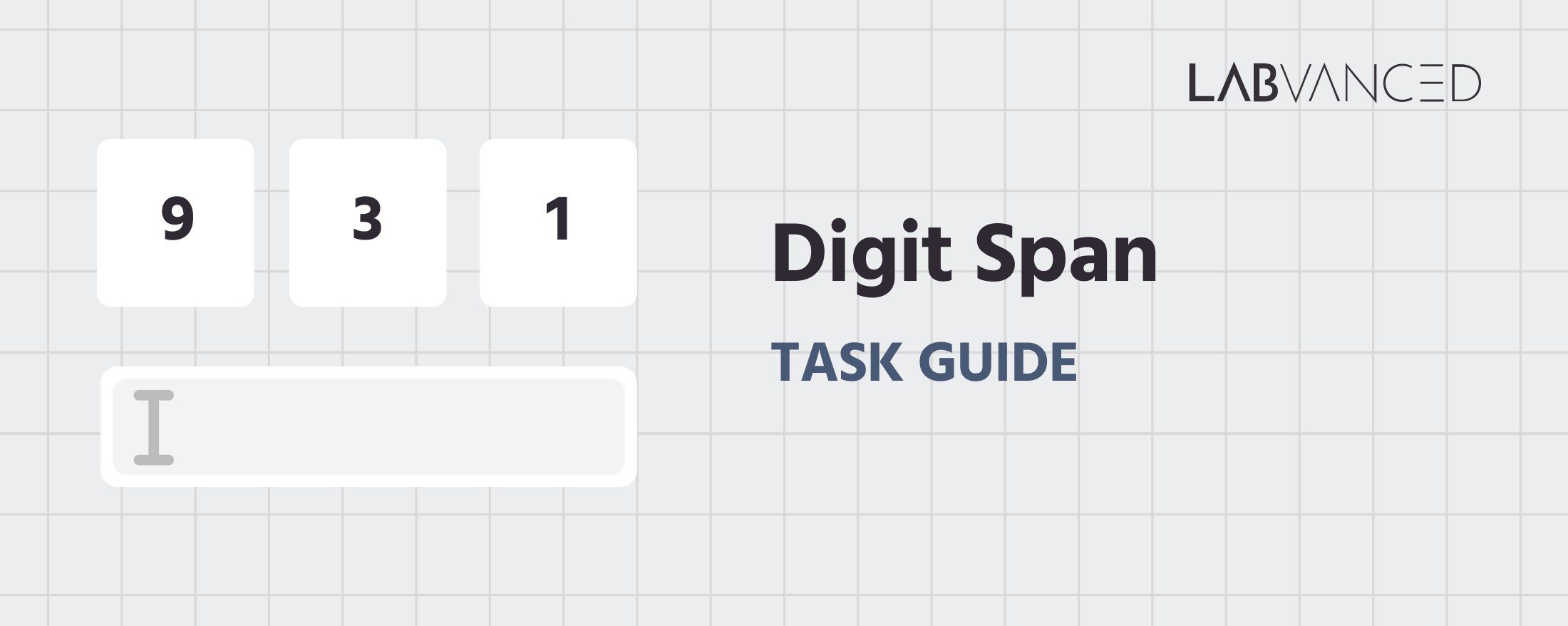
Digit Span Task
The Digit Span Task is a classic measure of verbal working memory in which participants recall a sequence of digits immediately after it is presented, either in the same order (forward) or in reverse order (backward). First described by Jacobs (1887) and later adopted into the Wechsler intelligence scales, it remains one of the most widely used working memory tasks in cognitive, clinical, and developmental research. Labvanced's digital Digit Span Task adapts sequence length to performance automatically and records trial-level accuracy and reaction time for both online and in-lab use.
Table of Contents
Task Format | Digit Span Task Online & In-Lab
In the Digit Span Task, participants view a sequence of single digits presented one at a time following a central fixation cross, then recall the sequence immediately after it ends. In the Forward condition, participants recall the digits in the same order they were shown; in the Backward condition, they recall the digits in reverse order. Sequences start at a 2-digit length and increase after each successfully recalled sequence, up to a maximum of 9 digits, with two sequences administered at every span length. If a participant does not meet the minimum span threshold for a given length, the task ends and records the longest span length the participant completed successfully.
Desktop Version
On desktop, participants respond by typing the remembered digit sequence using the keyboard number keys into an on-screen response field, then pressing Enter to submit. Immediate feedback on whether the response was correct is shown before the next trial begins.
Mobile Version
This task is currently designed for desktop-based administration. It can be imported into a new study and modified to optimize digit presentation and response input for mobile devices, if a study requires a mobile-compatible version.
Digit Span Task Metrics and Data Collected
The Digit Span Task captures a range of behavioral measurements that reveal how much verbal information a participant can hold and manipulate in working memory. The variables recorded help researchers measure accuracy, the longest span successfully recalled, and reaction time. All variables can be viewed and customized within the task's Variables Tab.
Below are the most task-specific variables researchers commonly analyze in this version of the task:
| Variable Name | Description |
|---|---|
accuracy | Whether the response was correct (1 = correct, 0 = incorrect) |
correctness | Whether the response was Correct or Incorrect |
answer | The digit sequence the participant actually typed for the current trial |
correct_answer | The correct digit sequence for the current trial |
current_digit_sequence | The digit sequence presented on the current trial |
reaction_time | Reaction time, in milliseconds, for the participant to input their response |
legnth_of_sequence | The length of the digit sequence presented in the current trial |
accomplished_span_length_forward | The longest span length successfully recalled in the forward task |
accomplished_span_length_backwards | The longest span length successfully recalled in the backward task |
accuracy_total_forwards | Total accurate answers across all trials in the forward task |
accuracy_total_backwards | Total accurate answers across all trials in the backward task |
minimum_span_threshold | The minimum span length a participant must reach for the task to progress to the next span level |
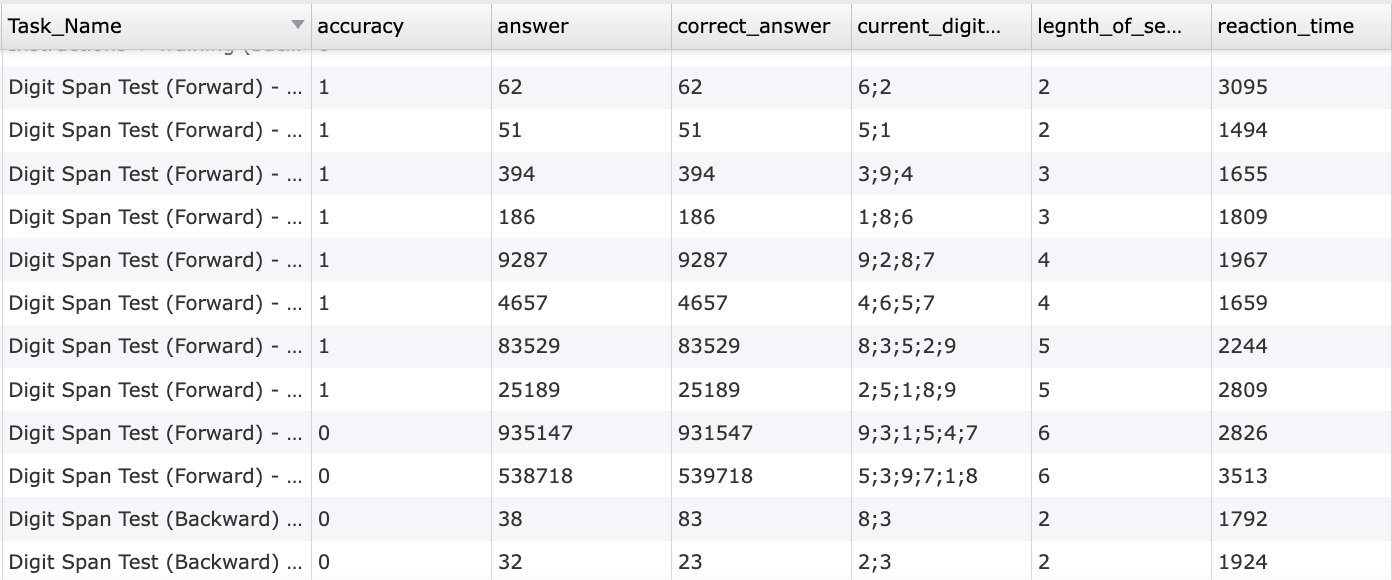
This study measures verbal working memory using the Digit Span Task. Participants recall digit sequences of increasing length in the same order they were shown or in reverse order. Accuracy, reaction time, and the longest span successfully recalled are captured as performance indicators.
Technology Driving the Digit Span Task for Online & In-Lab Research
The Digit Span Task requires precise control over stimulus timing, adaptive sequence progression, and response recording. Labvanced provides tools that allow researchers to reliably measure working memory span across devices and settings.
High Precision Timing for Stimulus and Response: The task depends on consistent digit presentation timing and accurate reaction time capture. Labvanced supports millisecond level timing for stimulus onset and response logging, ensuring reliable measurement across trials.
Desktop App Mode for Controlled Experiments: For in-lab or clinical administration requiring stable timing or integration with external systems, the task can be run through the Labvanced desktop app, supporting compatibility with EEG or other LSL based setups commonly used in neuropsychological research.
Code-Free Customization of Sequences and Logic: Span lengths, digit sequences, and the adaptive stopping rule are all configured through Labvanced's visual editor, allowing researchers to adjust the task without writing code.
Timing Precision
Capture reaction times, task performance, and more with millisecond accuracy for time-sensitive tasks.
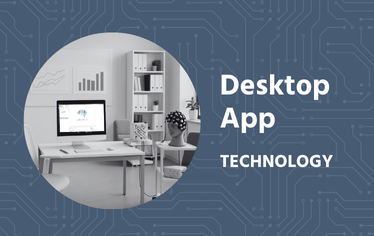
Desktop App
Run in-lab studies using the Desktop App, compatible with EEG and other LSL-connected lab hardware.
Code-free Editor
Build and adapt tasks visually, without writing code, using Labvanced's drag-and-drop experiment builder.
Customization of the Digit Span Task
There are many ways to adapt this Digit Span Task template depending on research goals. Below are several customization themes researchers commonly explore when modifying this task.
Sequence Length and Progression
The starting span length, the maximum span length, and the number of sequences administered at each length are all defined in the task's stimulus data frame and can be edited directly in the Trials & Conditions panel. The minimum span threshold that determines when the task ends can be adjusted the same way.
Digit Sequences and Stimulus Presentation
The digit sequences for each condition are fully customizable. This can be done by editing the fourth column on each condition's data frame (digit_span_stimuli_forwards or digit_span_stimuli_backwards), and then the respective individual array for that item, for example Item1a. Presentation timing for each digit can be adjusted by editing frame durations or adding a Delayed Action (Time Callback) Event. For any other questions or guidance on customizing stimuli, our support team is happy to help.
Feedback and Response Window
The Correct/Incorrect feedback text shown after each trial can be edited directly in the Object Properties panel, or removed entirely for researchers who prefer a no-feedback administration closer to standardized clinical protocols.
Forward-Only or Backward-Only Administration
The Forward and Backward conditions are built as separate blocks, so researchers can run either condition on its own or both in sequence, depending on whether the full protocol or a single direction is needed for their study design.
If you need help customizing this task, please feel welcome to write to us and ask:
Recommended Use and Applications of the Digit Span Task
The Digit Span Task is a foundational measure of verbal working memory, widely used across cognitive, clinical, and developmental research as well as standardized intelligence testing.
Cognitive Assessment and Intelligence Testing: Digit span is a core subtest of the Wechsler Adult Intelligence Scale (WAIS) and Wechsler Intelligence Scale for Children (WISC), tracing back to Jacobs' (1887) original digit span procedure. Outside standardized intelligence testing, researchers commonly generate their own numeric stimulus sequences for this task rather than reusing a published instrument's item set, as is the case with this Digit Span version in Labvanced.
Working Memory Research: Used to study the capacity and structure of verbal working memory, including the distinction between simple maintenance (forward span) and active manipulation of stored information (backward span) (Baddeley, 2012).
Clinical and Neuropsychological Assessment: Applied in neuropsychological batteries to assess short-term verbal memory, with refined scoring approaches shown to improve the sensitivity and reliability of forward versus backward span comparisons (Woods et al., 2011).
Aging Research: Used to study how verbal memory span changes across adulthood, with working memory span (backward) showing greater age sensitivity than simple short-term span (forward) (Bopp & Verhaeghen, 2005).
Attention and Developmental Research: Applied to examine working memory deficits associated with ADHD, where adults with ADHD show reduced working memory performance relative to healthy controls across span-based tasks (Alderson et al., 2013).
References
Alderson, R. M., Kasper, L. J., Hudec, K. L., & Patros, C. H. G. (2013). Attention-deficit/hyperactivity disorder (ADHD) and working memory in adults: A meta-analytic review. Neuropsychology, 27(3), 287-302. https://doi.org/10.1037/a0032371
Baddeley, A. (2012). Working memory: Theories, models, and controversies. Annual Review of Psychology, 63, 1-29. https://doi.org/10.1146/annurev-psych-120710-100422
Bopp, K. L., & Verhaeghen, P. (2005). Aging and verbal memory span: A meta-analysis. The Journals of Gerontology: Series B, 60(5), P223-P233. https://doi.org/10.1093/geronb/60.5.P223
Jacobs, J. (1887). Experiments on "prehension." Mind, 12(45), 75-79. https://doi.org/10.1093/mind/os-12.45.75
Woods, D. L., Kishiyama, M. M., Yund, E. W., Herron, T. J., Edwards, B., Poliva, O., Hink, R. F., & Reed, B. R. (2011). Improving digit span assessment of short-term verbal memory. Journal of Clinical and Experimental Neuropsychology, 33(1), 101-111. https://doi.org/10.1080/13803395.2010.493149
Related Tasks
The Digit Span Task pairs naturally with other working memory tasks in Labvanced's task library.
N-Back (2-back) Task
This task examines working memory capacity using the 2-back task. Participants complete a series of trials where they must indicate if the current stimulus matches the one presented two steps earlier. Training trials and immediate feedback are provided to support learning and engagement.
Corsi Block Tapping Test
Blocks flash sequentially on screen. Participants must repeat the sequence by clicking the blocks in the exact order shown.