labvanced logoLabVanced
Contact
    • Remote Physiological Measurements
    • Eye Tracking
    • Head & Face-Tracking
    • Emotion Detection
    • Heart Rate Detection (rPPG)
    • Generative AI
    • Audio Transcription
    • EEG & Hardware Integrations
    • Decision Making
    • Reaction Times
    • Keyboard Inputs
    • Mouse Tracking
    • Mobile / Touch
    • Questionnaires
    • Gamepad / Joystick Integration
    • Audio Recordings
    • Audio Transcription
    • Video Recordings
    • Screen Recordings
    • Photos / Snapshots
    • Video Conferencing
    • Canvas Drawings
    • Build with AI
    • Build with Spreadsheets
    • Using the Experiment Editor
    • Coding
    • Creating Questionnaires
    • Balancing & Randomization
    • UX & Website Testing
    • Single Session Studies
    • Factorial Designs
    • Longitudinal & Multi-session Studies
    • Individual & Case Studies
    • Real-time Multi-user Studies
    • Interviews & Video Calls
    • Surveys & Questionnaires
    • Experience Sampling & Diaries
    • Classroom & Group Testing
    • Interventions & Clinical Trials
    • In the Browser
    • Mobile App
    • Desktop App
    • WebBridge Chrome Extension
    • Stroop Test
    • Flanker Task
    • N-back Task
    • Implicit Association Test
    • Trail Making Test
    • Digit Span
    • Corsi Block Tapping
    • Tower of London
    • Balloon Analog Risk Task
    • Preferential Looking
    • Browse more →
    • DASS-21
    • GAD-7
    • Rosenberg Self-Esteem Scale
    • PHQ-9
    • Ten-Item Personality Inventory
    • Big Five Personality Test
    • Adult ADHD Self-Report Scale
    • Browse more →
    • Building a Multi-user Study
    • Webcam Eye Tracking with AOIs
    • Website Frame Eye Tracking
    • Conditional Eye Tracking Opt-in
    • ChatGPT Study
    • Desktop App Study with EEG
    • Between-subjects Group Balancing
    • Building a Reading Study
    • Stroop Task
    • Lexical Decision Task
    • Browse more →
    Public Experiment Library
    • Arts Research
    • Clinical Psychology & Neuropsychology Medicine
    • Cognitive Psychology
    • Developmental Psychology
    • Behavioral Economics & Decision Science
    • Educational Research & Psychology
    • HCI & Human Factors
    • Linguistics & Language Sciences
    • Consumer & Marketing Research
    • Social & Personality Psychology
    • Sport & Movement Science
    • UX & Website Testing
    • Executive Functions
    • Language & Reading
    • Decision-Making & Reasoning
    • Attention
    • Overview
    • HCI & Human Factors
    • UX & Website Testing
    • Consumer & Marketing Research
    • White-Label App
    • PageGazer
    • Webcam vs. Lab Eye Tracking in InfantsAnna Banki & Gabriela Markova
    • Eye Tracking for Influencer MarketingDr. Alexander Edeling
    • Eye Tracking Infant Word ComprehensionDr. Giulia Calignano
    • Sentence Reading and Grammar JudgmentsDr. Jonathan Mirault
    • Regulating Emotions with MusicDr. Katrin Starcke
    • Game-Based Grammar Learning in ChildrenDr. Mireia Marimon
    • Gaze Cueing and AutismMax Soares Miehstein
    • Personality and Hearing in NoiseDr. Malte Wöstmann
    • All interviews →
    • Lab Notes
    • How to Cite Labvanced
    • Labvanced Platform Paper (2017)
    • Webcam Eye Tracking Validation (2024)
    • Webcam Eye Tracking Studies
    • Cognitive Psychology Studies
    • Developmental Psychology Studies
    • Linguistics Studies
    • See all publications →
    • Getting Started
    • Guide
    • Video Tutorials
    • Walkthroughs
    • Live Chat
    • Webinars & Onboarding Calls
    • AI Assistant
    • FAQ
    • Importing Templates Guide
    • Test Templates
    • Live Eye Tracking Metrics
    • Mouse Tracking Demo
    • ChatGPT Demo
    • Audio Recording Object Demo
    • Adding Image Stimuli Demo
    • Score & Feedback Demo
    • Browse all technical demos →
    • Timing Precision
    • Stimuli Presentation
    • Headphone Checks
    • Bot Checks
    • Participant Management
    • Comparisons
    • Research Blog
    • Prolific Integration
    • CloudResearch Integration
    • Sona Systems Integration
    • BeSample Integration
    • Panelabs Integration
    • Clickworker Integration
    • Labvanced Webhook API
    • Labvanced REST API
    • About Us
    • Newsletter Archive
    • Terms & Conditions
    • Data Security & Data Privacy
    • Technical & Organisational Measures
    • Accessibility
    • W-8BEN-E Form
    • Data Processing Agreement Template
    LinkedInYouTubeDiscord
    • Individual
    • Lab
    • Department / Consortium
    • Teaching
    • Campus
    • Commercial
    Top-Ups
    • Overview
    • Study Building
    • Subject Recruitment
    • Dedicated Support
    Checkout
  • Contact
    • EN
      • 中國人
      • Deutsch
      • Français
      • Español
      • English
      • 日本語
    • Appgo to app icon
    • Loginlogin icon
    Platform
    Labvanced makes it easy to implement the most advanced study design and reliably collect your data.
    Biosignals & AI
    Remote Physiological MeasurementsEye TrackingHead & Face-TrackingEmotion DetectionHeart Rate Detection (rPPG)Generative AIAudio TranscriptionEEG & Hardware Integrations
    Behavioral Recordings
    Decision MakingReaction TimesKeyboard InputsMouse TrackingMobile / TouchQuestionnairesGamepad / Joystick Integration
    Media Recordings
    Audio RecordingsAudio TranscriptionVideo RecordingsScreen RecordingsPhotos / SnapshotsVideo ConferencingCanvas Drawings
    Implementation Techniques
    Build with AIBuild with SpreadsheetsUsing the Experiment EditorCodingCreating QuestionnairesBalancing & RandomizationUX & Website Testing
    Study Formats

    Your study can take whatever format your research needs. Here are a few popular examples.

    Single Session StudiesFactorial DesignsLongitudinal & Multi-session StudiesIndividual & Case StudiesReal-time Multi-user StudiesInterviews & Video CallsSurveys & QuestionnairesExperience Sampling & DiariesClassroom & Group TestingInterventions & Clinical Trials
    Where Studies Run

    Run your study online in the browser, on mobile or tablet with the mobile app, or in-lab with the desktop app.

    In the BrowserMobile AppDesktop AppWebBridge Chrome Extension
    Tests
    Explore cognitive tests, questionnaires, walkthroughs, and our public experiment library: a starting point for your next study.
    Popular Cognitive Tests
    Stroop TestFlanker TaskN-back TaskImplicit Association TestTrail Making TestDigit SpanCorsi Block TappingTower of LondonBalloon Analog Risk TaskPreferential Looking
    Browse more →
    Questionnaires & Scales
    DASS-21GAD-7Rosenberg Self-Esteem ScalePHQ-9Ten-Item Personality InventoryBig Five Personality TestAdult ADHD Self-Report Scale
    Browse more →
    Public Experiment Library

    Take a look at what other researchers in the community are doing through our extensive, open catalog of shared studies.

    Open the public library →
    Walkthroughs

    Step-by-step builds of complete studies, from a blank project to a running experiment, that you can follow along or adapt.

    Building a Multi-user StudyWebcam Eye Tracking with AOIsWebsite Frame Eye TrackingConditional Eye Tracking Opt-inChatGPT StudyDesktop App Study with EEGBetween-subjects Group BalancingBuilding a Reading StudyStroop TaskLexical Decision Task
    Browse more →
    Research
    One platform for students, academics, and industry researchers studying human behavior.
    Harvard UniversityStanford UniversityCambridge UniversityUCLNYUMax Planck InstituteUCLATU Munich

    Trusted by researchers at 1,500+ universities worldwide

    Academic Research
    Arts ResearchClinical Psychology & Neuropsychology MedicineCognitive PsychologyDevelopmental PsychologyBehavioral Economics & Decision ScienceEducational Research & PsychologyHCI & Human FactorsLinguistics & Language SciencesConsumer & Marketing ResearchSocial & Personality PsychologySport & Movement ScienceUX & Website Testing
    Research Areas
    Executive FunctionsLanguage & ReadingDecision-Making & ReasoningAttention
    Industry / Commercial
    OverviewHCI & Human FactorsUX & Website TestingConsumer & Marketing ResearchWhite-Label AppPageGazer
    Researcher Interviews

    Conversations with researchers about the studies they ran with Labvanced, what worked, and what they learned.

    Webcam vs. Lab Eye Tracking in InfantsAnna Banki & Gabriela MarkovaEye Tracking for Influencer MarketingDr. Alexander EdelingEye Tracking Infant Word ComprehensionDr. Giulia CalignanoSentence Reading and Grammar JudgmentsDr. Jonathan MiraultRegulating Emotions with MusicDr. Katrin StarckeGame-Based Grammar Learning in ChildrenDr. Mireia MarimonGaze Cueing and AutismMax Soares MiehsteinPersonality and Hearing in NoiseDr. Malte Wöstmann
    All interviews →
    Our Research
    Lab NotesHow to Cite Labvanced
    Peer Reviewed Studies

    A selection of peer-reviewed work built on Labvanced: our own platform and validation papers, and studies by the research community grouped by area. Hundreds more are listed on the full publications page.

    Labvanced Platform Paper (2017)Webcam Eye Tracking Validation (2024)Webcam Eye Tracking StudiesCognitive Psychology StudiesDevelopmental Psychology StudiesLinguistics Studies
    See all publications →
    Resources
    Valuable resources to help you learn the platform, stay updated, and more.
    Documentation
    Getting StartedGuideVideo TutorialsWalkthroughs
    Support
    Live ChatWebinars & Onboarding CallsAI AssistantFAQ
    Templates & Demos

    These are a few popular examples. Browse our guide and a selection of technical demos to get started with implementation.

    Importing Templates GuideTest TemplatesLive Eye Tracking MetricsMouse Tracking DemoChatGPT DemoAudio Recording Object DemoAdding Image Stimuli DemoScore & Feedback Demo
    Browse all technical demos →
    Methodology
    Timing PrecisionStimuli PresentationHeadphone ChecksBot ChecksParticipant ManagementComparisonsResearch Blog
    Integrations & APIs
    Prolific IntegrationCloudResearch IntegrationSona Systems IntegrationBeSample IntegrationPanelabs IntegrationClickworker IntegrationLabvanced Webhook APILabvanced REST API
    Company & Legal
    About UsNewsletter ArchiveTerms & ConditionsData Security & Data PrivacyTechnical & Organisational MeasuresAccessibilityW-8BEN-E FormData Processing Agreement Template
    LinkedInYouTubeDiscord
    Pricing
    Our licenses and additional services at a glance.
    Licenses
    IndividualLabDepartment / ConsortiumTeachingCampusCommercial
    Top-Ups

    Need more recordings for your lab or your own research? Simply use one of these recording top-up packages.

    Browse top-up packages →
    Additional Services

    Hire Labvanced’s expert team to quickly bring your project to the level of rigor it needs.

    OverviewStudy BuildingSubject RecruitmentDedicated Support
    Checkout

    Ready to purchase a license or top-up? Head straight to checkout.

    Go to checkout →
    • 中國人
    • Deutsch
    • Français
    • Español
    • English
    • 日本語
    TIPI item preview implemented in Labvanced.

    Ten-Item Personality Inventory (TIPI)

    The Ten-Item Personality Inventory (TIPI) is a 10-item self-report measure of the Big Five personality dimensions, developed by Gosling et al. (2003) for situations where very short measures are needed. Its authors describe it as somewhat inferior to standard multi-item instruments (Gosling et al., 2003).

    Table of Contents

    • Items and Structure
    • Scoring Summary
    • Psychometric Properties
    • Data Collected
    • Technology
    • Administration
    • Recommended Use
    • Explore Related Cognitive Tasks

    Items and Structure of the TIPI

    The TIPI consists of 10 pairs of descriptors, such as "Extraverted, enthusiastic." and "Reserved, quiet.", with 2 items for each of the five dimensions: Extraversion, Agreeableness, Conscientiousness, Emotional Stability, and Openness to Experiences. Participants rate how much each pair applies to them on a 7-point scale from "Disagree strongly" to "Agree strongly". Five of the items are reverse-scored (Gosling, n.d.-b). The author asks users to read his note on alpha and factor structure first, because the TIPI was built to optimize validity rather than those criteria (Gosling, n.d.-a). The authors report that it takes about 1 minute to complete (Gosling et al., 2003).
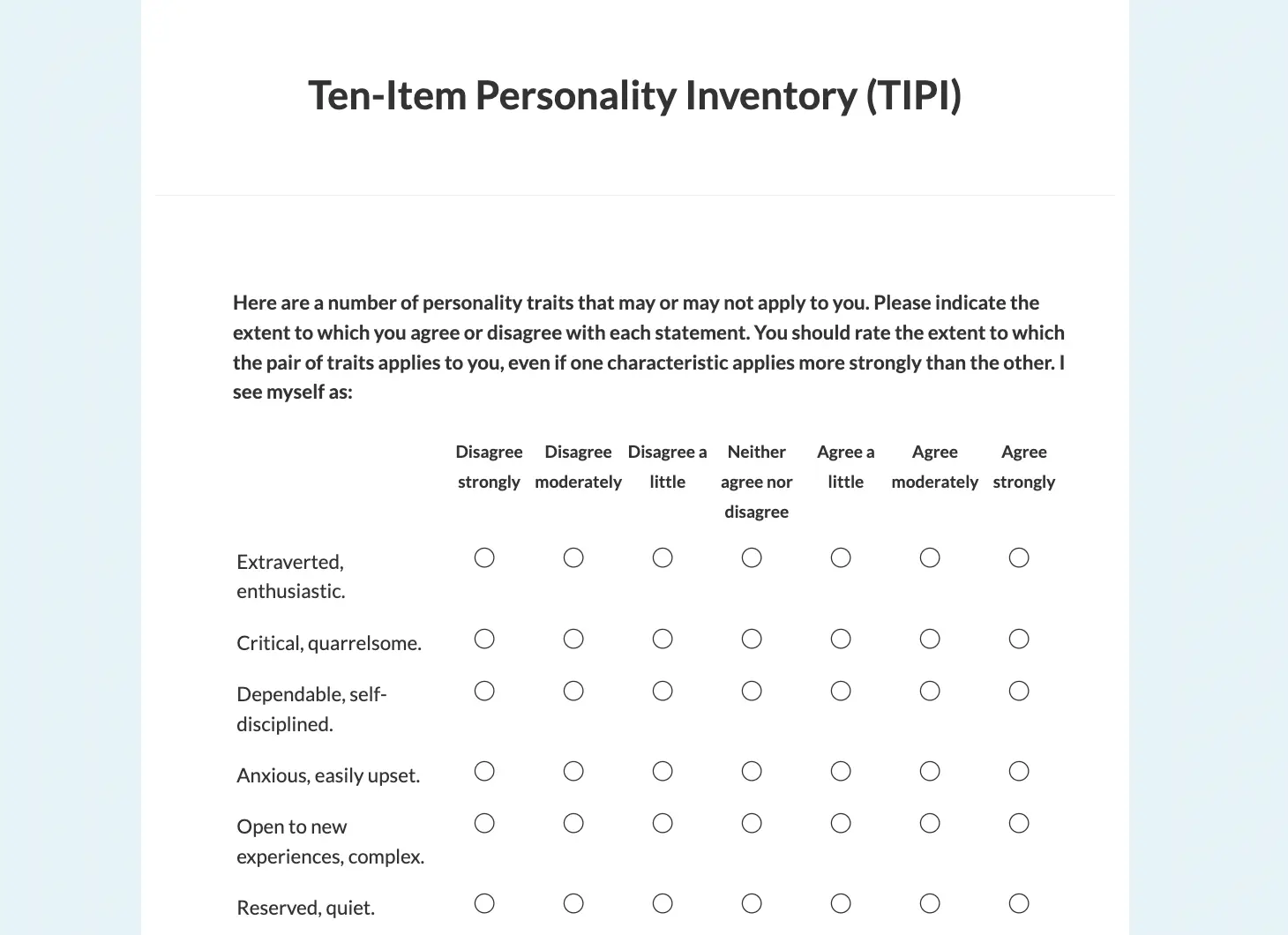

    Preview of the TIPI instrument running in Labvanced.
    TIPI

    This study measures the Big Five personality dimensions using the TIPI. Responses are automatically reverse-scored and averaged into five trait scores within Labvanced.

    Click the card above to see the full item list and study structure on Labvanced. Use Inspect to view it directly, or Import to copy the study into your own account and customize it.


    Scoring Summary

    Each dimension's score is the average of its 2 items after reverse-scoring, giving five separate scores from 1 to 7, with higher scores indicating more of the trait. The scoring key defines only these five scores, with no total score.

    For the full scoring procedure and interpretation, see the TIPI Scoring and Interpretation guide.

    Psychometric Properties of the TIPI

    • Reliability: Test-retest correlations over about 6 weeks in 180 participants were .77 for Extraversion, .71 for Agreeableness, .76 for Conscientiousness, .70 for Emotional Stability, and .62 for Openness, with a mean of .72, compared with a 2-week mean of .80 for the Big Five Inventory (Gosling et al., 2003). Cronbach's alphas were low, at .68, .40, .50, .73, and .45, because each scale has only 2 items chosen for broad content rather than overlap (Gosling et al., 2003).
    • Validity: A scoping review of 27 TIPI versions in 18 languages found acceptable test-retest reliability, somewhat mixed convergent and structural validity, and inappropriate internal consistency, and described the TIPI as a feasible compromise when survey length has to be kept short (Thørrisen & Sadeghi, 2023). In the original sample of 1,813 undergraduates, correlations with the Big Five Inventory were .87 for Extraversion, .70 for Agreeableness, .75 for Conscientiousness, .81 for Emotional Stability, and .65 for Openness (Gosling et al., 2003).
    • Normative Information: The authors publish norms by sex and age from a large online sample (Gosling et al., 2014). See the Scoring and Interpretation guide for an excerpt. The author's scoring materials give no cutoffs or score categories.

    Data Collected with the TIPI

    The TIPI captures item-level responses and five computed trait scores within Labvanced. All variables can be viewed and customized within the study's Variables Tab.

    Variable NameDescription
    Item 1 – Item 10Participant's raw response to each item, from 1 (Disagree strongly) to 7 (Agree strongly)
    Item 1 score – Item 10 scoreItem score after reverse-scoring items 2, 4, 6, 8, and 10 (8 minus the response)
    Extraversion Score, Agreeableness Score, Conscientiousness Score, Emotional Stability Score, Openness ScoreAverage of the trait's 2 item scores (range 1-7)

    Data preview of the 10 item scores collected using the TIPI in Labvanced.
    Preview of item-level score data collected with the TIPI in Labvanced, showing all 10 item scores after reverse-scoring.

    Data preview of the five computed trait scores collected using the TIPI in Labvanced.
    Preview of the computed data collected with the TIPI in Labvanced, showing the five trait scores.


    Technologies Supporting the TIPI

    The TIPI is a self-report instrument, but Labvanced allows additional data streams to be layered onto the study for deeper analysis beyond the item responses themselves.

    • Automatic Scoring, No-Code Setup: Reverse-scoring of the 5 reverse-keyed items and averaging into five trait scores are handled automatically within Labvanced's Questionnaire page structure, with no manual calculation required.
    • Response Behavior via Mouse Tracking: Cursor movement toward and away from response options can reveal hesitation or indecision while a participant is rating a personality item, adding a behavioral layer beyond the selected answer itself.
    • Webcam-Based Eye Tracking: Gaze patterns while reading and answering each item can be captured with built-in, code-free webcam eye tracking, useful for attention-check analysis or studying how participants engage with positively and reverse-keyed items.
    • Audio and Video Recording: Sessions can be recorded alongside item responses, useful when a researcher wants a qualitative record of participant behavior during a personality assessment.
    • Desktop App for Controlled Administration: For lab settings administering the TIPI as part of a larger test battery, the Labvanced desktop app supports standardized, offline-capable administration on dedicated in-lab machines.
    Icon representing mouse tracking capabilities in Labvanced

    Mouse Tracking

    Capture cursor movement and response hesitation alongside standard questionnaire answers.

    Icon representing webcam eye tracking capabilities in Labvanced

    Webcam Eye Tracking

    Capture gaze patterns and visual attention with built-in, code-free and peer-reviewed webcam eye-tracking.
    Icon representing the Labvanced desktop app for controlled in-lab administration

    Desktop App

    Run in-lab, controlled administration using the Desktop App, ideal for test batteries in the lab.

    Administration Options for the TIPI

    There are several ways this instrument can be configured in Labvanced.

    • Standard Questionnaire Setup: As a fixed-item rating scale, the TIPI is built using a standard Page Frame, with all 10 items in a single matrix listed top to bottom. See the Questionnaires implementation guide for how Page Frames, question objects, and scoring are set up in Labvanced, and the Reverse Scoring guide for the reverse-keyed items.
    • Choosing a Longer Measure: When personality is a main focus of the study, a longer scale gives more items per trait. Labvanced also offers the 50-item Big Five Personality Test.
    • Multi-Language Deployment: Translated versions of the TIPI exist in at least 18 languages, with varying evidence behind them (Thørrisen & Sadeghi, 2023). Labvanced supports multi-lingual study deployment, allowing a translated version to be configured for the target population.

    The card below covers the different ways researchers can build and analyze questionnaires in Labvanced. Beyond fixed Likert items, it supports image, video, and audio stimuli, drag-and-drop and slider-based interactions, branching logic and randomization, and real-time feedback. Layouts can be freely positioned on a canvas or auto-flowing in a page frame, and responses can be automatically scored, reverse-scored, and timed down to the individual item.
    Icon representing questionnaire and self-report capabilities in Labvanced

    Questionnaires

    Deploy validated self-report instruments with automatic scoring and no-code setup.

    If there is something else you'd like to know, please feel welcome to write to us and ask:


    Contact Us

    Recommended Use and Applications of the TIPI

    The TIPI is used where a study needs a Big Five estimate but has little room for a personality measure. The authors recommend it for situations where very short measures are needed, personality is not the primary topic of interest, or researchers can tolerate somewhat diminished psychometric properties (Gosling et al., 2003).

    • Online surveys of specific groups: An online survey of 593 multi-marathoners from 22 countries used the TIPI, with its normative data as a comparison benchmark, and reported higher Conscientiousness and lower Emotional Stability than the general population (Lundy et al., 2025).
    • Large-scale surveys: A Norwegian translation was tested with 5,009 master's graduates, with internal consistency judged acceptable and structural validity satisfactory (Thørrisen et al., 2021).
    • Cross-language research: A Portuguese version tested in 333 adults aged 18 to 65 showed alphas of .39 to .72, 4-week test-retest correlations above .71 in 81 participants, and correlations above .60 with the Big Five Inventory (Nunes et al., 2018).
    • Children and adolescents, with an adapted form: An adaptation for this age group, the TIPI-CA, showed reasonably appropriate psychometric properties in 2,428 Spanish children and adolescents, although with weaker discriminant validity than adult TIPI versions (López-Fernández et al., 2025).

    Explore Related Cognitive Tasks

    Ultimatum Game

    Measures fairness and cooperation through offers and rejections in a two-player economic game. In a meta-analysis of 770 studies across six economic games, Big Five Agreeableness correlated positively with prosocial behavior in every game, including the Ultimatum Game, though weakly (correlations of .07 to .16) (Thielmann et al., 2020).

    Delay Discounting Task (DDT)

    Measures how strongly people devalue rewards that arrive later. In a sample of 5,888 people, steeper discounting was predicted by lower Openness and Conscientiousness and higher Extraversion and Neuroticism (Mahalingam et al., 2014), though a later study of 1,206 adults found no correlation with Neuroticism or Conscientiousness (Yeh et al., 2021).

    Join Labvanced today and add the TIPI to your next online experiment.

    References

    • Gosling, S. D. (n.d.-a). A note on alpha reliability and factor structure in the TIPI. Retrieved November 4, 2026, from https://gosling.psy.utexas.edu/scales-weve-developed/ten-item-personality-measure-tipi/a-note-on-alpha-reliability-and-factor-structure-in-the-tipi/
    • Gosling, S. D. (n.d.-b). Ten Item Personality Measure (TIPI). Retrieved November 4, 2026, from https://gosling.psy.utexas.edu/scales-weve-developed/ten-item-personality-measure-tipi/
    • Gosling, S. D., Rentfrow, P. J., & Potter, J. (2014). Norms for the Ten Item Personality Inventory [Unpublished data].
    • Gosling, S. D., Rentfrow, P. J., & Swann, W. B., Jr. (2003). A very brief measure of the Big-Five personality domains. Journal of Research in Personality, 37, 504-528. https://doi.org/10.1016/S0092-6566(03)00046-1
    • López-Fernández, F. J., Pineda, D., Rivera-Riquelme, M., Lloret, D., & Piqueras, J. A. (2025). Psychometric properties of the Ten-Item Personality Inventory for Children and Adolescents (TIPI-CA) in a Spanish sample. Current Issues in Personality Psychology, 13(1), 58-66. https://doi.org/10.5114/cipp/188360
    • Lundy, L., Reilly, R. B., Fleming, N., & Wilczyńska, D. (2025). Unveiling the psychological traits of multi-marathoners: Insights from TIPI personality trait analysis. PLoS ONE, 20(4), e0311647. https://doi.org/10.1371/journal.pone.0311647
    • Mahalingam, V., Stillwell, D., Kosinski, M., Rust, J., & Kogan, A. (2014). Who can wait for the future? A personality perspective. Social Psychological and Personality Science, 5(5), 573-583. https://doi.org/10.1177/1948550613515007
    • Nunes, A., Limpo, T., Lima, C. F., & Castro, S. L. (2018). Short scales for the assessment of personality traits: Development and validation of the Portuguese Ten-Item Personality Inventory (TIPI). Frontiers in Psychology, 9, 461. https://doi.org/10.3389/fpsyg.2018.00461
    • Thielmann, I., Spadaro, G., & Balliet, D. (2020). Personality and prosocial behavior: A theoretical framework and meta-analysis. Psychological Bulletin, 146(1), 30-90. https://doi.org/10.1037/bul0000217
    • Thørrisen, M. M., & Sadeghi, T. (2023). The Ten-Item Personality Inventory (TIPI): A scoping review of versions, translations and psychometric properties. Frontiers in Psychology, 14, 1202953. https://doi.org/10.3389/fpsyg.2023.1202953
    • Thørrisen, M. M., Sadeghi, T., & Wiers-Jenssen, J. (2021). Internal consistency and structural validity of the Norwegian translation of the Ten-Item Personality Inventory. Frontiers in Psychology, 12, 723852. https://doi.org/10.3389/fpsyg.2021.723852
    • Yeh, Y. H., Myerson, J., & Green, L. (2021). Delay discounting, cognitive ability, and personality: What matters? Psychonomic Bulletin & Review, 28(2), 686-694.

