Tower of London Test
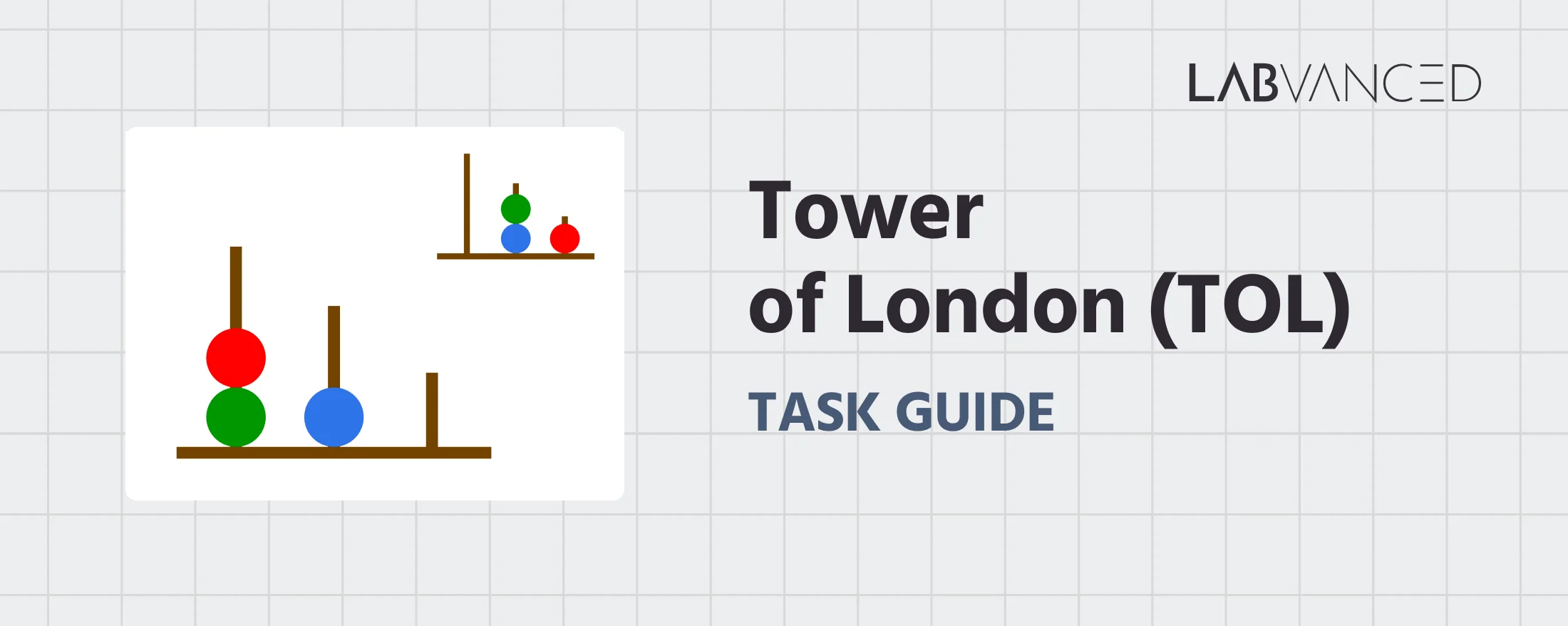
The Tower of London Test is a classic measure of planning and executive function in which participants move colored balls across three pegs, one at a time, to recreate a target arrangement shown alongside the board. Originally developed by Shallice (1982) to study prefrontal lobe function, it remains one of the most widely used tasks for measuring forward planning and problem-solving in cognitive, clinical, and developmental research. Labvanced's digital Tower of London Test implements the standardized 12-problem set published by Krikorian et al. (1994), automatically scoring each trial against its known minimum-move solution and recording detailed move and timing data for both online and in-lab use.
Table of Contents
Task Format | Tower of London Test Online & In-Lab
In the Tower of London Test, participants see a board with three pegs of different heights holding three colored balls, alongside a goal arrangement showing where those balls need to end up. Participants solve each problem by clicking a ball to select it, then clicking the peg to move it to, one move at a time, until the board matches the goal. Each of the 12 problems has a known minimum number of moves required to solve it, shown on screen before the participant begins, ranging from 2 moves on the easiest problems to 5 moves on the hardest. A move that isn't legal, selecting a ball that isn't on top of its peg, or trying to place a ball on a peg that's already full, doesn't count as a move and is recorded separately as an illegal move attempt. Each problem is administered once, with no retries if it isn't solved in the minimum number of moves (the TOL-F single-attempt model).
Desktop Version
On desktop, participants move balls with the mouse: clicking a ball selects it, and clicking a peg moves the selected ball there. A brief instruction and training phase precedes the 12 scored problems.
Mobile Version
The mobile version uses the same tap-to-select, tap-to-move interaction, on a touchscreen-sized board. The problem set, scoring, and single-attempt structure are otherwise identical across devices.
Tower of London Test Metrics and Data Collected
The Tower of London Test captures a range of behavioral measurements that reveal how participants plan and execute a sequence of moves toward a goal. The variables recorded help researchers measure accuracy against the optimal solution, planning time separately from execution time, and move efficiency. All variables can be viewed and customized within the task's Variables Tab.
Below are the most task-specific variables researchers commonly analyze in this version of the task:
| Variable Name | Description |
|---|---|
trial_outcome | This trial's result: Correct, Incorrect, timeout, or pending |
move_count | Number of moves made in the current trial |
min_moves | The minimum number of moves required to solve the current problem |
total_correct | Total trials solved in the minimum number of moves, the primary TOL-F outcome measure |
ITT | Initial Thinking Time: the time from stimulus onset to the first ball selected |
MET | Movement Execution Time: the time from the first ball selected to trial completion |
illegal_move_attempts | Invalid move attempts (a full peg, or a non-topmost ball selected) in the current trial |
current_goal | The target ball arrangement for the current trial |

This study measures planning and executive function using the Tower of London Test. Participants rearrange colored balls across three pegs to match a target configuration in as few moves as possible. Initial thinking time, movement execution time, move count, and accuracy against the optimal solution are captured as performance indicators.
Technology Driving the Tower of London Test for Online & In-Lab Research
The Tower of London Test depends on precise stimulus timing, accurate move-by-move logging, and reliable response recording to separate planning time from execution time. Labvanced provides tools that allow researchers to reliably measure executive function across devices and settings.
High Precision Timing for Stimulus and Response: Initial Thinking Time and Movement Execution Time both depend on accurate timestamping of the first and final moves in a trial. Labvanced supports millisecond level timing for stimulus onset and response logging, ensuring reliable measurement across trials.
Desktop App Mode for Controlled Experiments: For in-lab or clinical administration requiring stable timing or integration with external systems, the task can be run through the Labvanced desktop app, supporting compatibility with EEG or other LSL based setups commonly used in neuropsychological research.
Code-Free Customization of Problems and Logic: The problem set, minimum-move thresholds, and single-attempt scoring logic are all configured through Labvanced's visual editor, allowing researchers to adjust the task without writing code.

Timing Precision
Capture reaction times, task performance, and more with millisecond accuracy for time-sensitive tasks.

Desktop App
Run in-lab studies using the Desktop App, compatible with EEG and other LSL-connected lab hardware.

Code-free Editor
Build and adapt tasks visually, without writing code, using Labvanced's drag-and-drop experiment builder.
Customization of the Tower of London Test
There are many ways to adapt this Tower of London Test template depending on research goals. Below are several customization themes researchers commonly explore when modifying this task.
Problem Set and Minimum-Move Thresholds
The 12 problems, each problem's minimum-move solution, and the goal ball arrangement are all defined in the task's stimulus data frame and can be edited directly in the Trials & Conditions panel. Researchers can substitute their own problem set or adjust the minimum-move threshold used for scoring.
Illegal Move Handling
What counts as an illegal move attempt, selecting a ball that isn't topmost, or targeting a full peg, is configured through the task's event logic and can be adjusted or removed depending on how strictly a study needs to enforce standard administration rules.
Timing and Feedback
Presentation timing for the goal arrangement and feedback shown after each trial can be adjusted by editing frame durations or the Set Object Property actions that control feedback text, or removed entirely for researchers who prefer a no-feedback administration closer to standardized clinical protocols.
If you need help customizing this task, please feel welcome to write to us and ask:
Recommended Use and Applications of the Tower of London Test
The Tower of London Test is a foundational measure of planning and executive function, widely used across cognitive, clinical, and developmental research as well as standardized neuropsychological assessment.
Executive Function and Planning Research: Originally developed to study the planning deficits associated with prefrontal lobe damage, and widely used since to study forward planning, problem-solving, and means-end reasoning (Shallice, 1982).
Clinical and Neuropsychological Assessment: Applied in neuropsychological batteries to assess executive dysfunction, using the standardized 12-problem set and normative data established by Krikorian et al. (1994).
Developmental Research: Used to study how planning ability develops across childhood and adolescence, with performance on the Tower of London improving markedly between the ages of 6 and 13 (Injoque-Ricle et al., 2014).
References
Injoque-Ricle, I., Barreyro, J. P., Calero, A., & Burin, D. I. (2014). Tower of London: Planning development in children from 6 to 13 years of age. The Spanish Journal of Psychology, 17, Article e77. https://doi.org/10.1017/sjp.2014.83
Krikorian, R., Bartok, J., & Gay, N. (1994). Tower of London procedure: A standard method and developmental data. Journal of Clinical and Experimental Neuropsychology, 16(6), 840-850. https://doi.org/10.1080/01688639408402697
Shallice, T. (1982). Specific impairments of planning. Philosophical Transactions of the Royal Society of London B, 298(1089), 199-209. https://doi.org/10.1098/rstb.1982.0082
Related Tasks
The Tower of London Test pairs naturally with other executive function tasks in Labvanced's task library.
Trail Making Test
In Part A, the participant connects numbers in ascending order (1-2-3...) while in Part B, numbers and letters alternate (1-A-2-B...), in this classic task for measuring cognitive flexibility.
Corsi Block Tapping Test
Blocks flash sequentially on screen. Participants must repeat the sequence by clicking the blocks in the exact order shown.