Big Five Personality Test
The Big Five Personality Test measures the five broad dimensions of personality: Extraversion, Agreeableness, Conscientiousness, Neuroticism, and Intellect/Imagination. The version in Labvanced is the 50-item representation of Goldberg's (1992) Big-Five factor markers from the International Personality Item Pool (IPIP), a public-domain item pool that anyone can use for any purpose, commercial or non-commercial (International Personality Item Pool, n.d.-a).
Table of Contents
Items and Structure of the Big Five Personality Test
The test consists of 50 short phrases describing everyday behavior, such as "Am the life of the party." and "Pay attention to details.", with 10 items for each of the five traits. Participants rate how accurately each phrase describes them on a 5-point scale: Very Inaccurate, Moderately Inaccurate, Neither Accurate Nor Inaccurate, Moderately Accurate, or Very Accurate. The items from the five traits are mixed together, and 24 of the 50 items are reverse-keyed, so agreeing with them indicates less of the trait (International Personality Item Pool, n.d.-b).
In the original IPIP key, the fourth trait is Emotional Stability. In the Labvanced study, that score is reversed and reported as Neuroticism, the more common name for the same dimension, so higher scores mean more emotional reactivity.
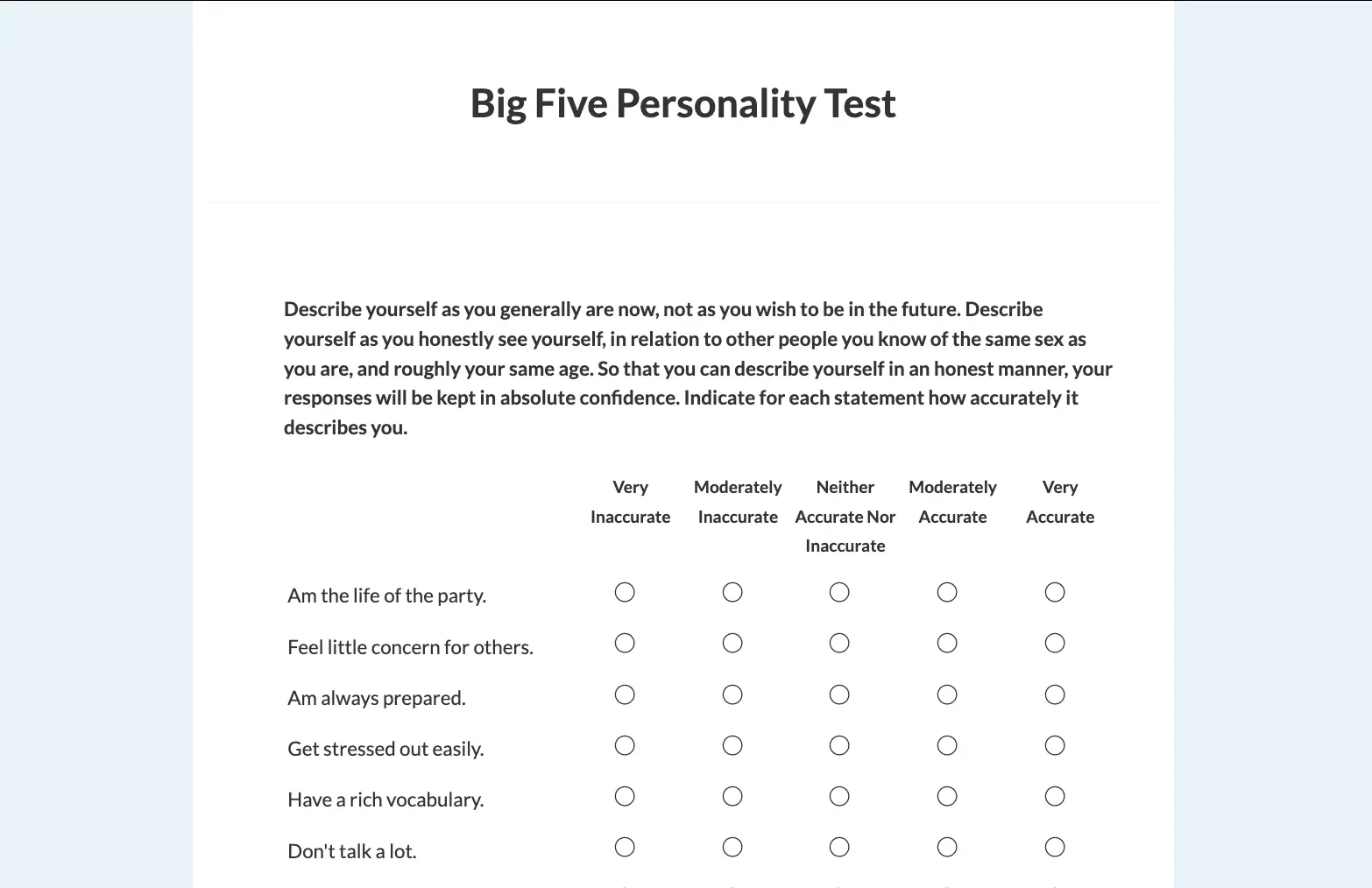
This study measures the five broad personality traits with the 50-item IPIP Big-Five factor markers. Responses are automatically reverse-scored and summed into five trait scores within Labvanced.
Click the card above to see the full item list and study structure on Labvanced. Use Inspect to view it directly, or Import to copy the study into your own account and customize it.
Scoring Summary
Each trait score is the sum of its 10 items after reverse-scoring the reverse-keyed items, giving five separate scores that each range from 10 to 50. Higher scores indicate more of the trait. The IPIP scoring key defines only these five scale scores, with no total score, and the IPIP provides no norms, cutoffs, or score categories (International Personality Item Pool, n.d.-b, n.d.-c).
For the full scoring key and interpretation, see the Big Five Personality Test Scoring and Interpretation guide.
Psychometric Properties of the Big Five Personality Test
- Reliability: In the original American sample, Cronbach's alpha for the 10-item scales was .87 for Extraversion, .82 for Agreeableness, .79 for Conscientiousness, .86 for Emotional Stability, and .84 for Intellect (International Personality Item Pool, n.d.-d; Mlačić & Goldberg, 2007). In two Chinese samples aged 13-45 (N = 633 and 437), alphas for the 10-item scales ranged from .76 to .87, except Agreeableness at .69 and .66 (Zheng et al., 2008).
- Validity: In a Chinese subsample of 301 participants who completed both instruments, the 50-item scales correlated with the corresponding Big Five Inventory scales at .72 for Extraversion, .47 for Agreeableness, .67 for Conscientiousness, and .59 for Intellect with Openness, while Emotional Stability correlated -.70 with Neuroticism, an average of .65 (Zheng et al., 2008).
- Factor Structure: The five-factor structure has been replicated in translated versions. In Croatian self-reports and peer ratings (N = 519 and 515), the structures were nearly identical to the American one (Mlačić & Goldberg, 2007). In two Chinese samples, 96% and 92% of the 50 items loaded on their intended factor (Zheng et al., 2008). In a Greek adult sample (N = 811), the five-factor model fit the data inadequately in confirmatory factor analysis (NNFI = .67, CFI = .75), though it fit better than an independence model and a model without correlations between factors (Ypofanti et al., 2015).
- Normative Information: The IPIP deliberately publishes no norms, because it considers most published norms misleading, and recommends local norms instead: comparing each score with the mean and standard deviation of the study's own sample (International Personality Item Pool, n.d.-c). See the Scoring and Interpretation guide for how to make a local comparison. For reference, item-level means (1-5 scale) in a Chinese adult sample (N = 633) were 3.03 for Extraversion, 3.66 for Agreeableness, 3.40 for Conscientiousness, 2.75 for Emotional Stability, and 3.53 for Intellect (Zheng et al., 2008).
Data Collected with the Big Five Personality Test
The Big Five Personality Test captures item-level responses and five computed trait scores within Labvanced. All variables can be viewed and customized within the study's Variables Tab.
| Variable Name | Description |
|---|---|
Item 1 – Item 50 | Participant's raw response to each item, from 1 (Very Inaccurate) to 5 (Very Accurate) |
Item 1 score – Item 50 score | Item score after reverse-scoring the 24 reverse-keyed items (6 minus the response) |
Extraversion Items, Agreeableness Items, Conscientiousness Items, Emotional Stability Items, Intellect Items | Arrays combining the 10 item scores of each trait |
Extraversion Score, Agreeableness Score, Conscientiousness Score, Intellect Score | Sum of each trait's 10 item scores (range 10-50) |
Emotional Stability Score | Sum of the 10 Emotional Stability item scores, as defined in the IPIP key (range 10-50) |
Neuroticism Score | 60 minus Emotional Stability Score (range 10-50), the score shown to participants |
Extraversion Percent, Agreeableness Percent, Conscientiousness Percent, Neuroticism Percent, Intellect Percent | Each trait score mapped onto a 0-100 range, (score minus 10) × 2.5, which sets the length of that trait's bar on the results screen |


Technologies Supporting the Big Five Personality Test
The Big Five Personality Test is a self-report instrument, but Labvanced allows additional data streams to be layered onto the study for deeper analysis beyond the item responses themselves.
- Automatic Scoring, No-Code Setup: Reverse-scoring of the 24 reverse-keyed items, summation into five trait scores, and the conversion of Emotional Stability into Neuroticism are handled automatically within Labvanced's Questionnaire page structure, with no manual calculation required.
- Response Behavior via Mouse Tracking: Cursor movement toward and away from response options can reveal hesitation or indecision while a participant is rating a personality item, adding a behavioral layer beyond the selected answer itself.
- Webcam-Based Eye Tracking: Gaze patterns while reading and answering each item can be captured with built-in, code-free webcam eye tracking, useful for attention-check analysis or studying how participants engage with positively and reverse-keyed items.
- Audio and Video Recording: Sessions can be recorded alongside item responses, useful when a researcher wants a qualitative record of participant behavior during a personality assessment.
- Desktop App for Controlled Administration: For lab settings administering the Big Five Personality Test as part of a larger test battery, the Labvanced desktop app supports standardized, offline-capable administration on dedicated in-lab machines.

Mouse Tracking
Capture cursor movement and response hesitation alongside standard questionnaire answers.

Webcam Eye Tracking
Capture gaze patterns and visual attention with built-in, code-free and peer-reviewed webcam eye-tracking.

Desktop App
Run in-lab, controlled administration using the Desktop App, ideal for test batteries in the lab.
Administration Options for the Big Five Personality Test
There are several ways this instrument can be configured in Labvanced.
- Standard Questionnaire Setup: As a fixed-item Likert scale, the Big Five Personality Test is built using a standard
Page Frame, with all 50 items in a single matrix listed top to bottom. See the Questionnaires implementation guide for how Page Frames, question objects, and scoring are set up in Labvanced, and the Reverse Scoring guide for the reverse-keyed items. - Choosing Which Scores to Show: Because the IPIP provides no score categories, the results screen shows each of the five trait scores as a horizontal bar, running from the lowest possible score (10) to the highest (50), with the raw score next to it and no labels such as "high" or "low." The displayed scores can be edited, hidden, or replaced with a thank-you screen when participant feedback is not part of the study design.
- Multi-Language Deployment: IPIP items have been translated into more than 25 languages (Zheng et al., 2008), and translated versions of the 50-item markers have been validated in Croatian (Mlačić & Goldberg, 2007), Chinese (Zheng et al., 2008), and Greek (Ypofanti et al., 2015). Labvanced supports multi-lingual study deployment, allowing a translated version to be configured for the target population.
- Choosing a Shorter Measure: When study time is very limited, Labvanced also offers the 10-item Ten-Item Personality Inventory (TIPI), whose authors describe it as somewhat inferior to standard multi-item instruments (Gosling et al., 2003).
The card below covers the different ways researchers can build and analyze questionnaires in Labvanced. Beyond fixed Likert items, it supports image, video, and audio stimuli, drag-and-drop and slider-based interactions, branching logic and randomization, and real-time feedback. Layouts can be freely positioned on a canvas or auto-flowing in a page frame, and responses can be automatically scored, reverse-scored, and timed down to the individual item.
If there is something else you'd like to know, please feel welcome to write to us and ask:
Recommended Use and Applications of the Big Five Personality Test
The Big Five Personality Test is used wherever researchers need a free, broad measure of personality that can be shared, translated, and modified without licensing restrictions.
- Personality and individual differences research: Used as a public-domain alternative to commercial Big Five inventories, with scores that correspond one-to-one with the Big Five Inventory's five scales (Zheng et al., 2008).
- Cross-cultural research: The 50-item markers were the most commonly used IPIP measure in the cross-cultural studies covered by a 2026 scoping review, with good internal consistency in Croatian, Chinese, British, Cypriot, Australian, and Indian samples. None of those studies tested measurement invariance across cultures, so the review cautions against using the scale to compare score levels between cultures (Sheppard et al., 2026).
- Occupational and workplace research: IPIP measures are among the instruments used to study how personality relates to job burnout. A systematic review of 83 studies found Neuroticism generally associated with higher burnout and the other four traits generally associated with lower burnout, with some exceptions in individual studies, and with IPIP measures used in six of the reviewed studies (Angelini, 2023).
Explore Related Cognitive Tasks
Ultimatum Game
Measures fairness and cooperation through offers and rejections in a two-player economic game. In a meta-analysis of 770 studies across six economic games, Big Five Agreeableness correlated positively with prosocial behavior in every game, including the Ultimatum Game, though weakly (correlations of .07 to .16) (Thielmann et al., 2020), making the game a behavioral counterpart to the Agreeableness score this test captures by self-report.
Delay Discounting Task (DDT)
Measures how strongly people devalue rewards that arrive later. In a sample of 5,888 people, steeper discounting was predicted by lower Openness and Conscientiousness and higher Extraversion and Neuroticism (Mahalingam et al., 2014), though a later study of 1,206 adults found no correlation with Neuroticism or Conscientiousness (Yeh et al., 2021), an open question that pairing the two measures can address.
References
- Angelini, G. (2023). Big five model personality traits and job burnout: A systematic literature review. BMC Psychology, 11, 49. https://doi.org/10.1186/s40359-023-01056-y
- Goldberg, L. R. (1992). The development of markers for the Big-Five factor structure. Psychological Assessment, 4, 26-42.
- Gosling, S. D., Rentfrow, P. J., & Swann, W. B., Jr. (2003). A very brief measure of the Big-Five personality domains. Journal of Research in Personality, 37, 504-528. https://doi.org/10.1016/S0092-6566(03)00046-1
- International Personality Item Pool. (n.d.-a). Permission. Retrieved October 21, 2026, from https://ipip.ori.org/newPermission.htm
- International Personality Item Pool. (n.d.-b). Administering IPIP measures, with a 50-item sample questionnaire. Retrieved October 21, 2026, from https://ipip.ori.org/New_IPIP-50-item-scale.htm
- International Personality Item Pool. (n.d.-c). Norms. Retrieved October 21, 2026, from https://ipip.ori.org/newNorms.htm
- International Personality Item Pool. (n.d.-d). Big Five broad domain table. Retrieved October 21, 2026, from https://ipip.ori.org/newBigFive5broadTable.htm
- Mahalingam, V., Stillwell, D., Kosinski, M., Rust, J., & Kogan, A. (2014). Who can wait for the future? A personality perspective. Social Psychological and Personality Science, 5(5), 573-583. https://doi.org/10.1177/1948550613515007
- Mlačić, B., & Goldberg, L. R. (2007). An analysis of a cross-cultural personality inventory: The IPIP Big-Five factor markers in Croatia. Journal of Personality Assessment, 88(2), 168-177.
- Sheppard, H., Bizumic, B., Christensen, B., & Monaghan, C. (2026). Understanding and assessing personality across cultures: A scoping review. PLoS ONE, 21(1), e0338521. https://doi.org/10.1371/journal.pone.0338521
- Thielmann, I., Spadaro, G., & Balliet, D. (2020). Personality and prosocial behavior: A theoretical framework and meta-analysis. Psychological Bulletin, 146(1), 30-90. https://doi.org/10.1037/bul0000217
- Yeh, Y. H., Myerson, J., & Green, L. (2021). Delay discounting, cognitive ability, and personality: What matters? Psychonomic Bulletin & Review, 28(2), 686-694.
- Ypofanti, M., Zisi, V., Zourbanos, N., Mouchtouri, B., Tzanne, P., Theodorakis, Y., & Lyrakos, G. (2015). Psychometric properties of the International Personality Item Pool Big-Five personality questionnaire for the Greek population. Health Psychology Research, 3(2), 2206. https://doi.org/10.4081/hpr.2015.2206
- Zheng, L., Goldberg, L. R., Zheng, Y., Zhao, Y., Tang, Y., & Liu, L. (2008). Reliability and concurrent validation of the IPIP Big-Five factor markers in China: Consistencies in factor structure between Internet-obtained heterosexual and homosexual samples. Personality and Individual Differences, 45, 649-654.