Face Perception Task
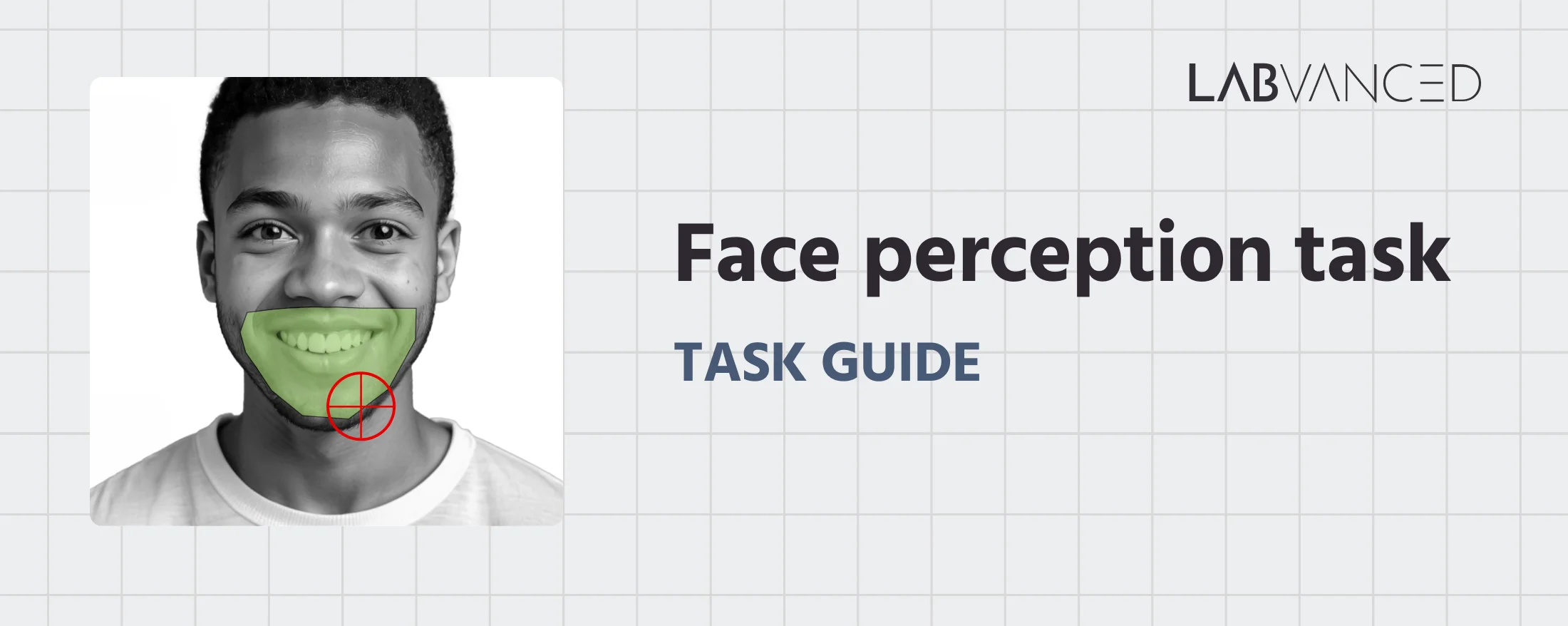
The Face Perception Task measures where people look when they view emotional faces, and whether they then recognize the emotion correctly. Participants view happy, neutral, and sad faces while webcam eye tracking records gaze on two areas of interest (AOIs): the eyes and the mouth. Viewers tend to look at the region that is most typical of each emotion, for example the mouth for happy faces and the eyes for sad faces (Eisenbarth & Alpers, 2011).
Table of Contents
Task Format | Face Perception Task
The study starts with a short instruction screen and a webcam eye tracking calibration of about two minutes. Participants then complete 6 trials: one female and one male face for each of three emotions (happy, neutral, and sad).
Each trial has three steps:
- Fixation cross (1.5 seconds): a central cross brings gaze back to the same starting point before every face.
- Face (10 seconds): the face is shown and participants look at it naturally. Polygon AOIs over the eyes and mouth light up when gaze enters them, and two small tables show the running dwell time, fixation count, and average fixation duration for each region.
- Emotion question: participants choose which emotion the face showed by clicking
Happy,Neutral, orSad.
At the end, a results screen shows how many faces of each emotion were recognized correctly, along with the session's eye tracking error as a percentage of the screen diagonal. The whole study takes about 2 minutes after calibration.
The live AOI highlighting and metric tables are there for demonstration, so participants can see eye tracking working. For a real study, you can hide them so they do not draw attention away from the face.
Data Collected with the Face Perception Task
The Face Perception Task records both how participants scanned each face and how they judged its emotion. This lets researchers compare looking behavior on the eyes and mouth across emotions, and relate it to recognition accuracy. All variables can be viewed and customized within the task's Variables Tab.
Below are the key variables collected in the Labvanced version of the Face Perception Task:
| Variable Name | Description |
|---|---|
Emotions | The emotion shown on the current trial (Happy, Neutral, or Sad) |
file_presented | File name of the face image shown on the trial |
dwell_time_eyes_eye | Total time (ms) gaze spent inside the eyes AOI during the trial |
dwell_time_mouth | Total time (ms) gaze spent inside the mouth AOI during the trial |
eye_fixations_count | Number of fixations that landed on the eyes AOI |
mouth_fixations_count | Number of fixations that landed on the mouth AOI |
eyes_avg_fixD | Average fixation duration (ms) on the eyes AOI |
mouth_avg_fixD | Average fixation duration (ms) on the mouth AOI |
stimulus_emotion | The emotion shown on the face in the current trial |
response_emotion | The emotion button the participant clicked |
correctness | Whether the response matched the emotion shown |
reaction_time_Mouse | Time (ms) from the question screen onset to the participant's click |
gaze_all | Time series of raw gaze samples (x, y, time, confidence) recorded while the face was shown |


This study shows where attention goes when people look at emotional faces. Participants view happy, neutral, and sad faces while webcam eye tracking records dwell time and fixations on the eyes and mouth, then identify the emotion each face showed.
Technology for the Face Perception Task
Labvanced includes several technologies that make the Face Perception Task suitable for remote and in-lab research on face processing:
Webcam Eye Tracking 2.0: Gaze is recorded with the participant's own webcam, with no extra hardware. In a validation with 494 online participants, the two-minute (High tier) calibration reached a median accuracy of 1.8° of visual angle with balanced screening, and larger areas of interest such as faces work on the High tier at 1.8 to 1.9° (Labvanced, 2026). This study uses the same two-minute calibration.
Polygon AOIs: The eyes and mouth regions are drawn as
Polygon Objectshapes that follow the outline of each feature, instead of rectangles that would also cover the cheeks or nose. Eye tracking events check gaze and fixations against these shapes directly.Built-in Fixation Detection: Fixations are detected automatically while the face is shown, so fixation counts and durations per AOI are available without post-processing.
Gaze Control and Drift Correction: A short Gaze Control check runs at regular intervals during the main task to correct drift and keep gaze estimates accurate across trials.
Participant Screening: Participants whose calibration does not reach the study's accuracy threshold are screened out before the main task, which protects data quality in remote studies.
High Precision Timing: Frame durations and response times are recorded with millisecond accuracy, so the 1.5 second fixation cross, the 10 second viewing period, and the time to choose an emotion are measured precisely.
Desktop App Mode: For in-lab studies, the Desktop App can also be used to administer this test and then combine it with lab hardware like EEG or any other LSL-based connection.
Privacy by Design: All face and eye processing runs on the participant's device. Only numeric gaze data is saved, never webcam images or video.

Webcam Eye Tracking
Capture gaze patterns and visual attention with built-in, code-free and peer-reviewed webcam eye-tracking.
Timing Precision
Capture reaction times, task performance, and more with millisecond accuracy for time-sensitive tasks.

Desktop App
Run in-lab studies using the Desktop App, compatible with EEG and other LSL-connected lab hardware.
Customization of the Face Perception Task
There are many ways to go about customizing this template. Below are a few themes researchers commonly ask about when it comes to modifying this task.
Face Stimuli and Emotions
The face images are set per trial on the Image Object, linked to the Emotions factor. You can replace them with your own face set, add more faces per emotion, or add new levels such as angry or fearful in Factors & Randomization. If you add a level, also add a matching response button on the question frame.
Areas of Interest
The eyes and mouth AOIs are Polygon Object shapes placed over each face. You can redraw them to fit a new stimulus set, or add further regions such as the nose or the whole face. For a step-by-step explanation of AOI setup, see the guide on Areas of Interest (AOI).
Live Feedback Display
The colored AOI highlights and the metric tables shown during each face are for demonstration. For a research study, set these objects to be invisible or remove them, so participants view the face without any visual feedback. The underlying eye tracking events keep recording the same measures.
Viewing Time and Eye Tracking Settings
The face is shown for 10 seconds and the fixation cross for 1.5 seconds. Both durations can be changed in the frame settings. Calibration length, screening level, and Gaze Control frequency can be adjusted in the study's eye tracking settings, depending on how much accuracy your AOIs need.
If there is something else you'd like to know, please feel welcome to write to us and ask:
Recommended Use of the Face Perception Task
The Face Perception Task is used wherever researchers need to know how people look at faces, not only what they say about them:
Emotion Recognition Research: Compare how scanning of the eyes and mouth differs across facial expressions, and test how it relates to recognition accuracy. Fixations tend to follow the regions typical of each emotion, but observers who looked mostly at the eyes and observers who looked mostly at the mouth recognized expressions about equally well (Yitzhak et al., 2022).
Autism and Social Attention Research: Test the long-standing hypothesis that autistic people look less at the eyes and more at the mouth. A study combining EEG and eye tracking in boys aged 8 to 12 found no support for it (Vettori et al., 2020), so the question remains open for other ages and stimuli.
Social Anxiety Research: A systematic review of 13 eye tracking studies found that people with social anxiety disorder tend to show hypervigilance followed by avoidance of emotional faces, especially avoidance of the eyes in negative expressions (Claudino et al., 2019).
Cross-Cultural Research: Two experiments with West European or North American and Chinese observers found cultural differences in fixation patterns during face recognition (Gingras et al., 2023). Remote webcam testing makes it easier to reach participants in several countries.
Developmental Research: British and Japanese infants aged 10 and 16 months and adults showed cultural differences in face scanning at every age, and infants shifted from eye to mouth scanning between 10 and 16 months (Haensel et al., 2020).
References
Claudino, R. G. e, de Lima, L. K. S., de Assis, E. D. B., & Torro, N. (2019). Facial expressions and eye tracking in individuals with social anxiety disorder: A systematic review. Psicologia: Reflexão e Crítica, 32, 9. https://doi.org/10.1186/s41155-019-0121-8
Eisenbarth, H., & Alpers, G. W. (2011). Happy mouth and sad eyes: Scanning emotional facial expressions. Emotion, 11(4), 860–865. https://doi.org/10.1037/a0022758
Gingras, F., Estéphan, A., Fiset, D., Lingnan, H., Caldara, R., & Blais, C. (2023). Differences in eye movements for face recognition between Canadian and Chinese participants are not modulated by social orientation. PLOS ONE, 18(12), e0295256. https://doi.org/10.1371/journal.pone.0295256
Haensel, J. X., Ishikawa, M., Itakura, S., Smith, T. J., & Senju, A. (2020). Cultural influences on face scanning are consistent across infancy and adulthood. Infant Behavior and Development, 61, 101503. https://doi.org/10.1016/j.infbeh.2020.101503
Labvanced. (2026). Labvanced Eye Tracking 2.0: Accurate webcam eye tracking for all online research. Labvanced Lab Notes. https://www.labvanced.com/content/research/en/lab-notes/2026-10-webcam-eyetracking-2-0/
Vettori, S., Van der Donck, S., Nys, J., Moors, P., Van Wesemael, T., Steyaert, J., Rossion, B., Dzhelyova, M., & Boets, B. (2020). Combined frequency-tagging EEG and eye-tracking measures provide no support for the "excess mouth/diminished eye attention" hypothesis in autism. Molecular Autism, 11(1), 94. https://doi.org/10.1186/s13229-020-00396-5
Yitzhak, N., Pertzov, Y., Guy, N., & Aviezer, H. (2022). Many ways to see your feelings: Successful facial expression recognition occurs with diverse patterns of fixation distributions. Emotion, 22(5), 844–860. https://doi.org/10.1037/emo0000812
Related Tasks
Face scanning sits close to other gaze-based and emotional attention tasks in Labvanced's task library.
Preferential Looking Paradigm
Participants view side-by-side of either images or videos, while gaze patterns, fixation durations and head orientation are recorded, as well as a video recording of the participant.
Dot Probe Task
In this task, participants see pairs of images followed by a small dot and must respond as quickly as possible to the dot’s location via key press (desktop) or button press (mobile).
Celebrity Endorsement Toy Preference Task
In this task, children are randomly assigned to a control or celebrity-endorsement group, then choose between two toys while webcam eye tracking records their gaze. Choice, reaction time, and fixation measures are recorded as outcome indicators.