Adult ADHD Self-Report Scale (ASRS)
The Adult ADHD Self-Report Scale (ASRS) is a self-report screening scale for attention-deficit/hyperactivity disorder (ADHD) in adults, developed with the World Health Organization (Kessler et al., 2005). Its 6-question ASRS-V1.1 Screener asks how often a person has experienced six ADHD symptoms over the past 6 months, and a score of 4 or more out of 6 indicates a positive screen.
Table of Contents
Items and Structure of the ASRS
The full ASRS has 18 questions about the frequency of recent DSM-IV symptoms of adult ADHD. The 6-question Screener is a subset of these, chosen by stepwise logistic regression to best match clinical diagnoses (Kessler et al., 2005). Four questions cover inattention, such as "How often do you have problems remembering appointments or obligations?", and two cover hyperactivity and impulsivity, such as fidgeting when sitting for a long time (Lundin et al., 2019).
Each question is answered on a 5-point frequency scale: "Never," "Rarely," "Sometimes," "Often," or "Very Often." The official form states that the Screener is intended for people aged 18 years or older (New York University & President and Fellows of Harvard College, n.d.).
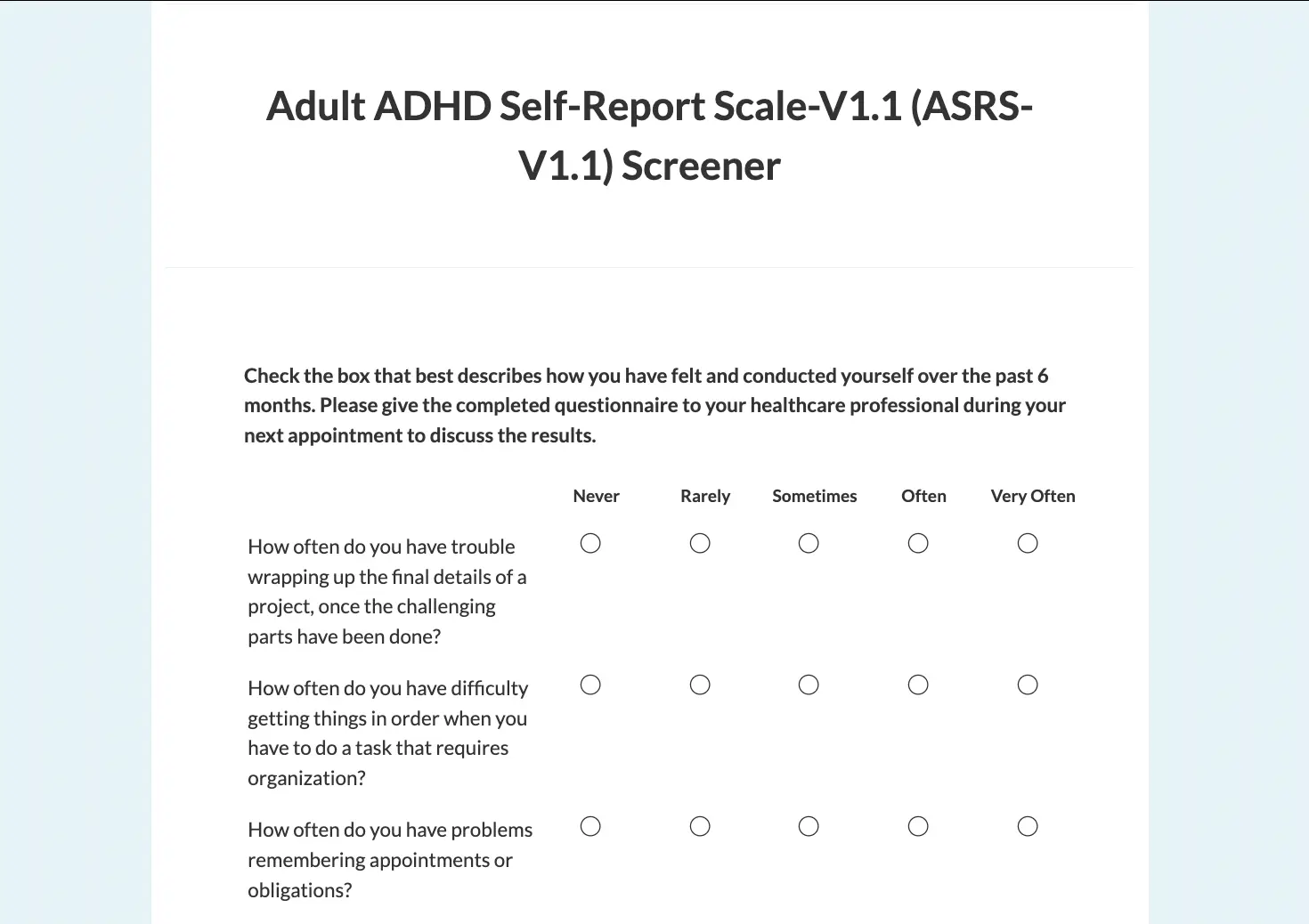
This study screens for adult ADHD symptoms using the 6-question ASRS-V1.1 Screener. Responses are automatically scored into a total score from 0 to 6 and a screening result within Labvanced.
Click the card above to see the full item list and study structure on Labvanced. Use Inspect to view it directly, or Import to copy the study into your own account and customize it.
Scoring Summary
For questions 1 to 3, answering "Sometimes," "Often," or "Very Often" adds 1 to the score. For questions 4 to 6, only "Often" or "Very Often" adds 1. The score ranges from 0 to 6, with higher scores indicating more ADHD symptoms. On the paper form, these answers are marked by shaded boxes. There are no subscales or reverse-scored items.
For the full scoring procedure and interpretation, see the ASRS Scoring and Interpretation guide.
Psychometric Properties of the ASRS
- Reliability: In 668 members of a large US health plan, internal consistency of the continuously scored Screener ranged from 0.63 to 0.72, and test-retest reliability (Pearson correlations) ranged from 0.58 to 0.77 (Kessler et al., 2007).
- Validity: Against blind clinical ratings in 154 respondents from the US National Comorbidity Survey Replication, a sample that oversampled people reporting childhood ADHD, the unweighted Screener had a sensitivity of 68.7%, specificity of 99.5%, total classification accuracy of 97.9%, and a kappa of 0.76. It outperformed the unweighted 18-question ASRS on all four measures (Kessler et al., 2005). In the health plan sample, a four-category version of the Screener had an area under the ROC curve of 0.90 against clinician diagnoses (Kessler et al., 2007).
- Normative Information: The Screener is interpreted with a fixed cutoff, a score of 4 or more, rather than against population norms (see the Scoring and Interpretation guide). In a survey of 72,627 adults in 42 countries, 21.4% of women and 18.1% of men screened positive, with the highest scores in the US, Canada, and other English-speaking Western countries (Lewczuk et al., 2024).
Data Collected with the ASRS
The ASRS-V1.1 Screener captures item-level responses, a computed total score, and a screening result within Labvanced. All variables can be viewed and customized within the study's Variables Tab.
| Variable Name | Description |
|---|---|
Item 1 – Item 6 | Participant's raw selection for each question, stored as 1 (Never) to 5 (Very Often) |
Item 1 score – Item 6 score | 1 if the answer reaches the question's cutoff, otherwise 0 |
ASRS Items | Array combining the 6 item scores |
Total Score | Number of questions answered at or above their cutoff (range 0-6) |
Screen Result | Positive for a score of 4 or more, otherwise Negative |

Technologies Supporting the ASRS
The ASRS is a self-report instrument, but Labvanced allows additional data streams to be layered onto the study for deeper analysis beyond the item responses themselves.
- Automatic Scoring, No-Code Setup: Each answer is checked against its threshold, the answers at or above it are counted, and the screening result is assigned automatically within Labvanced's Questionnaire page structure, with no manual calculation required.
- Response Behavior via Mouse Tracking: Cursor movement toward and away from response options can reveal hesitation or indecision while a participant is answering an ADHD symptom item, adding a behavioral layer beyond the selected answer itself.
- Webcam-Based Eye Tracking: Gaze patterns while reading and answering each item can be captured with built-in, code-free webcam eye tracking, useful for attention-check analysis or for studying how participants engage with the inattention and hyperactivity items.
- Audio and Video Recording: Sessions can be recorded alongside item responses, useful when a researcher wants a qualitative record of participant behavior during an ADHD screening.
- Desktop App for Controlled Administration: For clinical or lab settings administering the ASRS as part of a larger intake battery, the Labvanced desktop app supports standardized, offline-capable administration on dedicated in-lab machines.

Mouse Tracking
Capture cursor movement and response hesitation alongside standard questionnaire answers.

Webcam Eye Tracking
Capture gaze patterns and visual attention with built-in, code-free and peer-reviewed webcam eye-tracking.

Desktop App
Run in-lab, controlled administration using the Desktop App, ideal for clinical intake settings.
Administration Options for the ASRS
There are several ways this instrument can be configured in Labvanced.
- Standard Questionnaire Setup: As a fixed-item frequency scale, the ASRS-V1.1 Screener is built using a standard
Page Frame, where items are listed top to bottom. See the Questionnaires implementation guide for how Page Frames, question objects, and scoring are set up in Labvanced. - Multi-Language Deployment: The licensing office distributes the patient version of the Screener in English and a range of other languages (NYU Technology Opportunities & Ventures, n.d.). Labvanced supports multi-lingual study deployment, allowing an official translation to be configured for the target population.
The card below covers the different ways researchers can build and analyze questionnaires in Labvanced. Beyond fixed Likert items, it supports image, video, and audio stimuli, drag-and-drop and slider-based interactions, branching logic and randomization, and real-time feedback. Layouts can be freely positioned on a canvas or auto-flowing in a page frame, and responses can be automatically scored, reverse-scored, and timed down to the individual item.
If there is something else you'd like to know, please feel welcome to write to us and ask:
Recommended Use and Applications of the ASRS
The Adult ADHD Self-Report Scale Screener is used in population, workplace, and clinical research to screen for adult ADHD symptoms.
- Cross-national survey research: In 72,627 adults across 42 countries, the Screener showed good reliability and validity, with partial measurement invariance across languages, countries, and genders (Lewczuk et al., 2024).
- Occupational health research: In 753 Spanish-speaking employees in Puerto Rico, the Screener showed an area under the ROC curve of .91, and its scores were higher among participants reporting an ADHD diagnosis and associated with greater burnout, lower job satisfaction, and reduced work engagement (Rosario-Hernández et al., 2026).
- Substance use treatment settings: Among 225 Norwegian patients receiving opioid agonist therapy who completed the Screener, 45% screened positive, and 13% of those had a registered ADHD diagnosis (Vold et al., 2023).
- Veteran and trauma-exposed populations: Evidence is mixed. In 332 combat-deployed post-9/11 veterans, agreement between the Screener and the Wender Utah Rating Scale was low, with a sensitivity of 60.7% and specificity of 60.8%. The authors advise clinicians to consider overlapping conditions such as posttraumatic stress disorder when evaluating ADHD in veterans (Knight et al., 2025).
Explore Related Cognitive Tasks
Delay Discounting Task (DDT)
Measures how strongly people devalue rewards that arrive later, a behavioral index of impulsivity. A meta-analysis of 25 case-control comparisons (N = 3,913) found greater delay discounting in people with ADHD than in controls (d = 0.43), with no significant difference between samples under and over 18 (Jackson & MacKillop, 2016).
N-back (2-back) Task
Measures working memory updating. A meta-analysis of 38 studies found moderate-magnitude working memory deficits in adults with ADHD relative to healthy controls, in both phonological and visuospatial domains (Alderson et al., 2013).
References
- Alderson, R. M., Kasper, L. J., Hudec, K. L., & Patros, C. H. (2013). Attention-deficit/hyperactivity disorder (ADHD) and working memory in adults: A meta-analytic review. Neuropsychology, 27(3), 287-302. https://doi.org/10.1037/a0032371
- Jackson, J. N., & MacKillop, J. (2016). Attention-deficit/hyperactivity disorder and monetary delay discounting: A meta-analysis of case-control studies. Biological Psychiatry: Cognitive Neuroscience and Neuroimaging, 1(4), 316-325. https://doi.org/10.1016/j.bpsc.2016.01.007
- Kessler, R. C., Adler, L., Ames, M., Demler, O., Faraone, S., Hiripi, E., Howes, M. J., Jin, R., Secnik, K., Spencer, T., Ustun, T. B., & Walters, E. E. (2005). The World Health Organization Adult ADHD Self-Report Scale (ASRS): A short screening scale for use in the general population. Psychological Medicine, 35(2), 245-256. https://doi.org/10.1017/S0033291704002892
- Kessler, R. C., Adler, L. A., Gruber, M. J., Sarawate, C. A., Spencer, T., & Van Brunt, D. L. (2007). Validity of the World Health Organization Adult ADHD Self-Report Scale (ASRS) Screener in a representative sample of health plan members. International Journal of Methods in Psychiatric Research, 16(2), 52-65. https://doi.org/10.1002/mpr.208
- Knight, A. R., Kim, S., Currao, A., Lebas, A., Nowak, M. K., Milberg, W. P., & Fortier, C. B. (2025). Assessing attention-deficit/hyperactivity disorder in post-9/11 veterans: Prevalence, measurement correspondence, and comorbidity with posttraumatic stress disorder. Military Medicine, 190(5-6), e1106-e1113. https://doi.org/10.1093/milmed/usae539
- Lewczuk, K., Marcowski, P., Wizła, M., Gola, M., Nagy, L., Koós, M., Kraus, S. W., Demetrovics, Z., Potenza, M. N., Ballester-Arnal, R., Batthyány, D., Bergeron, S., Billieux, J., Briken, P., Burkauskas, J., Cárdenas-López, G., Carvalho, J., Castro-Calvo, J., Chen, L., ... Bőthe, B. (2024). Cross-cultural adult ADHD assessment in 42 countries using the Adult ADHD Self-Report Scale Screener. Journal of Attention Disorders, 28(4), 512-530. https://doi.org/10.1177/10870547231215518
- Lundin, A., Kosidou, K., & Dalman, C. (2019). Testing the discriminant and convergent validity of the World Health Organization Six-Item Adult ADHD Self-Report Scale Screener using the Stockholm Public Health Cohort. Journal of Attention Disorders, 23(10), 1170-1177. https://doi.org/10.1177/1087054717735381
- New York University & President and Fellows of Harvard College. (n.d.). Adult Self-Report Scale-V1.1 (ASRS-V1.1) Screener [Patient form, English]. NYU Technology Opportunities & Ventures. Retrieved November 11, 2026, from https://license.tov.med.nyu.edu/product/asrs6Qscreener
- NYU Technology Opportunities & Ventures. (n.d.). ASRS v1.1 6-Question Screener. Retrieved November 11, 2026, from https://license.tov.med.nyu.edu/product/asrs6Qscreener
- Rosario-Hernández, E., Rovira-Millán, L. V., & Blanco-Rovira, R. A. (2026). Review of the psychometric properties and measurement invariance of the Adult Self-Report Scale for ADHD in a sample of employees in Puerto Rico. Frontiers in Psychiatry, 16, 1702403. https://doi.org/10.3389/fpsyt.2025.1702403
- Vold, J. H., Halmøy, A., Chalabianloo, F., Pierron, M. C., Løberg, E. M., Johansson, K. A., & Fadnes, L. T. (2023). Attention-deficit/hyperactivity disorder (ADHD) symptoms and their relation to diagnosed ADHD, sociodemographic characteristics, and substance use among patients receiving opioid agonist therapy: A Norwegian cohort study. BMC Psychiatry, 23(1), 479. https://doi.org/10.1186/s12888-023-04980-w