Ten-Item Personality Inventory (TIPI)
The Ten-Item Personality Inventory (TIPI) is a 10-item self-report measure of the Big Five personality dimensions, developed by Gosling et al. (2003) for situations where very short measures are needed. Its authors describe it as somewhat inferior to standard multi-item instruments (Gosling et al., 2003).
Table of Contents
Items and Structure of the TIPI
The TIPI consists of 10 pairs of descriptors, such as "Extraverted, enthusiastic." and "Reserved, quiet.", with 2 items for each of the five dimensions: Extraversion, Agreeableness, Conscientiousness, Emotional Stability, and Openness to Experiences. Participants rate how much each pair applies to them on a 7-point scale from "Disagree strongly" to "Agree strongly". Five of the items are reverse-scored (Gosling, n.d.-b). The author asks users to read his note on alpha and factor structure first, because the TIPI was built to optimize validity rather than those criteria (Gosling, n.d.-a). The authors report that it takes about 1 minute to complete (Gosling et al., 2003).
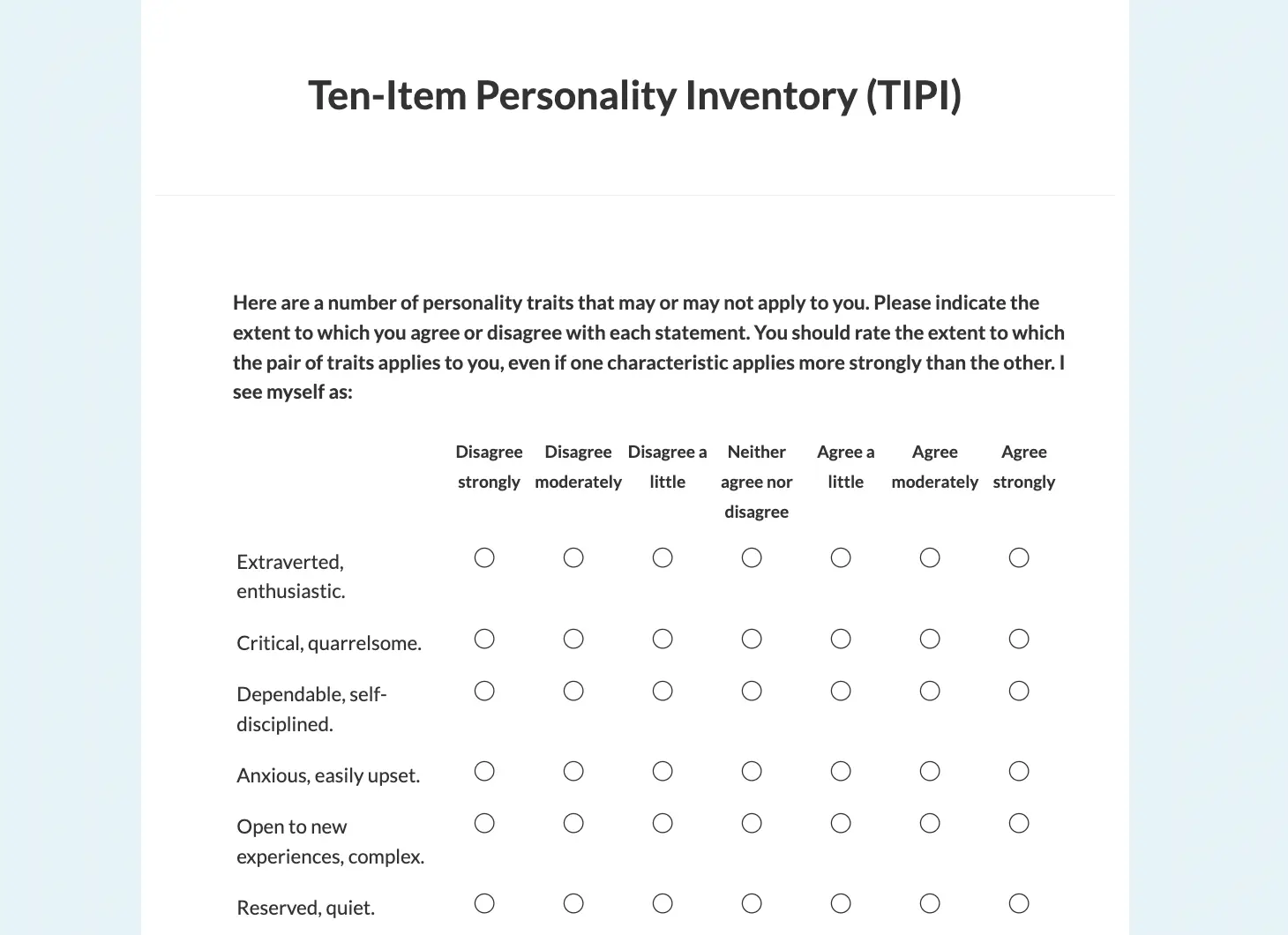
This study measures the Big Five personality dimensions using the TIPI. Responses are automatically reverse-scored and averaged into five trait scores within Labvanced.
Click the card above to see the full item list and study structure on Labvanced. Use Inspect to view it directly, or Import to copy the study into your own account and customize it.
Scoring Summary
Each dimension's score is the average of its 2 items after reverse-scoring, giving five separate scores from 1 to 7, with higher scores indicating more of the trait. The scoring key defines only these five scores, with no total score.
For the full scoring procedure and interpretation, see the TIPI Scoring and Interpretation guide.
Psychometric Properties of the TIPI
- Reliability: Test-retest correlations over about 6 weeks in 180 participants were .77 for Extraversion, .71 for Agreeableness, .76 for Conscientiousness, .70 for Emotional Stability, and .62 for Openness, with a mean of .72, compared with a 2-week mean of .80 for the Big Five Inventory (Gosling et al., 2003). Cronbach's alphas were low, at .68, .40, .50, .73, and .45, because each scale has only 2 items chosen for broad content rather than overlap (Gosling et al., 2003).
- Validity: A scoping review of 27 TIPI versions in 18 languages found acceptable test-retest reliability, somewhat mixed convergent and structural validity, and inappropriate internal consistency, and described the TIPI as a feasible compromise when survey length has to be kept short (Thørrisen & Sadeghi, 2023). In the original sample of 1,813 undergraduates, correlations with the Big Five Inventory were .87 for Extraversion, .70 for Agreeableness, .75 for Conscientiousness, .81 for Emotional Stability, and .65 for Openness (Gosling et al., 2003).
- Normative Information: The authors publish norms by sex and age from a large online sample (Gosling et al., 2014). See the Scoring and Interpretation guide for an excerpt. The author's scoring materials give no cutoffs or score categories.
Data Collected with the TIPI
The TIPI captures item-level responses and five computed trait scores within Labvanced. All variables can be viewed and customized within the study's Variables Tab.
| Variable Name | Description |
|---|---|
Item 1 – Item 10 | Participant's raw response to each item, from 1 (Disagree strongly) to 7 (Agree strongly) |
Item 1 score – Item 10 score | Item score after reverse-scoring items 2, 4, 6, 8, and 10 (8 minus the response) |
Extraversion Score, Agreeableness Score, Conscientiousness Score, Emotional Stability Score, Openness Score | Average of the trait's 2 item scores (range 1-7) |


Technologies Supporting the TIPI
The TIPI is a self-report instrument, but Labvanced allows additional data streams to be layered onto the study for deeper analysis beyond the item responses themselves.
- Automatic Scoring, No-Code Setup: Reverse-scoring of the 5 reverse-keyed items and averaging into five trait scores are handled automatically within Labvanced's Questionnaire page structure, with no manual calculation required.
- Response Behavior via Mouse Tracking: Cursor movement toward and away from response options can reveal hesitation or indecision while a participant is rating a personality item, adding a behavioral layer beyond the selected answer itself.
- Webcam-Based Eye Tracking: Gaze patterns while reading and answering each item can be captured with built-in, code-free webcam eye tracking, useful for attention-check analysis or studying how participants engage with positively and reverse-keyed items.
- Audio and Video Recording: Sessions can be recorded alongside item responses, useful when a researcher wants a qualitative record of participant behavior during a personality assessment.
- Desktop App for Controlled Administration: For lab settings administering the TIPI as part of a larger test battery, the Labvanced desktop app supports standardized, offline-capable administration on dedicated in-lab machines.

Mouse Tracking
Capture cursor movement and response hesitation alongside standard questionnaire answers.

Webcam Eye Tracking
Capture gaze patterns and visual attention with built-in, code-free and peer-reviewed webcam eye-tracking.

Desktop App
Run in-lab, controlled administration using the Desktop App, ideal for test batteries in the lab.
Administration Options for the TIPI
There are several ways this instrument can be configured in Labvanced.
- Standard Questionnaire Setup: As a fixed-item rating scale, the TIPI is built using a standard
Page Frame, with all 10 items in a single matrix listed top to bottom. See the Questionnaires implementation guide for how Page Frames, question objects, and scoring are set up in Labvanced, and the Reverse Scoring guide for the reverse-keyed items. - Choosing a Longer Measure: When personality is a main focus of the study, a longer scale gives more items per trait. Labvanced also offers the 50-item Big Five Personality Test.
- Multi-Language Deployment: Translated versions of the TIPI exist in at least 18 languages, with varying evidence behind them (Thørrisen & Sadeghi, 2023). Labvanced supports multi-lingual study deployment, allowing a translated version to be configured for the target population.
The card below covers the different ways researchers can build and analyze questionnaires in Labvanced. Beyond fixed Likert items, it supports image, video, and audio stimuli, drag-and-drop and slider-based interactions, branching logic and randomization, and real-time feedback. Layouts can be freely positioned on a canvas or auto-flowing in a page frame, and responses can be automatically scored, reverse-scored, and timed down to the individual item.
If there is something else you'd like to know, please feel welcome to write to us and ask:
Recommended Use and Applications of the TIPI
The TIPI is used where a study needs a Big Five estimate but has little room for a personality measure. The authors recommend it for situations where very short measures are needed, personality is not the primary topic of interest, or researchers can tolerate somewhat diminished psychometric properties (Gosling et al., 2003).
- Online surveys of specific groups: An online survey of 593 multi-marathoners from 22 countries used the TIPI, with its normative data as a comparison benchmark, and reported higher Conscientiousness and lower Emotional Stability than the general population (Lundy et al., 2025).
- Large-scale surveys: A Norwegian translation was tested with 5,009 master's graduates, with internal consistency judged acceptable and structural validity satisfactory (Thørrisen et al., 2021).
- Cross-language research: A Portuguese version tested in 333 adults aged 18 to 65 showed alphas of .39 to .72, 4-week test-retest correlations above .71 in 81 participants, and correlations above .60 with the Big Five Inventory (Nunes et al., 2018).
- Children and adolescents, with an adapted form: An adaptation for this age group, the TIPI-CA, showed reasonably appropriate psychometric properties in 2,428 Spanish children and adolescents, although with weaker discriminant validity than adult TIPI versions (López-Fernández et al., 2025).
Explore Related Cognitive Tasks
Ultimatum Game
Measures fairness and cooperation through offers and rejections in a two-player economic game. In a meta-analysis of 770 studies across six economic games, Big Five Agreeableness correlated positively with prosocial behavior in every game, including the Ultimatum Game, though weakly (correlations of .07 to .16) (Thielmann et al., 2020).
Delay Discounting Task (DDT)
Measures how strongly people devalue rewards that arrive later. In a sample of 5,888 people, steeper discounting was predicted by lower Openness and Conscientiousness and higher Extraversion and Neuroticism (Mahalingam et al., 2014), though a later study of 1,206 adults found no correlation with Neuroticism or Conscientiousness (Yeh et al., 2021).
References
- Gosling, S. D. (n.d.-a). A note on alpha reliability and factor structure in the TIPI. Retrieved November 4, 2026, from https://gosling.psy.utexas.edu/scales-weve-developed/ten-item-personality-measure-tipi/a-note-on-alpha-reliability-and-factor-structure-in-the-tipi/
- Gosling, S. D. (n.d.-b). Ten Item Personality Measure (TIPI). Retrieved November 4, 2026, from https://gosling.psy.utexas.edu/scales-weve-developed/ten-item-personality-measure-tipi/
- Gosling, S. D., Rentfrow, P. J., & Potter, J. (2014). Norms for the Ten Item Personality Inventory [Unpublished data].
- Gosling, S. D., Rentfrow, P. J., & Swann, W. B., Jr. (2003). A very brief measure of the Big-Five personality domains. Journal of Research in Personality, 37, 504-528. https://doi.org/10.1016/S0092-6566(03)00046-1
- López-Fernández, F. J., Pineda, D., Rivera-Riquelme, M., Lloret, D., & Piqueras, J. A. (2025). Psychometric properties of the Ten-Item Personality Inventory for Children and Adolescents (TIPI-CA) in a Spanish sample. Current Issues in Personality Psychology, 13(1), 58-66. https://doi.org/10.5114/cipp/188360
- Lundy, L., Reilly, R. B., Fleming, N., & Wilczyńska, D. (2025). Unveiling the psychological traits of multi-marathoners: Insights from TIPI personality trait analysis. PLoS ONE, 20(4), e0311647. https://doi.org/10.1371/journal.pone.0311647
- Mahalingam, V., Stillwell, D., Kosinski, M., Rust, J., & Kogan, A. (2014). Who can wait for the future? A personality perspective. Social Psychological and Personality Science, 5(5), 573-583. https://doi.org/10.1177/1948550613515007
- Nunes, A., Limpo, T., Lima, C. F., & Castro, S. L. (2018). Short scales for the assessment of personality traits: Development and validation of the Portuguese Ten-Item Personality Inventory (TIPI). Frontiers in Psychology, 9, 461. https://doi.org/10.3389/fpsyg.2018.00461
- Thielmann, I., Spadaro, G., & Balliet, D. (2020). Personality and prosocial behavior: A theoretical framework and meta-analysis. Psychological Bulletin, 146(1), 30-90. https://doi.org/10.1037/bul0000217
- Thørrisen, M. M., & Sadeghi, T. (2023). The Ten-Item Personality Inventory (TIPI): A scoping review of versions, translations and psychometric properties. Frontiers in Psychology, 14, 1202953. https://doi.org/10.3389/fpsyg.2023.1202953
- Thørrisen, M. M., Sadeghi, T., & Wiers-Jenssen, J. (2021). Internal consistency and structural validity of the Norwegian translation of the Ten-Item Personality Inventory. Frontiers in Psychology, 12, 723852. https://doi.org/10.3389/fpsyg.2021.723852
- Yeh, Y. H., Myerson, J., & Green, L. (2021). Delay discounting, cognitive ability, and personality: What matters? Psychonomic Bulletin & Review, 28(2), 686-694.