Balloon Analog Risk Task (BART)
The Balloon Analog Risk Task (BART) is a well-validated behavioral measure of risk-taking propensity. Participants pump a virtual balloon to accumulate potential earnings with each pump, but risk losing everything if the balloon pops. The balance between reward-seeking and loss-avoidance makes it a sensitive index of individual differences in risk tolerance.
Table of Contents
Task Format | Balloon Analog Risk Task (BART)
Each trial presents a virtual balloon alongside two buttons: Pump Balloon and $$ Cash in $$. Every click of the Pump button inflates the balloon slightly and adds $0.05 to a temporary reserve. The balloon can pop at any moment — when it does, all potential earnings for that trial are lost and the task advances to the next trial automatically. If the participant chooses to cash in before the balloon pops, the accumulated amount is added to their running total. The task runs across two blocks: a fixed-order block (6 trials) and a randomly-ordered block (15 trials), each containing three balloon colors with distinct pop probabilities. Blue balloons can sustain up to 128 pumps, yellow up to 32, and orange up to 8, creating a gradient of risk levels that participants must learn to navigate.
Desktop Version
The task runs in fullscreen and participants interact using mouse clicks on the on-screen buttons. The balloon grows visually with each pump, providing dynamic feedback on accumulated risk. A live data panel displays potential earnings, pump count, total earned so far, and the time between consecutive pumps in milliseconds. The pop event is accompanied by a sound and a brief "POP!" text display before advancing to the next trial after a 1-second delay.
Mobile Version
The BART is fully compatible with mobile and tablet devices. The button-based interaction requires no keyboard input, so the task runs on touchscreens without modification. The same balloon inflation animation and live data panel are presented, and the cash-in and pump buttons are touch-accessible throughout the trial.
Data Collected with the Balloon Analog Risk Task (BART)
The BART captures a range of behavioral measurements that reveal how participants balance potential reward against cumulative risk. The variables recorded help researchers quantify risk-taking propensity, decision timing, reward sensitivity, and trial-level outcomes across all balloon conditions. All variables can be viewed and customized within the task's Variables Tab.
Below are key variables collected in the Labvanced version of the BART:
| Variable Name | Description |
|---|---|
Pump_Count | Total number of pumps performed in that trial before the balloon popped or the participant cashed in |
Outcome | Trial result — "Pop" if the balloon exploded, "Collect" if the participant cashed in |
temporaryReserve | Potential earnings accumulated during a trial ($0.05 × pumps); resets to 0 on a pop |
Total_Earned | Running total of earnings from all successfully cashed-in trials across the session |
Adjusted_Average_Number_of_Pumps | Mean pump count across trials where the participant cashed in (the primary BART risk index) |
MeanPumps_ALL | Mean pumps across all trials regardless of outcome |
MaximumPumps | Maximum pump count achieved in a single trial across the session |
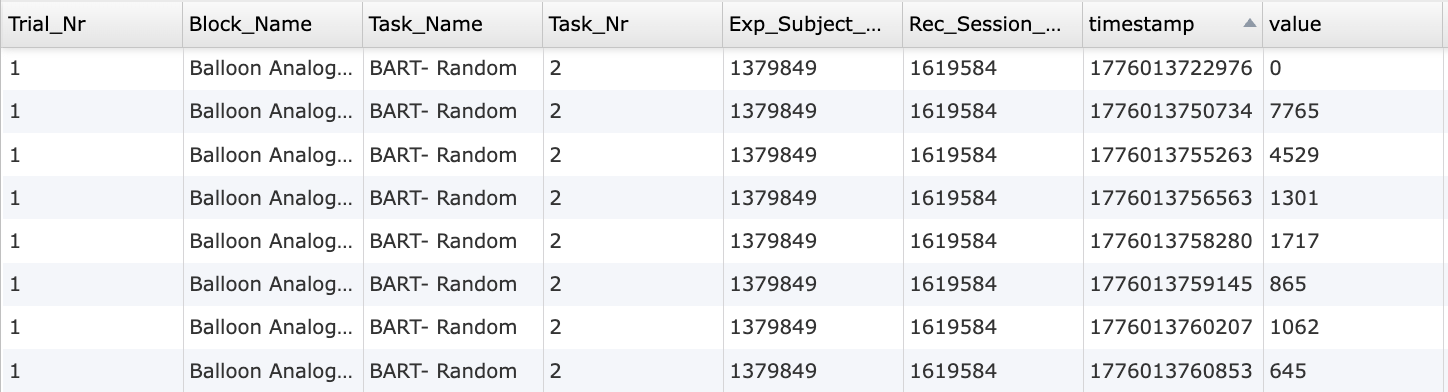
timeBetweenPumps | Time in milliseconds between consecutive pump button clicks (recorded as a timeseries per trial) |
Average_TimeBetweenPumps | Mean inter-pump interval in milliseconds across the full session |
totalExplosions | Total number of balloon pops across all trials |
Balloon_Color | Color of the balloon presented in that trial ("Blue", "Yellow", or "Orange") |
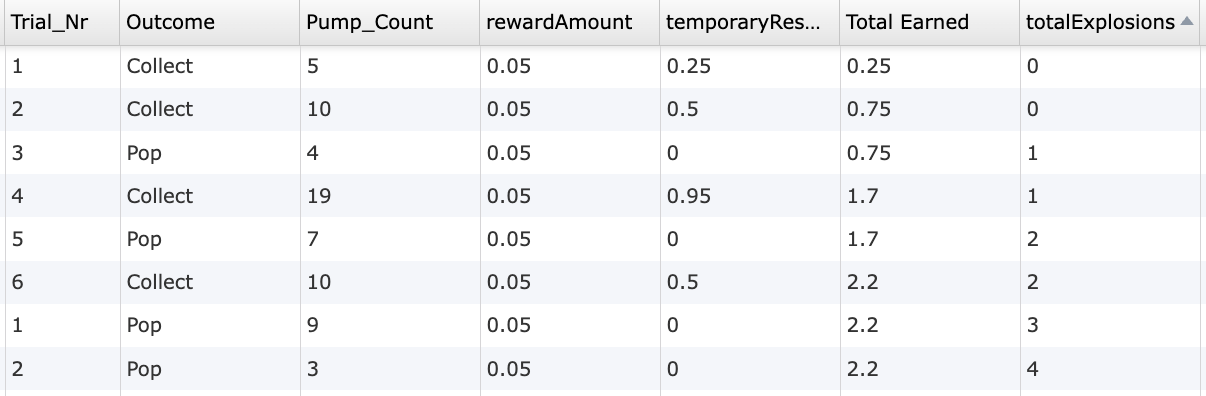
This study measures risk-taking behavior using the BART. Participants pump a virtual balloon to accumulate earnings, balancing potential reward against the risk of the balloon popping and losing all gains for that trial. Pump count, trial outcome, and earnings are recorded as performance indicators.
Technologies Supporting the Balloon Analog Risk Task (BART)
Webcam Eye Tracking: Optional gaze recording can be layered onto the BART to capture how participants visually attend to the balloon, earnings display, and buttons during risk accumulation. This adds a window into the attentional processes that accompany risk decisions, without requiring dedicated hardware.
Timing Precision: The inter-pump interval (
timeBetweenPumps) is captured as a millisecond-accurate timeseries, enabling latency-based analyses of decision hesitation, risk deliberation, and pumping rhythm across trials and conditions.Desktop App: The BART can be run in controlled lab settings using the Labvanced Desktop App, which supports offline testing and integration with LSL-compatible hardware such as EEG, enabling simultaneous physiological recording during risk decision-making trials.
Longitudinal Study Support: The task can be deployed across multiple sessions to track changes in risk propensity over time — for example, before and after an intervention — while keeping all task parameters consistent.

Webcam Eye Tracking
Capture gaze patterns and visual attention with built-in, code-free and peer-reviewed webcam eye-tracking.
Timing Precision
Capture reaction times, task performance, and more with millisecond accuracy for time-sensitive tasks.

Desktop App
Run in-lab studies using the Desktop App, compatible with EEG and other LSL-connected lab hardware.
Customizing the BART Template
There are many ways to go about customizing this template. Below are a few themes researchers commonly ask when it comes to modifying this task.
Pop Probability and Balloon Conditions
Each balloon color has its own independent array of pre-drawn random numbers that determine when the balloon pops. Blue draws from 1–128, yellow from 1–32, and orange from 1–8, reflecting the original BART paradigm's tiered risk structure. You can adjust these ranges in the Set Probabilities event's Draw Random Number action to increase or decrease pop risk for any balloon type, or replace the three-color structure with a single standardized balloon if your design calls for a simpler setup.
Reward Amount Per Pump
The reward value added with each pump is stored in the rewardAmount variable, which is initialized to 0.05 (representing $0.05 per pump). You can update this start value directly in the variable settings to change the incentive structure — for example, increasing the per-pump reward to amplify differences between cautious and risky participants, or adjusting it to fit a different currency or point-based scoring system.
Number of Trials and Block Structure
The task contains two trial loop tasks: a fixed-order block and a randomized block. The number of trials per block can be changed in the Trials & Conditions panel within each trial loop. You can also disable one block entirely, merge both into a single block, or reorder balloon types to match your experimental design.
Feedback and End-of-Task Summary
The results screen at the end of the task displays mean pumps, adjusted average pumps, maximum pumps, average time between pumps, and total earnings. Each of these summary values is computed via the Calculate Scores event on the results frame. You can add or remove summary metrics, change how they are displayed, or suppress the results screen entirely if you prefer to handle feedback at the study level rather than within the task.
If there is something else you'd like to know, please feel welcome to write to us and ask:
Recommended Use and Applications of the BART
The BART is one of the most widely cited behavioral measures of risk propensity and is used across clinical, developmental, and experimental research to quantify how individuals navigate reward-risk tradeoffs.
Addiction and Substance Use Research: The BART is extensively validated in studies of alcohol, nicotine, and drug use disorders. Higher adjusted average pump scores are consistently associated with greater substance use and elevated risk-taking in clinical and at-risk populations.
Adolescent Risk Behavior: A standard tool in developmental studies examining the emergence of risk-taking during adolescence, often combined with neuroimaging to study reward system maturation and its relationship to real-world risk behaviors.
Impulsivity and Executive Function Disorders: Used in research on ADHD, borderline personality disorder, and other conditions characterized by impulsivity or deficits in inhibitory control, where elevated pump counts and frequent explosions serve as behavioral indicators.
Personality and Sensation Seeking: Applied in individual difference research to examine how trait-level risk tolerance, sensation seeking, and behavioral inhibition relate to pump-based performance on the BART.
Behavioral Economics and Decision Science: Used to study how incentive structures, loss framing, and probability learning influence risk decisions in healthy adults, including comparisons of BART performance with other economic risk tasks such as the Iowa Gambling Task.
Intervention and Pre-Post Research: The BART's sensitivity to risk propensity makes it suitable for evaluating the effects of cognitive, pharmacological, or behavioral interventions intended to reduce impulsive risk-taking, with performance measured at baseline and follow-up sessions.
References
Lejuez, C. W., Read, J. P., Kahler, C. W., Richards, J. B., Ramsey, S. E., Stuart, G. L., Strong, D. R., & Brown, R. A. (2002). Evaluation of a behavioral measure of risk taking: The Balloon Analogue Risk Task (BART). Journal of Experimental Psychology: Applied, 8(2), 75–84. https://doi.org/10.1037//1076-898X.8.2.75
Lejuez, C. W., Aklin, W. M., Zvolensky, M. J., & Pedulla, C. M. (2003). Evaluation of the Balloon Analogue Risk Task (BART) as a predictor of adolescent real-world risk-taking behaviours. Journal of Adolescence, 26(4), 475–479. https://doi.org/10.1016/S0140-1971(03)00036-8
Related Tasks
The Balloon Analog Risk Task pairs naturally with other decision-making and risk-related tasks in Labvanced's task library.
Delay Discounting Task (DDT)
Participants choose between a smaller reward available now and a larger reward available later, across a range of delay intervals and discount rates, measuring impulsivity and time preference.
Ultimatum Game
In this interactive 2-player game, one player proposes a split of money and the other decides to accept or reject.
Beads Task
This study measures probabilistic reasoning and the jumping-to-conclusions bias using the Beads Task. Participants decide which of two jars a sequence of beads is being drawn from, requesting as many or as few beads as they need before choosing. Draws to decision, jar choice, and confidence are recorded as outcome measures.
Information Sampling Task (IST)
Participants open boxes from a grid to gather evidence before deciding which of two colors is in the majority, across a fixed-reward and a decreasing-reward condition, measuring reflection impulsivity.