
labvanced logoLabVanced
Contact
    • Remote Physiological Measurements
    • Eye Tracking
    • Head & Face-Tracking
    • Emotion Detection
    • Heart Rate Detection (rPPG)
    • Generative AI
    • Audio Transcription
    • EEG & Hardware Integrations
    • Decision Making
    • Reaction Times
    • Keyboard Inputs
    • Mouse Tracking
    • Mobile / Touch
    • Questionnaires
    • Gamepad / Joystick Integration
    • Audio Recordings
    • Audio Transcription
    • Video Recordings
    • Screen Recordings
    • Photos / Snapshots
    • Video Conferencing
    • Canvas Drawings
    • Build with AI
    • Build with Spreadsheets
    • Using the Experiment Editor
    • Coding
    • Creating Questionnaires
    • Balancing & Randomization
    • UX & Website Testing
    • Single Session Studies
    • Factorial Designs
    • Longitudinal & Multi-session Studies
    • Individual & Case Studies
    • Real-time Multi-user Studies
    • Interviews & Video Calls
    • Surveys & Questionnaires
    • Experience Sampling & Diaries
    • Classroom & Group Testing
    • Interventions & Clinical Trials
    • In the Browser
    • Mobile App
    • Desktop App
    • WebBridge Chrome Extension
    • Stroop Test
    • Flanker Task
    • N-back Task
    • Implicit Association Test
    • Trail Making Test
    • Digit Span
    • Corsi Block Tapping
    • Tower of London
    • Balloon Analog Risk Task
    • Preferential Looking
    • Browse more →
    • DASS-21
    • GAD-7
    • Rosenberg Self-Esteem Scale
    • PHQ-9
    • Ten-Item Personality Inventory
    • Big Five Personality Test
    • Adult ADHD Self-Report Scale
    • Browse more →
    • Building a Multi-user Study
    • Webcam Eye Tracking with AOIs
    • Website Frame Eye Tracking
    • Conditional Eye Tracking Opt-in
    • ChatGPT Study
    • Desktop App Study with EEG
    • Between-subjects Group Balancing
    • Building a Reading Study
    • Stroop Task
    • Lexical Decision Task
    • Browse more →
    Public Experiment Library
    • Arts Research
    • Clinical Psychology & Neuropsychology Medicine
    • Cognitive Psychology
    • Developmental Psychology
    • Behavioral Economics & Decision Science
    • Educational Research & Psychology
    • HCI & Human Factors
    • Linguistics & Language Sciences
    • Consumer & Marketing Research
    • Social & Personality Psychology
    • Sport & Movement Science
    • UX & Website Testing
    • Executive Functions
    • Language & Reading
    • Decision-Making & Reasoning
    • Attention
    • Overview
    • HCI & Human Factors
    • UX & Website Testing
    • Consumer & Marketing Research
    • White-Label App
    • PageGazer
    • Webcam vs. Lab Eye Tracking in InfantsAnna Banki & Gabriela Markova
    • Eye Tracking for Influencer MarketingDr. Alexander Edeling
    • Eye Tracking Infant Word ComprehensionDr. Giulia Calignano
    • Sentence Reading and Grammar JudgmentsDr. Jonathan Mirault
    • Regulating Emotions with MusicDr. Katrin Starcke
    • Game-Based Grammar Learning in ChildrenDr. Mireia Marimon
    • Gaze Cueing and AutismMax Soares Miehstein
    • Personality and Hearing in NoiseDr. Malte Wöstmann
    • All interviews →
    • Lab Notes
    • How to Cite Labvanced
    • Labvanced Platform Paper (2017)
    • Webcam Eye Tracking Validation (2024)
    • Webcam Eye Tracking Studies
    • Cognitive Psychology Studies
    • Developmental Psychology Studies
    • Linguistics Studies
    • See all publications →
    • Getting Started
    • Guide
    • Video Tutorials
    • Walkthroughs
    • Live Chat
    • Webinars & Onboarding Calls
    • AI Assistant
    • FAQ
    • Importing Templates Guide
    • Test Templates
    • Live Eye Tracking Metrics
    • Mouse Tracking Demo
    • ChatGPT Demo
    • Audio Recording Object Demo
    • Adding Image Stimuli Demo
    • Score & Feedback Demo
    • Browse all technical demos →
    • Timing Precision
    • Stimuli Presentation
    • Headphone Checks
    • Bot Checks
    • Participant Management
    • Comparisons
    • Research Blog
    • Prolific Integration
    • CloudResearch Integration
    • Sona Systems Integration
    • BeSample Integration
    • Panelabs Integration
    • Clickworker Integration
    • Labvanced Webhook API
    • Labvanced REST API
    • About Us
    • Newsletter Archive
    • Terms & Conditions
    • Data Security & Data Privacy
    • Technical & Organisational Measures
    • Accessibility
    • W-8BEN-E Form
    • Data Processing Agreement Template
    LinkedInYouTubeDiscord
    • Individual
    • Lab
    • Department / Consortium
    • Teaching
    • Campus
    • Commercial
    • Browse recording top-ups →
    • Browse AI token top-ups →
    • Overview
    • Study Building
    • Subject Recruitment
    • Dedicated Support
    Checkout
  • Contact
    • JA
      • 中國人
      • Deutsch
      • Français
      • Español
      • English
      • 日本語
    • Logout
    • Loginlogin icon
    Platform
    Labvanced makes it easy to implement the most advanced study design and reliably collect your data.
    Biosignals & AI
    Remote Physiological MeasurementsEye TrackingHead & Face-TrackingEmotion DetectionHeart Rate Detection (rPPG)Generative AIAudio TranscriptionEEG & Hardware Integrations
    Behavioral Recordings
    Decision MakingReaction TimesKeyboard InputsMouse TrackingMobile / TouchQuestionnairesGamepad / Joystick Integration
    Media Recordings
    Audio RecordingsAudio TranscriptionVideo RecordingsScreen RecordingsPhotos / SnapshotsVideo ConferencingCanvas Drawings
    Implementation Techniques
    Build with AIBuild with SpreadsheetsUsing the Experiment EditorCodingCreating QuestionnairesBalancing & RandomizationUX & Website Testing
    Study Formats

    Your study can take whatever format your research needs. Here are a few popular examples.

    Single Session StudiesFactorial DesignsLongitudinal & Multi-session StudiesIndividual & Case StudiesReal-time Multi-user StudiesInterviews & Video CallsSurveys & QuestionnairesExperience Sampling & DiariesClassroom & Group TestingInterventions & Clinical Trials
    Where Studies Run

    Run your study online in the browser, on mobile or tablet with the mobile app, or in-lab with the desktop app.

    In the BrowserMobile AppDesktop AppWebBridge Chrome Extension
    Tests
    Explore cognitive tests, questionnaires, walkthroughs, and our public experiment library: a starting point for your next study.
    Popular Cognitive Tests
    Stroop TestFlanker TaskN-back TaskImplicit Association TestTrail Making TestDigit SpanCorsi Block TappingTower of LondonBalloon Analog Risk TaskPreferential Looking
    Browse more →
    Questionnaires & Scales
    DASS-21GAD-7Rosenberg Self-Esteem ScalePHQ-9Ten-Item Personality InventoryBig Five Personality TestAdult ADHD Self-Report Scale
    Browse more →
    Public Experiment Library

    Take a look at what other researchers in the community are doing through our extensive, open catalog of shared studies.

    Open the public library →
    Walkthroughs

    Step-by-step builds of complete studies, from a blank project to a running experiment, that you can follow along or adapt.

    Building a Multi-user StudyWebcam Eye Tracking with AOIsWebsite Frame Eye TrackingConditional Eye Tracking Opt-inChatGPT StudyDesktop App Study with EEGBetween-subjects Group BalancingBuilding a Reading StudyStroop TaskLexical Decision Task
    Browse more →
    Research
    One platform for students, academics, and industry researchers studying human behavior.
    Harvard UniversityStanford UniversityCambridge UniversityUCLNYUMax Planck InstituteUCLATU Munich

    Trusted by researchers at 1,500+ universities worldwide

    Academic Research
    Arts ResearchClinical Psychology & Neuropsychology MedicineCognitive PsychologyDevelopmental PsychologyBehavioral Economics & Decision ScienceEducational Research & PsychologyHCI & Human FactorsLinguistics & Language SciencesConsumer & Marketing ResearchSocial & Personality PsychologySport & Movement ScienceUX & Website Testing
    Research Areas
    Executive FunctionsLanguage & ReadingDecision-Making & ReasoningAttention
    Industry / Commercial
    OverviewHCI & Human FactorsUX & Website TestingConsumer & Marketing ResearchWhite-Label AppPageGazer
    Researcher Interviews

    Conversations with researchers about the studies they ran with Labvanced, what worked, and what they learned.

    Webcam vs. Lab Eye Tracking in InfantsAnna Banki & Gabriela MarkovaEye Tracking for Influencer MarketingDr. Alexander EdelingEye Tracking Infant Word ComprehensionDr. Giulia CalignanoSentence Reading and Grammar JudgmentsDr. Jonathan MiraultRegulating Emotions with MusicDr. Katrin StarckeGame-Based Grammar Learning in ChildrenDr. Mireia MarimonGaze Cueing and AutismMax Soares MiehsteinPersonality and Hearing in NoiseDr. Malte Wöstmann
    All interviews →
    Our Research
    Lab NotesHow to Cite Labvanced
    Peer Reviewed Studies

    A selection of peer-reviewed work built on Labvanced: our own platform and validation papers, and studies by the research community grouped by area. Hundreds more are listed on the full publications page.

    Labvanced Platform Paper (2017)Webcam Eye Tracking Validation (2024)Webcam Eye Tracking StudiesCognitive Psychology StudiesDevelopmental Psychology StudiesLinguistics Studies
    See all publications →
    Resources
    Valuable resources to help you learn the platform, stay updated, and more.
    Documentation
    Getting StartedGuideVideo TutorialsWalkthroughs
    Support
    Live ChatWebinars & Onboarding CallsAI AssistantFAQ
    Templates & Demos

    These are a few popular examples. Browse our guide and a selection of technical demos to get started with implementation.

    Importing Templates GuideTest TemplatesLive Eye Tracking MetricsMouse Tracking DemoChatGPT DemoAudio Recording Object DemoAdding Image Stimuli DemoScore & Feedback Demo
    Browse all technical demos →
    Methodology
    Timing PrecisionStimuli PresentationHeadphone ChecksBot ChecksParticipant ManagementComparisonsResearch Blog
    Integrations & APIs
    Prolific IntegrationCloudResearch IntegrationSona Systems IntegrationBeSample IntegrationPanelabs IntegrationClickworker IntegrationLabvanced Webhook APILabvanced REST API
    Company & Legal
    About UsNewsletter ArchiveTerms & ConditionsData Security & Data PrivacyTechnical & Organisational MeasuresAccessibilityW-8BEN-E FormData Processing Agreement Template
    LinkedInYouTubeDiscord
    Pricing
    Our licenses and additional services at a glance.
    Licenses
    IndividualLabDepartment / ConsortiumTeachingCampusCommercial
    Top-Ups

    Need more recordings for your lab or your own research? Simply use one of these recording top-up packages.

    Browse recording top-ups →

    Need more AI tokens for the AI assistant and study translations? Simply use one of these AI token top-up packages.

    Browse AI token top-ups →
    Additional Services

    Hire Labvanced’s expert team to quickly bring your project to the level of rigor it needs.

    OverviewStudy BuildingSubject RecruitmentDedicated Support
    Checkout

    Ready to purchase a license or top-up? Head straight to checkout.

    Go to checkout →
    • 中國人
    • Deutsch
    • Français
    • Español
    • English
    • 日本語
    語彙判断課題の刺激の例で、実際の言葉と無意味語が提示されています。

    語彙判断課題: メンタルレキシコンへのアクセス

    語彙判断課題 (LDT) は、人間が言語をどのように処理するかを理解するための古典的かつ最も人気のある言語実験タスクの一つです。語彙判断課題の主な目的は、参加者が提示された文字列を単語または無意味語(擬似語)として識別する際の正確さと速度を測定することです。


    試してみてください!

    概要

    どのように機能するのか?

    1. 刺激提示: 参加者は、実際の単語または作り上げられた単語(すなわち、無意味語)が表示されるのを見ます。例えば、「sun」という文字列は単語ですが、「xog」という文字列は単語ではありません。
    2. 反応: 参加者は、単語が実際の単語かどうかを迅速に判断する必要があります。
    3. 結果 / 測定: 回答が正しかったかどうか、および反応時間。

    主な用途: 語彙判断課題の目的

    1. 語彙アクセス: 脳がメンタルレキシコン(すなわち、彼らのメンタル辞書)から情報にアクセスする方法。
    2. 単語の頻度: 単語がどれくらい頻繁(または一般的)であるかが認識に影響を与えます。
    3. 意味的プライミング: 関連する単語がターゲット単語にどのように影響するか。例えば、「chair」という単語を「table」という単語の前に提示すると、「table」という単語への反応が改善されます。
    4. 臨床評価: 語彙判断課題は、臨床評価の文脈で、患者や脆弱な集団の言語能力を理解するために心理学の分野でも人気があります。
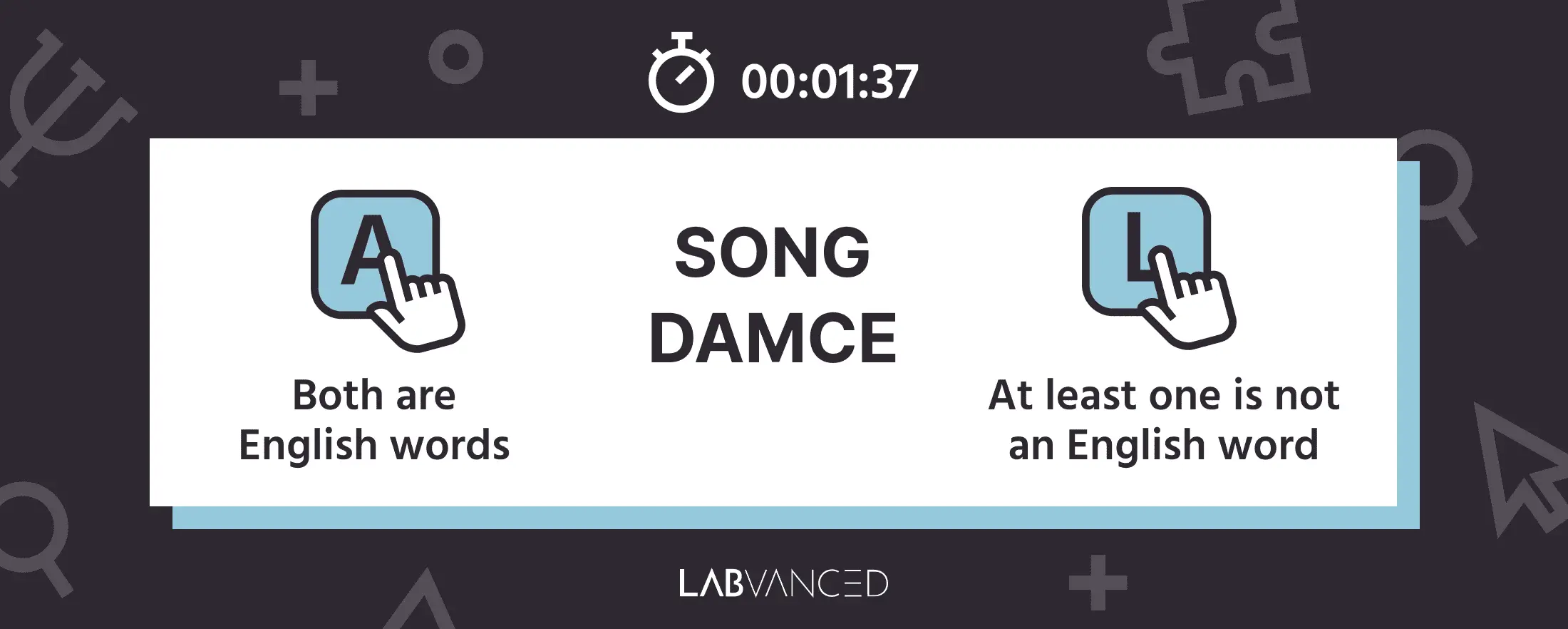
    反応時間と選択決定を主要な結果として持つ、語彙判断課題の双方向のイラスト。

    上の画像は、反応時間と選択決定を持つ双語彙判断課題のイラストであり、語彙判断課題の変種として知られています。

    タスクの詳細

    以下では、語彙判断課題について、使用される擬似語の種類や、タスクのために考慮される要因、タスクの変種について、より詳細に説明します。

    刺激提示

    参加者は一連の文字列が表示され、それらが指定された言語の実際の単語であるかどうかを示さなければなりません。

    • DOG(実際の単語)
    • MOP(実際の単語)
    • ZXTU(無意味語、音韻的に不可能)
    • PLARP(無意味語だが音韻的に可能)

    参加者は各文字列に対し、正しいかどうかを答えるためにキーを押します(すなわち、実際の単語かどうか)。多くの場合、答えが正しいか間違っているかを示すフィードバックが画面に表示されます。これは、以下のタスクフローの画像によって示されています。
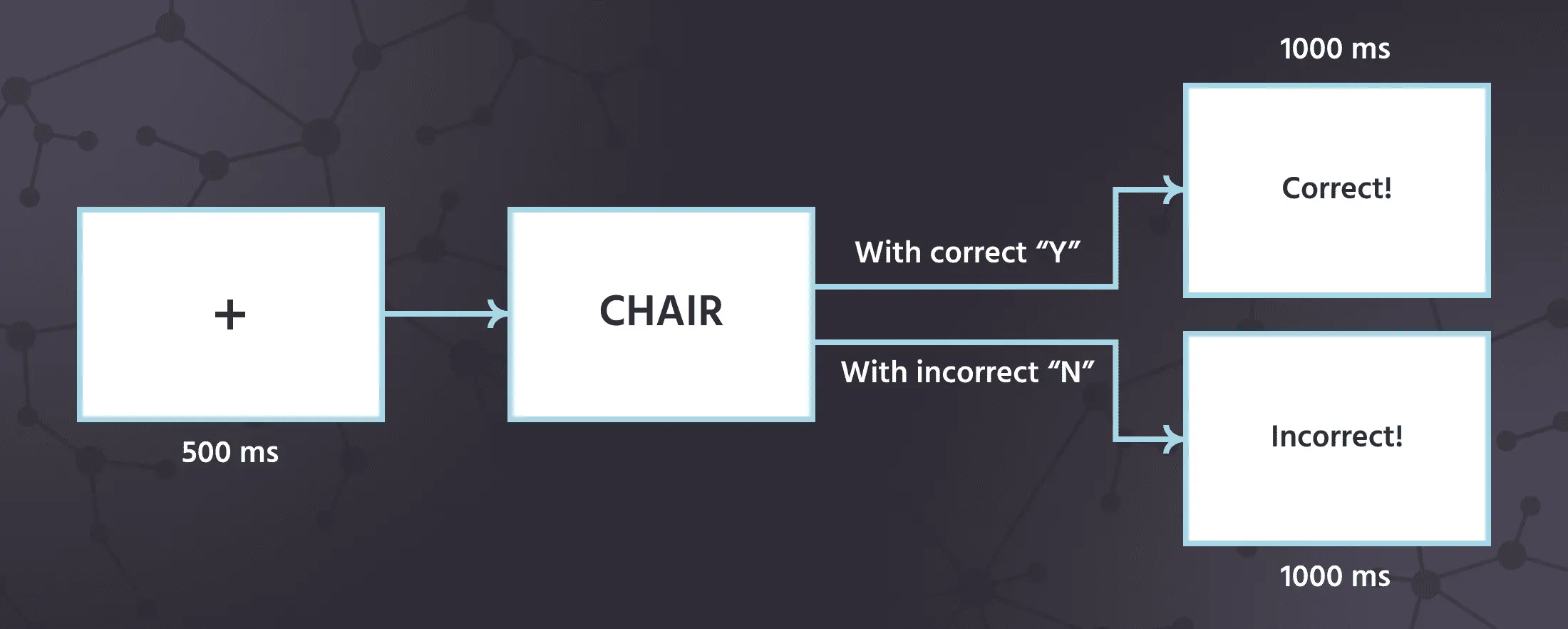
    注視点十字が文字列刺激の後に続き、参加者フィードバックがある語彙判断課題の例。

    刺激の種類 / 無意味語

    研究者は、単語認識のさまざまな側面を探るために刺激の種類を変更することがよくありますが、文献で使用される用語に多少のばらつきがありますが、以下はいくつかの例です:

    • 実際の単語: 参加者が正しく識別することが期待される対象言語の実際の単語の文字列。
    • 可能な無意味語: 実際の単語のように音韻的に聞こえる無意味語、例えば「bort」。擬似形態素もこのカテゴリに含まれることがあります。例えば、「CRANBERRY」という単語の「CRAN」という部分は形態素(言語の最小の意味のある単位)のように見えますが、実際には単語ではありません(Gagné, C. L., Spalding, T. L., Nisbet, K. A., & Armstrong, C., 2018)。
    • 不可能な無意味語: 実際の単語のように聞こえない無意味語、例えば「KLTZ」、これは通常、子音や記号の文字列です(Fernández-López, M., Marcet, A., & Perea, M., 2023)。
    • 高頻度無意味語: 高頻度の擬似語は、日常言語でよく出現する実際の単語に基づくfake wordsです。例えば「PEOGLE」は「PEOPLE」に基づく擬似語です。
    • 低頻度無意味語: 低頻度の擬似語は、日常言語であまり頻繁に出現しない実際の単語に基づくfake wordsです。例えば「DIURMAL」は「DIURNAL」に基づく擬似語です(Perea, M., Rosa, E., & Gómez, C., 2005)。

    Labvancedに登録し、今日オンラインで語彙判断課題の実験を作成して、心理学研究を進めましょう。

    単語認識に影響を与える要因

    以下は、語彙判断課題において単語認識に影響を与えることが知られている要因の例です。これは、語彙判断課題の実験を設定する際に考慮することが重要です。

    要因説明
    頻度日常的に使用される単語は、通常、反応時間が短く、認識が容易なため、低い反応時間をもたらします(Hudson, P. T., & Bergman, M. W., 1985)。
    単語の長さより長い(多くの文字を含む)単語は、通常、高い反応時間を持ちます(Hudson, P. T., & Bergman, M. W., 1985)。
    取得の年齢単語が人生の早い段階で習得されるほど、意味記憶からその単語をより早く引き出せます。後に習得された単語とは対照的です(Juhasz, B. J., Yap, M. J., Raoul, A., & Kaye, M., 2019)。
    隣接密度正字法的または音韻的隣接密度(ターゲット単語と1つのグラフェームまたは音素が異なる単語の数として計算されます)。言い換えれば、正字法的隣接密度は、1文字を変えることでターゲット単語に関連する単語の数を示します。音韻的隣接密度は、ターゲット単語に音が似ている単語の数を示します(Meade, G., Grainger, J., & Declerck, M., 2021; Karimi, H., & Diaz, M., 2020)。
    具体性単語の具体性は、感覚運動に基づく経験に関連しています。具体性は通常、連続体の一方の側にあり、「抽象性」はその反対側にあります(Khanna, M. M., & Cortese, M. J., 2021)。
    イメージ能力単語の知覚的または感覚的特徴を捉え、心の目を使用して単語を想像するのがどれほど容易か難しいかを指します。知覚的強度が高い単語は、よりイメージ化しやすい傾向があります(Khanna, M. M., & Cortese, M. J., 2021)。

    重要な点は、これらの要因の境界にはいくつかのあいまいさがあるということです。例えば、人生の早い段階で習得される単語は、より具体的である傾向があります。また、「具体性」と「イメージ可能性」は定義の面で重なり合っており、これら2つのトピックとその関係に関する研究がかなり蓄積されています (Khanna, M. M., & Cortese, M. J., 2021)。

    以下の画像は、LabvancedでTrial System:を利用して要因がどのように扱われるかを示しています。
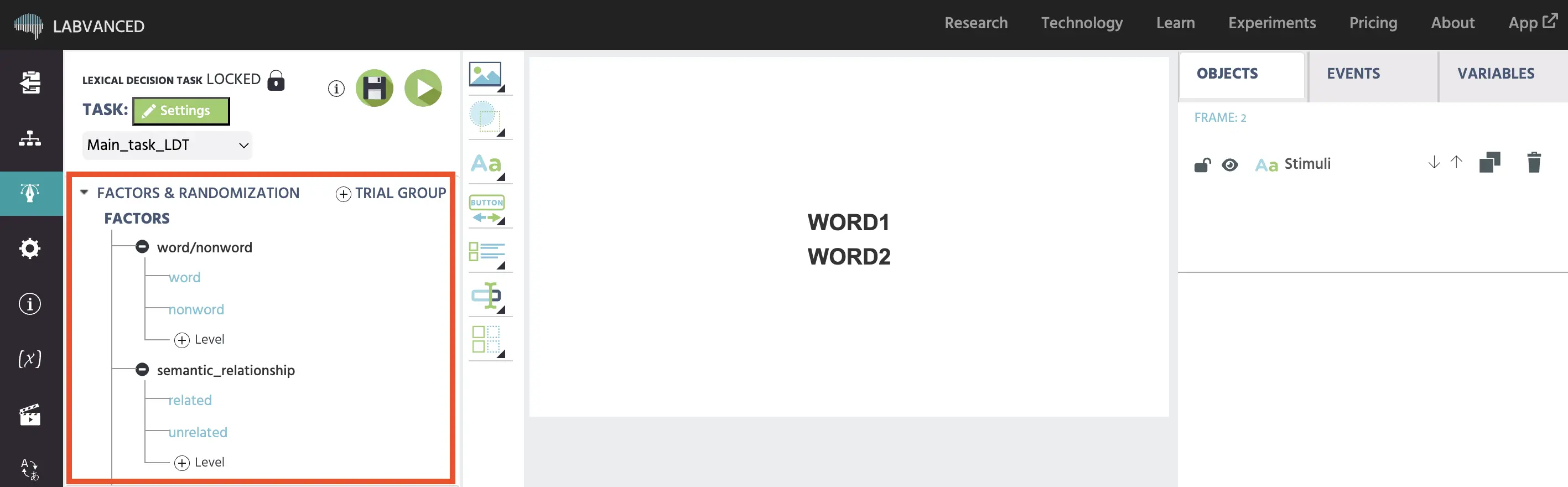
    Example of building the Lexical Decision Task online in Labvanced experiment to study language proficiency.

    Lexical Decision Taskのバリエーション

    Lexical Decision Taskは、その人気のタスクであるため、多くのバリエーションがあります。ここでは、いくつかの興味深いバリエーションのリストを示します:

    • ダブルLexical Decision TaskまたはデュアルLexical Decision Task: 一対の文字列が提示され、参加者は両方の文字列が実在の単語であるかどうかを判断しなければなりません。以下のビデオに示されています (Meyer, D.E. & Schvaneveldt, R.W., 1971)。
    • 聴覚Lexical Decision Task: 書面/視覚フォーマットで刺激を視認する代わりに、このタスクのバリエーションは刺激を聴覚フォーマットで提示します (Barrios, S., & Hayes-Harb, R., 2021)。最近の研究では、COVID-19の流行中のフェイスマスクの影響を評価し、研究者はLabvancedで聴覚的Lexical Decision Taskを実施し、布マスクが音声提示の単語認識タスクでKn95マスクよりも悪影響を及ぼすことを発見しました (Cox, B. G., Tuft, S. E., Morich, J. R., & McLennan, C. T., 2024)。
    • プライミング: この方法には多くのアプローチがありますが、プライミングの基本的原則は、非常に迅速に提示される文字列がLexical Decision Taskの後続のパフォーマンスに影響を与えることを指します (Soares, A. P., Velho, M., & Oliveira, H. M., 2020)。
    • アメリカ手話(ASL)におけるLexical Decision Task: 従来のLexical Decision Taskへの比較的新しいアプローチで、このバリエーションは視覚化可能なサインを使用します (Caselli, N. K., Emmorey, K., & Cohen-Goldberg, A. M., 2021)。
    • フランカー: 一部の研究では、目標単語を示すためにフランカーが利用されています。これは、フランカーを伴うLexical Decision Taskにおける空間的注意の分布が自然な読書行動を模倣することを示唆しています (Meade, G., Grainger, J., & Declerck, M., 2021)。
    • バイリンガルLexical Decision: このバリエーションは、刺激リストを混合して第二言語のターゲット単語を含めるものです (Vanlangendonck, F., Peeters, D., Rueschemeyer, S. A., & Dijkstra, T., 2020)。

    以下のビデオは、LabvancedでのデュアルLexical Decision Task実験をキャプチャしています。これをあなたのアカウントにインポートして、次の研究に使用できます。また、もちろん、異なる刺激を得るために編集したり、2つの文字列の代わりに1つだけ使用することもできます。

    データ収集

    以前に述べたように、Lexical Decision Taskから最も一般的に収集される測定値は、反応の正確性と反応時間です。

    以下の画像は、Labvancedのオンライン実験から収集されたLexical Decision Taskの結果がどのように見えるかを示しています。
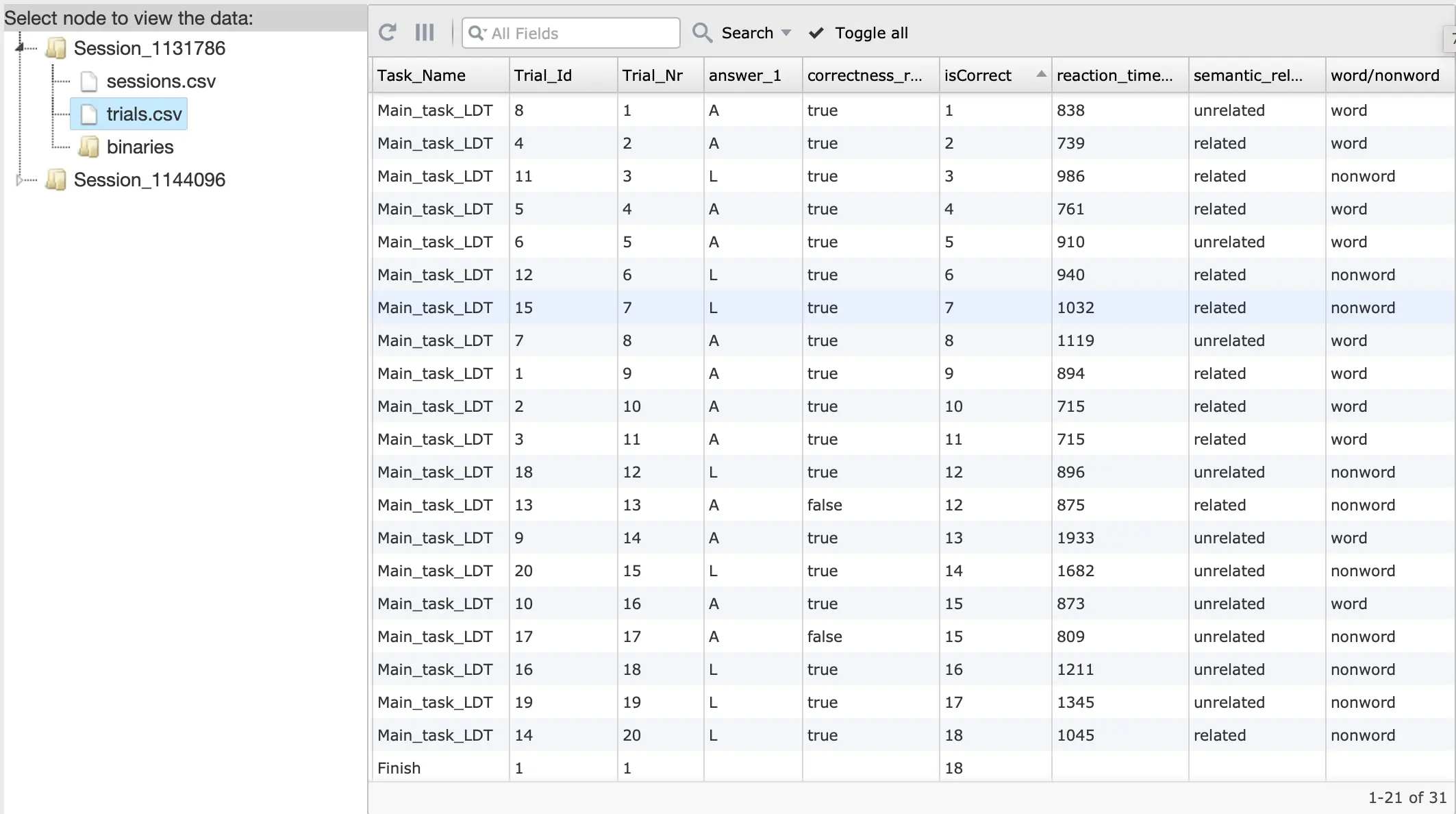
    Example of Lexical Decision Task results collected from an online experiment in Labvanced.

    高度な方法

    高度な方法は、上記のデータ収集アプローチと組み合わせて使用できます。

    • fMRI: Lexical Decision Taskと機能的磁気共鳴画像法(fMRI)を組み合わせた研究は、単語処理時の神経相関と脳活動パターンを見つけることを目的としています。このプロセスには、タスクに関連する意味的および形態的処理などの特定の側面が含まれます (Kim, J., Kim, S., & Nam, K., 2024)。
    • EEG: Lexical Decision Taskを利用する研究は、電気的な活動を測定するために脳波計(EEG)を利用する場合もあり、高い時間的精度で認知プロセスの電気活動を測定します (Silva, P. B., et al. 2022)。
    • アイ・トラッキング: Lexical Decision Taskにアイ・トラッキングを追加することで、研究者は視覚処理と目の動きパターンについての洞察を得ることを目指しています (Premeti, A., Isel, F., & Bucci, M. P., 2024)。

    Labvancedでwebcam eye trackingオプションを有効にし、Lexical Decision Taskで視線データの収集を開始してください。ウェブカメラベースのアイ・トラッキングは、注意を測定するための革新的で急成長している方法です。Labvancedの技術は査読されており、参加者の顔のデータを収集しないことでGDPRに準拠しています ✅ ✅

    Lexical Decision Taskの臨床応用

    Lexical Decision Taskは、多くの臨床応用の設定で利用されており、以下の分野を含みます:

    言語発達障害

    • ディスレクシア(失読症): Lexical Decision Taskは単語認識の研究に使用されるため、失読症患者のこの患者群に関連しています。Lexical Decision Taskは、正書法や音韻障害への感受性を測定でき、高度な方法と組み合わせて神経生理学的相関を特定し、語彙の取得の過程を理解することでレキシカルアクセールを孤立化できるのです (Silva, P. B., et al. 2022)。
    • 特定言語障害: 特定言語障害(SLI)は、言語の生成および理解に影響を与える神経遺伝的な状態です。Lexical Decision Taskは、レキシカル-音韻処理に関する直接的な測定を提供する手段として使用されます (Evans, J. L., Maguire, M. J., & Sizemore, M. L., 2022)。

    認知障害

    • アルツハイマー病: アルツハイマー病の高齢者は、言語やコミュニケーションの方法に変化を経験します。Lexical Decision Taskは、彼らの語彙を窺い見る窓を提供し、単語の意味を理解する能力を明らかにする特定のコンポーネントを評価する手段を提供します (Miceli, A., et al., 2023)。
    • TBI: 外傷性脳損傷(TBI)は認知処理に影響を与えます。Lexical Decision Taskを利用してTBI、認知、言語を研究する研究者は、これらのプロセスとメカニズムがどのように絡み合っているかを理解することを目指しています (Russell, K. C., et al., 2012)。

    神経発達障害

    • ASD: 自閉症スペクトラム障害(ASD)は、コミュニケーションにおける障害を含む主要な異なる行動によって特徴付けられる神経発達障害です。Lexical Decision Taskは、この集団に対して言語処理のプロファイルを捉えるために実施されます (Wilkinson, M., et al., 2022)。
    • ADHD: 注意欠陥多動性障害(ADHD)は、言語やスピーチの問題といくつかの方法で関連しています。Lexical Decision Taskは、このグループの認知プロファイルと言語処理を理解する手段として使用されます (Metzner, I. P., et al., 2021)。

    精神障害

    • 統合失調症: 統合失調症患者の言語的プロファイルは非常に特徴的です。したがって、Lexical Decision Taskは、これらの患者における意味記憶と言語理解を評価するための有用なタスクです (Li, F. & Xu, X., 2022)。
    • 双極性障害: この論文では、Lexical Decision Taskが双極性患者に実施された最初の研究を行いました。結果は、双極群と統制群の言語処理ネットワーク活動に統計的に有意な差はないものの、双極群の運動反応ネットワークの活性化がより高いことを示しました (Kusi, M. et al. 2022)

    その他

    • 語彙判断課題はさまざまな実験に使用できる。この例では、嗅覚を失った患者に対してLabvancedで語彙判断課題が実施され、嗅覚関連の言葉の理解が維持されているかどうかを評価した(Speed, L. J., Iravani, B., Lundström, J. N., & Majid, A., 2022)。
    Labvancedにサインアップして、心理学実験のための語彙判断課題をオンラインで実施するプラットフォームを利用してください

    結論

    全体として、語彙判断課題は、言語能力をより深く理解するためにオンラインまたはラボで実施できる強力な実験である。音声語彙判断課題など、語彙判断課題のいくつかのバリエーションや例が存在する。全体として、この課題の目的は、異なる集団における言語についての洞察を得ることである。

    続きを読む
    Webカメラによる視線追跡 | ピアレビューされた技術

    Labvancedでの研究にどのように実装できるか、正確性について、Webカメラによる視線追跡機能について詳しく学んでください。

    実験タスクへのAI統合

    実験にAIを直接統合してください。テキストからテキスト、画像および音声生成を利用して、人間とAI間の相互作用と認知を研究します。

    参考文献

    1. Barrios, S., & Hayes-Harb, R. (2021). L2 processing of words containing English/æ/-/ɛ/and/l/-/ɹ/contrasts, and the uses and limits of the auditory lexical decision task for understanding the locus of difficulty. Frontiers in Communication, 6, 689470.
    2. Caselli, N. K., Emmorey, K., & Cohen-Goldberg, A. M. (2021). The signed mental lexicon: Effects of phonological neighborhood density, iconicity, and childhood language experience. Journal of Memory and Language, 121, 104282.
    3. Cox, B. G., Tuft, S. E., Morich, J. R., & McLennan, C. T. (2024). Examining listeners’ perception of spoken words with different face masks. Quarterly Journal of Experimental Psychology, 77(3), 478-491.
    4. Evans, J. L., Maguire, M. J., & Sizemore, M. L. (2022). Neural patterns elicited by lexical processing in adolescents with specific language impairment: support for the procedural deficit hypothesis?. Journal of Neurodevelopmental Disorders, 14(1), 20.
    5. Fernández-López, M., Marcet, A., & Perea, M. (2023). Investigating the Role of Response Codes in Masked Priming Lexical Decision Tasks: The Case of Repeated Presentations. Brain Sciences, 13(3), 452.
    6. Gagné, C. L., Spalding, T. L., Nisbet, K. A., & Armstrong, C. (2018). Pseudo-morphemic structure inhibits, but morphemic structure facilitates, processing of a repeated free morpheme. Language, Cognition and Neuroscience, 33(10), 1252-1274.
    7. Hudson, P. T., & Bergman, M. W. (1985). Lexical knowledge in word recognition: Word length and word frequency in naming and lexical decision tasks. Journal of memory and language, 24(1), 46-58.
    8. Juhasz, B. J., Yap, M. J., Raoul, A., & Kaye, M. (2019). A further examination of word frequency and age-of-acquisition effects in English lexical decision task performance: The role of frequency trajectory. Journal of Experimental Psychology: Learning, Memory, and Cognition, 45(1), 82.
    9. Karimi, H., & Diaz, M. (2020). When phonological neighborhood density both facilitates and impedes: Age of acquisition and name agreement interact with phonological neighborhood during word production. Memory & Cognition, 48, 1061-1072.
    10. Khanna, M. M., & Cortese, M. J. (2021). How well imageability, concreteness, perceptual strength, and action strength predict recognition memory, lexical decision, and reading aloud performance. Memory, 29(5), 622-636.
    11. Kim, J., Kim, S., & Nam, K. (2024). Neural Dynamics of Processing Inflectional Morphology: An fMRI Study on Korean Inflected Verbs. Brain Sciences, 14(8), 752.
    12. Kusi, M., Wong, S. T. S., Percival, C. M., Zurrin, R., Roes, M. M., Woodward, T. S., & Goghari, V. M. (2022). Altered activity in functional brain networks involved in lexical decision making in bipolar disorder: An fMRI case-control study. Journal of Affective Disorders, 317, 59-71.
    13. Li, F., & Xu, X. (2022). Impairment of semantic composition in schizophrenia: An ERP study with lexical stimuli. Neuropsychologia, 171, 108241.
    14. Meade, G., Grainger, J., & Declerck, M. (2021). Friend or foe? Flankers reverse the direction of orthographic neighbourhood effects. Language, cognition and neuroscience, 36(5), 535-542.
    15. Metzner, I. P., Capellini, S. A., D’Angelo, I., Del Bianco, N., & Giaconi, C. (2021). Visual-Motor Perceptual and Reading Processes of Schoolchildren With Attention Deficit Hyperactivity Disorder. Psychology Research, 11, 236-247.
    16. Meyer, D.E. & Schvaneveldt, R.W. (1971). Facilitation in recognizing pairs of words: Evidence of a dependence between retrieval operations. Journal of Experimental Psychology, 90, 227-234.
    17. Miceli, A., Wauthia, E., Arachchige, K. K., Lefebvre, L., Ris, L., & Loureiro, I. S. (2023). Perceptual strength influences lexical decision in Alzheimer's disease. Journal of Neurolinguistics, 68, 101144.
    18. Perea, M., Rosa, E., & Gómez, C. (2005). The frequency effect for pseudowords in the lexical decision task. Perception & Psychophysics, 67(2), 301-314.
    19. Premeti, A., Isel, F., & Bucci, M. P. (2024). Visuo-Attentional and Phonological Deficits Explored in French Students with Dyslexia: Eye Movements Recorded during a Phonological Lexical Decision Task. Neurology International, 16(2), 312-326.
    20. Russell, K. C., Arenth, P. M., Scanlon, J. M., Kessler, L., & Ricker, J. H. (2012). Hemispheric and executive influences on low-level language processing after traumatic brain injury. Brain Injury, 26(7-8), 984-995.
    21. Silva, P. B., Oliveira, D. G., Cardoso, A. D., Laurence, P. G., Boggio, P. S., & Macedo, E. C. (2022). Event-related potential and lexical decision task in dyslexic adults: Lexical and lateralization effects. Frontiers in Psychology, 13, 852219.
    22. Soares, A. P., Velho, M., & Oliveira, H. M. (2020). The role of letter features on the consonant-bias effect: Evidence from masked priming. Acta Psychologica, 210, 103171.
    23. Speed, L. J., Iravani, B., Lundström, J. N., & Majid, A. (2022). Losing the sense of smell does not disrupt processing of odor words. Brain and language, 235, 105200.
    24. Vanlangendonck, F., Peeters, D., Rueschemeyer, S. A., & Dijkstra, T. (2020). Mixing the stimulus list in bilingual lexical decision turns cognate facilitation effects into mirrored inhibition effects. Bilingualism: Language and Cognition, 23(4), 836-844.
    25. Wilkinson, M., Keehn, R. J., Linke, A. C., You, Y., Gao, Y., Alemu, K., ... & Müller, R. A. (2022). fMRI BOLD and MEG theta power reflect complementary aspects of activity during lexicosemantic decision in adolescents with ASD. Neuroimage: Reports, 2(4), 100134.