
labvanced logoLabVanced
Contact
    • Remote Physiological Measurements
    • Eye Tracking
    • Head & Face-Tracking
    • Emotion Detection
    • Heart Rate Detection (rPPG)
    • Generative AI
    • Audio Transcription
    • EEG & Hardware Integrations
    • Decision Making
    • Reaction Times
    • Keyboard Inputs
    • Mouse Tracking
    • Mobile / Touch
    • Questionnaires
    • Gamepad / Joystick Integration
    • Audio Recordings
    • Audio Transcription
    • Video Recordings
    • Screen Recordings
    • Photos / Snapshots
    • Video Conferencing
    • Canvas Drawings
    • Build with AI
    • Build with Spreadsheets
    • Using the Experiment Editor
    • Coding
    • Creating Questionnaires
    • Balancing & Randomization
    • UX & Website Testing
    • Single Session Studies
    • Factorial Designs
    • Longitudinal & Multi-session Studies
    • Individual & Case Studies
    • Real-time Multi-user Studies
    • Interviews & Video Calls
    • Surveys & Questionnaires
    • Experience Sampling & Diaries
    • Classroom & Group Testing
    • Interventions & Clinical Trials
    • In the Browser
    • Mobile App
    • Desktop App
    • WebBridge Chrome Extension
    • Stroop Test
    • Flanker Task
    • N-back Task
    • Implicit Association Test
    • Trail Making Test
    • Digit Span
    • Corsi Block Tapping
    • Tower of London
    • Balloon Analog Risk Task
    • Preferential Looking
    • Browse more →
    • DASS-21
    • GAD-7
    • Rosenberg Self-Esteem Scale
    • PHQ-9
    • Ten-Item Personality Inventory
    • Big Five Personality Test
    • Adult ADHD Self-Report Scale
    • Browse more →
    • Building a Multi-user Study
    • Webcam Eye Tracking with AOIs
    • Website Frame Eye Tracking
    • Conditional Eye Tracking Opt-in
    • ChatGPT Study
    • Desktop App Study with EEG
    • Between-subjects Group Balancing
    • Building a Reading Study
    • Stroop Task
    • Lexical Decision Task
    • Browse more →
    Public Experiment Library
    • Arts Research
    • Clinical Psychology & Neuropsychology Medicine
    • Cognitive Psychology
    • Developmental Psychology
    • Behavioral Economics & Decision Science
    • Educational Research & Psychology
    • HCI & Human Factors
    • Linguistics & Language Sciences
    • Consumer & Marketing Research
    • Social & Personality Psychology
    • Sport & Movement Science
    • UX & Website Testing
    • Executive Functions
    • Language & Reading
    • Decision-Making & Reasoning
    • Attention
    • Overview
    • HCI & Human Factors
    • UX & Website Testing
    • Consumer & Marketing Research
    • White-Label App
    • PageGazer
    • Webcam vs. Lab Eye Tracking in InfantsAnna Banki & Gabriela Markova
    • Eye Tracking for Influencer MarketingDr. Alexander Edeling
    • Eye Tracking Infant Word ComprehensionDr. Giulia Calignano
    • Sentence Reading and Grammar JudgmentsDr. Jonathan Mirault
    • Regulating Emotions with MusicDr. Katrin Starcke
    • Game-Based Grammar Learning in ChildrenDr. Mireia Marimon
    • Gaze Cueing and AutismMax Soares Miehstein
    • Personality and Hearing in NoiseDr. Malte Wöstmann
    • All interviews →
    • Lab Notes
    • How to Cite Labvanced
    • Labvanced Platform Paper (2017)
    • Webcam Eye Tracking Validation (2024)
    • Webcam Eye Tracking Studies
    • Cognitive Psychology Studies
    • Developmental Psychology Studies
    • Linguistics Studies
    • See all publications →
    • Getting Started
    • Guide
    • Video Tutorials
    • Walkthroughs
    • Live Chat
    • Webinars & Onboarding Calls
    • AI Assistant
    • FAQ
    • Importing Templates Guide
    • Test Templates
    • Live Eye Tracking Metrics
    • Mouse Tracking Demo
    • ChatGPT Demo
    • Audio Recording Object Demo
    • Adding Image Stimuli Demo
    • Score & Feedback Demo
    • Browse all technical demos →
    • Timing Precision
    • Stimuli Presentation
    • Headphone Checks
    • Bot Checks
    • Participant Management
    • Comparisons
    • Research Blog
    • Prolific Integration
    • CloudResearch Integration
    • Sona Systems Integration
    • BeSample Integration
    • Panelabs Integration
    • Clickworker Integration
    • Labvanced Webhook API
    • Labvanced REST API
    • About Us
    • Newsletter Archive
    • Terms & Conditions
    • Data Security & Data Privacy
    • Technical & Organisational Measures
    • Accessibility
    • W-8BEN-E Form
    • Data Processing Agreement Template
    LinkedInYouTubeDiscord
    • Individual
    • Lab
    • Department / Consortium
    • Teaching
    • Campus
    • Commercial
    • Browse recording top-ups →
    • Browse AI token top-ups →
    • Overview
    • Study Building
    • Subject Recruitment
    • Dedicated Support
    Checkout
  • Contact
    • ZH
      • 中國人
      • Deutsch
      • Français
      • Español
      • English
      • 日本語
    • Logout
    • Loginlogin icon
    Platform
    Labvanced makes it easy to implement the most advanced study design and reliably collect your data.
    Biosignals & AI
    Remote Physiological MeasurementsEye TrackingHead & Face-TrackingEmotion DetectionHeart Rate Detection (rPPG)Generative AIAudio TranscriptionEEG & Hardware Integrations
    Behavioral Recordings
    Decision MakingReaction TimesKeyboard InputsMouse TrackingMobile / TouchQuestionnairesGamepad / Joystick Integration
    Media Recordings
    Audio RecordingsAudio TranscriptionVideo RecordingsScreen RecordingsPhotos / SnapshotsVideo ConferencingCanvas Drawings
    Implementation Techniques
    Build with AIBuild with SpreadsheetsUsing the Experiment EditorCodingCreating QuestionnairesBalancing & RandomizationUX & Website Testing
    Study Formats

    Your study can take whatever format your research needs. Here are a few popular examples.

    Single Session StudiesFactorial DesignsLongitudinal & Multi-session StudiesIndividual & Case StudiesReal-time Multi-user StudiesInterviews & Video CallsSurveys & QuestionnairesExperience Sampling & DiariesClassroom & Group TestingInterventions & Clinical Trials
    Where Studies Run

    Run your study online in the browser, on mobile or tablet with the mobile app, or in-lab with the desktop app.

    In the BrowserMobile AppDesktop AppWebBridge Chrome Extension
    Tests
    Explore cognitive tests, questionnaires, walkthroughs, and our public experiment library: a starting point for your next study.
    Popular Cognitive Tests
    Stroop TestFlanker TaskN-back TaskImplicit Association TestTrail Making TestDigit SpanCorsi Block TappingTower of LondonBalloon Analog Risk TaskPreferential Looking
    Browse more →
    Questionnaires & Scales
    DASS-21GAD-7Rosenberg Self-Esteem ScalePHQ-9Ten-Item Personality InventoryBig Five Personality TestAdult ADHD Self-Report Scale
    Browse more →
    Public Experiment Library

    Take a look at what other researchers in the community are doing through our extensive, open catalog of shared studies.

    Open the public library →
    Walkthroughs

    Step-by-step builds of complete studies, from a blank project to a running experiment, that you can follow along or adapt.

    Building a Multi-user StudyWebcam Eye Tracking with AOIsWebsite Frame Eye TrackingConditional Eye Tracking Opt-inChatGPT StudyDesktop App Study with EEGBetween-subjects Group BalancingBuilding a Reading StudyStroop TaskLexical Decision Task
    Browse more →
    Research
    One platform for students, academics, and industry researchers studying human behavior.
    Harvard UniversityStanford UniversityCambridge UniversityUCLNYUMax Planck InstituteUCLATU Munich

    Trusted by researchers at 1,500+ universities worldwide

    Academic Research
    Arts ResearchClinical Psychology & Neuropsychology MedicineCognitive PsychologyDevelopmental PsychologyBehavioral Economics & Decision ScienceEducational Research & PsychologyHCI & Human FactorsLinguistics & Language SciencesConsumer & Marketing ResearchSocial & Personality PsychologySport & Movement ScienceUX & Website Testing
    Research Areas
    Executive FunctionsLanguage & ReadingDecision-Making & ReasoningAttention
    Industry / Commercial
    OverviewHCI & Human FactorsUX & Website TestingConsumer & Marketing ResearchWhite-Label AppPageGazer
    Researcher Interviews

    Conversations with researchers about the studies they ran with Labvanced, what worked, and what they learned.

    Webcam vs. Lab Eye Tracking in InfantsAnna Banki & Gabriela MarkovaEye Tracking for Influencer MarketingDr. Alexander EdelingEye Tracking Infant Word ComprehensionDr. Giulia CalignanoSentence Reading and Grammar JudgmentsDr. Jonathan MiraultRegulating Emotions with MusicDr. Katrin StarckeGame-Based Grammar Learning in ChildrenDr. Mireia MarimonGaze Cueing and AutismMax Soares MiehsteinPersonality and Hearing in NoiseDr. Malte Wöstmann
    All interviews →
    Our Research
    Lab NotesHow to Cite Labvanced
    Peer Reviewed Studies

    A selection of peer-reviewed work built on Labvanced: our own platform and validation papers, and studies by the research community grouped by area. Hundreds more are listed on the full publications page.

    Labvanced Platform Paper (2017)Webcam Eye Tracking Validation (2024)Webcam Eye Tracking StudiesCognitive Psychology StudiesDevelopmental Psychology StudiesLinguistics Studies
    See all publications →
    Resources
    Valuable resources to help you learn the platform, stay updated, and more.
    Documentation
    Getting StartedGuideVideo TutorialsWalkthroughs
    Support
    Live ChatWebinars & Onboarding CallsAI AssistantFAQ
    Templates & Demos

    These are a few popular examples. Browse our guide and a selection of technical demos to get started with implementation.

    Importing Templates GuideTest TemplatesLive Eye Tracking MetricsMouse Tracking DemoChatGPT DemoAudio Recording Object DemoAdding Image Stimuli DemoScore & Feedback Demo
    Browse all technical demos →
    Methodology
    Timing PrecisionStimuli PresentationHeadphone ChecksBot ChecksParticipant ManagementComparisonsResearch Blog
    Integrations & APIs
    Prolific IntegrationCloudResearch IntegrationSona Systems IntegrationBeSample IntegrationPanelabs IntegrationClickworker IntegrationLabvanced Webhook APILabvanced REST API
    Company & Legal
    About UsNewsletter ArchiveTerms & ConditionsData Security & Data PrivacyTechnical & Organisational MeasuresAccessibilityW-8BEN-E FormData Processing Agreement Template
    LinkedInYouTubeDiscord
    Pricing
    Our licenses and additional services at a glance.
    Licenses
    IndividualLabDepartment / ConsortiumTeachingCampusCommercial
    Top-Ups

    Need more recordings for your lab or your own research? Simply use one of these recording top-up packages.

    Browse recording top-ups →

    Need more AI tokens for the AI assistant and study translations? Simply use one of these AI token top-up packages.

    Browse AI token top-ups →
    Additional Services

    Hire Labvanced’s expert team to quickly bring your project to the level of rigor it needs.

    OverviewStudy BuildingSubject RecruitmentDedicated Support
    Checkout

    Ready to purchase a license or top-up? Head straight to checkout.

    Go to checkout →
    • 中國人
    • Deutsch
    • Français
    • Español
    • English
    • 日本語
    词汇判断任务的刺激示例,其中呈现了真实单词和非单词。

    词汇判断任务:访问心理词典

    词汇判断任务(LDT)是理解人类如何处理语言时经典且最受欢迎的语言实验任务之一。词汇判断任务的主要目的是测量参与者识别所呈现字符串为单词或非单词(伪词)的准确性和速度。


    试试吧!

    概述

    它是如何工作的?

    1. **刺激呈现:**参与者看到实际单词(字母字符串),这些单词是真实的单词或虚构的单词(即非单词)。例如,字符串“sun”是一个单词,但字符串“xog”不是一个单词。
    2. **响应:**参与者必须快速决定这个词是否是真实的单词。
    3. **结果/测量:**答案是否正确,以及反应时间。

    主要用例:词汇判断任务目的

    1. **词汇获取:**大脑如何从其心理词典中获取信息(即他们的心理词典)。
    2. **单词频率:**理解单词的频率(或常见性)将影响识别。
    3. **语义启动:**相关单词如何影响目标单词。例如,在单词“table”之前呈现单词“chair”将提高对单词“table”的反应。
    4. **临床评估:**词汇判断任务在心理学领域中也很受欢迎,特别是在临床评估、理解患者和脆弱人群的语言能力方面。
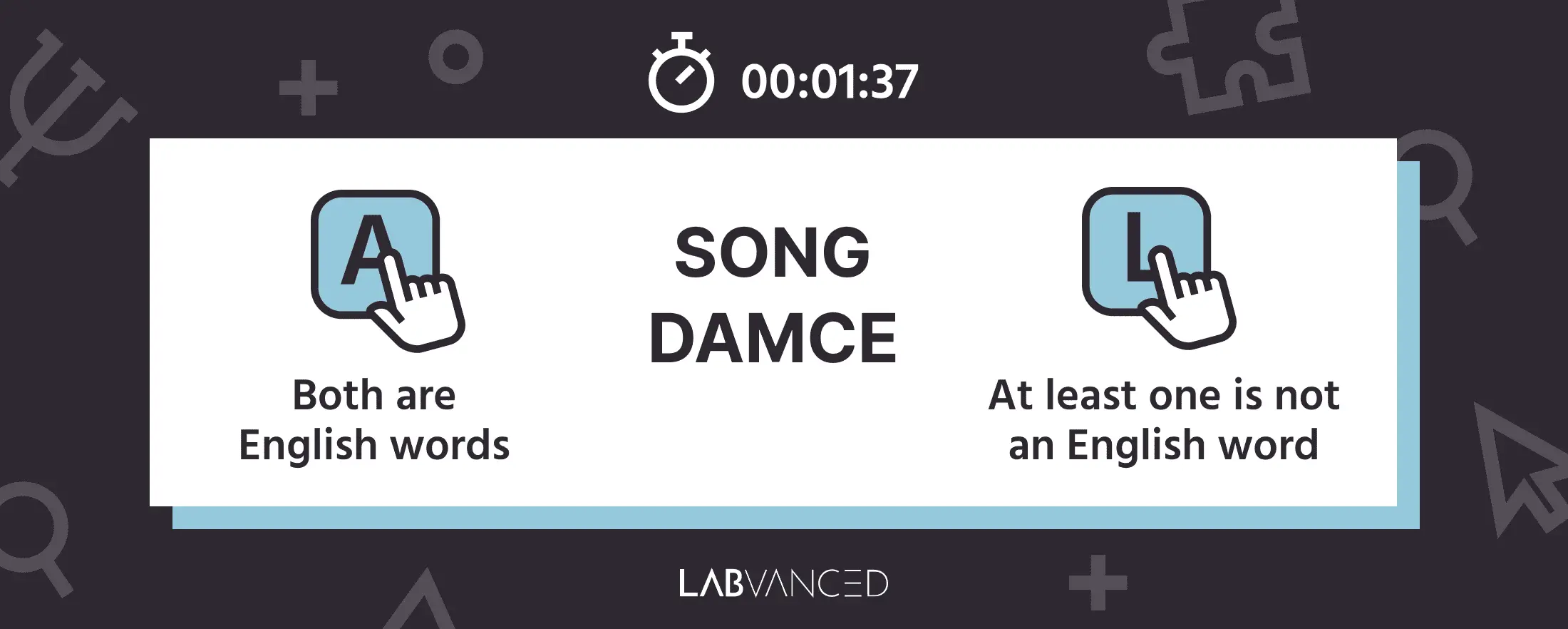
    双重词汇判断任务的插图,这是词汇判断任务的一个著名变体,以反应时间和选择为主要结果。

    上面的图片是双重词汇判断任务的插图,显示了反应时间和选择,这是一个著名的 词汇判断任务变体。

    任务细节

    下面,我们将更详细地讨论词汇判断任务,包括使用什么样的伪词(虚构的单词)、考虑哪种因素以及任务的变体。

    刺激呈现

    参与者会看到一系列字符串,他们必须指明这些字符串是否是所指定语言中的实际单词。

    • DOG(真实单词)
    • MOP(真实单词)
    • ZXTU(非单词,音韵不合理)
    • PLARP(非单词,但音韵合理)

    参与者通过按键来回应每个字符串,以提交他们的答案(即是否为真实单词)。通常会在屏幕上显示反馈,指示提供的答案是否正确,如下方的任务流程图所示。
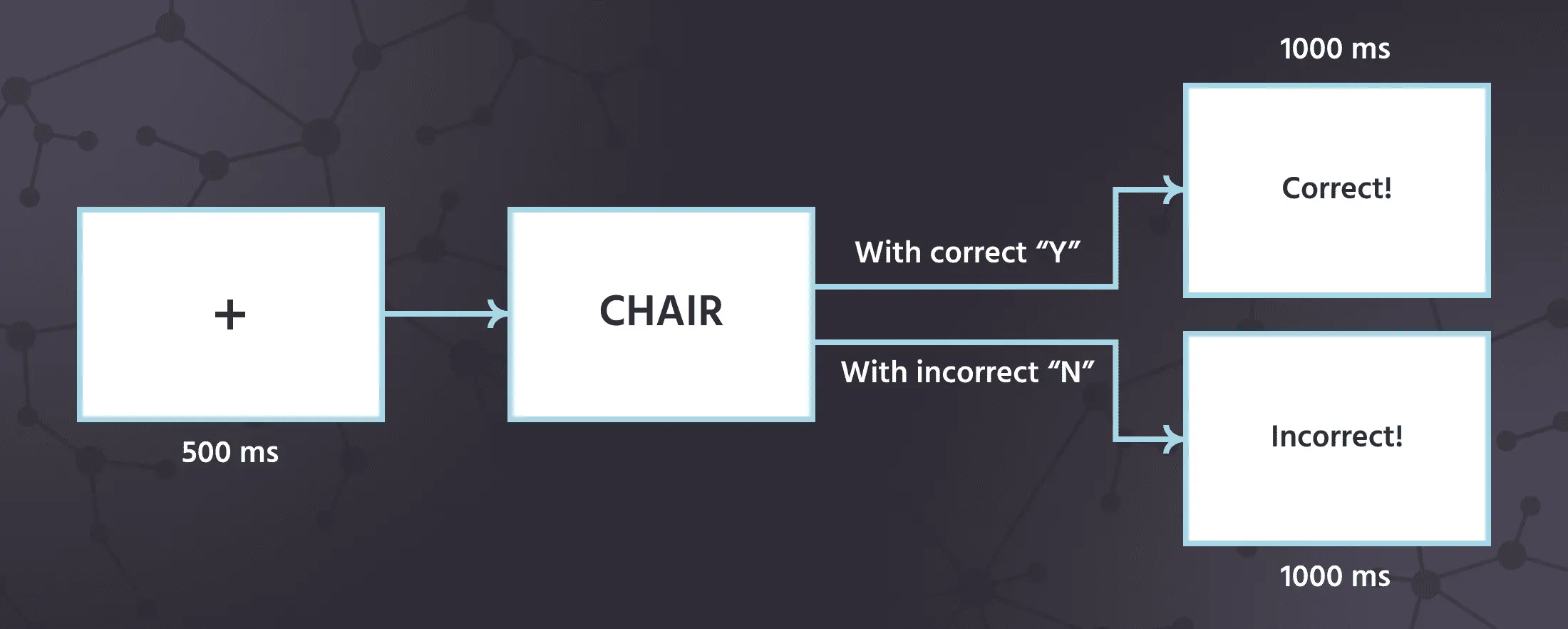
    词汇判断任务示例,其中一个注视十字之后跟随一个字符串刺激和参与者反馈。

    刺激/非词类型

    研究人员通常会改变刺激的类型,以探讨单词识别的不同方面,文献中使用的术语也有所不同,但以下是一些示例:

    • 真实单词:在目标语言中真实存在的字符串,参与者预计能够正确识别。
    • 合理的非单词:在音韵上听起来像真实单词的非单词,例如“bort”。伪词素可能属于这一类别。例如,取“CRANBERRY”这个词,其部分“CRAN”似乎是一个词素(语言中最小的有意义单位),但实际上它并不是一个单词(Gagné, C. L., Spalding, T. L., Nisbet, K. A., & Armstrong, C., 2018)。
    • 不合理的非单词:听起来不像真实单词的非单词,例如“KLTZ”,这些通常是辅音或符号的字符串(Fernández-López, M., Marcet, A., & Perea, M., 2023)。
    • 高频率非单词:高频率伪词是基于在日常语言中出现频率较高的实际单词所形成的虚构单词。例如“PEOGLE”是基于“PEOPLE”的伪词。
    • 低频率非单词:低频率伪词是基于不太频繁出现的实际单词所形成的虚构单词。例如“DIURMAL”是基于“DIURNAL”的伪词(Perea, M., Rosa, E., & Gómez, C., 2005)。

    注册Labvanced并创建您的词汇判断任务实验,马上在线提升您的心理研究。

    影响单词识别的因素

    以下是一些已知会影响词汇判断任务中单词识别的因素的示例。这些因素在设置您的词汇判断任务实验时需考虑。

    因素描述
    频率在日常使用中更频繁(或常见)的单词,通常会导致较低的反应时间,因为它们易于识别(Hudson, P. T., & Bergman, M. W., 1985)。
    单词长度较长的单词通常具有较高的反应时间(Hudson, P. T., & Bergman, M. W., 1985)。
    获取年龄较早获得的单词从语义记忆中提取的速度更快,而较晚获得的单词提取速度较慢(Juhasz, B. J., Yap, M. J., Raoul, A., & Kaye, M., 2019)。
    邻域密度正字法或音韵邻域密度(计算与目标单词在正字法上或音韵上相差一个音素或音节的单词数量)。换句话说,正字法邻域密度是指与目标单词通过改变一个字母相关联的单词数量。音韵邻域密度是指与目标单词发音相似的单词数量(Meade, G., Grainger, J., & Declerck, M., 2021;Karimi, H., & Diaz, M., 2020)。
    具体性单词的具体性与感觉运动基础经验相关。具体性通常处于一个连续体的一侧,而“抽象性”则在另一侧(Khanna, M. M., & Cortese, M. J., 2021)。
    可图像化性也捕捉单词的感知或感觉特征,指的是使用心灵的眼睛想象一个单词的难易程度。感知强度较高的单词通常更容易被图像化(Khanna, M. M., & Cortese, M. J., 2021)。

    需要注意的是,这些因素的边界有一定模糊性。例如,生命早期获得的单词往往更具具体性。此外,“具体性”和“可视性”的定义有重叠,围绕这两个主题及其关系的研究文献也相当丰富(Khanna, M. M., & Cortese, M. J., 2021)。

    下面的图像展示了如何在 Labvanced 中利用 试验系统: 处理这些因素。
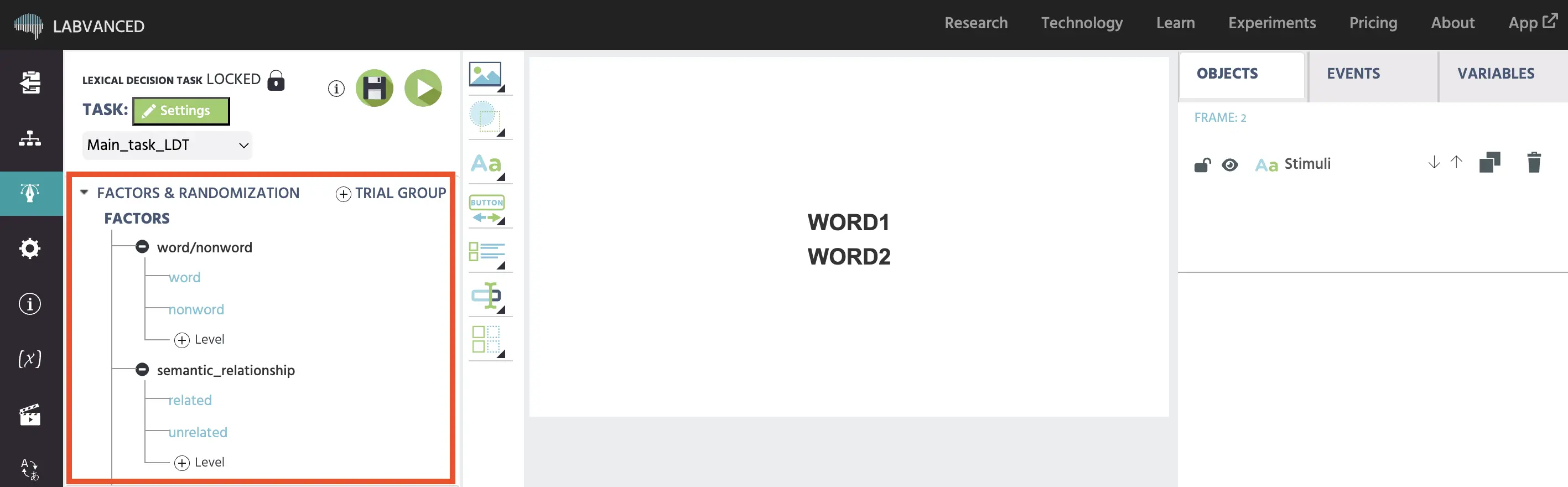
    在 Labvanced 实验中构建词汇决策任务的示例,用于研究语言熟练度。

    词汇决策任务的变体

    作为一种受欢迎的任务,词汇决策任务有很多变体。以下是一些有趣变体的列表:

    • 双重词汇决策任务或双词汇决策任务: 一对字符串被呈现,参与者必须决定这两个字符串是否都是实际单词,如下面的视频所示(Meyer, D.E. & Schvaneveldt, R.W., 1971)。
    • 听觉词汇决策任务: 与以书面/视觉格式查看刺激不同,这种任务的变体以听觉格式呈现刺激(Barrios, S., & Hayes-Harb, R., 2021)。在一项最近研究中,评估了 COVID-19 疫情期间面罩的影响,研究人员在 Labvanced 中实施了听觉词汇决策任务,发现布面罩在仅有音频呈现的单词识别任务中对结果的负面影响大于 Kn95 面罩(Cox, B. G., Tuft, S. E., Morich, J. R., & McLennan, C. T., 2024)。
    • 启发: 有许多方法可以接近这种方法,但启发的基本原理是,它指的是字符串的快速呈现如何影响后续在词汇决策任务上的表现(Soares, A. P., Velho, M., & Oliveira, H. M., 2020)。
    • 美国手语(ASL)中的词汇决策任务: 这是对传统词汇决策任务的一种相对新颖的方式,该变体使用可图示的手势(Caselli, N. K., Emmorey, K., & Cohen-Goldberg, A. M., 2021)。
    • 伙伴: 一些研究还利用伙伴来指示目标词,表明词汇决策任务中伙伴的空间注意分配模拟了自然阅读行为(Meade, G., Grainger, J., & Declerck, M., 2021)。
    • 双语词汇决策: 这种变体混合了刺激列表,以包括第二语言中的目标单词(Vanlangendonck, F., Peeters, D., Rueschemeyer, S. A., & Dijkstra, T., 2020)。

    下面的视频捕捉了 Labvanced 中的双词汇决策任务实验。您可以将其导入到您的账户并用于下一个研究。当然,您也可以编辑它,以拥有不同的刺激,或者只用一个字符串,而不是两个。

    数据收集

    如前所述,从词汇决策任务中最常收集的测量指标是回应的正确性和反应时间。

    在下图中,我们展示了在 Labvanced 在线实验中收集的词汇决策任务结果的样子。
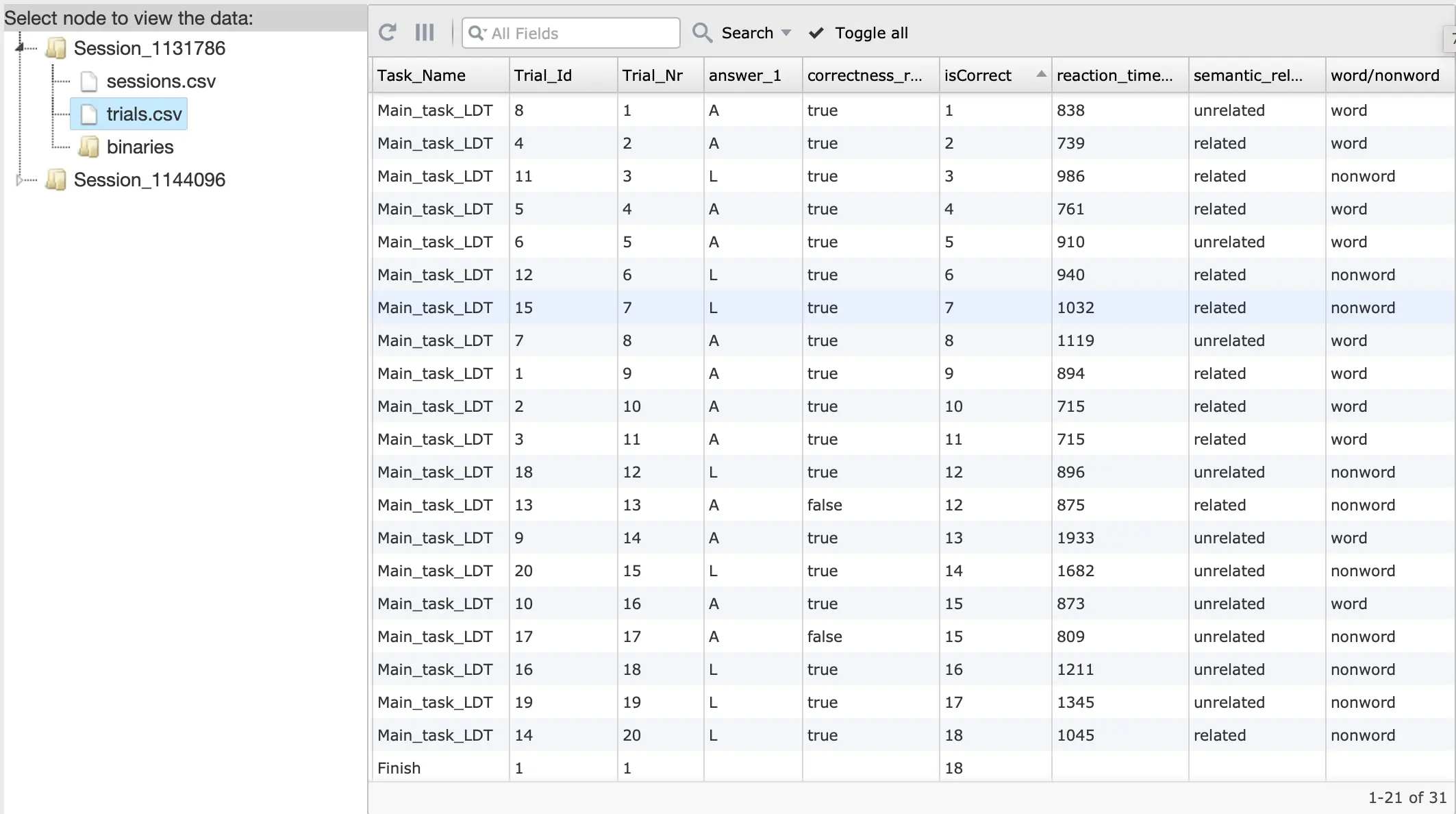
    从 Labvanced 在线实验中收集的词汇决策任务结果的示例。

    高级方法

    高级方法可以与上述数据收集方法结合使用,包括:

    • fMRI: 将词汇决策任务与功能性磁共振成像(fMRI)结合起来的研究旨在找出处理单词时的神经相关性和大脑激活模式,包括与任务相关的特定方面,如语义和形态处理(Kim, J., Kim, S., & Nam, K., 2024)。
    • EEG: 利用词汇决策任务的研究还可以利用脑电图(EEG)作为额外的数据流,以高时间精度测量认知过程中电活动(Silva, P. B., et al. 2022)。
    • 眼动追踪: 通过将眼动追踪添加到词汇决策任务,研究人员旨在获得有关视觉处理和眼动模式的见解(Premeti, A., Isel, F., & Bucci, M. P., 2024)。

    只需在 Labvanced 中启用 网络摄像头眼动追踪 选项,即可开始在您的词汇决策任务中收集注视数据。基于网络摄像头的眼动追踪是一种创新且快速发展的测量注意力的方法。Labvanced 的技术经过同行评审,并遵守 GDPR,不收集参与者的面部数据 ✅ ✅

    词汇决策任务的临床应用

    词汇决策任务在许多临床应用场景中被广泛使用,包括以下领域:

    语言发展障碍

    • 阅读障碍: 由于词汇决策任务用于研究单词识别,因此它在这一患者群体中具有相关性,因为阅读障碍患者在单词识别上受损。词汇决策任务可以测量对正字法和音韵缺陷的敏感性,并结合高级方法来识别神经生理相关性,并通过理解词汇检索的过程来隔离词汇接入(Silva, P. B., et al. 2022)。
    • 特定语言障碍: 特定语言障碍(SLI)是一种神经遗传病,语言产生和理解受到影响。词汇决策任务被用作直接测量词汇-音韵处理的方法(Evans, J. L., Maguire, M. J., & Sizemore, M. L., 2022)。

    认知障碍

    • 阿尔茨海默病: 患有阿尔茨海默病的老年人经历语言和沟通方式的变化。词汇决策任务提供了对其词汇的窗口,并评估特定成分,如词汇-语义处理,揭示他们理解单词意义的能力(Miceli, A., et al., 2023)。
    • 创伤性脑损伤(TBI): 创伤性脑损伤影响认知处理。利用词汇决策任务研究 TBI、认知和语言的研究人员旨在了解这些过程和机制是如何相互交织的(Russell, K. C., et al., 2012)。

    神经发育障碍

    • 自闭症谱系障碍(ASD): 自闭症谱系障碍(ASD)是一种神经发育障碍,其特征是主要的明显行为,包括沟通障碍。词汇决策任务在该人群中施行,以捕捉语言处理的特征(Wilkinson, M., et al., 2022)。
    • 注意力缺陷多动障碍(ADHD): 注意力缺陷多动障碍(ADHD)与多种语言和言语问题相关。词汇决策任务在此群体中被用作了解认知特征和语言处理的方法(Metzner, I. P., et al., 2021)。

    精神障碍

    • 精神分裂症: 精神分裂症患者的语言特征非常独特。因此,词汇决策任务对研究人员评估这些患者的语义记忆和语言理解非常有用(Li, F. & Xu, X., 2022)。
    • 双相情感障碍: 在这项研究中,研究人员进行了首次研究,在双相精神病患者中施行了词汇决策任务。结果表明,尽管双相组和对照组在语言处理网络活动中没有统计学显著差异,但双相组的运动反应网络的激活更高(Kusi, M. et al. 2022)。

    其他

    • 词汇决策任务可以用于多种实验。在这个例子中,词汇决策任务在 Labvanced 中对失去嗅觉的患者进行了管理,以评估他们对嗅觉相关词汇的理解是否仍然完好 (Speed, L. J., Iravani, B., Lundström, J. N., & Majid, A., 2022)。
    注册 Labvanced,这是您进行心理实验的在线词汇决策任务的首选平台

    结论

    总体而言,词汇决策任务是一个强大的实验,可以在在线或实验室中进行,以深入了解语言能力。词汇决策任务有几种变体和示例,包括听觉词汇决策任务。总体而言,这个任务的目的是获得关于不同人群语言的见解。

    了解更多
    网络摄像头眼动追踪 | 同行评审技术

    了解更多关于我们的网络摄像头眼动追踪功能、其准确性以及如何将其整合到您的 Labvanced 研究中。

    用于实验任务的 AI 集成

    直接将 AI 集成到您的实验中。利用文本到文本、图像和音频生成来研究人类与 AI 的互动和感知。

    参考文献

    1. Barrios, S., & Hayes-Harb, R. (2021). L2 processing of words containing English/æ/-/ɛ/and/l/-/ɹ/contrasts, and the uses and limits of the auditory lexical decision task for understanding the locus of difficulty. Frontiers in Communication, 6, 689470.
    2. Caselli, N. K., Emmorey, K., & Cohen-Goldberg, A. M. (2021). The signed mental lexicon: Effects of phonological neighborhood density, iconicity, and childhood language experience. Journal of Memory and Language, 121, 104282.
    3. Cox, B. G., Tuft, S. E., Morich, J. R., & McLennan, C. T. (2024). Examining listeners’ perception of spoken words with different face masks. Quarterly Journal of Experimental Psychology, 77(3), 478-491.
    4. Evans, J. L., Maguire, M. J., & Sizemore, M. L. (2022). Neural patterns elicited by lexical processing in adolescents with specific language impairment: support for the procedural deficit hypothesis?. Journal of Neurodevelopmental Disorders, 14(1), 20.
    5. Fernández-López, M., Marcet, A., & Perea, M. (2023). Investigating the Role of Response Codes in Masked Priming Lexical Decision Tasks: The Case of Repeated Presentations. Brain Sciences, 13(3), 452.
    6. Gagné, C. L., Spalding, T. L., Nisbet, K. A., & Armstrong, C. (2018). Pseudo-morphemic structure inhibits, but morphemic structure facilitates, processing of a repeated free morpheme. Language, Cognition and Neuroscience, 33(10), 1252-1274.
    7. Hudson, P. T., & Bergman, M. W. (1985). Lexical knowledge in word recognition: Word length and word frequency in naming and lexical decision tasks. Journal of memory and language, 24(1), 46-58.
    8. Juhasz, B. J., Yap, M. J., Raoul, A., & Kaye, M. (2019). A further examination of word frequency and age-of-acquisition effects in English lexical decision task performance: The role of frequency trajectory. Journal of Experimental Psychology: Learning, Memory, and Cognition, 45(1), 82.
    9. Karimi, H., & Diaz, M. (2020). When phonological neighborhood density both facilitates and impedes: Age of acquisition and name agreement interact with phonological neighborhood during word production. Memory & Cognition, 48, 1061-1072.
    10. Khanna, M. M., & Cortese, M. J. (2021). How well imageability, concreteness, perceptual strength, and action strength predict recognition memory, lexical decision, and reading aloud performance. Memory, 29(5), 622-636.
    11. Kim, J., Kim, S., & Nam, K. (2024). Neural Dynamics of Processing Inflectional Morphology: An fMRI Study on Korean Inflected Verbs. Brain Sciences, 14(8), 752.
    12. Kusi, M., Wong, S. T. S., Percival, C. M., Zurrin, R., Roes, M. M., Woodward, T. S., & Goghari, V. M. (2022). Altered activity in functional brain networks involved in lexical decision making in bipolar disorder: An fMRI case-control study. Journal of Affective Disorders, 317, 59-71.
    13. Li, F., & Xu, X. (2022). Impairment of semantic composition in schizophrenia: An ERP study with lexical stimuli. Neuropsychologia, 171, 108241.
    14. Meade, G., Grainger, J., & Declerck, M. (2021). Friend or foe? Flankers reverse the direction of orthographic neighbourhood effects. Language, cognition and neuroscience, 36(5), 535-542.
    15. Metzner, I. P., Capellini, S. A., D’Angelo, I., Del Bianco, N., & Giaconi, C. (2021). Visual-Motor Perceptual and Reading Processes of Schoolchildren With Attention Deficit Hyperactivity Disorder. Psychology Research, 11, 236-247.
    16. Meyer, D.E. & Schvaneveldt, R.W. (1971). Facilitation in recognizing pairs of words: Evidence of a dependence between retrieval operations. Journal of Experimental Psychology, 90, 227-234.
    17. Miceli, A., Wauthia, E., Arachchige, K. K., Lefebvre, L., Ris, L., & Loureiro, I. S. (2023). Perceptual strength influences lexical decision in Alzheimer's disease. Journal of Neurolinguistics, 68, 101144.
    18. Perea, M., Rosa, E., & Gómez, C. (2005). The frequency effect for pseudowords in the lexical decision task. Perception & Psychophysics, 67(2), 301-314.
    19. Premeti, A., Isel, F., & Bucci, M. P. (2024). Visuo-Attentional and Phonological Deficits Explored in French Students with Dyslexia: Eye Movements Recorded during a Phonological Lexical Decision Task. Neurology International, 16(2), 312-326.
    20. Russell, K. C., Arenth, P. M., Scanlon, J. M., Kessler, L., & Ricker, J. H. (2012). Hemispheric and executive influences on low-level language processing after traumatic brain injury. Brain Injury, 26(7-8), 984-995.
    21. Silva, P. B., Oliveira, D. G., Cardoso, A. D., Laurence, P. G., Boggio, P. S., & Macedo, E. C. (2022). Event-related potential and lexical decision task in dyslexic adults: Lexical and lateralization effects. Frontiers in Psychology, 13, 852219.
    22. Soares, A. P., Velho, M., & Oliveira, H. M. (2020). The role of letter features on the consonant-bias effect: Evidence from masked priming. Acta Psychologica, 210, 103171.
    23. Speed, L. J., Iravani, B., Lundström, J. N., & Majid, A. (2022). Losing the sense of smell does not disrupt processing of odor words. Brain and language, 235, 105200.
    24. Vanlangendonck, F., Peeters, D., Rueschemeyer, S. A., & Dijkstra, T. (2020). Mixing the stimulus list in bilingual lexical decision turns cognate facilitation effects into mirrored inhibition effects. Bilingualism: Language and Cognition, 23(4), 836-844.
    25. Wilkinson, M., Keehn, R. J., Linke, A. C., You, Y., Gao, Y., Alemu, K., ... & Müller, R. A. (2022). fMRI BOLD and MEG theta power reflect complementary aspects of activity during lexicosemantic decision in adolescents with ASD. Neuroimage: Reports, 2(4), 100134.