labvanced logoLabVanced
Contact
    • Remote Physiological Measurements
    • Eye Tracking
    • Head & Face-Tracking
    • Emotion Detection
    • Heart Rate Detection (rPPG)
    • Generative AI
    • Audio Transcription
    • EEG & Hardware Integrations
    • Decision Making
    • Reaction Times
    • Keyboard Inputs
    • Mouse Tracking
    • Mobile / Touch
    • Questionnaires
    • Gamepad / Joystick Integration
    • Audio Recordings
    • Audio Transcription
    • Video Recordings
    • Screen Recordings
    • Photos / Snapshots
    • Video Conferencing
    • Canvas Drawings
    • Build with AI
    • Build with Spreadsheets
    • Using the Experiment Editor
    • Coding
    • Creating Questionnaires
    • Balancing & Randomization
    • UX & Website Testing
    • Single Session Studies
    • Factorial Designs
    • Longitudinal & Multi-session Studies
    • Individual & Case Studies
    • Real-time Multi-user Studies
    • Interviews & Video Calls
    • Surveys & Questionnaires
    • Experience Sampling & Diaries
    • Classroom & Group Testing
    • Interventions & Clinical Trials
    • In the Browser
    • Mobile App
    • Desktop App
    • WebBridge Chrome Extension
    • Stroop Test
    • Flanker Task
    • N-back Task
    • Implicit Association Test
    • Trail Making Test
    • Digit Span
    • Corsi Block Tapping
    • Tower of London
    • Balloon Analog Risk Task
    • Preferential Looking
    • Browse more →
    • DASS-21
    • GAD-7
    • Rosenberg Self-Esteem Scale
    • PHQ-9
    • Ten-Item Personality Inventory
    • Big Five Personality Test
    • Adult ADHD Self-Report Scale
    • Browse more →
    • Building a Multi-user Study
    • Webcam Eye Tracking with AOIs
    • Website Frame Eye Tracking
    • Conditional Eye Tracking Opt-in
    • ChatGPT Study
    • Desktop App Study with EEG
    • Between-subjects Group Balancing
    • Building a Reading Study
    • Stroop Task
    • Lexical Decision Task
    • Browse more →
    Public Experiment Library
    • Arts Research
    • Clinical Psychology & Neuropsychology Medicine
    • Cognitive Psychology
    • Developmental Psychology
    • Behavioral Economics & Decision Science
    • Educational Research & Psychology
    • HCI & Human Factors
    • Linguistics & Language Sciences
    • Consumer & Marketing Research
    • Social & Personality Psychology
    • Sport & Movement Science
    • UX & Website Testing
    • Executive Functions
    • Language & Reading
    • Decision-Making & Reasoning
    • Attention
    • Overview
    • HCI & Human Factors
    • UX & Website Testing
    • Consumer & Marketing Research
    • White-Label App
    • PageGazer
    • Webcam vs. Lab Eye Tracking in InfantsAnna Banki & Gabriela Markova
    • Eye Tracking for Influencer MarketingDr. Alexander Edeling
    • Eye Tracking Infant Word ComprehensionDr. Giulia Calignano
    • Sentence Reading and Grammar JudgmentsDr. Jonathan Mirault
    • Regulating Emotions with MusicDr. Katrin Starcke
    • Game-Based Grammar Learning in ChildrenDr. Mireia Marimon
    • Gaze Cueing and AutismMax Soares Miehstein
    • Personality and Hearing in NoiseDr. Malte Wöstmann
    • All interviews →
    • Lab Notes
    • How to Cite Labvanced
    • Labvanced Platform Paper (2017)
    • Webcam Eye Tracking Validation (2024)
    • Webcam Eye Tracking Studies
    • Cognitive Psychology Studies
    • Developmental Psychology Studies
    • Linguistics Studies
    • See all publications →
    • Getting Started
    • Guide
    • Video Tutorials
    • Walkthroughs
    • Live Chat
    • Webinars & Onboarding Calls
    • AI Assistant
    • FAQ
    • Importing Templates Guide
    • Test Templates
    • Live Eye Tracking Metrics
    • Mouse Tracking Demo
    • ChatGPT Demo
    • Audio Recording Object Demo
    • Adding Image Stimuli Demo
    • Score & Feedback Demo
    • Browse all technical demos →
    • Timing Precision
    • Stimuli Presentation
    • Headphone Checks
    • Bot Checks
    • Participant Management
    • Comparisons
    • Research Blog
    • Prolific Integration
    • CloudResearch Integration
    • Sona Systems Integration
    • BeSample Integration
    • Panelabs Integration
    • Clickworker Integration
    • Labvanced Webhook API
    • Labvanced REST API
    • About Us
    • Newsletter Archive
    • Terms & Conditions
    • Data Security & Data Privacy
    • Technical & Organisational Measures
    • Accessibility
    • W-8BEN-E Form
    • Data Processing Agreement Template
    LinkedInYouTubeDiscord
    • Individual
    • Lab
    • Department / Consortium
    • Teaching
    • Campus
    • Commercial
    Top-Ups
    • Overview
    • Study Building
    • Subject Recruitment
    • Dedicated Support
    Checkout
  • Contact
    • JA
      • 中國人
      • Deutsch
      • Français
      • Español
      • English
      • 日本語
    • Appgo to app icon
    • Loginlogin icon
    Platform
    Labvanced makes it easy to implement the most advanced study design and reliably collect your data.
    Biosignals & AI
    Remote Physiological MeasurementsEye TrackingHead & Face-TrackingEmotion DetectionHeart Rate Detection (rPPG)Generative AIAudio TranscriptionEEG & Hardware Integrations
    Behavioral Recordings
    Decision MakingReaction TimesKeyboard InputsMouse TrackingMobile / TouchQuestionnairesGamepad / Joystick Integration
    Media Recordings
    Audio RecordingsAudio TranscriptionVideo RecordingsScreen RecordingsPhotos / SnapshotsVideo ConferencingCanvas Drawings
    Implementation Techniques
    Build with AIBuild with SpreadsheetsUsing the Experiment EditorCodingCreating QuestionnairesBalancing & RandomizationUX & Website Testing
    Study Formats

    Your study can take whatever format your research needs. Here are a few popular examples.

    Single Session StudiesFactorial DesignsLongitudinal & Multi-session StudiesIndividual & Case StudiesReal-time Multi-user StudiesInterviews & Video CallsSurveys & QuestionnairesExperience Sampling & DiariesClassroom & Group TestingInterventions & Clinical Trials
    Where Studies Run

    Run your study online in the browser, on mobile or tablet with the mobile app, or in-lab with the desktop app.

    In the BrowserMobile AppDesktop AppWebBridge Chrome Extension
    Tests
    Explore cognitive tests, questionnaires, walkthroughs, and our public experiment library: a starting point for your next study.
    Popular Cognitive Tests
    Stroop TestFlanker TaskN-back TaskImplicit Association TestTrail Making TestDigit SpanCorsi Block TappingTower of LondonBalloon Analog Risk TaskPreferential Looking
    Browse more →
    Questionnaires & Scales
    DASS-21GAD-7Rosenberg Self-Esteem ScalePHQ-9Ten-Item Personality InventoryBig Five Personality TestAdult ADHD Self-Report Scale
    Browse more →
    Public Experiment Library

    Take a look at what other researchers in the community are doing through our extensive, open catalog of shared studies.

    Open the public library →
    Walkthroughs

    Step-by-step builds of complete studies, from a blank project to a running experiment, that you can follow along or adapt.

    Building a Multi-user StudyWebcam Eye Tracking with AOIsWebsite Frame Eye TrackingConditional Eye Tracking Opt-inChatGPT StudyDesktop App Study with EEGBetween-subjects Group BalancingBuilding a Reading StudyStroop TaskLexical Decision Task
    Browse more →
    Research
    One platform for students, academics, and industry researchers studying human behavior.
    Harvard UniversityStanford UniversityCambridge UniversityUCLNYUMax Planck InstituteUCLATU Munich

    Trusted by researchers at 1,500+ universities worldwide

    Academic Research
    Arts ResearchClinical Psychology & Neuropsychology MedicineCognitive PsychologyDevelopmental PsychologyBehavioral Economics & Decision ScienceEducational Research & PsychologyHCI & Human FactorsLinguistics & Language SciencesConsumer & Marketing ResearchSocial & Personality PsychologySport & Movement ScienceUX & Website Testing
    Research Areas
    Executive FunctionsLanguage & ReadingDecision-Making & ReasoningAttention
    Industry / Commercial
    OverviewHCI & Human FactorsUX & Website TestingConsumer & Marketing ResearchWhite-Label AppPageGazer
    Researcher Interviews

    Conversations with researchers about the studies they ran with Labvanced, what worked, and what they learned.

    Webcam vs. Lab Eye Tracking in InfantsAnna Banki & Gabriela MarkovaEye Tracking for Influencer MarketingDr. Alexander EdelingEye Tracking Infant Word ComprehensionDr. Giulia CalignanoSentence Reading and Grammar JudgmentsDr. Jonathan MiraultRegulating Emotions with MusicDr. Katrin StarckeGame-Based Grammar Learning in ChildrenDr. Mireia MarimonGaze Cueing and AutismMax Soares MiehsteinPersonality and Hearing in NoiseDr. Malte Wöstmann
    All interviews →
    Our Research
    Lab NotesHow to Cite Labvanced
    Peer Reviewed Studies

    A selection of peer-reviewed work built on Labvanced: our own platform and validation papers, and studies by the research community grouped by area. Hundreds more are listed on the full publications page.

    Labvanced Platform Paper (2017)Webcam Eye Tracking Validation (2024)Webcam Eye Tracking StudiesCognitive Psychology StudiesDevelopmental Psychology StudiesLinguistics Studies
    See all publications →
    Resources
    Valuable resources to help you learn the platform, stay updated, and more.
    Documentation
    Getting StartedGuideVideo TutorialsWalkthroughs
    Support
    Live ChatWebinars & Onboarding CallsAI AssistantFAQ
    Templates & Demos

    These are a few popular examples. Browse our guide and a selection of technical demos to get started with implementation.

    Importing Templates GuideTest TemplatesLive Eye Tracking MetricsMouse Tracking DemoChatGPT DemoAudio Recording Object DemoAdding Image Stimuli DemoScore & Feedback Demo
    Browse all technical demos →
    Methodology
    Timing PrecisionStimuli PresentationHeadphone ChecksBot ChecksParticipant ManagementComparisonsResearch Blog
    Integrations & APIs
    Prolific IntegrationCloudResearch IntegrationSona Systems IntegrationBeSample IntegrationPanelabs IntegrationClickworker IntegrationLabvanced Webhook APILabvanced REST API
    Company & Legal
    About UsNewsletter ArchiveTerms & ConditionsData Security & Data PrivacyTechnical & Organisational MeasuresAccessibilityW-8BEN-E FormData Processing Agreement Template
    LinkedInYouTubeDiscord
    Pricing
    Our licenses and additional services at a glance.
    Licenses
    IndividualLabDepartment / ConsortiumTeachingCampusCommercial
    Top-Ups

    Need more recordings for your lab or your own research? Simply use one of these recording top-up packages.

    Browse top-up packages →
    Additional Services

    Hire Labvanced’s expert team to quickly bring your project to the level of rigor it needs.

    OverviewStudy BuildingSubject RecruitmentDedicated Support
    Checkout

    Ready to purchase a license or top-up? Head straight to checkout.

    Go to checkout →
    • 中國人
    • Deutsch
    • Français
    • Español
    • English
    • 日本語
    Labvancedに実装されたTIPI項目のプレビュー.

    十項性格インベントリ(TIPI)

    十項性格インベントリ(TIPI)は、Goslingら(2003)によって開発されたビッグファイブ性格次元の自己報告式10項目の尺度であり、非常に短い尺度が必要な状況に対応しています。その著者は、標準的な多項目の手段に比べてやや劣ると説明しています(Gosling et al., 2003)。

    目次

    • 項目と構造
    • スコアリングの概要
    • 心理測定特性
    • 収集データ
    • 技術
    • 実施方法
    • 推奨使用法
    • 関連する認知課題を探る

    TIPIの項目と構造

    TIPIは、「外向的、熱心」と「控えめ、静か」といった10ペアの記述子で構成されており、5つの次元(外向性、協調性、誠実性、感情的安定性、および経験への開放性)それぞれに対して2つの項目があります。参加者は、それぞれのペアがどれだけ自分に当てはまるかを「強く反対する」から「強く同意する」までの7段階の尺度で評価します。5項目は逆スコアで評価されます(Gosling, n.d.-b)。著者は、TIPIがこれらの基準に対してより有効性を最適化するために構築されたため、最初にアルファと因子構造に関する注意書きを読むようユーザーにお願いしています(Gosling, n.d.-a)。著者は、完成までに約1分かかると報告しています(Gosling et al., 2003)。
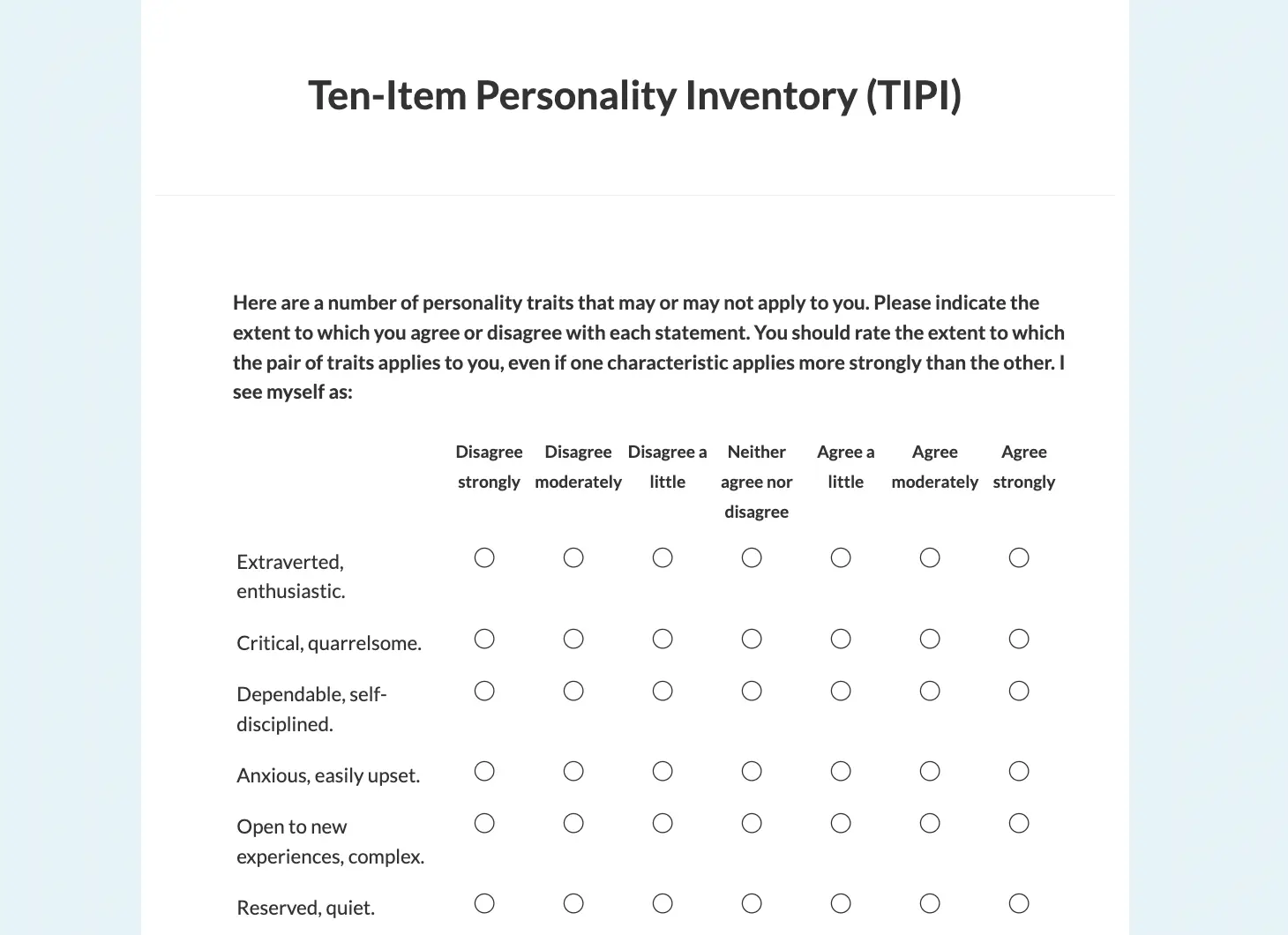

    Labvancedで実行されているTIPIツールのプレビュー.
    TIPI

    この研究ではTIPIを使用してビッグファイブ性格次元を測定します。回答は自動的に逆スコアされ、Labvanced内で5つの特性スコアに平均化されます。

    上記のカードをクリックして、Labvanced上での全項目リストや研究構造を確認してください。直接表示するにはInspectを使用するか、自分のアカウントに研究をコピーしてカスタマイズするにはImportを使用してください。


    スコアリングの概要

    各次元のスコアは、逆スコア後の2つの項目の平均値であり、1から7の範囲で5つの個別スコアが得られ、高いスコアは特性の多数を示します。スコアリングの鍵は、この5つのスコアのみを定義し、合計スコアはありません。

    完全なスコアリング手順と解釈については、TIPIスコアリングと解釈ガイドを参照してください。

    TIPIの心理測定特性

    • 信頼性: 180人の参加者を対象に約6週間のテスト再テスト相関は、外向性で.77、協調性で.71、誠実性で.76、感情的安定性で.70、経験への開放性で.62であり、平均は.72でした。ビッグファイブインベントリーの2週間の平均は.80でした(Gosling et al., 2003)。Cronbachのアルファは低く、.68、.40、.50、.73、.45であり、各尺度は広範な内容に基づいて選ばれた2項目のみを持っているため、重複がありません(Gosling et al., 2003)。
    • 妥当性: 18言語の27のTIPIバージョンに関するスコーピングレビューでは、受容可能なテスト再テスト信頼性、やや混合された収束的および構造的妥当性、不適切な内部一貫性が見つかり、調査の長さを短く保つ必要があるときの実行可能な妥協とTIPIが説明されました(Thørrisen & Sadeghi, 2023)。1,813人の学部生の元のサンプルでは、ビッグファイブインベントリーとの相関は、外向性で.87、協調性で.70、誠実性で.75、感情的安定性で.81、経験への開放性で.65でした(Gosling et al., 2003)。
    • 規範情報: 著者は、大規模なオンラインサンプルからの性別および年齢に基づく規範を公開しています(Gosling et al., 2014)。抜粋については、スコアリングと解釈ガイドを参照してください。著者のスコアリング資料にはカットオフやスコアカテゴリは示されていません。

    TIPIで収集されたデータ

    TIPIは、Labvanced内でアイテムレベルの応答と5つの計算された特性スコアを取得します。すべての変数は、研究のVariablesタブ内で表示およびカスタマイズできます。

    変数名説明
    Item 1 – Item 10各項目に対する参加者の生の応答、1(強く反対)から7(強く同意)まで
    Item 1 score – Item 10 score項目2、4、6、8、10の逆スコア後の項目スコア(8から応答を引いたもの)
    Extraversion Score, Agreeableness Score, Conscientiousness Score, Emotional Stability Score, Openness Score特性の2つの項目スコアの平均(範囲1-7)

    Labvancedで収集された10項目スコアのデータプレビュー.
    TIPIを使用してLabvancedで収集されたアイテムレベルのスコアデータのプレビューで、逆スコア後のすべての10項目スコアを示しています。

    Labvancedで収集された5つの計算された特性スコアのデータプレビュー.
    LabvancedでTIPIを使って収集された計算データのプレビューで、5つの特性スコアを示しています。


    TIPIをサポートする技術

    TIPIは自己報告式のツールですが、Labvancedは、アイテム応答自体を越えてより深い分析のために追加のデータストリームを研究に重ねることを可能にします。

    • 自動スコアリング、ノーコード設定: 5つの逆スコア項目の逆スコア化と、5つの特性スコアへの平均化は、Labvancedの質問票ページ構造内で自動的に処理され、手動計算は不要です。
    • マウストラッキングによる応答行動: 応答オプションに対するカーソルの動きは、参加者が性格項目を評価する際のためらいや優柔不断を示すことができ、選択された回答を超えた行動層を追加します。
    • ウェブカメラベースの視線追跡: 各項目を読み取り回答する際の視線パターンは、組み込みのコード不要のウェブカメラ視線追跡によりキャプチャでき、注意チェック分析や参加者がポジティブおよび逆スコア項目にどのように関与するかの研究に役立ちます。
    • 音声およびビデオ録画: セッションは、アイテム応答と並行して録画でき、研究者が性格評価中の参加者の行動の質的記録を求める際に便利です。
    • コントロールされた実施のためのデスクトップアプリ: TIPIをより大きなテストバッテリーの一部として実施するラボ環境では、Labvancedデスクトップアプリは、標準化されたオフライン対応の実施を専用のラボ内マシンでサポートします。
    Labvancedにおけるマウストラッキング機能を示すアイコン

    マウストラッキング

    標準的な質問票の回答に加えて、カーソルの動きと応答のためらいをキャプチャします。

    Labvancedにおけるウェブカメラ視線追跡機能を示すアイコン

    ウェブカメラ視線追跡

    組み込みのコード不要かつピアレビュー済みのウェブカメラ視線追跡を使用して、視線パターンと視覚的注意をキャプチャします。
    実験室での管理を制御するためのLabvancedデスクトップアプリを表すアイコン

    デスクトップアプリ

    ラボでのテストバッテリーに最適なデスクトップアプリを使用して、ラボ内の管理を制御して実行します。

    TIPIの管理オプション

    このツールはLabvancedでいくつかの方法で構成できます。

    • 標準質問票設定: 固定項目評価スケールとして、TIPIは標準のPage Frameを使用して構築されており、すべての10項目が上から下までの単一のマトリックスにリストされています。LabvancedでのPage Frames、質問オブジェクト、スコアリングの設定方法については、質問票実装ガイドを参照し、逆キー項目については逆スコアリングガイドをご覧ください。
    • 長い尺度の選択: 人格が研究の主な焦点である場合、より長い尺度は特性あたりのアイテムが増えます。Labvancedはまた、50項目のビッグファイブ性格テストも提供しています。
    • 多言語展開: TIPIの翻訳版は少なくとも18言語で存在し、それに伴う証拠はさまざまです(Thørrisen & Sadeghi, 2023)。Labvancedは多言語研究展開をサポートしており、ターゲット集団に合わせて翻訳版を構成することができます。

    以下のカードは、研究者がLabvancedで質問票を構築し、分析するさまざまな方法をカバーしています。固定のリッカートアイテムを超えて、画像、動画、音声刺激、ドラッグアンドドロップとスライダー方式のインタラクション、分岐ロジックとランダム化、リアルタイムフィードバックをサポートしています。レイアウトはキャンバス上で自由に配置でき、ページフレーム内で自動フローさせることができ、応答は自動的にスコアリングや逆スコアリングされ、各アイテムごとにタイミングを計ることができます。
    Labvancedの質問票と自己報告機能を表すアイコン

    質問票

    自動スコアリングとコードなしの設定で検証済みの自己報告機器を展開します。

    他に何か知りたいことがあれば、ぜひお気軽にご連絡ください:


    お問い合わせ

    TIPIの推奨使用と応用

    TIPIは、研究がビッグファイブの推定を必要としながら、人格測定の余地が少ない場合に使用されます。著者らは、非常に短い測定が必要な状況、人格が主要な興味の対象でない場合、または研究者が幾分心理測定特性が低下していることを許容できる場合に推奨しています(Gosling et al., 2003)。

    • 特定のグループへのオンライン調査: 22カ国からの593人のマルチマラソンランナーを対象にしたオンライン調査ではTIPIが使用され、その基準データが比較基準として使用され、一般人口に比べて高い誠実性と低い感情安定性が報告されました(Lundy et al., 2025)。
    • 大規模調査: ノルウェー語の翻訳が5,009人の修士卒業生を対象にテストされ、内部一貫性は許容可能と判断され、構造的妥当性は満足のいくものでした(Thørrisen et al., 2021)。
    • 言語間研究: 18歳から65歳までの333人の成人を対象にテストされたポルトガル語版は、アルファ係数が.39から.72、81人の参加者において4週間の再テスト相関が.71以上、ビッグファイブインベントリとの相関が.60以上であることが示されました(Nunes et al., 2018)。
    • 子供と青年向けの適応版: この年齢層のための適応版TIPI-CAは、2,428人のスペインの子供と青年において、比較的適切な心理測定特性を示しましたが、大人のTIPI版よりも識別的妥当性は弱いものでした(López-Fernández et al., 2025)。

    関連する認知タスクを探索する

    オルタナティブゲーム

    二人の経済ゲームにおける提案と拒否を通じて公平性と協力を測定します。6つの経済ゲームにおける770件の研究のメタ分析では、ビッグファイブの協調性がすべてのゲーム、包括的にオルタナティブゲームで弱くも正の相関を示しました(相関係数は.07から.16)(Thielmann et al., 2020)。

    遅延割引課題(DDT)

    人々が後で到着する報酬をどれだけ強く過小評価するかを測定します。5,888人のサンプルでは、より急峻な割引は低い開放性と誠実性、高い外向性と神経症によって予測されました(Mahalingam et al., 2014)が、その後の1,206人の成人の研究では神経症や誠実性との相関は見られませんでした(Yeh et al., 2021)。

    今すぐLabvancedに参加してTIPIを次のオンライン実験に追加しましょう。

    参考文献

    • Gosling, S. D. (n.d.-a). TIPIにおけるα信頼性と因子構造に関するメモ. 2026年11月4日取得, https://gosling.psy.utexas.edu/scales-weve-developed/ten-item-personality-measure-tipi/a-note-on-alpha-reliability-and-factor-structure-in-the-tipi/
    • Gosling, S. D. (n.d.-b). 十項目性格測定(TIPI). 2026年11月4日取得, https://gosling.psy.utexas.edu/scales-weve-developed/ten-item-personality-measure-tipi/
    • Gosling, S. D., Rentfrow, P. J., & Potter, J. (2014). 十項目性格インベントリの基準 [未発表データ].
    • Gosling, S. D., Rentfrow, P. J., & Swann, W. B., Jr. (2003). ビッグファイブ性格分野の非常に短い測定。 Journal of Research in Personality, 37, 504-528. https://doi.org/10.1016/S0092-6566(03)00046-1
    • López-Fernández, F. J., Pineda, D., Rivera-Riquelme, M., Lloret, D., & Piqueras, J. A. (2025). スペインのサンプルにおける子供と青年用の十項目性格インベントリ(TIPI-CA)の心理測定特性。 Current Issues in Personality Psychology, 13(1), 58-66. https://doi.org/10.5114/cipp/188360
    • Lundy, L., Reilly, R. B., Fleming, N., & Wilczyńska, D. (2025). マルチマラソンランナーの心理的特性を明らかにする:TIPI性格特性分析からの洞察。 PLoS ONE, 20(4), e0311647. https://doi.org/10.1371/journal.pone.0311647
    • Mahalingam, V., Stillwell, D., Kosinski, M., Rust, J., & Kogan, A. (2014). 誰が未来を待つことができるか?人格の視点から。 Social Psychological and Personality Science, 5(5), 573-583. https://doi.org/10.1177/1948550613515007
    • Nunes, A., Limpo, T., Lima, C. F., & Castro, S. L. (2018). 性格特性の評価のための短い尺度:ポルトガルの十項目性格インベントリ(TIPI)の開発と検証。 Frontiers in Psychology, 9, 461. https://doi.org/10.3389/fpsyg.2018.00461
    • Thielmann, I., Spadaro, G., & Balliet, D. (2020). 人格と親社会的行動:理論的枠組みとメタ分析。 Psychological Bulletin, 146(1), 30-90. https://doi.org/10.1037/bul0000217
    • Thørrisen, M. M., & Sadeghi, T. (2023). 十項目性格インベントリ(TIPI):バージョン、翻訳、心理測定特性のスコーピングレビュー。 Frontiers in Psychology, 14, 1202953. https://doi.org/10.3389/fpsyg.2023.1202953
    • Thørrisen, M. M., Sadeghi, T., & Wiers-Jenssen, J. (2021). 十項目性格インベントリのノルウェー語翻訳の内部一貫性と構造的妥当性。 Frontiers in Psychology, 12, 723852. https://doi.org/10.3389/fpsyg.2021.723852
    • Yeh, Y. H., Myerson, J., & Green, L. (2021). 遅延割引、認知能力、人格:何が重要か? Psychonomic Bulletin & Review, 28(2), 686-694.

