labvanced logoLabVanced
Contact
    • Remote Physiological Measurements
    • Eye Tracking
    • Head & Face-Tracking
    • Emotion Detection
    • Heart Rate Detection (rPPG)
    • Generative AI
    • Audio Transcription
    • EEG & Hardware Integrations
    • Decision Making
    • Reaction Times
    • Keyboard Inputs
    • Mouse Tracking
    • Mobile / Touch
    • Questionnaires
    • Gamepad / Joystick Integration
    • Audio Recordings
    • Audio Transcription
    • Video Recordings
    • Screen Recordings
    • Photos / Snapshots
    • Video Conferencing
    • Canvas Drawings
    • Build with AI
    • Build with Spreadsheets
    • Using the Experiment Editor
    • Coding
    • Creating Questionnaires
    • Balancing & Randomization
    • UX & Website Testing
    • Single Session Studies
    • Factorial Designs
    • Longitudinal & Multi-session Studies
    • Individual & Case Studies
    • Real-time Multi-user Studies
    • Interviews & Video Calls
    • Surveys & Questionnaires
    • Experience Sampling & Diaries
    • Classroom & Group Testing
    • Interventions & Clinical Trials
    • In the Browser
    • Mobile App
    • Desktop App
    • WebBridge Chrome Extension
    • Stroop Test
    • Flanker Task
    • N-back Task
    • Implicit Association Test
    • Trail Making Test
    • Digit Span
    • Corsi Block Tapping
    • Tower of London
    • Balloon Analog Risk Task
    • Preferential Looking
    • Browse more →
    • DASS-21
    • GAD-7
    • Rosenberg Self-Esteem Scale
    • PHQ-9
    • Ten-Item Personality Inventory
    • Big Five Personality Test
    • Adult ADHD Self-Report Scale
    • Browse more →
    • Building a Multi-user Study
    • Webcam Eye Tracking with AOIs
    • Website Frame Eye Tracking
    • Conditional Eye Tracking Opt-in
    • ChatGPT Study
    • Desktop App Study with EEG
    • Between-subjects Group Balancing
    • Building a Reading Study
    • Stroop Task
    • Lexical Decision Task
    • Browse more →
    Public Experiment Library
    • Arts Research
    • Clinical Psychology & Neuropsychology Medicine
    • Cognitive Psychology
    • Developmental Psychology
    • Behavioral Economics & Decision Science
    • Educational Research & Psychology
    • HCI & Human Factors
    • Linguistics & Language Sciences
    • Consumer & Marketing Research
    • Social & Personality Psychology
    • Sport & Movement Science
    • UX & Website Testing
    • Executive Functions
    • Language & Reading
    • Decision-Making & Reasoning
    • Attention
    • Overview
    • HCI & Human Factors
    • UX & Website Testing
    • Consumer & Marketing Research
    • White-Label App
    • PageGazer
    • Webcam vs. Lab Eye Tracking in InfantsAnna Banki & Gabriela Markova
    • Eye Tracking for Influencer MarketingDr. Alexander Edeling
    • Eye Tracking Infant Word ComprehensionDr. Giulia Calignano
    • Sentence Reading and Grammar JudgmentsDr. Jonathan Mirault
    • Regulating Emotions with MusicDr. Katrin Starcke
    • Game-Based Grammar Learning in ChildrenDr. Mireia Marimon
    • Gaze Cueing and AutismMax Soares Miehstein
    • Personality and Hearing in NoiseDr. Malte Wöstmann
    • All interviews →
    • Lab Notes
    • How to Cite Labvanced
    • Labvanced Platform Paper (2017)
    • Webcam Eye Tracking Validation (2024)
    • Webcam Eye Tracking Studies
    • Cognitive Psychology Studies
    • Developmental Psychology Studies
    • Linguistics Studies
    • See all publications →
    • Getting Started
    • Guide
    • Video Tutorials
    • Walkthroughs
    • Live Chat
    • Webinars & Onboarding Calls
    • AI Assistant
    • FAQ
    • Importing Templates Guide
    • Test Templates
    • Live Eye Tracking Metrics
    • Mouse Tracking Demo
    • ChatGPT Demo
    • Audio Recording Object Demo
    • Adding Image Stimuli Demo
    • Score & Feedback Demo
    • Browse all technical demos →
    • Timing Precision
    • Stimuli Presentation
    • Headphone Checks
    • Bot Checks
    • Participant Management
    • Comparisons
    • Research Blog
    • Prolific Integration
    • CloudResearch Integration
    • Sona Systems Integration
    • BeSample Integration
    • Panelabs Integration
    • Clickworker Integration
    • Labvanced Webhook API
    • Labvanced REST API
    • About Us
    • Newsletter Archive
    • Terms & Conditions
    • Data Security & Data Privacy
    • Technical & Organisational Measures
    • Accessibility
    • W-8BEN-E Form
    • Data Processing Agreement Template
    LinkedInYouTubeDiscord
    • Individual
    • Lab
    • Department / Consortium
    • Teaching
    • Campus
    • Commercial
    Top-Ups
    • Overview
    • Study Building
    • Subject Recruitment
    • Dedicated Support
    Checkout
  • Contact
    • ZH
      • 中國人
      • Deutsch
      • Français
      • Español
      • English
      • 日本語
    • Appgo to app icon
    • Loginlogin icon
    Platform
    Labvanced makes it easy to implement the most advanced study design and reliably collect your data.
    Biosignals & AI
    Remote Physiological MeasurementsEye TrackingHead & Face-TrackingEmotion DetectionHeart Rate Detection (rPPG)Generative AIAudio TranscriptionEEG & Hardware Integrations
    Behavioral Recordings
    Decision MakingReaction TimesKeyboard InputsMouse TrackingMobile / TouchQuestionnairesGamepad / Joystick Integration
    Media Recordings
    Audio RecordingsAudio TranscriptionVideo RecordingsScreen RecordingsPhotos / SnapshotsVideo ConferencingCanvas Drawings
    Implementation Techniques
    Build with AIBuild with SpreadsheetsUsing the Experiment EditorCodingCreating QuestionnairesBalancing & RandomizationUX & Website Testing
    Study Formats

    Your study can take whatever format your research needs. Here are a few popular examples.

    Single Session StudiesFactorial DesignsLongitudinal & Multi-session StudiesIndividual & Case StudiesReal-time Multi-user StudiesInterviews & Video CallsSurveys & QuestionnairesExperience Sampling & DiariesClassroom & Group TestingInterventions & Clinical Trials
    Where Studies Run

    Run your study online in the browser, on mobile or tablet with the mobile app, or in-lab with the desktop app.

    In the BrowserMobile AppDesktop AppWebBridge Chrome Extension
    Tests
    Explore cognitive tests, questionnaires, walkthroughs, and our public experiment library: a starting point for your next study.
    Popular Cognitive Tests
    Stroop TestFlanker TaskN-back TaskImplicit Association TestTrail Making TestDigit SpanCorsi Block TappingTower of LondonBalloon Analog Risk TaskPreferential Looking
    Browse more →
    Questionnaires & Scales
    DASS-21GAD-7Rosenberg Self-Esteem ScalePHQ-9Ten-Item Personality InventoryBig Five Personality TestAdult ADHD Self-Report Scale
    Browse more →
    Public Experiment Library

    Take a look at what other researchers in the community are doing through our extensive, open catalog of shared studies.

    Open the public library →
    Walkthroughs

    Step-by-step builds of complete studies, from a blank project to a running experiment, that you can follow along or adapt.

    Building a Multi-user StudyWebcam Eye Tracking with AOIsWebsite Frame Eye TrackingConditional Eye Tracking Opt-inChatGPT StudyDesktop App Study with EEGBetween-subjects Group BalancingBuilding a Reading StudyStroop TaskLexical Decision Task
    Browse more →
    Research
    One platform for students, academics, and industry researchers studying human behavior.
    Harvard UniversityStanford UniversityCambridge UniversityUCLNYUMax Planck InstituteUCLATU Munich

    Trusted by researchers at 1,500+ universities worldwide

    Academic Research
    Arts ResearchClinical Psychology & Neuropsychology MedicineCognitive PsychologyDevelopmental PsychologyBehavioral Economics & Decision ScienceEducational Research & PsychologyHCI & Human FactorsLinguistics & Language SciencesConsumer & Marketing ResearchSocial & Personality PsychologySport & Movement ScienceUX & Website Testing
    Research Areas
    Executive FunctionsLanguage & ReadingDecision-Making & ReasoningAttention
    Industry / Commercial
    OverviewHCI & Human FactorsUX & Website TestingConsumer & Marketing ResearchWhite-Label AppPageGazer
    Researcher Interviews

    Conversations with researchers about the studies they ran with Labvanced, what worked, and what they learned.

    Webcam vs. Lab Eye Tracking in InfantsAnna Banki & Gabriela MarkovaEye Tracking for Influencer MarketingDr. Alexander EdelingEye Tracking Infant Word ComprehensionDr. Giulia CalignanoSentence Reading and Grammar JudgmentsDr. Jonathan MiraultRegulating Emotions with MusicDr. Katrin StarckeGame-Based Grammar Learning in ChildrenDr. Mireia MarimonGaze Cueing and AutismMax Soares MiehsteinPersonality and Hearing in NoiseDr. Malte Wöstmann
    All interviews →
    Our Research
    Lab NotesHow to Cite Labvanced
    Peer Reviewed Studies

    A selection of peer-reviewed work built on Labvanced: our own platform and validation papers, and studies by the research community grouped by area. Hundreds more are listed on the full publications page.

    Labvanced Platform Paper (2017)Webcam Eye Tracking Validation (2024)Webcam Eye Tracking StudiesCognitive Psychology StudiesDevelopmental Psychology StudiesLinguistics Studies
    See all publications →
    Resources
    Valuable resources to help you learn the platform, stay updated, and more.
    Documentation
    Getting StartedGuideVideo TutorialsWalkthroughs
    Support
    Live ChatWebinars & Onboarding CallsAI AssistantFAQ
    Templates & Demos

    These are a few popular examples. Browse our guide and a selection of technical demos to get started with implementation.

    Importing Templates GuideTest TemplatesLive Eye Tracking MetricsMouse Tracking DemoChatGPT DemoAudio Recording Object DemoAdding Image Stimuli DemoScore & Feedback Demo
    Browse all technical demos →
    Methodology
    Timing PrecisionStimuli PresentationHeadphone ChecksBot ChecksParticipant ManagementComparisonsResearch Blog
    Integrations & APIs
    Prolific IntegrationCloudResearch IntegrationSona Systems IntegrationBeSample IntegrationPanelabs IntegrationClickworker IntegrationLabvanced Webhook APILabvanced REST API
    Company & Legal
    About UsNewsletter ArchiveTerms & ConditionsData Security & Data PrivacyTechnical & Organisational MeasuresAccessibilityW-8BEN-E FormData Processing Agreement Template
    LinkedInYouTubeDiscord
    Pricing
    Our licenses and additional services at a glance.
    Licenses
    IndividualLabDepartment / ConsortiumTeachingCampusCommercial
    Top-Ups

    Need more recordings for your lab or your own research? Simply use one of these recording top-up packages.

    Browse top-up packages →
    Additional Services

    Hire Labvanced’s expert team to quickly bring your project to the level of rigor it needs.

    OverviewStudy BuildingSubject RecruitmentDedicated Support
    Checkout

    Ready to purchase a license or top-up? Head straight to checkout.

    Go to checkout →
    • 中國人
    • Deutsch
    • Français
    • Español
    • English
    • 日本語
    佩戴EEG电极的头部旁边有一个信号监视器,标题为EEG和硬件集成

    EEG & 硬件集成

    Labvanced通过两种方式连接到EEG和其他实验室硬件,两者都可以承载Lab Streaming Layer(LSL)标记,这是一个用于时间同步数据流的开放标准。桌面应用程序内置了LSL,因此研究可以在每个刺激、反应或条件变化时发送标记,并接收来自其他设备的标记。

    WebSocket API将研究连接到同一台计算机上的脚本。该脚本可以为在其他地方运行的研究桥接LSL标记的双向传输,也可以连接不使用LSL的设备。


    目录

    • 两种连接方式
    • 桌面应用中的内置LSL
    • 与WebSocket API的LSL桥接和其他设备
    • 远程和实验室参与者的单一研究
    • 您可以连接的硬件示例
    • 热门研究应用

    两种连接方式

    EEG记录只有在记录系统知道每个刺激出现的时间和参与者所做的事情时才可解释,标记提供了这些信息。两种方式都可以传递LSL标记。它们的区别在于研究运行的位置和涉及的设备。

    连接最佳时机
    桌面应用中的内置LSL研究在实验室计算机上离线运行,靠近EEG或传感器记录仪。LSL标记通过事件编辑器中的操作和触发器发送和接收,无需编码。请参见 桌面应用。
    带脚本的WebSocket API研究连接到同一计算机上的脚本,在Linux、macOS或Windows上。该脚本可以双向桥接LSL标记,因此不在桌面应用中运行的研究仍然可以到达LSL记录仪。它还可以与不使用LSL的设备进行通信,并且适合闭环设置、生物反馈或将数据发送到另一个服务器。请参见WebSocket API指南。

    桌面应用中的内置LSL

    在桌面应用中,LSL是内置的:标记通过您在研究设置中定义的LSL流发送,无需任何代码。

    从您的研究发送标记

    您在研究设置中激活Lab-Streaming-Layer,并定义一个或多个输出流,每个流都有名称、频道格式和频道数量。一个Send LabStreamingLayer Marker操作然后将一个值发送到所选流,例如当前试验的条件或参与者点击刺激的时刻。频道格式包括字符串、32位和64位浮点数,以及8、16和32位整数。默认情况下,标记携带当前时间,当事件时间从其他地方已知时,可以提供自定义时间戳。
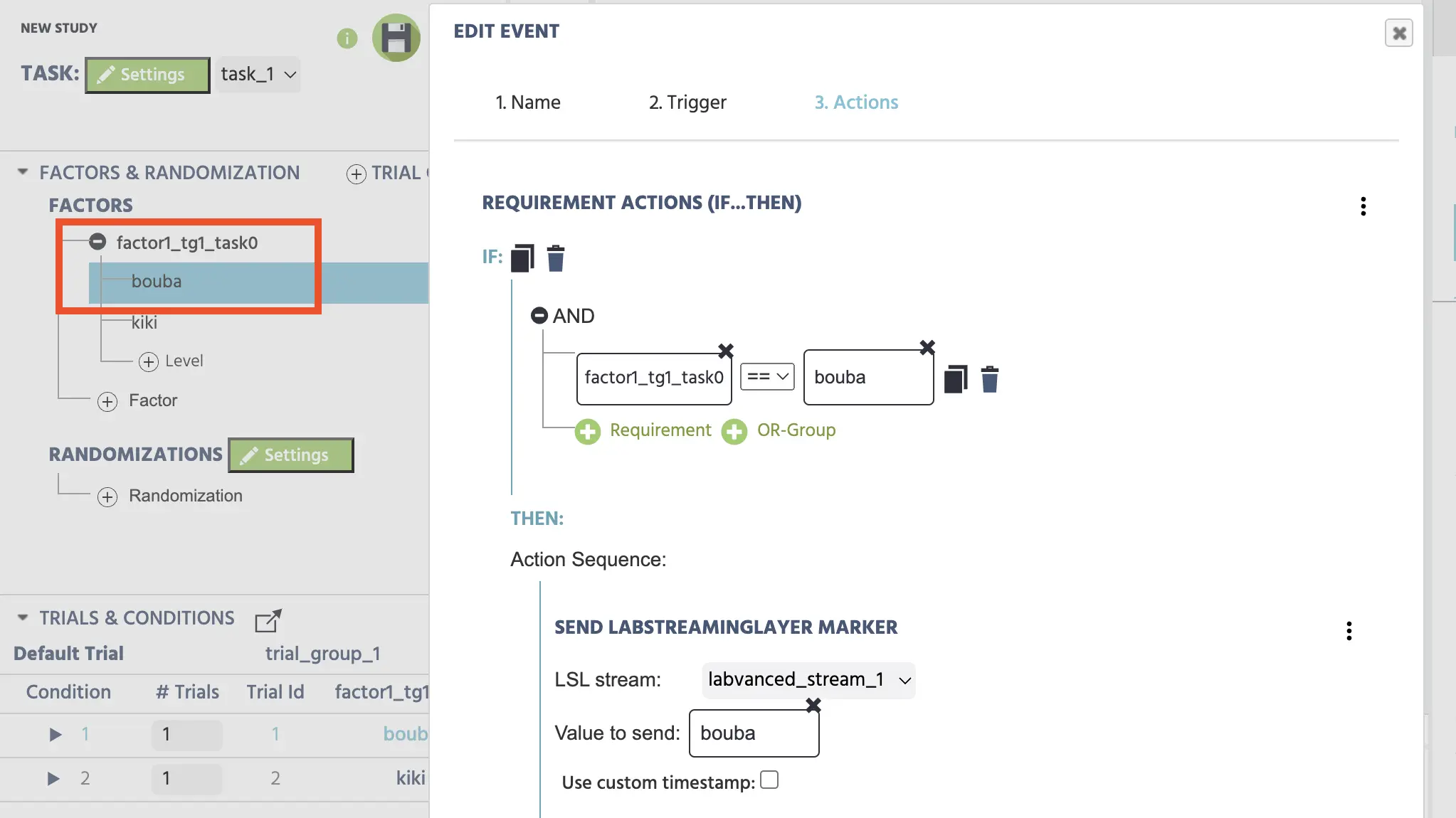
    在Labvanced事件编辑器中的发送LabStreamingLayer标记操作,当试验因子等于bouba时发送值bouba
    根据刺激的条件指定LSL标记,这里是Bouba-Kiki研究的bouba类别。
    在BrainVision LSL Viewer中的EEG记录,其中在信号底部高亮显示了在Labvanced中创建的两个标记
    在Labvanced中创建的标记基于类型和点击条件出现在EEG记录的底部。

    从其他设备接收标记

    Received LSL Marker触发器在输入流上接收到标记时开始一个事件。该事件可以读取接收到的值以及LSL时间戳和时钟校正,以便研究可以对来自其他设备的信号做出反应,并将其与自己的时间线相关联。

    内置LSL的帮助文档

    • Lab-Streaming-Layer设置
    • 带EEG集成的桌面应用研究演示

    与WebSocket API的LSL桥接和其他设备

    WebSocket API将研究连接到同一台计算机上运行的脚本。对于LSL,示例脚本从Labvanced发送标记并接收标记,使得相同的标记在没有内置LSL支持的情况下到达记录仪,在Linux、macOS或Windows上。对于没有LSL支持的设备,脚本直接与设备通信。一个Send To Websocket操作将事件或值从您的研究发送到脚本,而一个Websocket Trigger在脚本返回消息时启动一个事件,因此任何具有可编程接口的设备都可以实时交换触发器和数据与研究。

    下面的示例使用这种方式在一个会话中同时记录硬件眼球追踪仪和Labvanced网络摄像头的眼动追踪。
    眼睛的插图

    通过WebSocket连接的Tobii眼球追踪仪5示例

    在GitHub上的实验示例脚本,记录Tobii眼球追踪仪5和Labvanced网络摄像头的眼动追踪。

    WebSocket方法的帮助文档

    • WebSocket API指南
    • GitHub上的LSL标记脚本
    • 库研究: 发送标记和接收标记

    远程和实验室参与者的单一研究

    一些实验具有双部分结构:一大组参与者远程参与,而一小组参与者进入实验室,在佩戴EEG设备的情况下进行相同的实验。同一个Labvanced研究可以服务这两个组,因此不必重复构建和编程。例如,可能在实验室录制50名参与者的EEG,同时还有400名参与者在线参与,都是在同一研究中进行的。请参见桌面应用以离线运行实验室部分。


    您可以连接的硬件示例

    任何支持LSL的设备都可以与Labvanced研究交换数据,以下是常见示例。

    硬件对研究的补充
    EEG从您的实验中记录的事件标记与EEG信号共同进行事件相关分析,适用于任何与LSL兼容的EEG系统。有关示例,请参见EEG集成演示,使用的是Muse 2耳机。
    GSR和其他传感器皮肤电导或其他生理信号与相同事件标记对齐。
    硬件眼球追踪仪来自专用眼球追踪仪的凝视录音与研究的事件同步。
    运动传感器和可穿戴设备在同一会话中记录来自传感器和可穿戴设备的运动数据。

    当没有额外的硬件可用时,还可以通过参与者的网络摄像头记录注视、面部情绪和心率。
    代表Labvanced中远程生理测量的图标

    远程生理测量

    通过一个网络摄像头进行注视、情绪检测和心率检测。

    代表Labvanced桌面应用程序的图标

    桌面应用程序

    在实验室离线运行研究并连接外部设备。

    代表技术演示页面的图标

    技术演示

    发送和接收LSL标记的演示研究。

    Questions about your study design or platform fit?

    Book a Call Write to Us

    流行的研究应用

    以下是硬件同步研究的流行应用:

    • 认知心理学: 事件相关的EEG研究标记每个刺激的开始和参与者的反应,以便根据条件对信号进行分段。演示发送基于刺激种类和点击的标记,这是典型的模式。请参见 认知心理学。
    • 临床研究: 行为任务可以与生理信号在同一会话中记录,使每个任务事件在生理记录中有一个位置。当参与者无法到实验室时,提供基于网络摄像头的选项。请参见 临床心理学。
    • 语言学: 阅读和听力研究可以在每个单词、句子或声音开始时发送标记。标记将刺激时间线与EEG信号对齐。请参见 语言学。
    • 运动与运动研究: 运动传感器和可穿戴设备可以与任务事件同时记录,因此运动数据与任务在同一会话中。请参见 运动心理学。
    使用Labvanced进行的认知心理学研究

    认知心理学

    带有刺激标记的事件相关EEG。

    使用Labvanced进行的临床心理学研究

    临床心理学

    与生理信号一起记录的任务。

    使用Labvanced进行的语言学研究

    语言学

    单词和句子的开始标记。

    使用Labvanced进行的运动心理学研究

    运动心理学

    与任务事件一起的运动传感器。


    常见问题

    我可以将哪些硬件连接到Labvanced研究中?
    任何支持Lab Streaming Layer的设备,包括EEG系统、GSR传感器、硬件眼动仪、运动传感器和可穿戴设备。没有LSL支持的设备可以通过WebSocket API连接。
    我需要编写代码来发送标记吗?
    不需要。在桌面应用程序中,可以通过事件编辑器中的操作发送标记,并通过触发器接收。WebSocket路由使用与研究并行运行的Python脚本。
    我可以在浏览器研究中使用LSL吗?
    内置的LSL在桌面应用程序中运行。对于在其他地方运行的研究,WebSocket API可以用示例Python脚本在Linux、macOS或Windows中双向桥接LSL标记。
    标记时间是如何设置的?
    默认情况下,一个标记会随当前时间发送,当事件时间从其他地方已知时,可以提供自定义时间戳。有关Labvanced如何处理刺激时机,请参见 时机精度。
    标记可以包含什么?
    标记携带一种或多种值,格式为流的通道格式:字符串、8位、16位或32位整数,或32位或64位浮点数。除非提供自定义时间戳,否则它会随当前时间发送。

    进一步阅读

    代表Labvanced桌面应用程序的图标

    桌面应用程序

    在实验室离线运行研究并连接外部设备。

    代表Labvanced中远程生理测量的图标

    远程生理测量

    通过一个网络摄像头进行注视、情绪检测和心率检测。

    代表Labvanced中时机精度的图标

    时机精度

    毫秒精确的刺激时机和反应测量。


    Questions about your study design or platform fit?

    Book a Call Write to Us