labvanced logoLabVanced
Contact
    • Remote Physiological Measurements
    • Eye Tracking
    • Head & Face-Tracking
    • Emotion Detection
    • Heart Rate Detection (rPPG)
    • Generative AI
    • Audio Transcription
    • EEG & Hardware Integrations
    • Decision Making
    • Reaction Times
    • Keyboard Inputs
    • Mouse Tracking
    • Mobile / Touch
    • Questionnaires
    • Gamepad / Joystick Integration
    • Audio Recordings
    • Audio Transcription
    • Video Recordings
    • Screen Recordings
    • Photos / Snapshots
    • Video Conferencing
    • Canvas Drawings
    • Build with AI
    • Build with Spreadsheets
    • Using the Experiment Editor
    • Coding
    • Creating Questionnaires
    • Balancing & Randomization
    • UX & Website Testing
    • Single Session Studies
    • Factorial Designs
    • Longitudinal & Multi-session Studies
    • Individual & Case Studies
    • Real-time Multi-user Studies
    • Interviews & Video Calls
    • Surveys & Questionnaires
    • Experience Sampling & Diaries
    • Classroom & Group Testing
    • Interventions & Clinical Trials
    • In the Browser
    • Mobile App
    • Desktop App
    • WebBridge Chrome Extension
    • Stroop Test
    • Flanker Task
    • N-back Task
    • Implicit Association Test
    • Trail Making Test
    • Digit Span
    • Corsi Block Tapping
    • Tower of London
    • Balloon Analog Risk Task
    • Preferential Looking
    • Browse more →
    • DASS-21
    • GAD-7
    • Rosenberg Self-Esteem Scale
    • PHQ-9
    • Ten-Item Personality Inventory
    • Big Five Personality Test
    • Adult ADHD Self-Report Scale
    • Browse more →
    • Building a Multi-user Study
    • Webcam Eye Tracking with AOIs
    • Website Frame Eye Tracking
    • Conditional Eye Tracking Opt-in
    • ChatGPT Study
    • Desktop App Study with EEG
    • Between-subjects Group Balancing
    • Building a Reading Study
    • Stroop Task
    • Lexical Decision Task
    • Browse more →
    Public Experiment Library
    • Arts Research
    • Clinical Psychology & Neuropsychology Medicine
    • Cognitive Psychology
    • Developmental Psychology
    • Behavioral Economics & Decision Science
    • Educational Research & Psychology
    • HCI & Human Factors
    • Linguistics & Language Sciences
    • Consumer & Marketing Research
    • Social & Personality Psychology
    • Sport & Movement Science
    • UX & Website Testing
    • Executive Functions
    • Language & Reading
    • Decision-Making & Reasoning
    • Attention
    • Overview
    • HCI & Human Factors
    • UX & Website Testing
    • Consumer & Marketing Research
    • White-Label App
    • PageGazer
    • Webcam vs. Lab Eye Tracking in InfantsAnna Banki & Gabriela Markova
    • Eye Tracking for Influencer MarketingDr. Alexander Edeling
    • Eye Tracking Infant Word ComprehensionDr. Giulia Calignano
    • Sentence Reading and Grammar JudgmentsDr. Jonathan Mirault
    • Regulating Emotions with MusicDr. Katrin Starcke
    • Game-Based Grammar Learning in ChildrenDr. Mireia Marimon
    • Gaze Cueing and AutismMax Soares Miehstein
    • Personality and Hearing in NoiseDr. Malte Wöstmann
    • All interviews →
    • Lab Notes
    • How to Cite Labvanced
    • Labvanced Platform Paper (2017)
    • Webcam Eye Tracking Validation (2024)
    • Webcam Eye Tracking Studies
    • Cognitive Psychology Studies
    • Developmental Psychology Studies
    • Linguistics Studies
    • See all publications →
    • Getting Started
    • Guide
    • Video Tutorials
    • Walkthroughs
    • Live Chat
    • Webinars & Onboarding Calls
    • AI Assistant
    • FAQ
    • Importing Templates Guide
    • Test Templates
    • Live Eye Tracking Metrics
    • Mouse Tracking Demo
    • ChatGPT Demo
    • Audio Recording Object Demo
    • Adding Image Stimuli Demo
    • Score & Feedback Demo
    • Browse all technical demos →
    • Timing Precision
    • Stimuli Presentation
    • Headphone Checks
    • Bot Checks
    • Participant Management
    • Comparisons
    • Research Blog
    • Prolific Integration
    • CloudResearch Integration
    • Sona Systems Integration
    • BeSample Integration
    • Panelabs Integration
    • Clickworker Integration
    • Labvanced Webhook API
    • Labvanced REST API
    • About Us
    • Newsletter Archive
    • Terms & Conditions
    • Data Security & Data Privacy
    • Technical & Organisational Measures
    • Accessibility
    • W-8BEN-E Form
    • Data Processing Agreement Template
    LinkedInYouTubeDiscord
    • Individual
    • Lab
    • Department / Consortium
    • Teaching
    • Campus
    • Commercial
    • Browse recording top-ups →
    • Browse AI token top-ups →
    • Overview
    • Study Building
    • Subject Recruitment
    • Dedicated Support
    Checkout
  • Contact
    • EN
      • 中國人
      • Deutsch
      • Français
      • Español
      • English
      • 日本語
    • Logout
    • Loginlogin icon
    Platform
    Labvanced makes it easy to implement the most advanced study design and reliably collect your data.
    Biosignals & AI
    Remote Physiological MeasurementsEye TrackingHead & Face-TrackingEmotion DetectionHeart Rate Detection (rPPG)Generative AIAudio TranscriptionEEG & Hardware Integrations
    Behavioral Recordings
    Decision MakingReaction TimesKeyboard InputsMouse TrackingMobile / TouchQuestionnairesGamepad / Joystick Integration
    Media Recordings
    Audio RecordingsAudio TranscriptionVideo RecordingsScreen RecordingsPhotos / SnapshotsVideo ConferencingCanvas Drawings
    Implementation Techniques
    Build with AIBuild with SpreadsheetsUsing the Experiment EditorCodingCreating QuestionnairesBalancing & RandomizationUX & Website Testing
    Study Formats

    Your study can take whatever format your research needs. Here are a few popular examples.

    Single Session StudiesFactorial DesignsLongitudinal & Multi-session StudiesIndividual & Case StudiesReal-time Multi-user StudiesInterviews & Video CallsSurveys & QuestionnairesExperience Sampling & DiariesClassroom & Group TestingInterventions & Clinical Trials
    Where Studies Run

    Run your study online in the browser, on mobile or tablet with the mobile app, or in-lab with the desktop app.

    In the BrowserMobile AppDesktop AppWebBridge Chrome Extension
    Tests
    Explore cognitive tests, questionnaires, walkthroughs, and our public experiment library: a starting point for your next study.
    Popular Cognitive Tests
    Stroop TestFlanker TaskN-back TaskImplicit Association TestTrail Making TestDigit SpanCorsi Block TappingTower of LondonBalloon Analog Risk TaskPreferential Looking
    Browse more →
    Questionnaires & Scales
    DASS-21GAD-7Rosenberg Self-Esteem ScalePHQ-9Ten-Item Personality InventoryBig Five Personality TestAdult ADHD Self-Report Scale
    Browse more →
    Public Experiment Library

    Take a look at what other researchers in the community are doing through our extensive, open catalog of shared studies.

    Open the public library →
    Walkthroughs

    Step-by-step builds of complete studies, from a blank project to a running experiment, that you can follow along or adapt.

    Building a Multi-user StudyWebcam Eye Tracking with AOIsWebsite Frame Eye TrackingConditional Eye Tracking Opt-inChatGPT StudyDesktop App Study with EEGBetween-subjects Group BalancingBuilding a Reading StudyStroop TaskLexical Decision Task
    Browse more →
    Research
    One platform for students, academics, and industry researchers studying human behavior.
    Harvard UniversityStanford UniversityCambridge UniversityUCLNYUMax Planck InstituteUCLATU Munich

    Trusted by researchers at 1,500+ universities worldwide

    Academic Research
    Arts ResearchClinical Psychology & Neuropsychology MedicineCognitive PsychologyDevelopmental PsychologyBehavioral Economics & Decision ScienceEducational Research & PsychologyHCI & Human FactorsLinguistics & Language SciencesConsumer & Marketing ResearchSocial & Personality PsychologySport & Movement ScienceUX & Website Testing
    Research Areas
    Executive FunctionsLanguage & ReadingDecision-Making & ReasoningAttention
    Industry / Commercial
    OverviewHCI & Human FactorsUX & Website TestingConsumer & Marketing ResearchWhite-Label AppPageGazer
    Researcher Interviews

    Conversations with researchers about the studies they ran with Labvanced, what worked, and what they learned.

    Webcam vs. Lab Eye Tracking in InfantsAnna Banki & Gabriela MarkovaEye Tracking for Influencer MarketingDr. Alexander EdelingEye Tracking Infant Word ComprehensionDr. Giulia CalignanoSentence Reading and Grammar JudgmentsDr. Jonathan MiraultRegulating Emotions with MusicDr. Katrin StarckeGame-Based Grammar Learning in ChildrenDr. Mireia MarimonGaze Cueing and AutismMax Soares MiehsteinPersonality and Hearing in NoiseDr. Malte Wöstmann
    All interviews →
    Our Research
    Lab NotesHow to Cite Labvanced
    Peer Reviewed Studies

    A selection of peer-reviewed work built on Labvanced: our own platform and validation papers, and studies by the research community grouped by area. Hundreds more are listed on the full publications page.

    Labvanced Platform Paper (2017)Webcam Eye Tracking Validation (2024)Webcam Eye Tracking StudiesCognitive Psychology StudiesDevelopmental Psychology StudiesLinguistics Studies
    See all publications →
    Resources
    Valuable resources to help you learn the platform, stay updated, and more.
    Documentation
    Getting StartedGuideVideo TutorialsWalkthroughs
    Support
    Live ChatWebinars & Onboarding CallsAI AssistantFAQ
    Templates & Demos

    These are a few popular examples. Browse our guide and a selection of technical demos to get started with implementation.

    Importing Templates GuideTest TemplatesLive Eye Tracking MetricsMouse Tracking DemoChatGPT DemoAudio Recording Object DemoAdding Image Stimuli DemoScore & Feedback Demo
    Browse all technical demos →
    Methodology
    Timing PrecisionStimuli PresentationHeadphone ChecksBot ChecksParticipant ManagementComparisonsResearch Blog
    Integrations & APIs
    Prolific IntegrationCloudResearch IntegrationSona Systems IntegrationBeSample IntegrationPanelabs IntegrationClickworker IntegrationLabvanced Webhook APILabvanced REST API
    Company & Legal
    About UsNewsletter ArchiveTerms & ConditionsData Security & Data PrivacyTechnical & Organisational MeasuresAccessibilityW-8BEN-E FormData Processing Agreement Template
    LinkedInYouTubeDiscord
    Pricing
    Our licenses and additional services at a glance.
    Licenses
    IndividualLabDepartment / ConsortiumTeachingCampusCommercial
    Top-Ups

    Need more recordings for your lab or your own research? Simply use one of these recording top-up packages.

    Browse recording top-ups →

    Need more AI tokens for the AI assistant and study translations? Simply use one of these AI token top-up packages.

    Browse AI token top-ups →
    Additional Services

    Hire Labvanced’s expert team to quickly bring your project to the level of rigor it needs.

    OverviewStudy BuildingSubject RecruitmentDedicated Support
    Checkout

    Ready to purchase a license or top-up? Head straight to checkout.

    Go to checkout →
    • 中國人
    • Deutsch
    • Français
    • Español
    • English
    • 日本語
    Trials of the Dual Lexical Decision Task

    Dual Lexical Decision Task (DLDT)

    The Dual Lexical Decision Task is a fast paced assessment that measures word recognition, reading fluency, and automatic language processing. Participants judge whether presented stimuli are real words or nonwords. This task is widely used in psycholinguistics, cognitive psychology, and language proficiency research.

    Table of Contents

    • Task Format
    • Data Collected
    • Technology
    • Customization
    • Recommended Use

    Task Structure of the Dual Lexical Decision Task

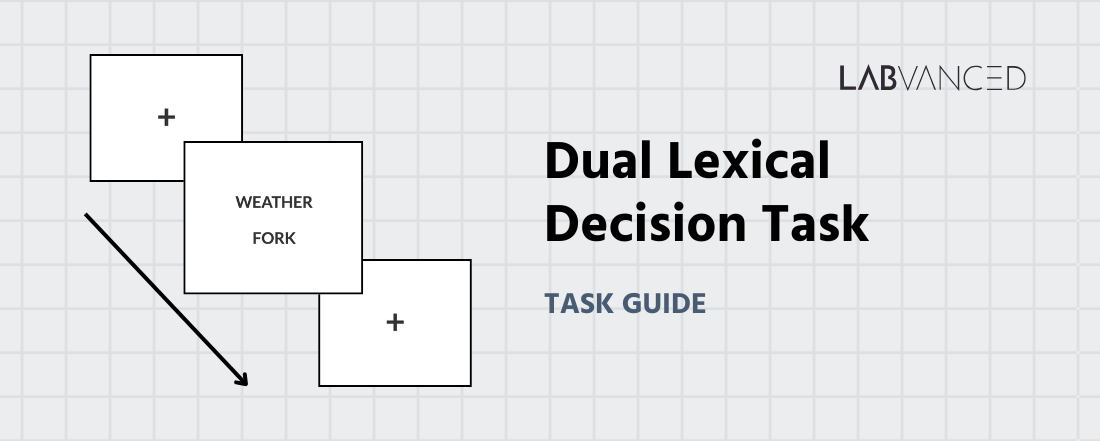
    In the Dual Lexical Decision Task (DLDT), two letter sequences appear on the screen at the same time. The participant’s goal is to decide whether both sequences are real English words or whether one or both are not. Each session begins with a short training block where participants receive feedback so they can become familiar with the response rules.


    Test it out!

    Two versions of the task are available, each optimized for the type of device and input method being used:

    Desktop Version

    In the desktop version, participants view two letter sequences arranged vertically, with one word on top and the other below it. Responses are made using the A and L keys, which correspond to the two judgment options: both sequences are real English words or when at least one sequence is not. The task includes balanced key assignments so that each response option is paired with both keys across participants, helping control for key-press biases and motor tendencies.

    Mobile Version

    The mobile version is optimized for touchscreen use. Two letter sequences are shown vertically on the screen, and participants respond by tapping one of two clearly labeled buttons beneath the stimuli. They tap the Words button when both sequences are real English words and tap Non-words when at least one sequence is not a real word. The interface is arranged for comfortable thumb access and consistent tap detection across different screen sizes. Participants are asked to respond as quickly and accurately as possible. The training block provides immediate feedback to help them learn the response rules before the main task begins. At the end of the task, participants also receive a results summary showing their overall accuracy and reaction time, as well as separate accuracy and reaction time values for each word class and semantic relationship condition.

    Data Collected in the Dual Lexical Decision Task

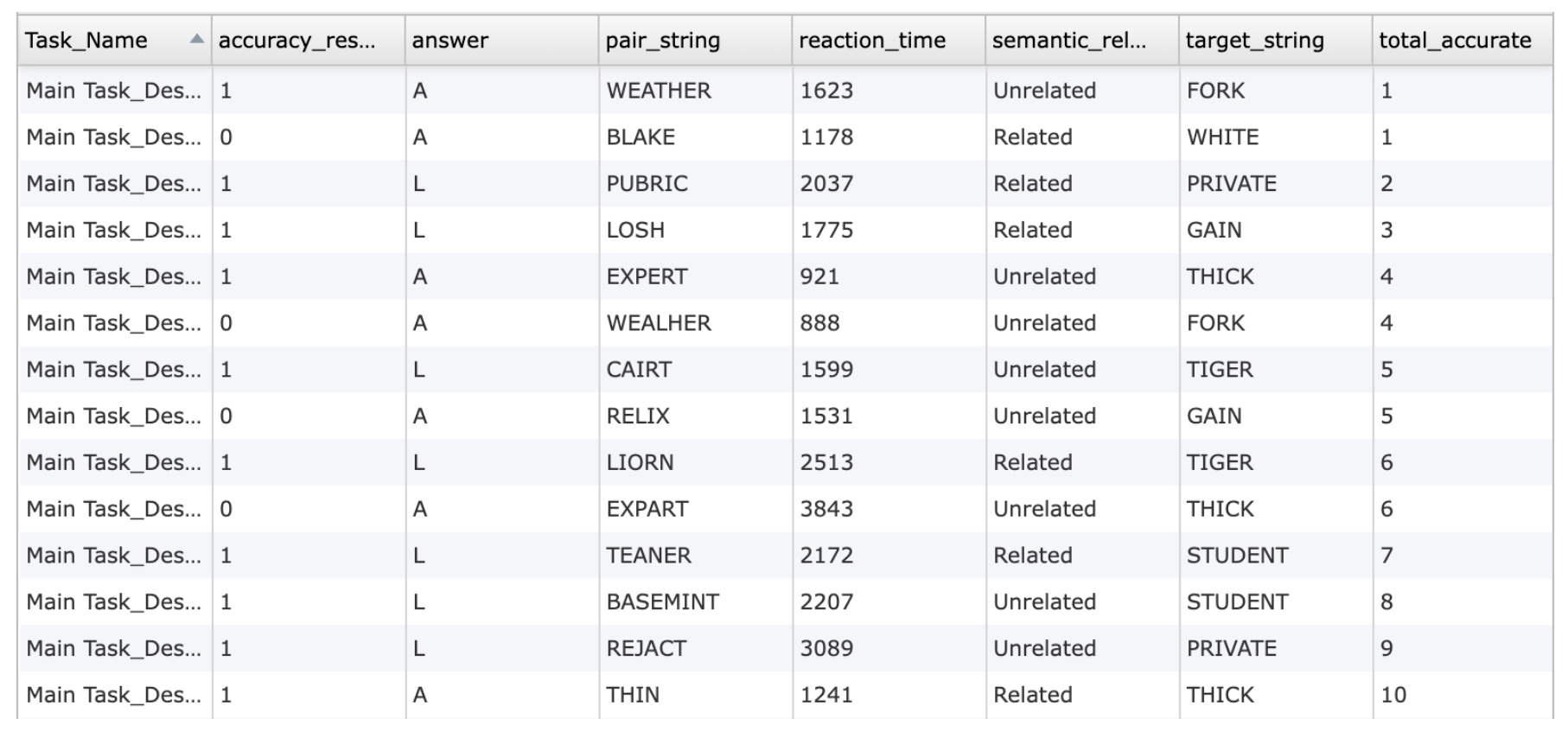
    The DLDT evaluates task performance by capturing a range of linguistic and cognitive processing metrics. In the Variables Tab, you will see all measures recorded during the task. Below are several of the most informative indicators that researchers frequently analyze in this version of the DLDT:

    Variable NameDescription
    answerThe participant’s response for a trial
    reaction_timeTime taken by the participant (in ms) to respond in a trial
    word_conditionThe condition type of the presented string pair. Gives info if both are words (word) or if at least either of the presented strings is a non word (non-word)
    semantic_relationshipThe relationship between the strings presented (related/unrelated)
    total_accurateCumulative number of correct responses across trials

    Data preview of behavioral measures and responses collected using the Dual Lexical Decision Task template.

    Data table showing individual trial level data from the Dual Lexical Decision Task, displaying accuracy, response keys, reaction times, paired letter strings, and the semantic relationship assigned to each item.

    These variables / outcome measures can be renamed, expanded, or combined with additional logic to align with different experimental goals. Labvanced also supports advanced filtering, custom scoring, and automated summary calculation during or after the task.


    Dual Lexical Decision Task

    This study investigates word recognition and decision-making in language processing. Participants will view pairs of letter strings and decide whether they are real words or non-words. The task measures accuracy and reaction times in lexical processing.


    Technologies Supporting the Dual Lexical Decision Task

    Labvanced provides a high precision and flexible environment for implementing the Dual Lexical Decision Task in online and in-lab settings. Several technologies enhance the quality of DLDT data:

    • Code-free Interface: Labvanced empowers linguistics researchers by providing a fully code-free platform for building sophisticated language experiments without programming expertise.

    • Millisecond Accurate Timing: Ensures precise presentation of simultaneous stimuli and accurate measurement of reaction times for both streams.

    • Dual Stream Presentation Control: Allows independent timing, randomization, and positioning of left and right stimuli, supporting experiments on divided attention and lateralized processing.

    • Webcam Eye Tracking: Enables optional gaze recording to examine fixation shifts, reading behavior, or attention allocation between the two stimulus positions.

    • Cross Device Compatibility: Supports desktops, laptops, and tablets, with well calibrated layouts for keyboard or touchscreen responding.

    • Desktop App for High Control Environments: Provides a stable environment for lab based studies with potential integration of EEG or LSL compatible sensors for synchronized multimodal recordings.

    • Remote Testing and Longitudinal Designs: Facilitates repeated sessions, large online samples, and diverse participant recruitment while preserving data integrity.

    A person looking at a webcam eye tracking task created with Labvanced during a dot probe task

    Webcam Eye Tracking

    Capture gaze patterns and visual attention with built-in, code-free and peer-reviewed webcam eye-tracking.
    An icon of a clock symbolizing accurate reaction times from this dot probe task template

    Timing Precision

    Capture reaction times, task performance, and more with millisecond accuracy for time-sensitive tasks.
    A person looking at a webcam eye tracking task created with Labvanced the experiment builder.

    Code-free Editor

    Build powerful experiments with advanced technologies, without having to write a single line of code.

    Customizing the Dual Lexical Decision Task Template

    The Dual Lexical Decision Task template can be tailored in numerous ways to match different research questions or participant groups. Below are a few themes researchers commonly ask when it comes to modifying this task.


    Stimulus Design

    Researchers can upload their own word lists, pseudowords, or multilingual stimuli. You can do this by editing the stimuli data frame variable. This variable consists of all the stimuli text used for the task. The Trials & Conditions panel lets you manually edit each trial and add the words directly to the frame.


    Timing and Trial Parameters

    Stimulus duration, inter stimulus intervals, and feedback timing can be modified to match the needs of the study. These can be modified through Delayed Action (Time Callback) or frame specific timing controls.


    Layout and Presentation Format

    The appearance of the stimuli can be customized by changing spacing, font type, size, and placement of the letter sequences. The ‘Object Properties’ panel provides you with the option to edit the stimuli’s position, size, scaling, rotation and more. The vertical layout can also be adapted to accommodate different screen sizes and device types.


    Response Options and Input Modes

    Keyboard keys or touchscreen buttons used for responses can be changed to suit accessibility requirements or better align with the instructions. The events with mouse trigger or button trigger could be edited to include varied response options and allow the task to be optimized for different devices or participant groups.


    Difficulty and Condition Structure

    Researchers can introduce additional conditions such as word frequency levels, morphological families, and more. It is also possible to add masks, distractors, or varied presentation speeds to change task difficulty. The event system could be utilized to set up any presentation rule or level of difficulty.


    Multimodal Integration

    The task can be combined with eye tracking, EEG, or other LSL compatible devices via the Labvanced Desktop App, supporting synchronized behavioral and physiological data collection.


    If you need help customizing this task, please feel welcome to write to us and ask:


    Contact Us

    Recommended Use and Applications of the Dual Lexical Decision Task

    The Dual Lexical Decision Task is useful in many areas of language and cognitive research, whether online or in-lab. It helps researchers understand how people recognize written words, especially when they must respond quickly or handle two items at the same time.

    • Psycholinguistics and Word Recognition Research: Used to study how people access word meanings, recognize letter patterns, and show semantic priming effects during fast word recognition.

    • Bilingualism and Second Language Learning: Helps compare how quickly and accurately people process words in different languages, and how language proficiency affects word recognition under time pressure.

    • Developmental and Educational Populations: Useful for assessing reading development, word decoding, and early literacy skills in children and adolescents, especially in tasks involving word versus nonword decisions.

    • Reading and Language Disorders: Commonly used to examine difficulties in dyslexia, language disorders, or other conditions that affect phonological processing, spelling, or understanding written words.

    • Neuropsychological and Clinical Populations: Relevant for studying word recognition problems in individuals with neurological conditions, mild cognitive impairment, or disorders affecting language and semantic memory.

    • Cognitive Neuroscience and Brain Mapping: Often combined with EEG or fMRI to study the brain activity linked to semantic priming, hemispheric differences, and rapid language understanding.


    Sign Up


    References

    • Meyer, D. E., & Schvaneveldt, R. W. (1971). Facilitation in recognizing pairs of words: Evidence of a dependence between retrieval operations. Journal of Experimental Psychology, 90(2), 227–234. https://doi.org/10.1037/h0031564

    • Hoedemaker, R. S., & Gordon, P. C. (2017). The onset and time course of semantic priming during rapid recognition of visual words. Journal of experimental psychology. Human perception and performance, 43(5), 881–902. https://doi.org/10.1037/xhp0000377

    Related Tasks

    The Dual Lexical Decision Task pairs naturally with other language processing tasks in Labvanced's task library.

    Bouba-Kiki Task

    In this experiment, two shapes are presented and a word. The participant must select one of the two shapes as being the best match to the presented word.