labvanced logoLabVanced
Contact
    • Remote Physiological Measurements
    • Eye Tracking
    • Head & Face-Tracking
    • Emotion Detection
    • Heart Rate Detection (rPPG)
    • Generative AI
    • Audio Transcription
    • EEG & Hardware Integrations
    • Decision Making
    • Reaction Times
    • Keyboard Inputs
    • Mouse Tracking
    • Mobile / Touch
    • Questionnaires
    • Gamepad / Joystick Integration
    • Audio Recordings
    • Audio Transcription
    • Video Recordings
    • Screen Recordings
    • Photos / Snapshots
    • Video Conferencing
    • Canvas Drawings
    • Build with AI
    • Build with Spreadsheets
    • Using the Experiment Editor
    • Coding
    • Creating Questionnaires
    • Balancing & Randomization
    • UX & Website Testing
    • Single Session Studies
    • Factorial Designs
    • Longitudinal & Multi-session Studies
    • Individual & Case Studies
    • Real-time Multi-user Studies
    • Interviews & Video Calls
    • Surveys & Questionnaires
    • Experience Sampling & Diaries
    • Classroom & Group Testing
    • Interventions & Clinical Trials
    • In the Browser
    • Mobile App
    • Desktop App
    • WebBridge Chrome Extension
    • Stroop Test
    • Flanker Task
    • N-back Task
    • Implicit Association Test
    • Trail Making Test
    • Digit Span
    • Corsi Block Tapping
    • Tower of London
    • Balloon Analog Risk Task
    • Preferential Looking
    • Browse more →
    • DASS-21
    • GAD-7
    • Rosenberg Self-Esteem Scale
    • PHQ-9
    • Ten-Item Personality Inventory
    • Big Five Personality Test
    • Adult ADHD Self-Report Scale
    • Browse more →
    • Building a Multi-user Study
    • Webcam Eye Tracking with AOIs
    • Website Frame Eye Tracking
    • Conditional Eye Tracking Opt-in
    • ChatGPT Study
    • Desktop App Study with EEG
    • Between-subjects Group Balancing
    • Building a Reading Study
    • Stroop Task
    • Lexical Decision Task
    • Browse more →
    Public Experiment Library
    • Arts Research
    • Clinical Psychology & Neuropsychology Medicine
    • Cognitive Psychology
    • Developmental Psychology
    • Behavioral Economics & Decision Science
    • Educational Research & Psychology
    • HCI & Human Factors
    • Linguistics & Language Sciences
    • Consumer & Marketing Research
    • Social & Personality Psychology
    • Sport & Movement Science
    • UX & Website Testing
    • Executive Functions
    • Language & Reading
    • Decision-Making & Reasoning
    • Attention
    • Overview
    • HCI & Human Factors
    • UX & Website Testing
    • Consumer & Marketing Research
    • White-Label App
    • PageGazer
    • Webcam vs. Lab Eye Tracking in InfantsAnna Banki & Gabriela Markova
    • Eye Tracking for Influencer MarketingDr. Alexander Edeling
    • Eye Tracking Infant Word ComprehensionDr. Giulia Calignano
    • Sentence Reading and Grammar JudgmentsDr. Jonathan Mirault
    • Regulating Emotions with MusicDr. Katrin Starcke
    • Game-Based Grammar Learning in ChildrenDr. Mireia Marimon
    • Gaze Cueing and AutismMax Soares Miehstein
    • Personality and Hearing in NoiseDr. Malte Wöstmann
    • All interviews →
    • Lab Notes
    • How to Cite Labvanced
    • Labvanced Platform Paper (2017)
    • Webcam Eye Tracking Validation (2024)
    • Webcam Eye Tracking Studies
    • Cognitive Psychology Studies
    • Developmental Psychology Studies
    • Linguistics Studies
    • See all publications →
    • Getting Started
    • Guide
    • Video Tutorials
    • Walkthroughs
    • Live Chat
    • Webinars & Onboarding Calls
    • AI Assistant
    • FAQ
    • Importing Templates Guide
    • Test Templates
    • Live Eye Tracking Metrics
    • Mouse Tracking Demo
    • ChatGPT Demo
    • Audio Recording Object Demo
    • Adding Image Stimuli Demo
    • Score & Feedback Demo
    • Browse all technical demos →
    • Timing Precision
    • Stimuli Presentation
    • Headphone Checks
    • Bot Checks
    • Participant Management
    • Comparisons
    • Research Blog
    • Prolific Integration
    • CloudResearch Integration
    • Sona Systems Integration
    • BeSample Integration
    • Panelabs Integration
    • Clickworker Integration
    • Labvanced Webhook API
    • Labvanced REST API
    • About Us
    • Newsletter Archive
    • Terms & Conditions
    • Data Security & Data Privacy
    • Technical & Organisational Measures
    • Accessibility
    • W-8BEN-E Form
    • Data Processing Agreement Template
    LinkedInYouTubeDiscord
    • Individual
    • Lab
    • Department / Consortium
    • Teaching
    • Campus
    • Commercial
    • Browse recording top-ups →
    • Browse AI token top-ups →
    • Overview
    • Study Building
    • Subject Recruitment
    • Dedicated Support
    Checkout
  • Contact
    • JA
      • 中國人
      • Deutsch
      • Français
      • Español
      • English
      • 日本語
    • Logout
    • Loginlogin icon
    Platform
    Labvanced makes it easy to implement the most advanced study design and reliably collect your data.
    Biosignals & AI
    Remote Physiological MeasurementsEye TrackingHead & Face-TrackingEmotion DetectionHeart Rate Detection (rPPG)Generative AIAudio TranscriptionEEG & Hardware Integrations
    Behavioral Recordings
    Decision MakingReaction TimesKeyboard InputsMouse TrackingMobile / TouchQuestionnairesGamepad / Joystick Integration
    Media Recordings
    Audio RecordingsAudio TranscriptionVideo RecordingsScreen RecordingsPhotos / SnapshotsVideo ConferencingCanvas Drawings
    Implementation Techniques
    Build with AIBuild with SpreadsheetsUsing the Experiment EditorCodingCreating QuestionnairesBalancing & RandomizationUX & Website Testing
    Study Formats

    Your study can take whatever format your research needs. Here are a few popular examples.

    Single Session StudiesFactorial DesignsLongitudinal & Multi-session StudiesIndividual & Case StudiesReal-time Multi-user StudiesInterviews & Video CallsSurveys & QuestionnairesExperience Sampling & DiariesClassroom & Group TestingInterventions & Clinical Trials
    Where Studies Run

    Run your study online in the browser, on mobile or tablet with the mobile app, or in-lab with the desktop app.

    In the BrowserMobile AppDesktop AppWebBridge Chrome Extension
    Tests
    Explore cognitive tests, questionnaires, walkthroughs, and our public experiment library: a starting point for your next study.
    Popular Cognitive Tests
    Stroop TestFlanker TaskN-back TaskImplicit Association TestTrail Making TestDigit SpanCorsi Block TappingTower of LondonBalloon Analog Risk TaskPreferential Looking
    Browse more →
    Questionnaires & Scales
    DASS-21GAD-7Rosenberg Self-Esteem ScalePHQ-9Ten-Item Personality InventoryBig Five Personality TestAdult ADHD Self-Report Scale
    Browse more →
    Public Experiment Library

    Take a look at what other researchers in the community are doing through our extensive, open catalog of shared studies.

    Open the public library →
    Walkthroughs

    Step-by-step builds of complete studies, from a blank project to a running experiment, that you can follow along or adapt.

    Building a Multi-user StudyWebcam Eye Tracking with AOIsWebsite Frame Eye TrackingConditional Eye Tracking Opt-inChatGPT StudyDesktop App Study with EEGBetween-subjects Group BalancingBuilding a Reading StudyStroop TaskLexical Decision Task
    Browse more →
    Research
    One platform for students, academics, and industry researchers studying human behavior.
    Harvard UniversityStanford UniversityCambridge UniversityUCLNYUMax Planck InstituteUCLATU Munich

    Trusted by researchers at 1,500+ universities worldwide

    Academic Research
    Arts ResearchClinical Psychology & Neuropsychology MedicineCognitive PsychologyDevelopmental PsychologyBehavioral Economics & Decision ScienceEducational Research & PsychologyHCI & Human FactorsLinguistics & Language SciencesConsumer & Marketing ResearchSocial & Personality PsychologySport & Movement ScienceUX & Website Testing
    Research Areas
    Executive FunctionsLanguage & ReadingDecision-Making & ReasoningAttention
    Industry / Commercial
    OverviewHCI & Human FactorsUX & Website TestingConsumer & Marketing ResearchWhite-Label AppPageGazer
    Researcher Interviews

    Conversations with researchers about the studies they ran with Labvanced, what worked, and what they learned.

    Webcam vs. Lab Eye Tracking in InfantsAnna Banki & Gabriela MarkovaEye Tracking for Influencer MarketingDr. Alexander EdelingEye Tracking Infant Word ComprehensionDr. Giulia CalignanoSentence Reading and Grammar JudgmentsDr. Jonathan MiraultRegulating Emotions with MusicDr. Katrin StarckeGame-Based Grammar Learning in ChildrenDr. Mireia MarimonGaze Cueing and AutismMax Soares MiehsteinPersonality and Hearing in NoiseDr. Malte Wöstmann
    All interviews →
    Our Research
    Lab NotesHow to Cite Labvanced
    Peer Reviewed Studies

    A selection of peer-reviewed work built on Labvanced: our own platform and validation papers, and studies by the research community grouped by area. Hundreds more are listed on the full publications page.

    Labvanced Platform Paper (2017)Webcam Eye Tracking Validation (2024)Webcam Eye Tracking StudiesCognitive Psychology StudiesDevelopmental Psychology StudiesLinguistics Studies
    See all publications →
    Resources
    Valuable resources to help you learn the platform, stay updated, and more.
    Documentation
    Getting StartedGuideVideo TutorialsWalkthroughs
    Support
    Live ChatWebinars & Onboarding CallsAI AssistantFAQ
    Templates & Demos

    These are a few popular examples. Browse our guide and a selection of technical demos to get started with implementation.

    Importing Templates GuideTest TemplatesLive Eye Tracking MetricsMouse Tracking DemoChatGPT DemoAudio Recording Object DemoAdding Image Stimuli DemoScore & Feedback Demo
    Browse all technical demos →
    Methodology
    Timing PrecisionStimuli PresentationHeadphone ChecksBot ChecksParticipant ManagementComparisonsResearch Blog
    Integrations & APIs
    Prolific IntegrationCloudResearch IntegrationSona Systems IntegrationBeSample IntegrationPanelabs IntegrationClickworker IntegrationLabvanced Webhook APILabvanced REST API
    Company & Legal
    About UsNewsletter ArchiveTerms & ConditionsData Security & Data PrivacyTechnical & Organisational MeasuresAccessibilityW-8BEN-E FormData Processing Agreement Template
    LinkedInYouTubeDiscord
    Pricing
    Our licenses and additional services at a glance.
    Licenses
    IndividualLabDepartment / ConsortiumTeachingCampusCommercial
    Top-Ups

    Need more recordings for your lab or your own research? Simply use one of these recording top-up packages.

    Browse recording top-ups →

    Need more AI tokens for the AI assistant and study translations? Simply use one of these AI token top-up packages.

    Browse AI token top-ups →
    Additional Services

    Hire Labvanced’s expert team to quickly bring your project to the level of rigor it needs.

    OverviewStudy BuildingSubject RecruitmentDedicated Support
    Checkout

    Ready to purchase a license or top-up? Head straight to checkout.

    Go to checkout →
    • 中國人
    • Deutsch
    • Français
    • Español
    • English
    • 日本語
    マインドフルネスベースの自己効力感尺度の抽象的なイラスト。

    遅延割引タスクにおける刺激の種類

    仮想のお金は、操作の容易さと一般化可能性から遅延割引タスクで最も一般的に使用される刺激ですが、研究者は特定の行動、人口、または実際の決定を調査するために、食べ物から健康結果、エンターテイメントまでのさまざまな他の刺激を使用します。

    遅延割引タスクで使用される刺激のカテゴリは以下の通りです:

    • お金と金銭的報酬
    • 一次強化子
          食べ物
          飲み物 / アルコール
          薬物
          性行為
    • 社会的相互作用
    • 健康結果
    • 環境結果
    • 教育およびキャリアの結果
    • 消費財と体験

    これらは大まかに分類可能であり、以下でさらに詳しく説明します。

    お金と金銭的報酬

    お金は、遅延割引タスクで一般的に使用される刺激であり、いくつかの理由から効果的な刺激と見なされています。研究によると、仮想のお金の結果は実際のお金の結果と同様に割引されるため、遅延割引研究において実用的かつ有効な刺激です。さらに、お金は腐敗しないか、満足効果の影響を受けることはありません(Odum et al., 2006; Odum et al., 2020)。

    お金を刺激として使用した遅延割引タスクでは、参加者は通常、少ない即時の金額と大きな遅延金額の選択肢が提示され、2つのうちの1つを選ぶことが期待されます。提示される金額は各試行で異なり、通常はパターンに従います。たとえば:

    • 今日$10を受け取るか、明日$11を受け取る
    • 今日$10を受け取るか、1か月後に$50を受け取る

    遅延割引タスクを試すか、それをアカウントにインポートします。

    一次強化子

    これらは本質的に報酬を持ち、しばしば直接的な生物学的または生理的基盤を持つ刺激です。例としては:

    食べ物

    食べ物を刺激として使用する遅延割引タスクは肥満研究で関連があり、食行動や動物モデル(例:今すぐ小さなご褒美と後で大きなポーション)を評価する研究でも使用されます(Weygandt, M., et al. 2015)。ある研究では、食べ物の報酬はお金よりも急激に割引されることが示され、肥満に関連する研究において生態的に妥当であることが示されました(Rasmussen et al., 2024)。

    飲み物とアルコール

    食べ物と同様に、飲み物の刺激は渇き、アルコール使用などの研究に関連しています。たとえば、アルコールを報酬刺激として組み込んだ場合、単一商品(今すぐアルコールを提供するか、後で提供するか)と交差商品タスク(例:今すぐアルコール vs. 後でお金)の両方において、アルコールの即時摂取を好む傾向があり、即時のお金よりもアルコールを待つことに意欲的であることがわかりました(Taylor et al., 2023)。

    薬物

    物質使用障害のある個人にとって、即時の薬物アクセス(例:今すぐ1回の投与か2日後に3回の投与)と、遅延した薬物アクセスやお金の選択肢は、その物質に特有の非常に急激な割引を暴露できます。薬物関連の選択肢に強調が置かれることは、非使用者と比較して薬物乱用者の決定が衝動的であることを強調しています(Petry, 2003)。

    性行為

    倫理的および実用的な考慮から一般的ではありませんが、即時と遅延の性的満足の概念は関連があります。性による遅延割引に関する研究では、参加者は性の即時の好みと遅延の好みを選ぶことが求められました(例:保護なしで性行為を今すぐ、または保護ありで3時間後に待つ)(Lawyer, 2008)。

    社会的相互作用

    いくつかの遅延割引タスクでは、参加者には仮想の対面での社会的相互作用を含む選択肢が提示されました。即時の要素は今すぐ対面で話すことであり、遅延の要素は遅延後に対面で話すことでした(例:今すぐその人と10分対面で話すか、10か月後にその人と25分対面で話す)(Charlton et al., 2012)。

    オンラインの「いいね!」やフォロワー

    デジタルな文脈でますます重要になっているのは、参加者がオンライン関連の報酬(「いいね!」やフォロワーなど)をどのように評価するかを研究することです。

    ある研究では、仮想のInstagramのフォロワーや「いいね!」を遅延割引タスクで使用しました(例:今すぐ少ない「いいね!」やフォロワー vs. 後での多い「いいね!」やフォロワー)。人々は、特に少ない量では、未来のInstagramフォロワーや「いいね!」の価値を即時のものよりも低く評価する傾向があることがわかりました(Schulz van Endert & Mohr, 2022)。
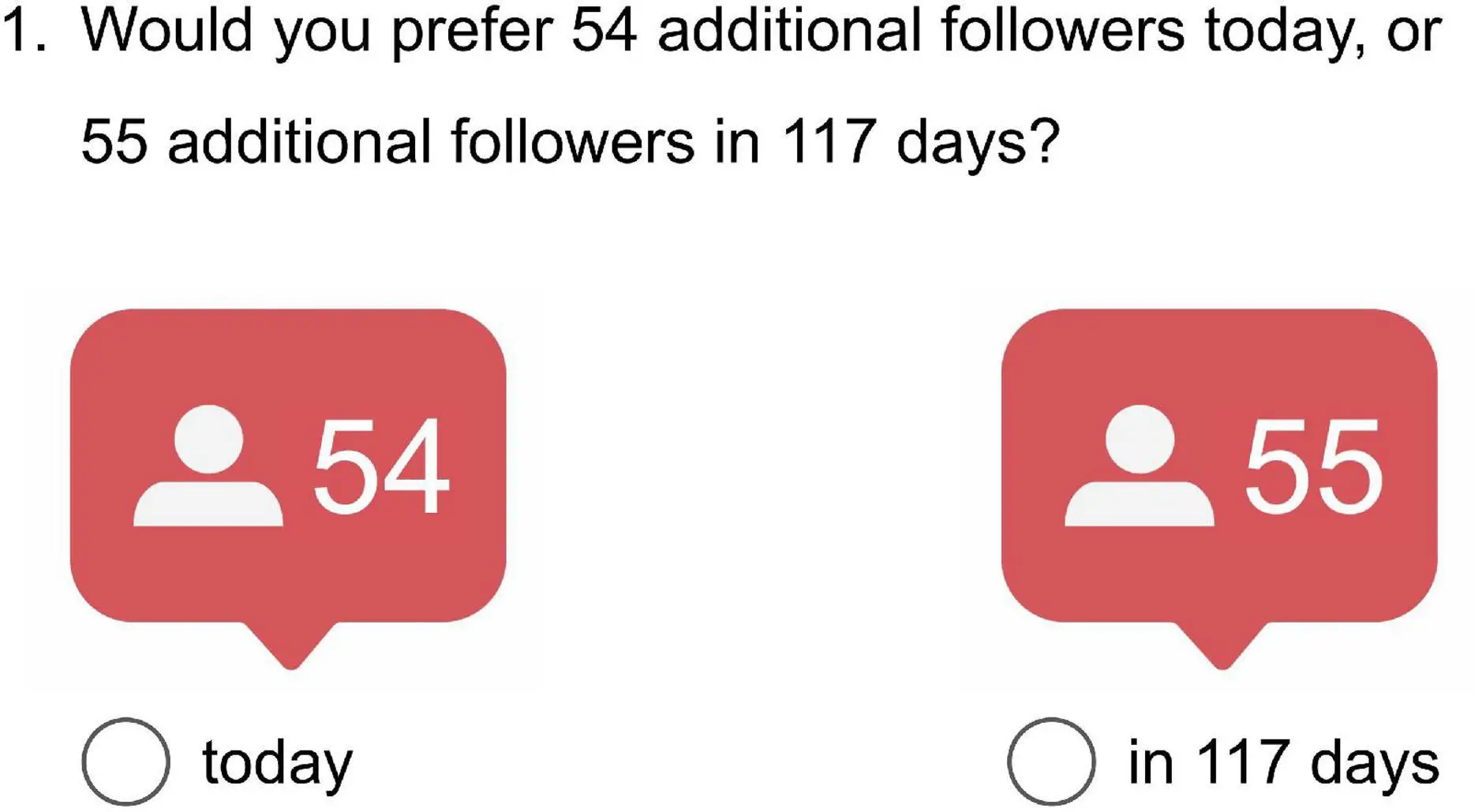
    オンラインフォロワーに対する遅延割引タスク; Schulz van Endert & Mohr, 2022。
    オンラインフォロワーに対する遅延割引タスク; Schulz van Endert & Mohr, 2022。 CC BY 4.0

    環境結果

    環境結果に関連する刺激も利用され、長期的な環境保護のための即時のコスト/努力を伴う決定を捉えることができます。研究者は、人々が今少しのお金を支払って後で多くの環境的利益を得ることを望むか、または小さい利益を即座に得ることを好むかを確認しました。たとえば、今すぐの炭素貯蔵の少しの増加(今日の税金支払いx)vs. 6年後の炭素貯蔵のかなりの増加(6年後の税金支払いy)(Grammatikopoulou et al., 2020)。

    ヘルスアウトカム

    これには、医療手続きや治療、さらには運動や身体活動など、長期的な健康への影響や結果に関する意思決定が含まれます。

    医療手続きと治療

    この遅延割引課題の文脈において、参加者は即時および遅延された健康シナリオの間で選択しました。

    研究に関与した刺激は、さまざまな種類の健康結果、すなわち、「健康の向上」(即時的な一時的または短期的な健康の向上)と「治療」(遅延された長期的な健康の改善)でした(Friedel et al., 2016)。

    参加者は、即時の不快感(例:今すぐ非常に痛い医療テストを受けること)と遅延された健康利益(例:テスト後の改善された健康結果)の間で選択するよう求められることもあります(Talmi & Pine, 2012)。

    運動と身体活動

    運動に焦点を当てた遅延割引課題を用いた研究では、参加者は今すぐ運動するか、それとも後でお金や食べ物といった他の報酬を待つかを選びました。結果は、運動を即時に行うことを好む人々によって、時間とともに運動の価値が低く評価されることを示しました(特に、自分のペースで運動する場合)(Albelwi et al., 2019)。

    Join Labvanced today and implement the delay discounting task in your next experiment.

    教育とキャリアの結果

    遅延割引課題は、若い参加者に対する教育や学業の成果、または年長の参加者に対するキャリアの結果に関する刺激を使用することもできます。

    学業成績

    これは、即時的な余暇と将来のより良い成績の対比を含みます。ある論文は、即時的な余暇活動と固有に遅延される学業課題の一般的な概念を提示することによって、学業の文脈における遅延割引の質的側面に焦点を当てました(例:「テレビ番組を見る」対「課題を成功裏に完了し提出する」)(Olsen et al., 2018)。

    キャリアの向上

    キャリアの概念では、即時の快適さと長期的なキャリアの成長が考慮されます。高校を卒業する学生には、即時の快適さと長期的なキャリアの成長(例:即時の仕事か、引き続き学業を続けるか)に関する選択肢が提示されました(Leitão et al., 2013)。

    Labvancedとは何ですか?

    強力な実験デザインプラットフォーム(コーディングは不要)で、ウェブおよびネイティブデスクトップ/モバイルアプリケーションを通じて、ウェブカメラの眼球追跡などの高度な機能を備えています。

    サインアップ


    消費財と体験

    製品は、即時の満足と遅延された満足の間の消費者の好みを研究するために、遅延割引課題の刺激として機能します。例えば、消費者の販売促進に関する研究では、参加者に即時の節約と遅延された節約($900の即時節約今対$1,000の還付を2週間後に)を選択させました(Coker et al., 2010)。

    余暇活動やエンターテインメント関連の刺激も、即時と遅延された体験へのアクセスの選択を定量化するために使用できます。例えば、参加者は、今週末にスポーツイベントに参加するために$500を支払うか、来月まで待って無料で参加するかを選ぶかもしれません(Goodman et al., 2019)。

    結論

    刺激の選択は、研究の質問、対象となる人口、および研究者が理解しようとする現実世界の行動に大きく依存します。遅延割引課題において金銭的および非金銭的な刺激の両方を使用することは、特定の意思決定コンテキストにおいて、より生態学的に妥当な洞察を提供する可能性があります。

    参考文献

    Albelwi, T. A., Rogers, R. D., & Kubis, H. P. (2019). Exercise as a reward: Self-paced exercise perception and delay discounting in comparison with food and money. Physiology & Behavior, 199, 333–342.

    Charlton, S. R., Gossett, B. D., & Charlton, V. A. (2012). Effect of delay and social distance on the perceived value of social interaction. Behavioural Processes, 89(1), 23–26.

    Coker, K. K., Pillai, D., & Balasubramanian, S. K. (2010). Delay‐discounting rewards from consumer sales promotions. Journal of Product & Brand Management, 19(7), 487–495.

    Friedel, J. E., DeHart, W. B., Frye, C. C., Rung, J. M., & Odum, A. L. (2016). Discounting of qualitatively different delayed health outcomes in current and never smokers. Experimental and Clinical Psychopharmacology, 24(1), 18.

    Goodman, J. K., Malkoc, S. A., & Rosenboim, M. (2019). The material-experiential asymmetry in discounting: When experiential purchases lead to more impatience. Journal of Consumer Research, 46(4), 671–688.

    Grammatikopoulou, I., Artell, J., Hjerppe, T., & Pouta, E. (2020). A mire of discount rates: delaying conservation payment schedules in a choice experiment. Environmental and Resource Economics, 77, 615–639.

    Lawyer, S. R. (2008). Probability and delay discounting of erotic stimuli. Behavioural Processes, 79, 36–42.

    Leitão, M., Guedes, Á., Yamamoto, M. E., & Lopes, F. D. A. (2013). Do people adjust career choices according to socioeconomic conditions? An evolutionary analysis of future discounting. Psychology & Neuroscience, 6(3), 383.

    Odum, A. L., Baumann, A. A., & Rimington, D. D. (2006). Discounting of delayed hypothetical money and food: Effects of amount. Behavioural processes, 73(3), 278-284.

    Odum, A. L., Becker, R. J., Haynes, J. M., Galizio, A., Frye, C. C., Downey, H., ... & Perez, D. M. (2020). Delay discounting of different outcomes: Review and theory. Journal of the experimental analysis of behavior, 113(3), 657-679.

    Olsen, R. A., Macaskill, A. C., & Hunt, M. J. (2018). A measure of delay discounting within the academic domain. Journal of Behavioral Decision Making, 31(4), 522–534.

    Petry, N. M. (2003). Discounting of money, health, and freedom in substance abusers and controls. Drug and Alcohol Dependence, 71(2), 133–141.

    Rasmussen, E. B., Camp, L., & Lawyer, S. R. (2024). The use of nonmonetary outcomes in health-related delay discounting research: Review and recommendations. Perspectives on Behavior Science, 47(2), 523–558.

    Schulz van Endert, T., & Mohr, P. N. (2022). Delay discounting of monetary and social media rewards: Magnitude and trait effects. Frontiers in Psychology, 13, 822505.

    Talmi, D., & Pine, A. (2012). How costs influence decision values for mixed outcomes. Frontiers in Neuroscience, 6, 146.

    Taylor, H., Smith, A. P., & Yi, R. (2023). Valuation of future alcohol in cross-commodity delay discounting is associated with alcohol misuse/consequences. Psychology of Addictive Behaviors, 37(1), 166.

    Weygandt, M., Mai, K., Dommes, E., Ritter, K., Leupelt, V., Spranger, J., & Haynes, J. D. (2015). Impulse control in the dorsolateral prefrontal cortex counteracts post-diet weight regain in obesity. Neuroimage, 109, 318-327.