実行機能スキルの評価 | タスクとバッテリー
実行機能スキルは、個人が自らの行動を制御および監視し、最終的に目標を達成するのを助ける一連のメンタルおよび認知的プロセスです。これらのスキルを評価するための特定のタスクや包括的なバッテリーがあります。
実行機能スキルとは?
実行機能(EF)は、しばしば脳の「制御センター」として説明され、目標指向の行動の開始、計画、制御に必要なさまざまな認知プロセスを調整するのを助けるための傘的な用語として使用されます(Reimers, 2019)。
実行機能スキルは、実行機能から生じる実用的なスキルまたは能力です。よく研究されている実行機能スキルは3つあります:
- 抑制: 不要な反応や気を散らす情報の抑制。
- 切り替え: 異なるタスク間の切り替え。
- 作業記憶: 心の中で情報を監視および操作すること(Cragg, 2014)。
実行機能を評価するためのタスク
実行機能タスクは、作業記憶や抑制など、実行機能内の特定のスキルを評価するために設計された個別のテストです。
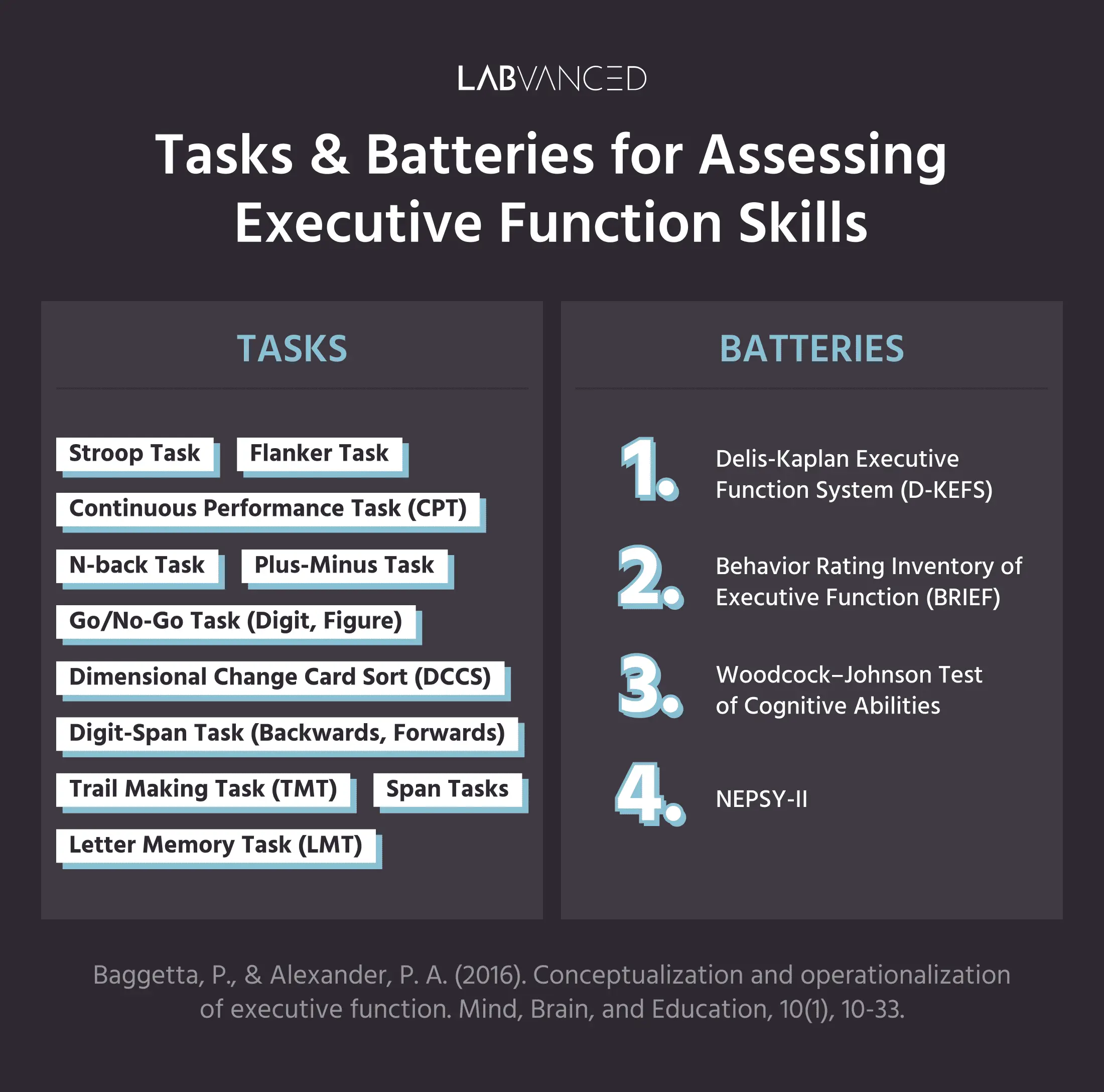
2016年に行われた106の実証研究の系統的レビューでは、実行機能スキルがどのように概念化され、実証研究で運用されているかを理解しようとしました。著者たちは、文献の中で実行機能スキルを測定するために使用された109の異なるタスクを特定しました。そのうち56のタスクは1回だけ使用されたことがあり、これは研究者が特定の研究の文脈で使用するために独自のタスクを開発したことを示唆しています。残りの53のタスクは何度も使用されました(Baggetta, P., & Alexander, P. A., 2016)。そのリストから最も一般的に使用される実行機能タスクを選択しました(表 S5- 補足情報を参照)し、人気の順に以下に示しました:
これらのタスク実装をLabvancedで比較するには、実行機能タスクページをご覧ください。それらに基づいて研究を設計するためのガイダンスについては、実行機能研究をご覧ください。
- ストループタスク
- 数字スパンタスク(バックワード、フォワード)
- ゴー/ノーゴータスク(数字、図形)
- トレイルメイキングタスク(TMT)
- Nバックタスク
- スパンタスク
- 継続的パフォーマンスタスク(CPT)
- プラスマイナスタスク
- 次元変化カードソート(DCCS)
- フランカータスク
- 文字記憶タスク(LMT)
ストループタスク
- タスク説明: ストループタスクは、参加者に単語の色を名付けるよう指示する古典的な認知タスクであり、単語を読むのではなく、その色に集中する必要があります。試行には、色の名前が表示されるが、対立する色で書かれることがよくあります。例えば、参加者は「BLUE」と書かれた刺激を目にしますが、赤いフォントカラーで表示され、参加者はその単語の色(つまり赤)を名付けることが期待されます。
- 実行機能とストループタスク: ストループタスクは、参加者の選択的注意、認知的柔軟性、そして認知的抑制スキルを測定する優れた手段であり、参加者は単語を読む自動的な反応ではなく、その色を特定することに集中しなければなりません。反応時間(RT)は、ストループタスクで一般的に使用される測定値です。(Bjekić, 2017; Timmeren, 2018)。
数字スパンタスク(バックワード、フォワード)
- タスク説明: 数字スパンタスクは、特定の順序で表示された数字の列を思い出すことを含みます。数字スパンフォワードでは、参加者は表示されたと同じ順序で数字を繰り返すことが期待され、数字スパンバックワードでは、参加者は逆の順序で列を繰り返す必要があります(Wahlstrom, 2016)。
- 実行機能と数字スパンタスク: 数字スパンタスクは主に作業記憶、注意、認知的柔軟性、そして強い短期記憶保持を測定します(Watanabe, 2023; Weiss, 2016)。
ゴー/ノーゴータスク(数字、図形)
- タスク説明: ゴー/ノーゴータスクでは、参加者は特定の刺激(主に「ゴー」サイン)に反応し、他の刺激(「ノーゴー」サイン)には反応しない必要があります。参加者は通常「ゴー」刺激に対してボタンを押し、「ノーゴー」刺激に対しては反応を控えます。タスクは、数字や図形の形式で刺激を使用するようにカスタマイズできます。
- 実行機能とゴー/ノーゴータスク: このタスクは、反応抑制や衝動制御などのスキルを評価し、参加者が自動的な反応を抑制し、制御することが要求されます。注意の調整もタスク中に示される実行機能スキルの1つです(Weidacker, 2017; Bezdjian, 2009)。
トレイルメイキングタスク(TMT)
- タスク説明: トレイルメイキングタスクは、EFのよく知られた測定方法です。これは二部構成で、数字を昇順に接続する(パートA)と、数字とアルファベットを交互に昇順に接続する(パートB)の2つの部分があります。数字とアルファベットは円の中に書かれ、参加者は線を描いて円を接続することが期待されます。
- 実行機能とトレイルメイキングタスク: TMTは、精神運動速度、集中注意、視空間探索、目標指向の運動追跡、そして応答の更新などの実行機能を測定します。パートBは、抑制制御とセットの切り替えスキルも測定します(Lähde, 2024; Gajewski, 2018)。
Nバックタスク
- タスク説明: Nバックタスクでは、刺激の列が提示され、参加者は現在の刺激が「N」回前と同じかどうかを判断する必要があります。「N」は1、2などです。
- 実行機能とNバックタスク: このタスクでは、参加者はリコールを継続的に調整し、作業記憶容量、更新、持続的注意、そして認知的柔軟性などの実行機能スキルについての洞察を提供することが期待されます(Gajewski, 2018)。
スパンタスク
- タスク説明: メモリスパンタスクでは、特定の順序で異なる刺激(言葉、算数、操作的または視空間的)を提示し、回答者はそれらを提示されたと同じ順序で覚えて思い出すことが期待されます。
- 実行機能とスパンタスク: これらのタスクは、主に特定の領域における作業記憶と注意容量を測定します。また、更新能力もスパンタスクにおいて重要な実行機能スキルであることが分かっています。特に言語および視空間的作業記憶スパンタスクにおいて重要です(McCabe, 2010; St Clair-Thompson, 2006)。
Continuous Performance Task (CPT)
- タスクの説明: 継続的なパフォーマンスタスク(CPT)では、参加者は特定の刺激に正しく反応する必要があります。例えば、参加者は「A」以外のすべての文字または特定の単語や画像を見たり聞いたりしたときにスペースを押すことが期待されています。
- 実行機能とCPT: CPTは主に持続的注意力と反応抑制を評価し、参加者は継続的な刺激の流れに集中し、無関係な刺激への衝動的反応を制御/抑制する必要があります。(Clark, 2023)。
Plus-Minus Task
- タスクの説明: プラスマイナスタスクは3つの条件を含みます: ブロック1では参加者が加算の算術演算を行う必要があり、ブロック2では減算の条件が提供されます。ブロック3では、参加者は加算と減算を交互に行う必要があります。
- 実行機能とプラスマイナスタスク: このタスクは認知柔軟性とシフトの実行機能の一般的な測定基準です(Chainay, 2021)。
Dimensional Change Card Sort (DCCS)
- タスクの説明: 次元変更カードソート(DCCS)は、実行機能の広く使用されている標準的な測定方法です。特定の方法(例:形)でカードや画像を分類し、その後、別の分類方法(例:色)に切り替えることが含まれます。DCCSはウィスコンシンカードソートテスト の簡略版です。
- 実行機能とDCCS: DCCSはタスクシフトと認知柔軟性の測定基準であり、参加者は自発的に新しいルールに適応する必要があります(Beaucage, 2020)。
Flanker Task
- タスクの説明: フランカータスクでは、参加者は中心のターゲット刺激(矢印や文字など)を提示され、その周囲にはフランカー(適合または不適合の刺激)が配置されています。参加者は、フランカー(異なる方向を指す矢印)を無視し、中心ターゲットの特定の特徴(左を指す矢印)にのみ反応することが期待されています。
- 実行機能とフランカータスク: このタスクは主に選択的注意と反応抑制をテストし、参加者は無関係な刺激を取り除くことでターゲットに焦点を合わせようとします。タスクが活性化させる他の実行機能には、作業記憶、時間知覚、開始、運動制御が含まれます(Rusnáková, 2011)。
Letter Memory Task (LMT)
- タスクの説明: レターメモリタスクは、各試行が5、7、または9の子音から成る一連の刺激として子音文字を使用し、一度に1文字ずつ提示されます。参加者は、遅延の後に最後の3文字を常に思い出す必要があります(Golsteijn, 2021)。
- 実行機能とレターメモリタスク: LMTは作業記憶を測定し、特に作業記憶の表象の更新と監視を評価します(Mielicki, 2018; Miyake, 2000)。
実行機能を評価するためのバッテリー
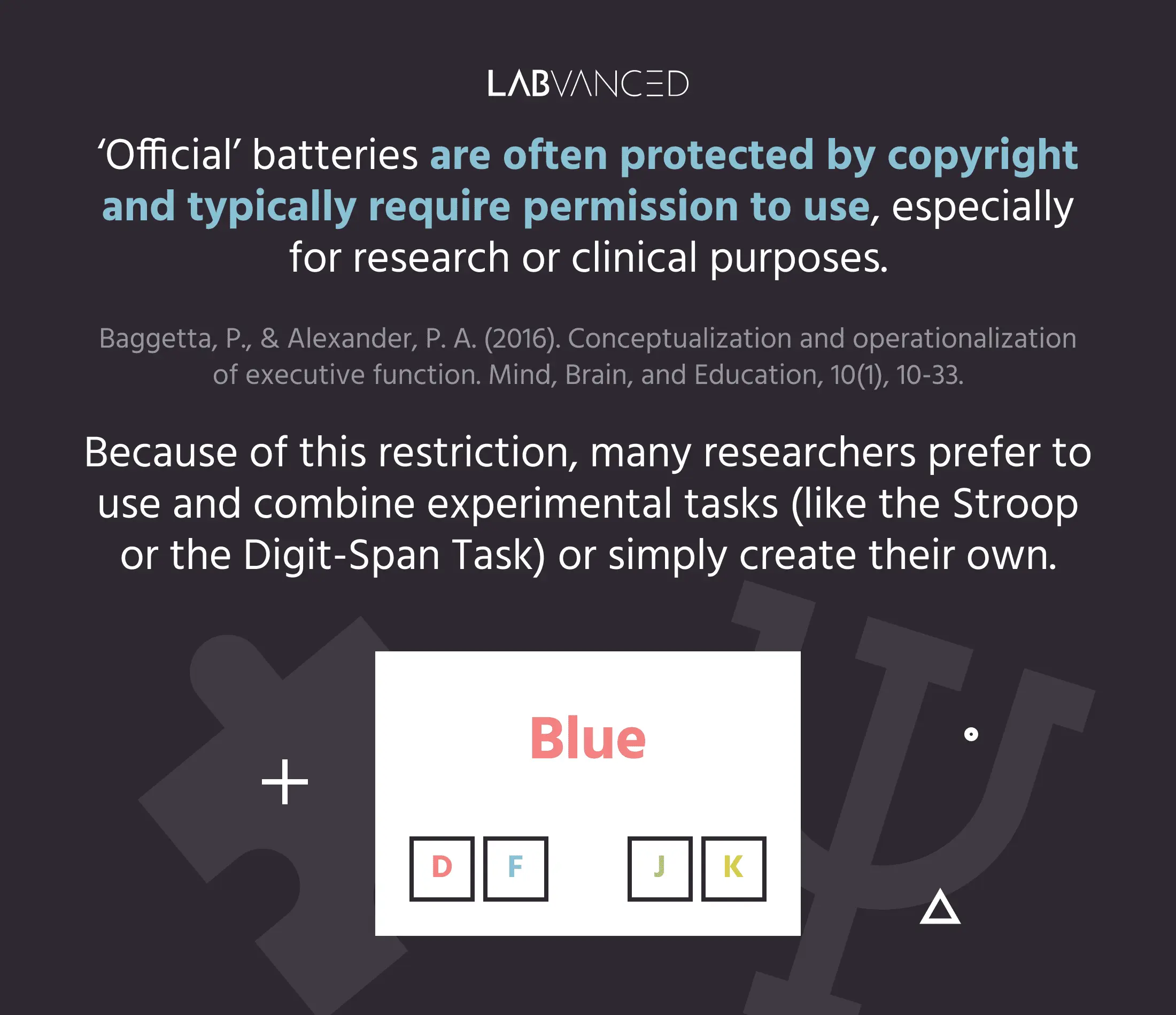
実行機能バッテリーは、実行機能を評価するための包括的なアプローチを提供します。これらには、参加者の実行機能プロファイルをより広い視点から提供する複数のタスクと尺度が含まれています。これらの「公式な」バッテリーは著作権で保護されており、研究や臨床目的で使用するには通常、許可が必要です。この制約のため、多くの研究者は上記で説明した実験タスクを使用したり、独自のタスクを作成したりすることを好みます。
これらのバッテリーに含まれるすべての尺度とタスクは、パフォーマンスベースのタスクと行動評価(他者または自己報告)に分類できます。2016年のBaggetta & Alexanderによる体系的レビューでは、実行機能を測定するいくつかの一般的なバッテリーが特定されました。以下はその一部です:
デリス-カプラン実行機能システム (D-KEFS)
デリス-カプラン実行機能システム (D-KEFS) は、大人と子供(8歳から89歳)の両方の高度な認知機能を評価するための最初の全国標準化テストセットです。
- サブテスト: D-KEFは、トレイルメイキングテスト、言語流暢性テスト、デザイン流暢性テスト、色-単語干渉テスト、ソートテスト、20の質問テスト、単語文脈テスト、タワーテスト、ことわざテストの9つのサブテストを含みます。標準記録フォームと代替バージョンのソートテスト、言語流暢性テスト、20の質問テストを含む代替記録フォームの2つの形式で利用可能です。
- 評価される実行機能: D-KEFによって評価される実行機能の要素は、認知柔軟性、デザイン流暢性、言語流暢性、抑制、カテゴリー処理、問題解決、演繹的推論、空間計画、言語抽象化の9つです。
- 利用用途: D-KEFは、ADHD、自閉症、ディスレクシアを含む神経心理的状態を評価するために、臨床集団で広く使用されています。また、子供と大人の両方における認知パフォーマンスと実行機能の研究にも使用されています(Cahill, 2019; MacDonald, 2024; Ehtesabi, 2022)。
実行機能の行動評価インベントリ (BRIEF)
実行機能の行動評価インベントリ (BRIEF) は、実行機能を評価するためのバッテリーであり、さまざまな年齢層と集団向けの複数のバージョンがあります。この測定は、教師や親による情報提供者の報告と行動評価によって行われます(Mcauley et al, 2010)。
- サブテスト: BRIEFには、合計8つの尺度を含む3つの指標があります: 行動調整インデックス (BRI): 抑制、シフト、および感情調整を評価します。 メタ認知インデックス (MI): 開始、作業記憶、計画/整理、材料の整理、監視を評価します。 全体の実行能力コモジット: BRIとMIの組み合わせで計算されます(Wolrich, 2008)。
- 評価される実行機能: 評価される実行機能スキルは、衝動の制御、行動の変更、認知の柔軟性、遷移、感情の調整、タスクや活動の開始、独立してアイデアを生み出す、情報を心に留める、持続性、将来のイベントの予測、目標の設定、作業空間、遊び場、秩序、作業の確認、行動が他者に与える影響を把握すること(Wolrich, 2008)。
- バリエーション: 実行機能の行動評価インベントリ (BRIEF) は、異なる年齢層や特定の評価ニーズに合わせた複数のバージョンがあります。
- BRIEF2: 5歳から18歳の子供向け(親、教師、自己報告のフォーマットに改訂された基準を使用)。
- BRIEF-P: 2歳から5歳の若い子供向けの幼児版。
- BRIEF-SR: 11歳から18歳の大きな子供および青年向けの自己報告版。
- BRIEF2 ADHDフォーム: 子供のADHD症状を特定するため。
- BRIEF-A: 18歳から90歳の成人向け版(ScienceDirect Topics. (n.d.-b)。
ウッドコック–ジョンソン認知能力テスト
ウッドコック-ジョンソン認知能力テストは、広範な認知能力と知的能力を評価するために設計された標準化された評価のセットです。最新の第4版 – ウッドコック-ジョンソンIV 認知テスト (WJ-IV COG) です。子供と大人(2歳から90歳)に対して管理できます。
- サブテスト: WJ-IV COGは、10の標準バッテリーと8つの拡張バッテリーのテストで構成され、その内容には、口頭語彙、数字のシリーズ、言語的注意、文字-パターンマッチング、音韻処理、物語の再現、視覚化、一般情報、概念形成、逆転数、数字-パターンマッチング、非単語再現、視覚-聴覚学習、絵の認識、分析-合成、物体-数字のシーケンス、ペアのキャンセル、単語の記憶が含まれます(Dumont, 2016)。
- 評価される実行機能: WJ-IV COGは、理解-知識、流動的推論、短期記憶、処理速度、聴覚処理、視空間能力、長期的ストレージ及び取得を含むさまざまな実行機能スキルを評価します(Bulut, 2021)。
- 利用用途: WJ-IV COGは、教育、臨床、研究分野など複数の設定で広く使用されています。これは、認知的強さと弱さを持つ子供の知的障害の診断を支援するのに役立ち、特別支援教育サービスの資格を決定するためにも使用されています。WJ-IV COGは、認知能力に関する研究に貢献し、評価の実践を改善するために使用されています(Floyd, 2016)。
NEPSY-II
NEPSY-IIは、幼稚園児、子供、および思春期(3〜12歳)のための神経心理学的バッテリーです(Hooper, S.R. (2013)。このバッテリーのサブテストは、子供のニーズや評価要件に応じて組み合わせて実施することができます。
- サブテスト: NEPSY-IIには32のサブテストと4つの遅延課題が含まれており、これらはさらに6つのコンテンツ領域に分類されています:注意と実行機能、言語、社会的知覚、記憶と学習、感覚運動、および視空間処理(Davis, 2010)。
- 評価される実行機能: NEPSY-IIによって評価される実行機能には、抑制、モニタリング、自己調整、警戒、選択的および持続的注意プロセス、反応セットの創造、保持、および適応の能力、非言語的問題解決、複合反応の準備および管理、図形流暢性が含まれます(Davis, 2010)。
- 応用: NEPSY-IIは、さまざまな臨床状況の診断や学校に基づく介入によく使用されており、子供の認知的、学業的、社会的、非行問題への洞察を提供します(Davis, 2010)。

オンラインでの実行機能スキルの評価
技術と研究の進歩により、参加者への評価の実施が世界中の教育機関、研究施設、臨床環境に採用されています。その広範な使用にもかかわらず、オンラインでの実行機能の評価には依然としていくつかの課題があります。しかし、適切な措置と安全対策が講じられれば、これらはリモート環境で考慮され、制御することができます。オンラインで実行機能タスクを実施する際の実験設計段階とセットアップ時に留意すべき一般的な課題をいくつか挙げます:
- 技術的障壁: 信頼性のない遅いインターネット接続といった技術的障壁は、重要な課題です。遅い接続は、異なる刺激を提示する際の遅延や反応時間データの記録を引き起こし、最終的には結果の精度を損ないます。遅いインターネット接続は、低所得(SES)背景を持つ人々にとって特に一般的ですが、高SES層でも予期しないインターネット接続の切断が発生することがあります(Ahmed, 2022; Biagianti, 2019; Ernst, 2024; Segura, 2021)。
- 機器のアクセス可能性: 研究によれば、参加者は可動式または文書カメラなど、特定の機器のアクセスに制限を受けることがあります(Ahmed, 2022; Segura, 2021)。これは、実行機能バッテリーがコンピュータ化された形で実施されていない場合、参加者が手でテストを記入することが期待される場合に特に関連します。
- デバイスおよび技術的専門知識: 研究によれば、参加者がテストを実施するために使用したデバイスの種類や参加者のコンピュータ能力に基づいて、認知機能スコアに観察可能な変動が見られることがあります(Liu, 2022)。技術的専門知識が低い参加者は、タスクの完了により多くの時間を要します(Ernst, 2024)。
- 環境的な気晴らしと参加者の関与: リモート評価は、騒音、ペット、周囲の他の要因などの環境的な気晴らしに大きく影響されます。これは、参加者の注意と関与を妨げ、タスクの成果にバイアスを引き起こす可能性があります(Ahmed, 2022; Liu, 2022; Ernst, 2024; Segura, 2021)。監視の欠如が参加者の関与に影響を与えた事例もあります(Biagianti, 2019)。
実行機能タスクやバッテリーの実施には複数の課題が見られますが、研究はその効果を高めるためのさまざまな方法を示唆しています。これには、試験官(在席している場合)と被験者の両方に信頼性のあるインターネット接続を利用し、参加者に周囲の気晴らしを最小限に抑えるよう促し、参加者が評価の準備ができていることを確認し、いかなる気晴らしからも解放されていることを確認する要件を実施することが含まれます(Ahmed, 2022; Liu, 2022)。自宅などの慣れ親しんだ環境から評価を受けることで、評価中の不安を軽減することが証明されています(Segura, 2021)。
リモート評価を設計する際には、効果を高めるためのいくつかの戦略が見られます。以下にいくつか挙げます:
- ユーザーフレンドリーなプラットフォーム: 簡単にナビゲートできるユーザーフレンドリーなプラットフォームを活用すること(Ahmed, 2022)。
- 明確でシンプルなタスクデザイン: シンプルなプレゼンテーションと明確な刺激、指示でバリデーションされたタスクを選ぶこと(Ahmed, 2022)。
- 制御されたタスクの進行: 実施者がタスクの進行を制御可能にすること(例:キーボード入力など)および、実施者が不在の場合、実験が正しく読み込まれ、進行することを確認すること(Ahmed, 2022)。
- 関連する教材の適応: リモート環境で取り扱いやすい形式でタスクを提示すること(例:必要に応じてPDFではなくパワーポイントプレゼンテーションを使用する)、またはコンピュータ化されたタスクが元のペンと紙のタスクを代表するものであることを確認すること(Ahmed, 2022)。
- 情報のチャンク化: 特に子供に対して注意を維持するために、小さな管理可能なチャンクで情報を提示すること(Ahmed, 2022)。たとえば、長いタスクの指示がある場合、1つの画面にすべて表示するのではなく、2つのステップに分けて提示すること。
- 短い時間: 参加者の関与を高めるために短時間で設計されたタスク(Biagianti, 2019)。
- 多様なタスクの包含: 参加者の興味を維持するために、異なるタスクを含めること(Biagianti, 2019)。
- 複数デバイスとの互換性: 設計されたウェブベースのタスクが、標準化された実施のために複数のデバイスで互換性があることを確認すること(Liu, 2022)。
- テストの適応性: 異なる社会経済的および文化的グループや状況に適応可能なテストバッテリーの使用(Segura, 2021)。
- 休憩の組み込み: 評価中に休憩を組み込むこと(Ernst, 2024)。
上記の戦略に加えて、評価全体を通して明確なコミュニケーションを維持することが重要です。ラポールを築き、評価前に期待を伝え、包括的な指示を提供することが、リモート評価において重要です(Ahmed, 2022; Liu, 2022; Segura, 2021; Ernst, 2024)。
デバイスの互換性や環境設定を管理するなどの戦略の大部分は、Labvancedがどのようにして実験的制御を扱うことで対処しています。
結論
実行機能は、認知発達と目標指向行動の進展において重要です。実行機能を評価するために設計された具体的なタスクと包括的なバッテリーは、個人が目標を達成するために環境とどのように相互作用するかを理解するのに役立ちます。技術の進歩により、これらの評価は現在、多様な集団や年齢層にわたって効果的にリモートで実施できるようになり、研究および臨床応用に新しい機会を提供します!
参考文献
- Ahmed, S. F., Skibbe, L. E., McRoy, K., Tatar, B. H., & Scharphorn, L. (2022). Strategies, recommendations, and validation of remote executive function tasks for use with young children. Early Childhood Research Quarterly. https://doi.org/10.31234/osf.io/z2cu3
- Baggetta, P., & Alexander, P. A. (2016). Conceptualization and operationalization of executive function. Mind, Brain, and Education, 10(1), 10–33. https://doi.org/10.1111/mbe.12100
- Beaucage, N., Skolney, J., Hewes, J., & Vongpaisal, T. (2020). Multisensory stimuli enhance 3-year-old children’s executive function: A three-dimensional object version of the Standard Dimensional Change Card Sort. Journal of Experimental Child Psychology, 189, 104694. https://doi.org/10.1016/j.jecp.2019.104694
- Behavior rating inventory of executive function. Behavior Rating Inventory of Executive Function - an overview | ScienceDirect Topics. (n.d.-a). https://www.sciencedirect.com/topics/medicine-and-dentistry/behavior-rating-inventory-of-executive-function
- Behavior rating inventory of executive function. Behavior Rating Inventory of Executive Function - an overview | ScienceDirect Topics. (n.d.-b). https://www.sciencedirect.com/topics/medicine-and-dentistry/behavior-rating-inventory-of-executive-function
- Bezdjian, S., Baker, L. A., Lozano, D. I., & Raine, A. (2009). Assessing inattention and impulsivity in children during the Go/Nogo Task. British Journal of Developmental Psychology, 27(2), 365–383. https://doi.org/10.1348/026151008x314919
- Biagianti, B., Fisher, M., Brandrett, B., Schlosser, D., Loewy, R., Nahum, M., & Vinogradov, S. (2019). Development and testing of a web-based battery to remotely assess cognitive health in individuals with schizophrenia. Schizophrenia Research, 208, 250–257. https://doi.org/10.1016/j.schres.2019.01.047
- Bjekić, J., Živanović, M., Purić, D., Oosterman, J. M., & Filipović, S. R. (2017). Pain and executive functions: A unique relationship between Stroop task and experimentally induced pain. Psychological Research, 82(3), 580–589. https://doi.org/10.1007/s00426-016-0838-2
- Bulut, O., Cormier, D. C., Aquilina, A. M., & Bulut, H. C. (2021). Age and sex invariance of the Woodcock-Johnson IV tests of cognitive abilities: Evidence from Psychometric Network modeling. Journal of Intelligence, 9(3), 35. https://doi.org/10.3390/jintelligence9030035
- Cahill, M. N., Dodzik, P., Pyykkonen, B. A., & Flanagan, K. S. (2019). Using the delis–kaplan executive function system tower test to examine ADHD sensitivity in children: Expanding analysis beyond the summary score. Journal of Pediatric Neuropsychology, 5(3), 85–102. https://doi.org/10.1007/s40817-019-00068-0
- Chainay, H., Joubert, C., & Massol, S. (2021). Behavioural and ERP effects of cognitive and combined cognitive and physical training on working memory and executive function in healthy older adults. Advances in Cognitive Psychology, 17(1), 58–69. https://doi.org/10.5709/acp-0317-y
- Clark, C. A., Cook, K., Wang, R., Rueschman, M., Radcliffe, J., Redline, S., & Taylor, H. G. (2023). Psychometric Properties of a combined go/no-go and continuous performance task across childhood. Psychological Assessment, 35(4), 353–365. https://doi.org/10.1037/pas0001202
- Cragg, L., & Gilmore, C. (2014). Skills Underlying Mathematics: The role of executive function in the development of mathematics proficiency. Trends in Neuroscience and Education, 3(2), 63–68. https://doi.org/10.1016/j.tine.2013.12.001
- Davis, J. L., & Matthews, R. N. (2010). NEPSY-II Review. Journal of Psychoeducational Assessment, 28(2), 175–182. https://doi.org/10.1177/0734282909346716
- Dumont, R., Willis, J. O., & Walrath, R. (2016). Clinical interpretation of the woodcock–johnson IV tests of cognitive abilities, academic achievement, and Oral Language. WJ IV Clinical Use and Interpretation, 31–64. https://doi.org/10.1016/b978-0-12-802076-0.00002-5
- Ehtesabi, A., Faramarzi, S., Ehteshamzadeh, P., Bakhtiarpour, S., & Ghamarani, A. (2022). The effectiveness of training package based on executive functions of delis-kaplan on reading skill of dyslexic students. Journal of Adolescent and Youth Psychological Studies, 3(2), 160–170. https://doi.org/10.61838/kman.jayps.3.2.12
- Ernst, J. R., Pan, S. E., & Carlson, S. M. (2024). Remote assessment of the association between Early Executive Function and mathematics skills. Infant and Child Development, 33(5). https://doi.org/10.1002/icd.2534
- Floyd, R. G., Woods, I. L., Singh, L. J., & Hawkins, H. K. (2016). Use of the woodcock–johnson IV tests of cognitive abilities in the diagnosis of intellectual disability. WJ IV Clinical Use and Interpretation, 271–289. https://doi.org/10.1016/b978-0-12-802076-0.00010-4
- Gajewski, P. D., Hanisch, E., Falkenstein, M., Thönes, S., & Wascher, E. (2018). What does the N-back task measure as we get older? relations between working-memory measures and other cognitive functions across the lifespan. Frontiers in Psychology, 9. https://doi.org/10.3389/fpsyg.2018.02208
- Golsteijn, R. H., Gijselaers, H. J., Savelberg, H. H., Singh, A. S., & de Groot, R. H. (2021). Differences in habitual physical activity behavior between students from different vocational education tracks and the association with Cognitive Performance. International Journal of Environmental Research and Public Health, 18(6), 3031. https://doi.org/10.3390/ijerph18063031
- Hooper, S.R. (2013). NEPSY-II. In: Volkmar, F.R. (eds) Encyclopedia of Autism Spectrum Disorders. Springer, New York, NY. https://doi.org/10.1007/978-1-4419-1698-3_353
- Liu, Y., Schneider, S., Orriens, B., Meijer, E., Darling, J. E., Gutsche, T., & Gatz, M. (2022). Self-administered web-based tests of executive functioning and Perceptual Speed: Measurement Development Study with a large probability-based survey panel. Journal of Medical Internet Research, 24(5). https://doi.org/10.2196/34347
- Lähde, N., Basnyat, P., Raitanen, J., Kämppi, L., Lehtimäki, K., Rosti-Otajärvi, E., & Peltola, J. (2024). Complex executive functions assessed by the trail making test (TMT) part B improve more than those assessed by the TMT part A or digit span backward task during vagus nerve stimulation in patients with drug-resistant epilepsy. Frontiers in Psychiatry, 15. https://doi.org/10.3389/fpsyt.2024.1349201
- MacDonald, R., Baker‐Ericzén, M., Roesch, S., Yeh, M., Dickson, K. S., & Smith, J. (2024). The latent structure of the delis–kaplan system for autism. Autism Research, 17(4), 728–738. https://doi.org/10.1002/aur.3122
- MCAULEY, T., CHEN, S., GOOS, L., SCHACHAR, R., & CROSBIE, J. (2010). Is the behavior rating inventory of executive function more strongly associated with measures of impairment or executive function? Journal of the International Neuropsychological Society, 16(3), 495–505. https://doi.org/10.1017/s1355617710000093
- McCabe, D. P., Roediger, H. L., McDaniel, M. A., Balota, D. A., & Hambrick, D. Z. (2010). The relationship between working memory capacity and executive functioning: Evidence for a common executive attention construct. Neuropsychology, 24(2), 222–243. https://doi.org/10.1037/a0017619
- Mielicki, M. K., Koppel, R. H., Valencia, G., & Wiley, J. (2018). Measuring working memory capacity with the letter–number sequencing task: Advantages of visual administration. Applied Cognitive Psychology, 32(6), 805–814. https://doi.org/10.1002/acp.3468
- Miyake, A., Friedman, N. P., Emerson, M. J., Witzki, A. H., Howerter, A., & Wager, T. D. (2000). The unity and diversity of executive functions and their contributions to complex “frontal lobe” tasks: A latent variable analysis. Cognitive Psychology, 41(1), 49–100. https://doi.org/10.1006/cogp.1999.0734
- Reimers, K. (2019). Evaluation of cognitive impairment. The Clinician’s Guide to Geriatric Forensic Evaluations, 65–113. https://doi.org/10.1016/b978-0-12-815034-4.00003-9
- Rusnáková, Š., Daniel, P., Chládek, J., Jurák, P., & Rektor, I. (2011). The executive functions in frontal and temporal lobes: A flanker task intracerebral recording study. Journal of Clinical Neurophysiology, 28(1), 30–35. https://doi.org/10.1097/wnp.0b013e31820512d4
- Segura, I. A., & Pompéia, S. (2021). Feasibility of remote performance assessment using the Free Research Executive Evaluation Test Battery in adolescents. Frontiers in Psychology, 12. https://doi.org/10.3389/fpsyg.2021.723063
- St Clair-Thompson, H. L., & Gathercole, S. E. (2006). Executive functions and achievements in school: Shifting, updating, inhibition, and working memory. Quarterly Journal of Experimental Psychology, 59(4), 745–759. https://doi.org/10.1080/17470210500162854
- Timmeren, T. V., Daams, J. G., van Holst, R. J., & Goudriaan, A. E. (2018). Compulsivity-related neurocognitive performance deficits in gambling disorder: A systematic review and meta-analysis. Neuroscience & Biobehavioral Reviews, 84, 204–217. https://doi.org/10.1016/j.neubiorev.2017.11.022
- Wahlstrom, D., Weiss, L. G., & Saklofske, D. H. (2016). Practical issues in WISC-V administration and scoring. WISC-V Assessment and Interpretation, 25–62. https://doi.org/10.1016/b978-0-12-404697-9.00002-9
- Watanabe, N. (2023). An empirical study of supporting executive function in Family Education with mental abacus. Frontiers in Education, 8. https://doi.org/10.3389/feduc.2023.851093
- Weidacker, K., Whiteford, S., Boy, F., & Johnston, S. J. (2017). Response inhibition in the parametric go/no-go task and its relation to impulsivity and subclinical psychopathy. Quarterly Journal of Experimental Psychology, 70(3), 473–487. https://doi.org/10.1080/17470218.2015.1135350
- Weiss, L. G., Saklofske, D. H., Holdnack, J. A., & Prifitera, A. (2016). WISC-V. WISC-V Assessment and Interpretation, 3–23. https://doi.org/10.1016/b978-0-12-404697-9.00001-7
- WOLRAICH, M. L., PERRIN, E. C., DWORKIN, P. H., & DROTAR, D. D. (2008). CHAPTER 7 - Screening and assessment tools. Developmental-Behavioral Pediatrics, 123–201. https://doi.org/10.1016/b978-0-323-04025-9.50010-6