labvanced logoLabVanced
Contact
    • Remote Physiological Measurements
    • Eye Tracking
    • Head & Face-Tracking
    • Emotion Detection
    • Heart Rate Detection (rPPG)
    • Generative AI
    • Audio Transcription
    • EEG & Hardware Integrations
    • Decision Making
    • Reaction Times
    • Keyboard Inputs
    • Mouse Tracking
    • Mobile / Touch
    • Questionnaires
    • Gamepad / Joystick Integration
    • Audio Recordings
    • Audio Transcription
    • Video Recordings
    • Screen Recordings
    • Photos / Snapshots
    • Video Conferencing
    • Canvas Drawings
    • Build with AI
    • Build with Spreadsheets
    • Using the Experiment Editor
    • Coding
    • Creating Questionnaires
    • Balancing & Randomization
    • UX & Website Testing
    • Single Session Studies
    • Factorial Designs
    • Longitudinal & Multi-session Studies
    • Individual & Case Studies
    • Real-time Multi-user Studies
    • Interviews & Video Calls
    • Surveys & Questionnaires
    • Experience Sampling & Diaries
    • Classroom & Group Testing
    • Interventions & Clinical Trials
    • In the Browser
    • Mobile App
    • Desktop App
    • WebBridge Chrome Extension
    • Stroop Test
    • Flanker Task
    • N-back Task
    • Implicit Association Test
    • Trail Making Test
    • Digit Span
    • Corsi Block Tapping
    • Tower of London
    • Balloon Analog Risk Task
    • Preferential Looking
    • Browse more →
    • DASS-21
    • GAD-7
    • Rosenberg Self-Esteem Scale
    • PHQ-9
    • Ten-Item Personality Inventory
    • Big Five Personality Test
    • Adult ADHD Self-Report Scale
    • Browse more →
    • Building a Multi-user Study
    • Webcam Eye Tracking with AOIs
    • Website Frame Eye Tracking
    • Conditional Eye Tracking Opt-in
    • ChatGPT Study
    • Desktop App Study with EEG
    • Between-subjects Group Balancing
    • Building a Reading Study
    • Stroop Task
    • Lexical Decision Task
    • Browse more →
    Public Experiment Library
    • Arts Research
    • Clinical Psychology & Neuropsychology Medicine
    • Cognitive Psychology
    • Developmental Psychology
    • Behavioral Economics & Decision Science
    • Educational Research & Psychology
    • HCI & Human Factors
    • Linguistics & Language Sciences
    • Consumer & Marketing Research
    • Social & Personality Psychology
    • Sport & Movement Science
    • UX & Website Testing
    • Executive Functions
    • Language & Reading
    • Decision-Making & Reasoning
    • Attention
    • Overview
    • HCI & Human Factors
    • UX & Website Testing
    • Consumer & Marketing Research
    • White-Label App
    • PageGazer
    • Webcam vs. Lab Eye Tracking in InfantsAnna Banki & Gabriela Markova
    • Eye Tracking for Influencer MarketingDr. Alexander Edeling
    • Eye Tracking Infant Word ComprehensionDr. Giulia Calignano
    • Sentence Reading and Grammar JudgmentsDr. Jonathan Mirault
    • Regulating Emotions with MusicDr. Katrin Starcke
    • Game-Based Grammar Learning in ChildrenDr. Mireia Marimon
    • Gaze Cueing and AutismMax Soares Miehstein
    • Personality and Hearing in NoiseDr. Malte Wöstmann
    • All interviews →
    • Lab Notes
    • How to Cite Labvanced
    • Labvanced Platform Paper (2017)
    • Webcam Eye Tracking Validation (2024)
    • Webcam Eye Tracking Studies
    • Cognitive Psychology Studies
    • Developmental Psychology Studies
    • Linguistics Studies
    • See all publications →
    • Getting Started
    • Guide
    • Video Tutorials
    • Walkthroughs
    • Live Chat
    • Webinars & Onboarding Calls
    • AI Assistant
    • FAQ
    • Importing Templates Guide
    • Test Templates
    • Live Eye Tracking Metrics
    • Mouse Tracking Demo
    • ChatGPT Demo
    • Audio Recording Object Demo
    • Adding Image Stimuli Demo
    • Score & Feedback Demo
    • Browse all technical demos →
    • Timing Precision
    • Stimuli Presentation
    • Headphone Checks
    • Bot Checks
    • Participant Management
    • Comparisons
    • Research Blog
    • Prolific Integration
    • CloudResearch Integration
    • Sona Systems Integration
    • BeSample Integration
    • Panelabs Integration
    • Clickworker Integration
    • Labvanced Webhook API
    • Labvanced REST API
    • About Us
    • Newsletter Archive
    • Terms & Conditions
    • Data Security & Data Privacy
    • Technical & Organisational Measures
    • Accessibility
    • W-8BEN-E Form
    • Data Processing Agreement Template
    LinkedInYouTubeDiscord
    • Individual
    • Lab
    • Department / Consortium
    • Teaching
    • Campus
    • Commercial
    Top-Ups
    • Overview
    • Study Building
    • Subject Recruitment
    • Dedicated Support
    Checkout
  • Contact
    • EN
      • 中國人
      • Deutsch
      • Français
      • Español
      • English
      • 日本語
    • Appgo to app icon
    • Loginlogin icon
    Platform
    Labvanced makes it easy to implement the most advanced study design and reliably collect your data.
    Biosignals & AI
    Remote Physiological MeasurementsEye TrackingHead & Face-TrackingEmotion DetectionHeart Rate Detection (rPPG)Generative AIAudio TranscriptionEEG & Hardware Integrations
    Behavioral Recordings
    Decision MakingReaction TimesKeyboard InputsMouse TrackingMobile / TouchQuestionnairesGamepad / Joystick Integration
    Media Recordings
    Audio RecordingsAudio TranscriptionVideo RecordingsScreen RecordingsPhotos / SnapshotsVideo ConferencingCanvas Drawings
    Implementation Techniques
    Build with AIBuild with SpreadsheetsUsing the Experiment EditorCodingCreating QuestionnairesBalancing & RandomizationUX & Website Testing
    Study Formats

    Your study can take whatever format your research needs. Here are a few popular examples.

    Single Session StudiesFactorial DesignsLongitudinal & Multi-session StudiesIndividual & Case StudiesReal-time Multi-user StudiesInterviews & Video CallsSurveys & QuestionnairesExperience Sampling & DiariesClassroom & Group TestingInterventions & Clinical Trials
    Where Studies Run

    Run your study online in the browser, on mobile or tablet with the mobile app, or in-lab with the desktop app.

    In the BrowserMobile AppDesktop AppWebBridge Chrome Extension
    Tests
    Explore cognitive tests, questionnaires, walkthroughs, and our public experiment library: a starting point for your next study.
    Popular Cognitive Tests
    Stroop TestFlanker TaskN-back TaskImplicit Association TestTrail Making TestDigit SpanCorsi Block TappingTower of LondonBalloon Analog Risk TaskPreferential Looking
    Browse more →
    Questionnaires & Scales
    DASS-21GAD-7Rosenberg Self-Esteem ScalePHQ-9Ten-Item Personality InventoryBig Five Personality TestAdult ADHD Self-Report Scale
    Browse more →
    Public Experiment Library

    Take a look at what other researchers in the community are doing through our extensive, open catalog of shared studies.

    Open the public library →
    Walkthroughs

    Step-by-step builds of complete studies, from a blank project to a running experiment, that you can follow along or adapt.

    Building a Multi-user StudyWebcam Eye Tracking with AOIsWebsite Frame Eye TrackingConditional Eye Tracking Opt-inChatGPT StudyDesktop App Study with EEGBetween-subjects Group BalancingBuilding a Reading StudyStroop TaskLexical Decision Task
    Browse more →
    Research
    One platform for students, academics, and industry researchers studying human behavior.
    Harvard UniversityStanford UniversityCambridge UniversityUCLNYUMax Planck InstituteUCLATU Munich

    Trusted by researchers at 1,500+ universities worldwide

    Academic Research
    Arts ResearchClinical Psychology & Neuropsychology MedicineCognitive PsychologyDevelopmental PsychologyBehavioral Economics & Decision ScienceEducational Research & PsychologyHCI & Human FactorsLinguistics & Language SciencesConsumer & Marketing ResearchSocial & Personality PsychologySport & Movement ScienceUX & Website Testing
    Research Areas
    Executive FunctionsLanguage & ReadingDecision-Making & ReasoningAttention
    Industry / Commercial
    OverviewHCI & Human FactorsUX & Website TestingConsumer & Marketing ResearchWhite-Label AppPageGazer
    Researcher Interviews

    Conversations with researchers about the studies they ran with Labvanced, what worked, and what they learned.

    Webcam vs. Lab Eye Tracking in InfantsAnna Banki & Gabriela MarkovaEye Tracking for Influencer MarketingDr. Alexander EdelingEye Tracking Infant Word ComprehensionDr. Giulia CalignanoSentence Reading and Grammar JudgmentsDr. Jonathan MiraultRegulating Emotions with MusicDr. Katrin StarckeGame-Based Grammar Learning in ChildrenDr. Mireia MarimonGaze Cueing and AutismMax Soares MiehsteinPersonality and Hearing in NoiseDr. Malte Wöstmann
    All interviews →
    Our Research
    Lab NotesHow to Cite Labvanced
    Peer Reviewed Studies

    A selection of peer-reviewed work built on Labvanced: our own platform and validation papers, and studies by the research community grouped by area. Hundreds more are listed on the full publications page.

    Labvanced Platform Paper (2017)Webcam Eye Tracking Validation (2024)Webcam Eye Tracking StudiesCognitive Psychology StudiesDevelopmental Psychology StudiesLinguistics Studies
    See all publications →
    Resources
    Valuable resources to help you learn the platform, stay updated, and more.
    Documentation
    Getting StartedGuideVideo TutorialsWalkthroughs
    Support
    Live ChatWebinars & Onboarding CallsAI AssistantFAQ
    Templates & Demos

    These are a few popular examples. Browse our guide and a selection of technical demos to get started with implementation.

    Importing Templates GuideTest TemplatesLive Eye Tracking MetricsMouse Tracking DemoChatGPT DemoAudio Recording Object DemoAdding Image Stimuli DemoScore & Feedback Demo
    Browse all technical demos →
    Methodology
    Timing PrecisionStimuli PresentationHeadphone ChecksBot ChecksParticipant ManagementComparisonsResearch Blog
    Integrations & APIs
    Prolific IntegrationCloudResearch IntegrationSona Systems IntegrationBeSample IntegrationPanelabs IntegrationClickworker IntegrationLabvanced Webhook APILabvanced REST API
    Company & Legal
    About UsNewsletter ArchiveTerms & ConditionsData Security & Data PrivacyTechnical & Organisational MeasuresAccessibilityW-8BEN-E FormData Processing Agreement Template
    LinkedInYouTubeDiscord
    Pricing
    Our licenses and additional services at a glance.
    Licenses
    IndividualLabDepartment / ConsortiumTeachingCampusCommercial
    Top-Ups

    Need more recordings for your lab or your own research? Simply use one of these recording top-up packages.

    Browse top-up packages →
    Additional Services

    Hire Labvanced’s expert team to quickly bring your project to the level of rigor it needs.

    OverviewStudy BuildingSubject RecruitmentDedicated Support
    Checkout

    Ready to purchase a license or top-up? Head straight to checkout.

    Go to checkout →
    • 中國人
    • Deutsch
    • Français
    • Español
    • English
    • 日本語
    • Getting Started
    • Guide
      • GETTING STARTED

        • Task Editor
        • Frames
          • Canvas Frame
          • Page Frame
          • Website Frame
        • Trial Timeline
        • Stimulus Presentation
        • Correctness of Response
        • Objects
        • Events
        • Variables
        • Task Wizard
        • AI Assistant
        • Trial System
        • Experiment Design
          • Creating a Study
          • Importing Templates in Labvanced
          • Data Frame Patterns
          • Multi-user Experiment Design
          • Longitudinal Experiment Design
      • FEATURED TOPICS

        • Randomization & Balance
        • Eye Tracking
          • Presenting Stimuli in an Eye Tracking Task
          • How to Choose Eye Tracking Calibration Settings
          • Setting Up Eye Tracking in a Task
          • Recording and Exporting Gaze Data
          • Using Shapes as Areas of Interest (AOI) for Eye Tracking
          • The Participant Calibration Experience
        • Web Bridge
          • Selecting Website AOIs | Anchor, Adjust, and Verify AOI Tracking
          • Tracking Mouse Behavior on a Website AOI | Web Bridge Guide
        • Questionnaires
        • Desktop App
        • Sample Studies
        • Participant Recruitment
        • API Access
          • REST API
          • Webhook API
          • WebSocket API
        • Other Topics

          • Precise Stimulus Timings
          • Multi User Studies
          • Head Tracking in Labvanced | Guide
      • MAIN APP TABS

        • Overview: Main Tabs
        • Dashboard
        • My Studies
        • Shared Studies
        • My Files
        • Experiment Library
        • My Account
        • License & Services
      • STUDY TABS

        • Overview: Study-Specific Tabs
        • Study Design
          • Tasks
          • Blocks
          • Sessions
          • Groups
        • Task Editor
          • Task Controls
          • The Trial System
          • Frame Types
          • Objects
          • Object Property Tables
          • Variables
          • System Variables Table
          • The Event System
          • Text Editor Functions
          • Eye Tracking Options in the Task Editor
          • Head Tracking in a Task
          • Multi-User Studies
        • Settings
        • Variables
        • Media
        • Texts & Translate
        • Launch & Participate
        • Subject Management
        • Dataview and Export
    • Video Tutorials
      • Video Overview
      • Getting Started in Labvanced
      • Creating Tasks
      • Element Videos
      • Events & Variables
      • Advanced Topics
    • Walkthroughs
      • Introduction
      • Stroop Task
      • Lexical Decision Task
      • Posner Gaze Cueing Task
      • Change Blindness Flicker Paradigm
      • Eye-tracking Sample Study
      • Infant Eye-tracking Study
      • Attentional Capture Study with Mouse Tracking
      • Rapid Serial Visual Presentation
      • ChatGPT Study
      • Eye Tracking Demo: SVGs as AOIs
      • Multi-User Demo: Show Subjects' Cursors
      • Gamepad / Joystick Controller- Basic Set Up
      • Desktop App Study with EEG Integration
      • Between-subjects Group Balancing and Variable Setup
      • Building a Multi-user Study
      • Website Frame Eye Tracking Walkthrough
      • Conditional Webcam Eye Tracking
      • Text Segmentation Study Building
      • Building a Study with AI
    • FAQ
      • Features
      • Support Policy & Guidelines
      • Security & Data Privacy
      • Licensing
      • Precision of Labvanced
      • Programmatic Use & API
      • Using Labvanced Offline
      • Troubleshooting
      • Study Creation Questions
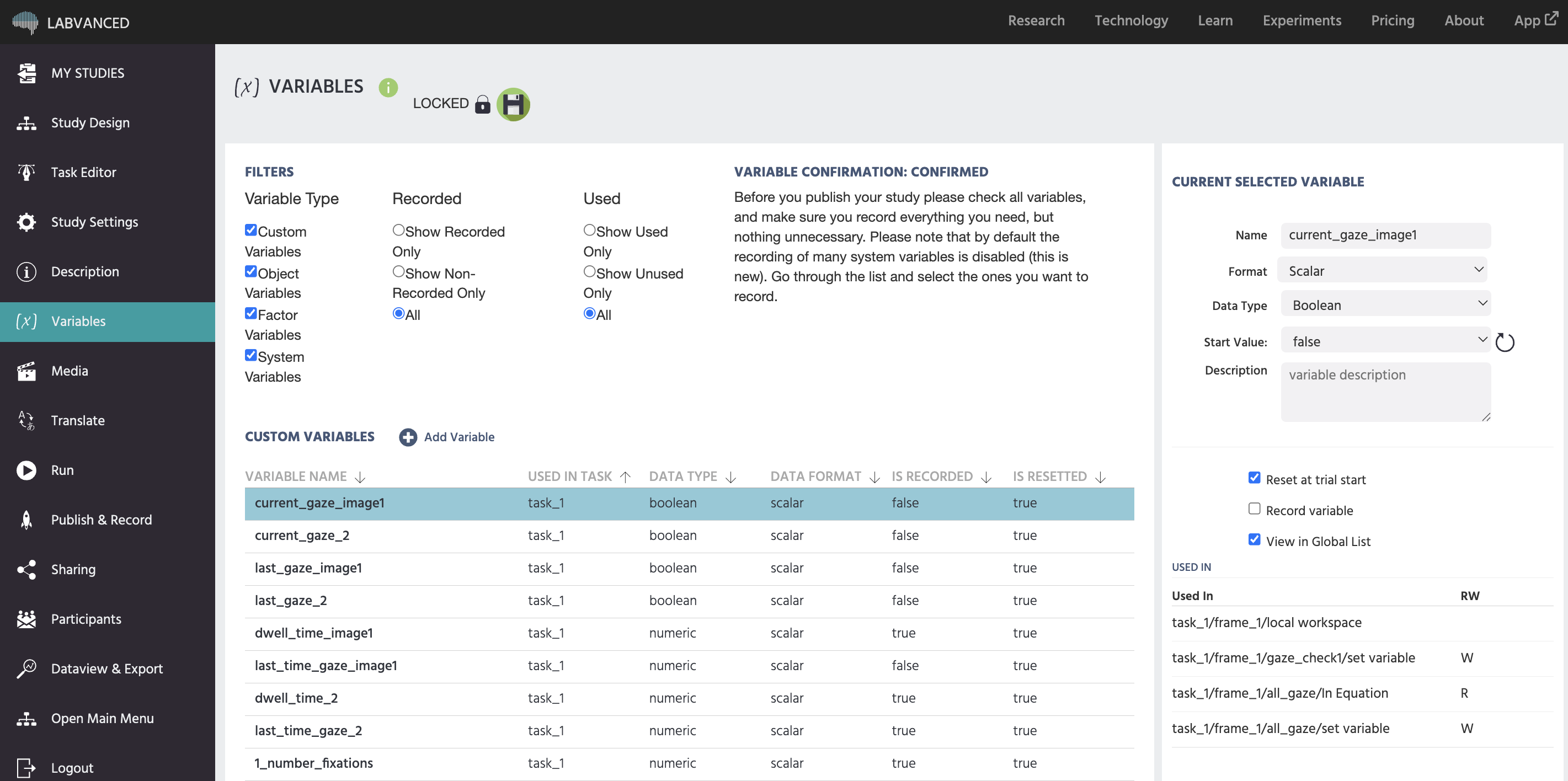
    Representation of the variables tab in Labvanced.

    Variables Tab

    Description

    In the "Variables" section, all variables of the study are shown in one list, categorized by type. The most important variable properties (Name, Scale, Data Type, Data Format, Is Recorded, is Reset) are displayed. Each variable can be selected such that the variable's properties are shown and can be edited on the right side of the screen.
    text

    Important Note: Reviewing / inspecting all variable properties is recommended before publishing the study and starting the data recordings (e.g. check whether all relevant variables are being recorded, etc).

    Variable Types

    In the Variables overview, the variables are divided by their main type. There are 4 main variable types:

    • Custom Variables: All of the user created variables.
    • Object Variables: All variables that were created together with a (questionnaire) object (e.g checkbox, slider etc.)
    • Factor Variables: All variables that function as factors within trial groups.
    • System Variables: All automatically created variables (pre-created by Labvanced).

    Variables are also categorized by their scope:

    • Trial Variables: These are variables that are recorded per trial. Typically user-created, some examples include reaction times and participant choices.
    • Session Variables: These variables are only recorded once per session and are mostly Labvanced-created. Some examples include browser type, screen size, and start/end times of the study.
    • Subject Variables: These variables are only recorded once per subject and are Labvanced-created. These variables remain the same for the same subject across multiple sessions and include values such as subject ID.

    Researchers will typically only look at trial and session variables. Subject variables are useful for longitudinal studies.

    Deleting Variables

    Deleting variables should be done with extreme care. Before deleting a variable, make sure that this variable is not used anywhere in your study. The variable usages are shown in the variable properties of the currently selected variable on the lower right portion of the screen (you may need to scroll down). While Labvanced tries to update these variable usages, please also check by looking into the different tasks and frames to see whether a variable is really unused or not before deleting it.

    If you are not 100% sure that a variable is not being used, it is recommended to disable the recording of the variable. This way, the variable will not appear in the dataview, but there is no risk of damage to your study. Another option is to make a copy of your study (copy all variables and objects, etc.), then delete the variable in question from the COPY of the study and perform a test run. This way, you can see how the study will perform without that variable.

    IF A VARIABLE THAT IS STILL USED SOMEWHERE IS DELETED (E.G. IN EVENTS OR OBJECTS) THIS MAY CAUSE IRREVERSIBLE DAMAGE TO YOUR STUDY! Please be careful!

    Shared Variables

    Shared variables are dynamic variables that can be shared across sessions and/or subjects. The variables are stored on the Labvanced server.

    Between-Subjects Balancing

    Imagine a study that has 10,000 images, but only 100 images are shown to each participant. However, each of the ten thousand images should be shown at least once, in a random order. Therefore 100 participants are needed to complete the study.

    Shared variables can be used to write to an array that stores the numbers of the images that have not been shown yet. This ensures that Participant 2 does not see any of the images that Participant 1 saw. This balances stimuli between subjects on a stimulus basis. To prevent imbalance from drop-out participants, the variable can be set to only record an image as having been seen after the participant makes their response. This ensures a usable response for each image, regardless of whether a participant finished the study or not. Therefore, a study will result in randomized, balanced, and complete data.

    Multi-Session (Longitudinal) Studies

    Shared variables can be used to ensure that the subject uses (or does not use) the same device for each session of a longitudinal study.

    In this case, another version of shared variables can be used. In this method, the shared variables are stored locally on the participant’s device and only shared with the participant themselves across sessions. However, this will not work if the subject uses a private browser or has a corrupted device.

    In another example, imagine a study that has two sessions per participant. In each session, 100 images will be shown, but they will be entirely different between the two sessions. The images are picked randomly from a corpus of 10,000 images. You can draw numbers randomly and save them to an array for each subject to pick the images, then retrieve that array in the next session to make sure they are not picked a second time.

    Multi-User Studies

    These variables are used in studies involving multiple participants to send values from one person to another. This method uses server storage to distribute variables across subjects.

    Remember the example above of a study that has 10,000 images, but only 100 images are shown to each participant. Each of the ten thousand images should be shown at least once, in a random order.

    Again, shared variables can be used to write to an array that stores the numbers of the images that have not been shown yet. For this example, random numbers should be drawn at the initialization of the study and written to an array. The array will then include the images seen by each of the participants in the multi-user study. This ensures that Participant 2 does not see the same images that Participant 1 is currently seeing.

    Sample Study

    Imagine a sample study in which your intelligence is compared to that of a population in which the average intelligence is 100 points. Your score is only relevant when compared to others as a relative value. To make this comparison, the researcher could perform a post-hoc analysis, or they could give the participant live feedback.

    Using shared variables, a participant’s score can be pushed to an array full of values. The array can then be averaged and the percentile value pushed back to the participant at the end of the study. In this way, the shared variable is updated dynamically as more individuals participate in the study, but the analysis is done during the study instead of post-hoc.

    Prev
    Settings
    Next
    Media