
视觉搜索任务:研究人员的综合指南
视觉搜索任务涉及在各种干扰物中识别目标,在研究人类如何处理视觉信息方面发挥着至关重要的作用。这些任务还提供了关于视觉搜索背后认知功能的宝贵见解。
在这里,我们将解释视觉搜索任务及其变体,讨论涉及的认知过程(从注意到处理速度),深入探讨数据收集,并解释其在认知心理学和临床心理学研究中的应用等!
- 社会场景与道德推理 - 心智理论与社会认知 描述: 通过互动场景衡量社会理解。 (链接占位符:“查看社会任务”)
- 儿童的趣味认知任务 - 参与度 + 数据质量 描述: 有趣、游戏化的任务以保持注意力。 (链接占位符:“探索游戏化任务”)
视觉搜索任务 - 解释
视觉搜索任务是一种注意任务,参与者被要求在视觉场景中的一个设置中检测目标刺激,其存在和位置未知,要尽可能快且准确地识别出来(Chesham et al., 2019)。
视觉搜索任务的基本要素是(Wickens, 2023):
- 目标: 要识别或定位的特定刺激、物体或特征。
- 干扰物: 非目标元素,增加搜索的难度。
- 搜索字段: 进行搜索的空间区域。
视觉搜索任务旨在研究不同的认知功能,主要是注意力和感知。
心理学研究中常见的视觉搜索任务类型
视觉搜索任务可以概念化为两个宽泛的类别:
- 特征搜索任务: 视觉搜索任务的最简单版本,参与者被指示寻找独特的目标。这个目标通常会“跳出”视觉场,就像在蜗牛中间的蝴蝶。
- 结合搜索任务: 更高级的版本,参与者必须花费更多时间和精力集中于识别目标刺激,因为它与干扰物共享多个特征,就像识别一位与其替身演员同框的女演员。
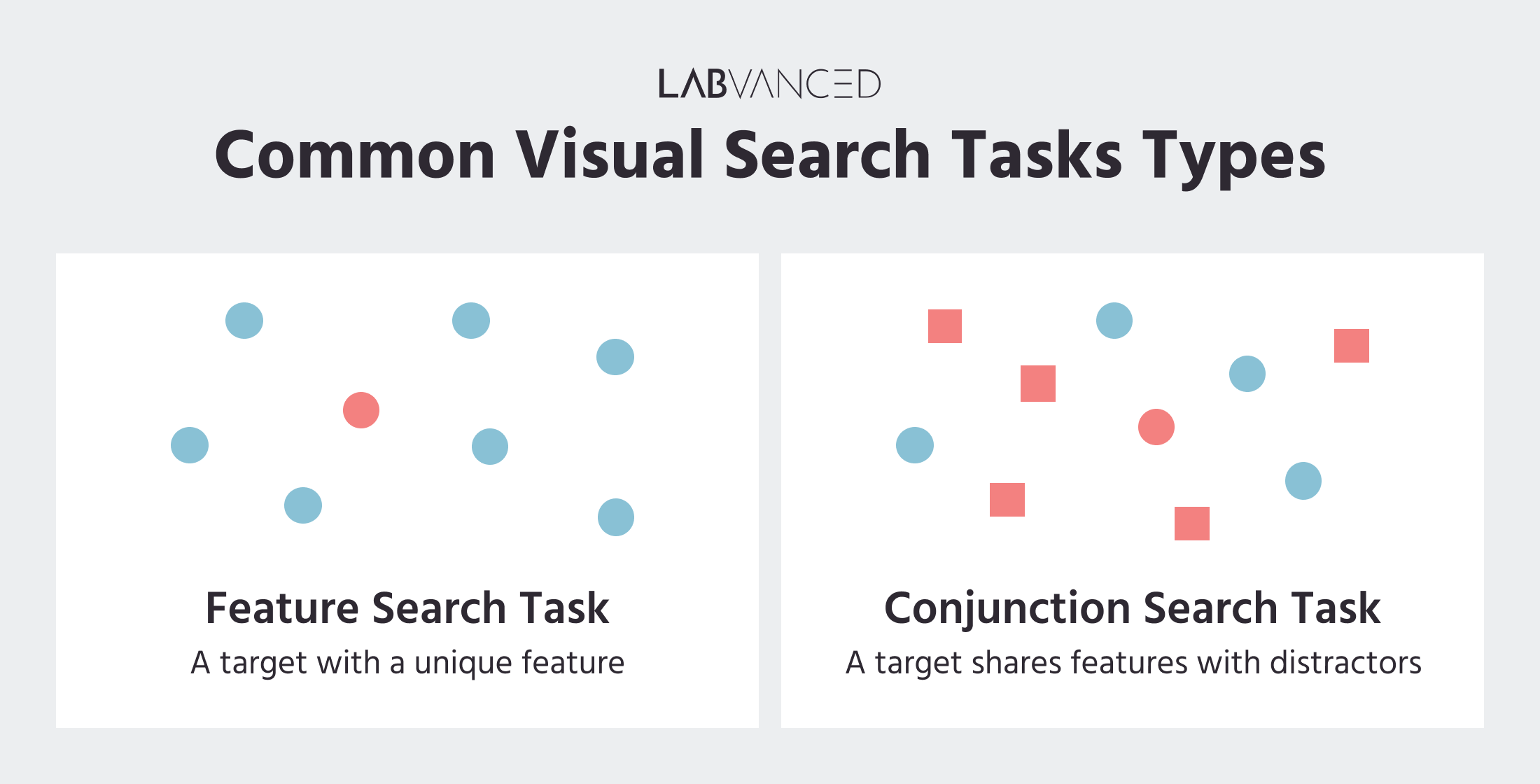
特征搜索任务(左)和结合搜索任务(右)。
特征搜索任务
特征搜索任务涉及寻找一个带有独特特征的目标,这个特征未被周围的干扰物共享。目标通常会在视觉场中跳出,可以轻松找到。例如,在上述左侧的图像中,检测红色圆圈与干扰的蓝色圆圈。
这些特征搜索任务采取的视觉搜索常用模式是 并行搜索。 在这种模式下,所有项目同时处理,允许快速检测。检测时间通常与干扰物的数量无关(即使干扰物数量增加,也不会影响找到目标所需的时间)。这是特征搜索任务与结合搜索任务之间的巨大区别,后者使用 串行搜索 模式,如下所述。
结合搜索任务
在结合搜索任务中,目标与干扰物共享一个或多个特征,需要更多的努力才能基于特征的组合来识别目标。例如,在上述右侧的图像中,识别一个红色圆圈在干扰的蓝色圆圈和红色方形中。
在以下的Labvanced在线视觉搜索任务示例中,目标是垂直的红色矩形,周围的干扰物与之共享的特征包括形状、颜色和方向。
这里采用的视觉搜索模式是 串行搜索模式。 由于目标与干扰物共享特征,每个项目必须逐个处理,这使得找到目标变得更加困难。检测时间通常依赖于干扰物的数量(随着干扰物数量的增加,找到目标所需的时间也会增加)。
在视觉搜索研究中的数据收集
通过视觉搜索任务收集的数据为不同研究领域的发现做出了贡献。
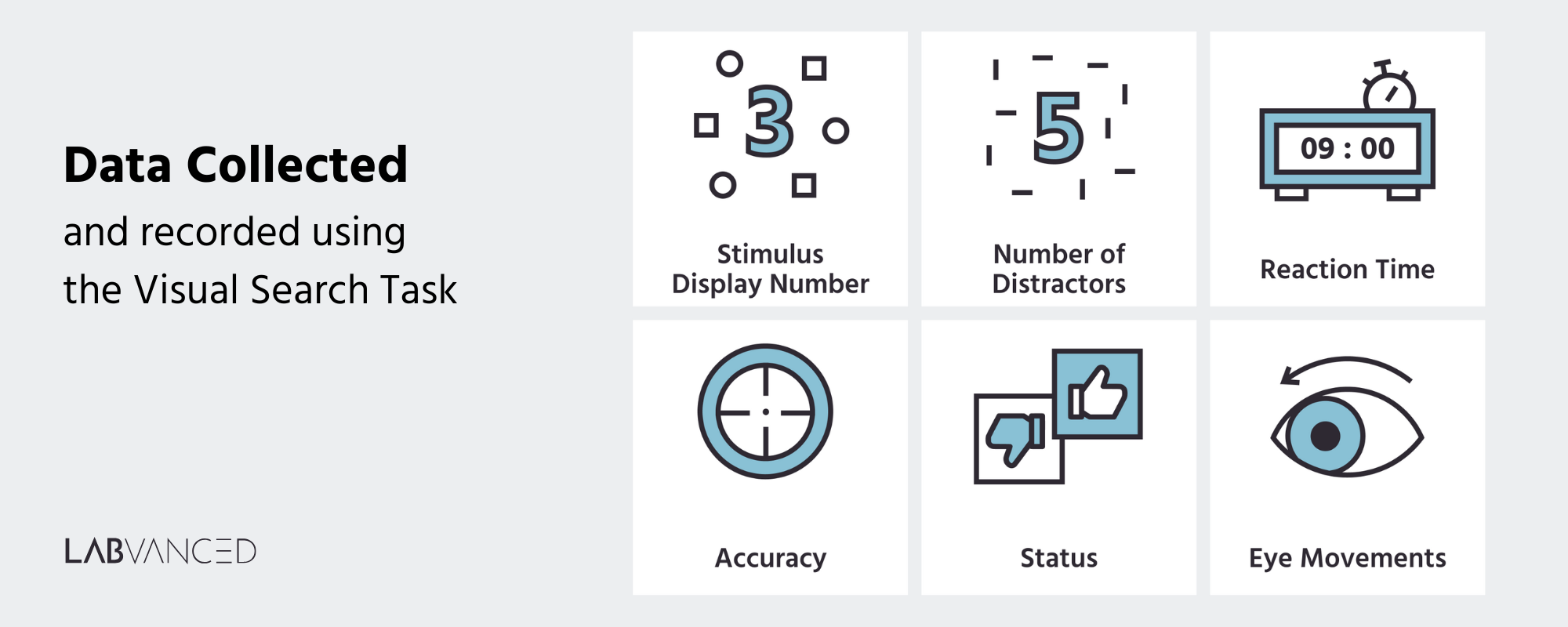
以下是收集的主要数据类型:
- 刺激显示编号: 目标刺激出现在屏幕上的精确位置(通常是行/坐标编号)。
- 干扰物数量: 视觉搜索领域中的非目标刺激总数。
- 反应时间: 参与者找到目标并做出响应所花费的时间。
- 准确性: 通常通过以下方式测量:
- 正确反应/命中: 找到的目标数量。
- 遗漏错误: 错过的目标数量。
- 误报错误: 误报数量。
- 状态: 指示参与者的反应是否正确、错误或太慢。
- 眼动: 通过眼动追踪收集的指标,例如注视持续时间、扫视和注视模式。
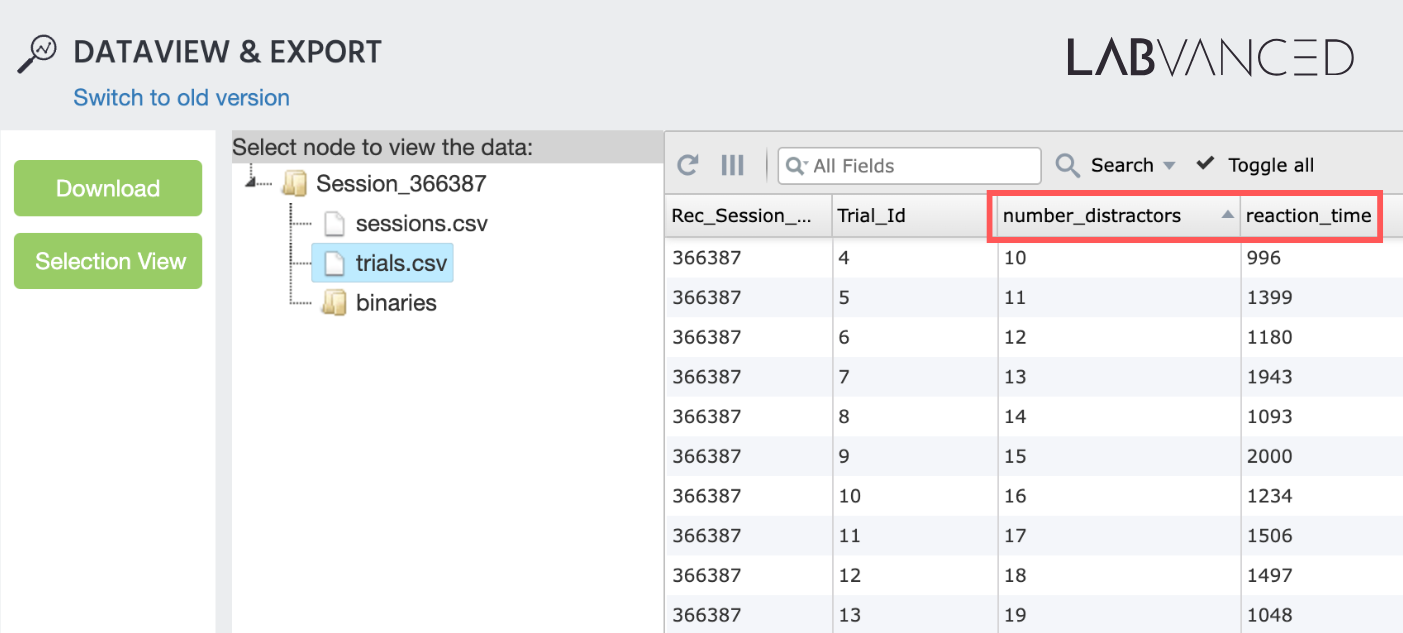
上面的图像展示了从Labvanced的视觉搜索任务中记录的数据的示例。
什么是 Labvanced?
Labvanced 是一个强大的平台,您可以在上面创建基于心理学的实验(无需编码)并收集数据……同时访问先进的功能,如经过同行评审的网络摄像头眼动追踪和通过网络及本地桌面/移动应用程序支持的多用户研究!
需要考虑的潜在混淆因素
无论您是在在线管理视觉搜索任务还是在实验室中,有几个混淆因素值得注意:
- 执行工作记忆负荷: 执行工作记忆负荷是指在执行任务时同时管理和操作多条信息的心理努力。当有很多干扰物存在时,工作记忆在视觉搜索任务中受到挑战,挑战参与者高效并避免重复扫描相同区域。当工作记忆超载时,专注于寻找目标变得更加困难,增加了错误并减少了事后对目标的记忆(Nachtnebel et al., 2023)。
- 搜索方向: 要求左右搜索的任务通常需要的时间比垂直、对角线或随机方向的搜索短(Radhakrishnan et al., 2022)。
- 音频干扰物: 音频干扰物的存在显著增加了视觉搜索时间,表明背景噪音可能会干扰完成搜索任务所需的专注。这种干扰可能是由于处理视觉信息和管理听觉刺激所需的认知资源的竞争(Radhakrishnan et al., 2022)。
- 熟悉度: 在视觉搜索任务中遇到熟悉的物体或标志时,可能会显著降低搜索时间。熟悉度使项目的处理更快,并且减少了识别目标所需的心理负荷,从而加快了视觉搜索时间(Qin et al., 2014)。
相关的认知功能
认知功能在视觉搜索任务的高效和有效执行中发挥着至关重要的作用,因此成为了认知心理学研究中的一个主要研究主题。
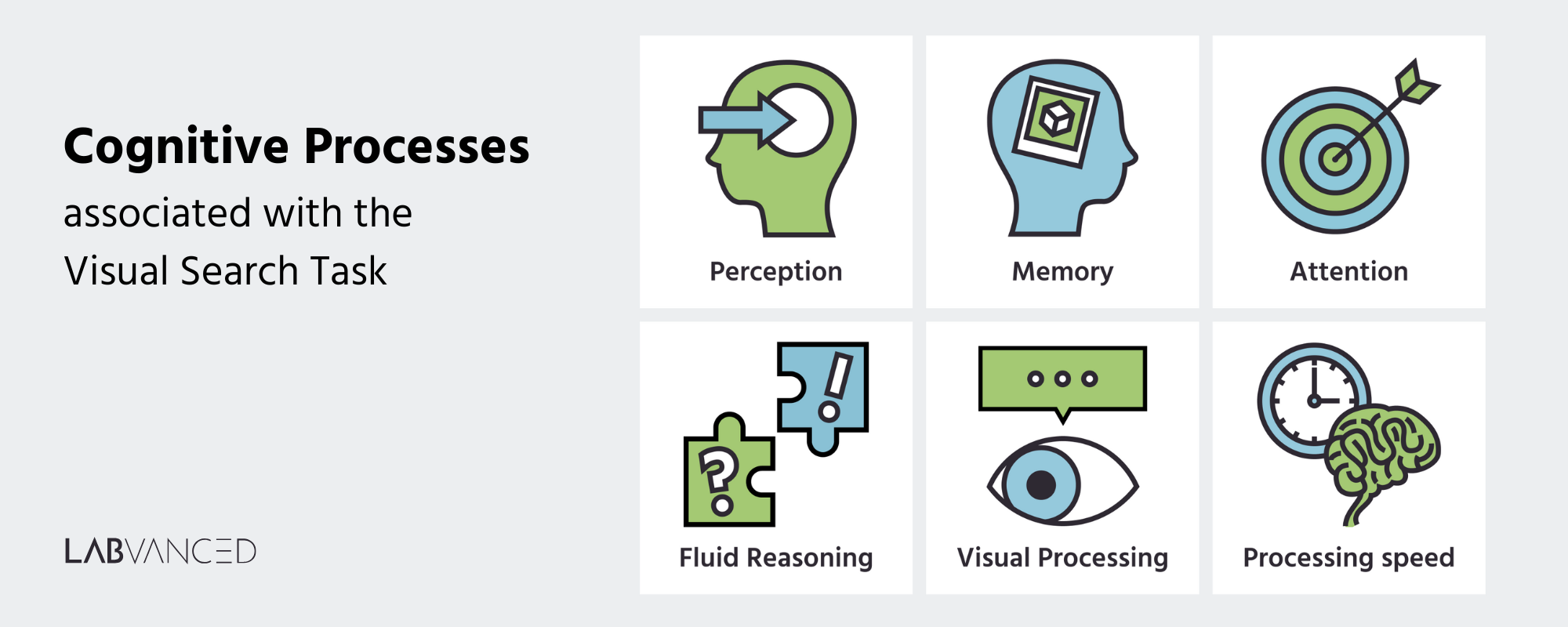
以下是一些支撑这些任务的认知功能。
- 感知: 感知通过优先处理相关特征来帮助组织感官信息,从而实现更快的识别和反应。通过高效的视觉感知,参与者可以更好地完成任务(Lin & Qian, 2023)。
- 记忆
- 短期记忆: 短期记忆(暂时存储少量信息的能力)使个体能够快速存储和处理信息,利用隐性记忆(一种短期记忆形式)通过随着时间的推移积累记忆痕迹来更快地对频繁刺激作出反应(Maljkovic & Martini, 2005)。
- 工作记忆: 更高的工作记忆容量有助于个体在视觉搜索任务中更有效地管理认知资源,特别是在双任务场景中(视觉搜索任务与另一种认知任务一起执行)(Redden et al., 2022)。
- 长期记忆: 长期记忆(存储先前事件和知识的地方)使在视觉搜索任务中提取过去的视觉经验成为可能,从而进一步指导当前的搜索行为。这也有助于参与者更快地识别和选择目标(Friedman et al., 2018)。
- 注意
- 选择性注意: 选择性注意在视觉搜索任务中发挥着重要作用,使个体能够专注于场景中的特定项或特征。这有助于高效识别目标并排除无关刺激(Wolfe, 2021)。
- 持续注意: 视觉搜索任务需要持续的参与,而持续注意确保在整个任务中始终如一地分配注意力资源。这减少了错误,例如忽视目标,从而提高视觉搜索的效率(Adam & Serences, 2022)。
- 注意转移: 随着搜索集大小的增加,注意的串行转移需求也随之增加,以处理多个刺激。注意转移使参与者能够有效地在各种刺激之间转移注意力,无论是以并行还是串行方式进行(Lee & Han, 2020)。
- 分散注意: 当两个目标刺激位于相距较远的空间位置时,需要同时处理来自两个位置的信息。在这些情况下,分散注意对于高效的视觉搜索性能至关重要,因为需要同时处理来自多个空间位置的信息(Davis et al., 2003)。
- 流体推理: 也称为流动智力,它指的是解决无法通过以往学习来解决的问题的能力。研究表明,它使个体在视觉搜索中表现出高效的眼动行为。具有更高流体推理能力的个体在识别目标时还表现出更高的准确性和速度(Wagneret al., 2024)。
- 视觉处理: 视觉处理是使个体能够解释和理解视觉信息的认知功能,从而识别模式,并将注意力集中在相关刺激上,同时忽略干扰物(Wagneret al., 2024)。
- 处理速度: 这是视觉搜索任务中的一个重要认知功能,因为它使个体能够快速处理视觉信息,从而在干扰物中更快地识别目标。更快的处理速度支持快速决策,并进一步提高真实场景中的视觉搜索性能(Wagneret al., 2024)。
视觉搜索任务设计的变化
视觉搜索任务可以在线或在实验室中执行,它们在复杂性上可以有显著差异,主要差异在于使用的刺激类型和数量,以及目标-干扰物的相似性。
以下是任务的一些变体:
- 连续视觉搜索任务: 此变体中的搜索区域将包括多个目标和干扰物(Hokken et al., 2022)。
- 单帧搜索任务: 在此任务中,观察者需要对目标是否存在做出简单的“是/否”决策(Hokken et al., 2022)。
- 现实世界视觉搜索任务: 这包括在现实空间中设置的任务,而不是使用计算机屏幕。一项研究使用真实的乐高积木进行了此任务(Sauter et al., 2020)。
- 天空搜索: 它是TEA-Ch评估电池的一个子测试。在此变体中,观察者需要在一大张纸上定位特定的宇宙飞船,该纸上充满了类似的诱饵宇宙飞船(Nasiri et al., 2023)。
- 字母取消任务: 此视觉搜索任务变体要求参与者识别并标记分布在其他干扰字母之间的60个目标字母 'A' (Rorden & Karnath, 2010)。
- TMM3拼图游戏: 此变体将视觉搜索与游戏结合。目标始终存在,要求玩家根据颜色和形状等特征持续扫描和匹配相同的瓷砖(Chesham et al., 2019)。
视觉搜索任务的临床应用
视觉搜索任务超越了认知心理学的领域,并在临床心理学中发挥着至关重要的作用,因为它们在理解不同神经发育和心理条件下的各种注意力和感知过程方面起着重要作用。
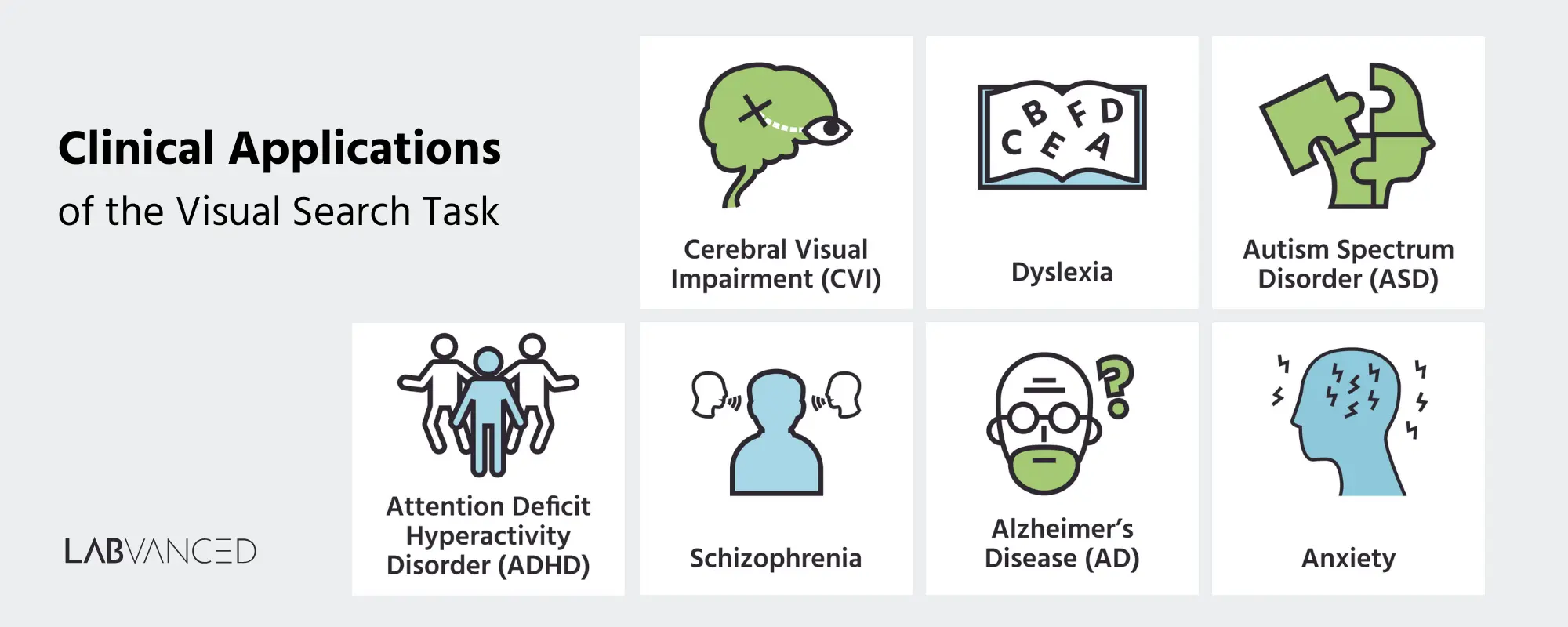
以下是一些例子:
- 注意缺陷多动障碍(ADHD): 视觉搜索任务是选择性注意的良好测量,而这方面在ADHD中常常受到损害。这些任务有助于识别个体的反应相关缺陷,从而理解ADHD中的认知和行为特征(Mason et al., 2003)。
- 脑性视觉损伤(CVI): 视觉选择性注意功能障碍(VSAD)是CVI儿童中常见的一种情况。视觉搜索任务揭示了CVI中反应时间较慢和准确性降低的状况,从而在这一人群中实现有针对性的干预(Hokken et al., 2022)。
- 阅读障碍: 阅读障碍(一种以书面语言和阅读处理困难为特征的学习能力障碍),可以通过视觉搜索任务与其他神经发育条件进行区分。阅读障碍儿童通常表现出快速和准确处理视觉信息的困难,这可能影响他们在视觉搜索任务中的表现(Hokken et al., 2022)。
- 自闭症谱系障碍(ASD): 视觉搜索任务有助于揭示和理解ASD个体面临的神经发育挑战。一项研究显示,自闭症个体在视觉搜索任务的表现中表现出模式,例如注视持续时间和搜索后的过程(Canu et al., 2021)。
- 精神分裂症: 研究表明,精神分裂症个体在视觉搜索任务表现中显示出显著的损伤,例如增加的注视时间和搜索模式的变异性。这些发现有助于深入理解精神分裂症的注意力和感知特征(Canu et al., 2021)。
- 阿尔茨海默病(AD): 阿尔茨海默群体中的视觉搜索任务可能提供有关认知衰退和注意障碍的见解。研究表明,AD个体在视觉搜索效率上表现出显著缺陷,例如反应时间较慢、注视持续时间增加,以及在干扰物中准确识别目标刺激的困难(Pereira et al., 2020)。
- 焦虑: 视觉搜索任务已被用来评估焦虑对注意控制和任务中处理效率的影响。它们提供了焦虑如何影响与视觉注意和决策相关的各种认知功能的见解(Vater et al., 2016)。
其他领域的应用
视觉搜索任务不仅在临床心理学领域重要,而且在各个其他领域也有延伸。以下是VST在不同领域中应用的一些例子:
- 神经科学: 视觉搜索任务在探索大脑内的功能互动方面得到了广泛应用。在一项结合了VST以及fMRI和近视矫正镜等神经影像设备的研究中,研究人员能够解码与视觉疲劳和认知工作负荷相关的大脑网络(Ryu et al., 2024)。
- 神经生理学: 视觉搜索任务在神经生理学中也具有重要意义。一项利用眼动追踪技术审查眼动追踪的研究显示,移动目标速度和方向的视觉识别与运动选择紧密相关(Souto & Kerzel, 2021)。同样有趣的是,眼动指标对识别视觉搜索障碍是有用的。
- 执法: 视觉搜索任务例如剑桥面孔记忆测试 (CFMT+)(测量个体识别面孔的能力),在执法中被广泛用于预测警察在现实场景中寻找不熟悉面孔时的个人差异表现(Thielgen et al., 2021)。
- 人机交互: 视觉搜索任务在人机交互中有重要的应用。它们有助于理解用户如何视觉扫描和与显示器进行互动,这进一步有助于设计与用户的视觉能力和局限性相契合的界面(Halverson & Hornof, 2007)。
- 市场营销: 在市场营销领域,视觉搜索任务被用于理解消费者如何视觉互动不同的产品展示。这些为如何设计能够有效吸引个体注意力的产品提供了洞见,从而影响消费者决策(Banović et al., 2014; Qin et al., 2014)。
- 航空: 在航空安全领域,视觉搜索任务有助于理解时间压力和目标预期等不同因素如何影响检测性能、反应时间和视觉搜索。这些可以进一步帮助改善机场安全中的安全关键任务。
总体来说,视觉搜索任务及其变体,例如 结合搜索任务,为认知心理学提供了许多见解,并有潜力与许多现实世界的应用相连接。
结论
视觉搜索任务帮助我们更好地理解人们如何在其环境中聚焦、寻找和处理信息的认知心理学。它们揭示了我们在日常生活中注意力和决策如何运作的许多方面。随着技术的发展,我们可以使用视觉搜索任务来解决现实世界问题的方式也在不断增加。这使它成为一个有价值的工具,不仅对研究人员而言,而且也是为每个人创造一个更好和更高效的世界!
参考文献
Adam, K., & Serences, J. (2022). Interactions of sustained attention and visual search. Journal of Vision, 22(14), 4355. https://doi.org/10.1167/jov.22.14.4355
Banović, Marija & Rosa, Pedro Joel & Gamito, Pedro. (2014). Eye of the Beholder: Visual Search, Attention and Product Choice.
Canu, D., Ioannou, C., Müller, K., Martin, B., Fleischhaker, C., Biscaldi, M., Beauducel, A., Smyrnis, N., van Elst, L. T., & Klein, C. (2021). Visual search in neurodevelopmental disorders: Evidence towards a continuum of impairment. European Child & Adolescent Psychiatry, 31(8), 1–18. https://doi.org/10.1007/s00787-021-01756-z
Chesham, A., Gerber, S. M., Schütz, N., Saner, H., Gutbrod, K., Müri, R. M., Nef, T., & Urwyler, P. (2019a). Search and match task: Development of a taskified match-3 puzzle game to assess and Practice Visual Search. JMIR Serious Games, 7(2). https://doi.org/10.2196/13620
Chesham, A., Gerber, S. M., Schütz, N., Saner, H., Gutbrod, K., Müri, R. M., Nef, T., & Urwyler, P. (2019b). Search and match task: Development of a taskified match-3 puzzle game to assess and Practice Visual Search. JMIR Serious Games, 7(2). https://doi.org/10.2196/13620
Davis, E. T., Shikano, T., Peterson, S. A., & Keyes Michel, R. (2003). Divided attention and visual search for simple versus complex features. Vision Research, 43(21), 2213–2232. https://doi.org/10.1016/s0042-6989(03)00339-0
Friedman, G. N., Johnson, L., & Williams, Z. M. (2018). Long-term visual memory and its role in learning suppression. Frontiers in Psychology, 9. https://doi.org/10.3389/fpsyg.2018.01896
Halverson, T., & Hornof, A. J. (2007). A minimal model for predicting visual search in human-computer interaction. Proceedings of the SIGCHI Conference on Human Factors in Computing Systems, 431–434. https://doi.org/10.1145/1240624.1240693
Hokken, M. J., Krabbendam, E., van der Zee, Y. J., & Kooiker, M. J. (2022). Visual selective attention and visual search performance in children with CVI, ADHD, and dyslexia: A scoping review. Child Neuropsychology, 29(3), 357–390. https://doi.org/10.1080/09297049.2022.2057940
Lee, J., & Han, S. W. (2020). Visual search proceeds concurrently during the attentional blink and Response Selection Bottleneck. Attention, Perception, & Psychophysics, 82(6), 2893–2908. https://doi.org/10.3758/s13414-020-02047-6
Lin, W., & Qian, J. (2023). Priming effect of individual similarity and ensemble perception in Visual Search and working memory. Psychological Research, 88(3), 719–734. https://doi.org/10.1007/s00426-023-01902-z
Maljkovic, V., & Martini, P. (2005). Implicit short-term memory and event frequency effects in visual search. Vision Research, 45(21), 2831–2846. https://doi.org/10.1016/j.visres.2005.05.019
Mason, D. J., Humphreys, G. W., & Kent, L. S. (2003). Exploring selective attention in ADHD: Visual search through space and Time. Journal of Child Psychology and Psychiatry, 44(8), 1158–1176. https://doi.org/10.1111/1469-7610.00204
Nachtnebel, S. J., Cambronero-Delgadillo, A. J., Helmers, L., Ischebeck, A., & Höfler, M. (2023). The impact of different distractions on outdoor visual search and Object Memory. Scientific Reports, 13(1). https://doi.org/10.1038/s41598-023-43679-6
Nasiri, E., Khalilzad, M., Hakimzadeh, Z., Isari, A., Faryabi-Yousefabad, S., Sadigh-Eteghad, S., & Naseri, A. (2023). A comprehensive review of attention tests: Can we assess what we exactly do not understand? The Egyptian Journal of Neurology, Psychiatry and Neurosurgery, 59(1). https://doi.org/10.1186/s41983-023-00628-4
Pereira, M. L., Camargo, M. von, Bellan, A. F., Tahira, A. C., dos Santos, B., dos Santos, J., Machado-Lima, A., Nunes, F. L. S., & Forlenza, O. V. (2020). Visual search efficiency in mild cognitive impairment and alzheimer’s disease: An eye movement study. Journal of Alzheimer’s Disease, 75(1), 261–275. https://doi.org/10.3233/jad-190690
Qin, X. A., Koutstaal, W., & Engel, S. A. (2014a). The hard-won benefits of familiarity in visual search: Naturally familiar brand logos are found faster. Attention, Perception & Psychophysics, 76(4), 914–930. https://doi.org/10.3758/s13414-014-0623-5
Qin, X. A., Koutstaal, W., & Engel, S. A. (2014b). The hard-won benefits of familiarity in visual search: Naturally familiar brand logos are found faster. Attention, Perception, & Psychophysics, 76(4), 914–930. https://doi.org/10.3758/s13414-014-0623-5
Radhakrishnan, A., Balakrishnan, M., Behera, S., & Raghunandhan, R. (2022). Role of reading medium and audio distractors on visual search. Journal of Optometry, 15(4), 299–304. https://doi.org/10.1016/j.optom.2021.12.004
Redden, R. S., Eady, K., Klein, R. M., & Saint-Aubin, J. (2022). Individual differences in working memory capacity and visual search while reading. Memory & Cognition, 51(2), 321–335. https://doi.org/10.3758/s13421-022-01357-4
Rorden, C., & Karnath, H.-O. (2010). A simple measure of neglect severity. Neuropsychologia, 48(9), 2758–2763. https://doi.org/10.1016/j.neuropsychologia.2010.04.018
Ryu, H., Ju, U., & Wallraven, C. (2024a). Decoding visual fatigue in a visual search task selectively manipulated via myopia-correcting lenses. Frontiers in Neuroscience, 18. https://doi.org/10.3389/fnins.2024.1307688
Ryu, H., Ju, U., & Wallraven, C. (2024b). Decoding visual fatigue in a visual search task selectively manipulated via myopia-correcting lenses. Frontiers in Neuroscience, 18. https://doi.org/10.3389/fnins.2024.1307688
Sauter, M., Stefani, M., & Mack, W. (2020). Towards interactive search: Investigating visual search in a novel real-world paradigm. Brain Sciences, 10(12), 927. https://doi.org/10.3390/brainsci10120927
Souto, D., & Kerzel, D. (2021). Visual selective attention and the control of tracking eye movements: A critical review. Journal of Neurophysiology, 125(5), 1552–1576. https://doi.org/10.1152/jn.00145.2019
Thielgen, M. M., Schade, S., & Bosé, C. (2021). Face processing in Police Service: The relationship between laboratory-based assessment of face processing abilities and performance in a real-world identity matching task. Cognitive Research: Principles and Implications, 6(1). https://doi.org/10.1186/s41235-021-00317-x
Vater, C., Roca, A., & Williams, A. M. (2016). Effects of anxiety on anticipation and visual search in dynamic, time-constrained situations. Sport, Exercise, and Performance Psychology, 5(3), 179–192. https://doi.org/10.1037/spy0000056
Wagner, J., Zurlo, A., & Rusconi, E. (2024). Individual differences in visual search: A systematic review of the link between visual search performance and traits or abilities. Cortex, 178, 51–90. https://doi.org/10.1016/j.cortex.2024.05.020
Wickens, C. D. (2023). Pilot attention and perception and spatial cognition. Human Factors in Aviation and Aerospace, 141–170. https://doi.org/10.1016/b978-0-12-420139-2.00009-5
Wolfe, J. M. (2021). Guided search 6.0: An updated model of visual search. Psychonomic Bulletin & Review, 28(4), 1060–1092. https://doi.org/10.3758/s13423-020-01859-9